Wisconsin: Emergency vehicles and work zones Practice Test
Yielding to emergency vehicles, moving over for stopped vehicles, traffic stops, and construction zones.
Independent educational site · not affiliated with any government agency or DMV
Ready? Test yourself
Answer to start, or tap Start below:
What do construction signs warn you about?
- Instant feedback with an explanation
- Every answer cites its source in the manual
- Your best score is saved on this device
- Keyboard: press 1 to 4 to answer and Enter for the next question
Questions are original and based on the official manual "Wisconsin Motorists' Handbook" (2026 (BDS126)), Wisconsin Department of Transportation, Division of Motor Vehicles (DMV).
All 21 questions in this practice test
Take the test above first, then use this list to study. Tap “Show answer” to see the correct answer and explanation.
Show the questions and answersHide the questions
-
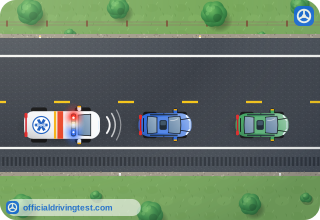
An emergency vehicle is using its lights and/or sirens. What should you do about right-of-way?
- Keep your right-of-way if you arrived first
- Yield right-of-way to it
- Yield only if it is behind you
- Yield only if you hear a siren
Show answer
Correct answer: Yield right-of-way to it
You should yield right-of-way to emergency vehicles that are using their lights and/or sirens.
Source: Wisconsin Motorists' Handbook (2026 (BDS126)), page 9 · Open this page in the manual (Manual page 9)
-
What do construction signs warn you about?
- Rules of the road you must obey
- Gas, food and lodging nearby
- Directions to nearby cities
- People working on or near the road
Show answer
Correct answer: People working on or near the road
Construction signs warn you about people working on or near the road.
Source: Wisconsin Motorists' Handbook (2026 (BDS126)), page 26 · Open this page in the manual (Manual page 26)
-
You see orange signs, cones and flags around a work area. What do they signal you to do?
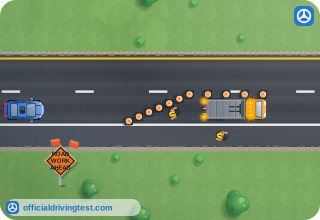
- Slow down
- Speed up to get through
- Turn on your emergency flashers
- Sound your horn to warn workers
Show answer
Correct answer: Slow down
Orange signs, cones and flags around work areas are your signal to slow down.
Source: Wisconsin Motorists' Handbook (2026 (BDS126)), page 26 · Open this page in the manual (Manual page 26)
-
What happens to traffic fines in work areas marked with orange signs, cones and flags?
- They stay the same
- They are cut in half
- They double
- They triple
Show answer
Correct answer: They double
Traffic fines double in work areas.
Source: Wisconsin Motorists' Handbook (2026 (BDS126)), page 26 · Open this page in the manual (Manual page 26)
-
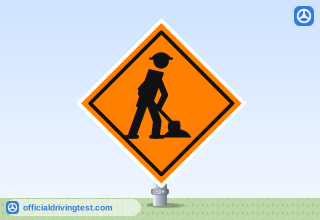
An orange diamond sign shows a worker digging with a shovel. What should you do?
- Stop and wait for a flagger
- Speed up to pass the workers
- Sound your horn and keep going
- Slow down or move over
Show answer
Correct answer: Slow down or move over
The Road Workers Ahead sign means road workers are up ahead, so slow down or move over.
Source: Wisconsin Motorists' Handbook (2026 (BDS126)), page 26 · Open this page in the manual (Manual page 26)
-
An orange diamond sign shows a worker holding out a flag. When you reach that worker, what must you do?
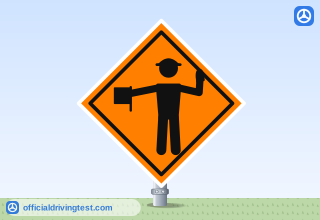
- Follow the worker's directions
- Follow the posted signs instead
- Drive around on the shoulder
- Honk to show you are coming
Show answer
Correct answer: Follow the worker's directions
The Road Construction Flagger Ahead sign warns of a worker with a sign or a flag, and you must follow their directions.
Source: Wisconsin Motorists' Handbook (2026 (BDS126)), page 26 · Open this page in the manual (Manual page 26)
-
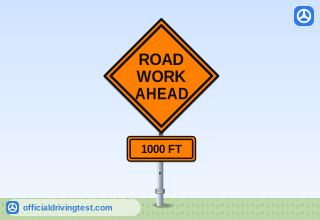
An orange diamond sign reads ROAD WORK AHEAD, with a small plate below it reading 1000 FT. What does the sign tell you?
- How long the work zone is from start to end
- How far back you must stay from workers
- How far up ahead the construction work is
- The distance to the next exit or detour
Show answer
Correct answer: How far up ahead the construction work is
The Road Work Ahead sign tells you how far up ahead the construction work is, so you can slow down or move over.
Source: Wisconsin Motorists' Handbook (2026 (BDS126)), page 26 · Open this page in the manual (Manual page 26)
-
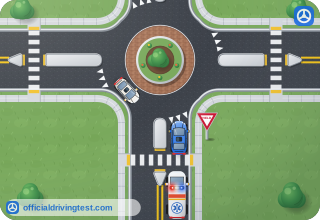
A vehicle with its siren on is approaching a roundabout and you have not entered it yet. What should you do?
- Enter and drive to the next exit
- Enter the roundabout and stop inside it
- Speed up to enter ahead of it
- Pull over and allow it to pass
Show answer
Correct answer: Pull over and allow it to pass
If you have not entered the roundabout, you pull over and let the emergency vehicle pass.
Source: Wisconsin Motorists' Handbook (2026 (BDS126)), page 39 · Open this page in the manual (Manual page 39)
-
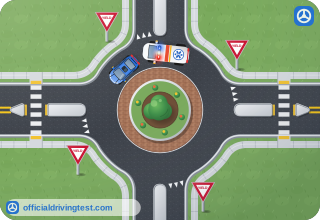
You are already in a roundabout when a vehicle with its siren on enters it. What should you do?
- Safely exit at the next right, then pull over
- Stop where you are and wait for it to pass
- Move to the center island and stop
- Speed up and exit at your planned exit
Show answer
Correct answer: Safely exit at the next right, then pull over
Inside a roundabout you safely exit at the next right and then pull over, avoiding stopping in the roundabout.
Source: Wisconsin Motorists' Handbook (2026 (BDS126)), page 39 · Open this page in the manual (Manual page 39)
-
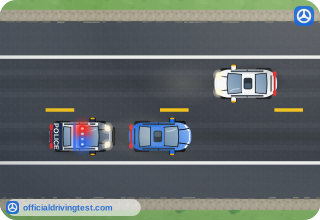
If you are stopped by law enforcement, where should you pull off when you see emergency lights flashing?
- To the left-hand side of the road
- Onto the center median
- To the right-hand side of the road
- Past the next intersection
Show answer
Correct answer: To the right-hand side of the road
When you see emergency lights flashing you pull off to the right-hand side of the road.
Source: Wisconsin Motorists' Handbook (2026 (BDS126)), page 42 · Open this page in the manual (Manual page 42)
-
If you are pulled over, what will police check for?
- Only whether your license has expired
- Only whether your tires are properly inflated
- Only whether you passed vision screening
- A possible incident, crime or minor violation of law
Show answer
Correct answer: A possible incident, crime or minor violation of law
When you are pulled over, police will see if there is a possible incident, crime or minor violation of law.
Source: Wisconsin Motorists' Handbook (2026 (BDS126)), page 42 · Open this page in the manual (Manual page 42)
-
During a traffic stop, what should you do with your vehicle and radio?
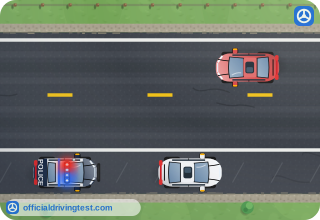
- Put it in park and turn off the car and radio
- Leave the engine running and turn the radio down
- Keep it in gear and turn off only the radio
- Turn off the radio and leave the engine running
Show answer
Correct answer: Put it in park and turn off the car and radio
You put your vehicle in park and turn off your car and radio.
Source: Wisconsin Motorists' Handbook (2026 (BDS126)), page 43 · Open this page in the manual (Manual page 43)
-
During a traffic stop, what should you do about staying in your vehicle and your seatbelt?
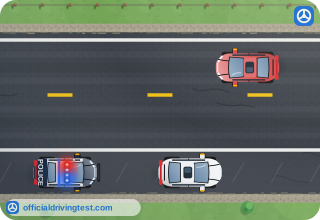
- Get out and walk back toward the officer
- Unbuckle and step out when the officer arrives
- Stay in your vehicle and keep your seatbelt on
- Stand beside your vehicle with your seatbelt off
Show answer
Correct answer: Stay in your vehicle and keep your seatbelt on
You stay in your vehicle and keep your seatbelt on during a traffic stop.
Source: Wisconsin Motorists' Handbook (2026 (BDS126)), page 43 · Open this page in the manual (Manual page 43)
-
During a traffic stop, what should you do with your window?
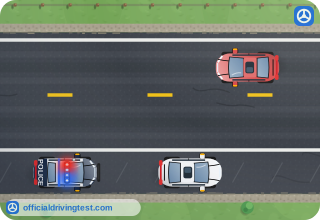
- Keep it closed and speak through the glass
- Roll it down
- Open the door slightly instead
- Roll it down only after the officer knocks twice
Show answer
Correct answer: Roll it down
You roll down your window when stopped by law enforcement.
Source: Wisconsin Motorists' Handbook (2026 (BDS126)), page 43 · Open this page in the manual (Manual page 43)
-
During a traffic stop, where should you put your hands?
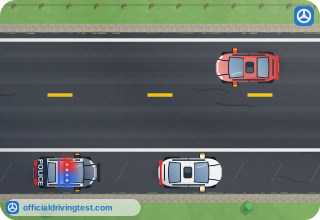
- On your lap with your palms down
- On the dashboard above the radio
- Out of the window with your fingers spread
- On the top of the steering wheel in plain sight
Show answer
Correct answer: On the top of the steering wheel in plain sight
You put your hands on the top of the steering wheel in plain sight.
Source: Wisconsin Motorists' Handbook (2026 (BDS126)), page 43 · Open this page in the manual (Manual page 43)
-
What should you do about sudden movements during a traffic stop?
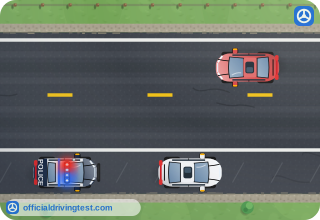
- Make none and do not reach for things around you
- Reach for your documents right away
- Move quickly to show you are cooperating
- Lean over to find items on the passenger side
Show answer
Correct answer: Make none and do not reach for things around you
You do not make sudden movements or reach for things around you during a traffic stop.
Source: Wisconsin Motorists' Handbook (2026 (BDS126)), page 43 · Open this page in the manual (Manual page 43)
-
If you are given a ticket at a traffic stop, where will you have a chance to express concerns?
- At the roadside, with the officer
- At the DMV service center
- In front of a judge or court
- By phone with the officer's supervisor
Show answer
Correct answer: In front of a judge or court
You should not argue about a ticket; you will have an opportunity in front of a judge or court to express concerns.
Source: Wisconsin Motorists' Handbook (2026 (BDS126)), page 43 · Open this page in the manual (Manual page 43)
-
What does the handbook tell you to do during a traffic stop after following the listed steps?
- Explain to the officer why the stop was unfair
- Stay calm and follow the officers' directions
- Ask the officer to hurry so you can leave
- Get out and wait beside your vehicle
Show answer
Correct answer: Stay calm and follow the officers' directions
You stay calm and follow the officers' directions, and you will get back on your way as soon as possible.
Source: Wisconsin Motorists' Handbook (2026 (BDS126)), page 43 · Open this page in the manual (Manual page 43)
-
When you see emergency lights and hear sirens, what should you do?
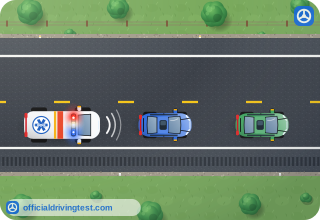
- Stop in the middle of the intersection until it has passed
- Slow down and keep driving in your lane until it passes
- Speed up to clear the road ahead of the emergency vehicle
- Pull over to the side of the road and stop until it has passed
Show answer
Correct answer: Pull over to the side of the road and stop until it has passed
You should pull over to the side of the road and stop until the emergency vehicle has passed, and never stop in the middle of an intersection.
Source: Wisconsin Motorists' Handbook (2026 (BDS126)), page 51 · Open this page in the manual (Manual page 51)
-
You are approaching a stopped emergency vehicle with its lights flashing. Which lane should you move into?
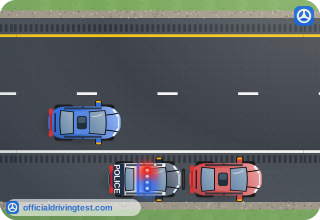
- The lane nearest the stopped vehicle
- The lane not nearest the stopped vehicle
- The shoulder on the opposite side
- Any lane, then slow to a stop
Show answer
Correct answer: The lane not nearest the stopped vehicle
The handbook says to move into the lane not nearest the stopped vehicle and stay in the farthest lane until you are past it.
Source: Wisconsin Motorists' Handbook (2026 (BDS126)), page 51 · Open this page in the manual (Manual page 51)
-
A police car is stopped on the side of the road with its lights and sirens on. What does the law say to do?
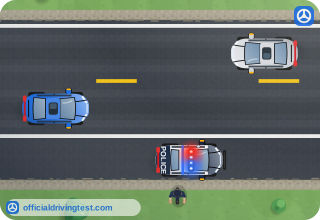
- Move over or slow down
- Stop and wait until it leaves
- Speed up to pass quickly
- Flash your headlights and keep going
Show answer
Correct answer: Move over or slow down
The handbook says to move over or slow down, because it is the law and gives the officer room.
Source: Wisconsin Motorists' Handbook (2026 (BDS126)), page 51 · Open this page in the manual (Manual page 51)