West Virginia: Road signs — Part 1 Practice Test
Questions in this part include: “What may the examiner ask you about traffic signs during the road test?” · “A dual turn lane sign is posted over a highway lane used for what?”
Independent educational site · not affiliated with any government agency or DMV
Ready? Test yourself
Answer to start, or tap Start below:
What may the examiner ask you about traffic signs during the road test?
- Instant feedback with an explanation
- Every answer cites its source in the manual
- Your best score is saved on this device
- Keyboard: press 1 to 4 to answer and Enter for the next question
Questions are original and based on the official manual "West Virginia Driver's Licensing Handbook" (Revised July 2026), West Virginia Division of Motor Vehicles (DMV).
All 17 questions in this practice test
Take the test above first, then use this list to study. Tap “Show answer” to see the correct answer and explanation.
Show the questions and answersHide the questions
-
What may the examiner ask you about traffic signs during the road test?
- To name every sign shown in the handbook
- To draw a sign from memory
- What sign you just passed
- To read aloud the number of each sign
Show answer
Correct answer: What sign you just passed
The examiner may ask what sign you just passed, and you should be able to tell the examiner.
Source: West Virginia Driver's Licensing Handbook (Revised July 2026), page 30 · Open this page in the manual (Manual page 30)
-
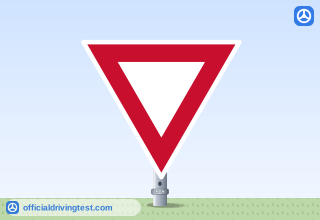
What does a sign shaped like a triangle pointing downward require you to do?
- Stop completely before you go on, even if no traffic is near
- Yield the right-of-way to cross traffic or merging traffic
- Slow down to 15 m.p.h. while children are present
- Yield only to traffic coming from the left side of the road
Show answer
Correct answer: Yield the right-of-way to cross traffic or merging traffic
The downward-pointing triangle requires you to yield the right-of-way to cross traffic or to merging traffic.
Source: West Virginia Driver's Licensing Handbook (Revised July 2026), page 34 · Open this page in the manual (Manual page 34)
-
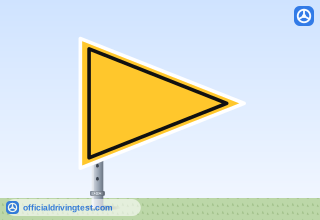
What does a pennant-shaped sign mark?
- The end of a construction work zone ahead
- The start of a school zone on this road
- A railroad crossing on the road ahead
- The beginning of a no-passing zone
Show answer
Correct answer: The beginning of a no-passing zone
The pennant-shaped sign marks the beginning of a no-passing zone.
Source: West Virginia Driver's Licensing Handbook (Revised July 2026), page 34 · Open this page in the manual (Manual page 34)
-
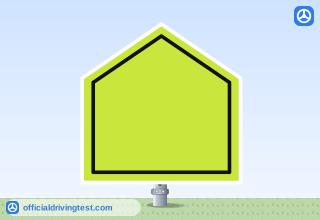
What does a five-sided (pentagon) sign warn of?
- A railroad crossing
- A no-passing zone
- A school zone ahead
- A slow moving vehicle
Show answer
Correct answer: A school zone ahead
The pentagon warns of a school zone ahead or marks a school zone crossing.
Source: West Virginia Driver's Licensing Handbook (Revised July 2026), page 34 · Open this page in the manual (Manual page 34)
-
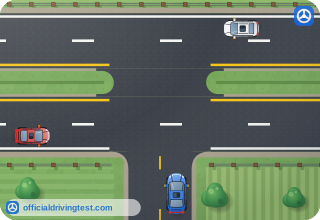
Why are lane directions signs placed at openings in highway dividers where streets intersect the highway?
- To show where you may turn around on the highway
- To tell you how fast to drive across the opening
- To remind you which side of the divider you belong on
- To warn you that the divider ends at the next block
Show answer
Correct answer: To remind you which side of the divider you belong on
Lane directions signs remind you which side of the divider you belong on.
Source: West Virginia Driver's Licensing Handbook (Revised July 2026), page 35 · Open this page in the manual (Manual page 35)
-
No Right Turn and No Left Turn signs are used when meeting what?
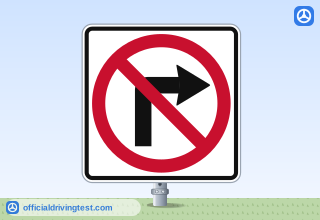
- A railroad crossing
- A one way street
- A school zone
- A work zone
Show answer
Correct answer: A one way street
These signs are used when meeting a one way street or in situations where it is unsafe to turn.
Source: West Virginia Driver's Licensing Handbook (Revised July 2026), page 35 · Open this page in the manual (Manual page 35)
-
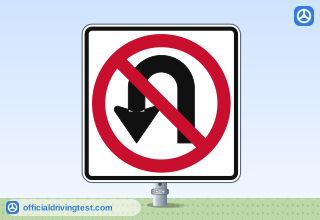
What does a sign with a red circle and a diagonal bar across a U-shaped arrow tell you?
- Turn around only at an intersection that has a signal
- Use extra care when you turn around in the street
- Do not enter the road ahead because it is a one way street
- Do not turn around in the middle of a street or an intersection
Show answer
Correct answer: Do not turn around in the middle of a street or an intersection
The No U-Turn sign means do not turn around in the middle of a street or an intersection.
Source: West Virginia Driver's Licensing Handbook (Revised July 2026), page 35 · Open this page in the manual (Manual page 35)
-
What do Wrong Way and Do Not Enter signs warn you of?
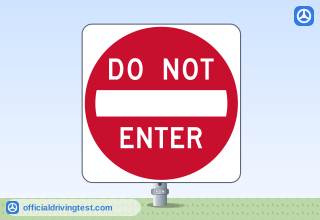
- Traffic in that direction is prohibited
- The road ahead is closed for construction
- The road ahead has only one lane
- You must yield to traffic entering ahead
Show answer
Correct answer: Traffic in that direction is prohibited
These signs warn you that traffic in that direction is prohibited.
Source: West Virginia Driver's Licensing Handbook (Revised July 2026), page 35 · Open this page in the manual (Manual page 35)
-
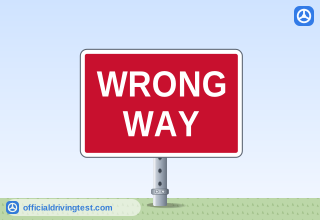
If you choose a traffic lane marked with a Wrong Way or Do Not Enter sign, what will you likely do?
- Enter a lane that is closed for construction
- Be told to turn around by a flagger
- Run into another vehicle
- Come to the end of a dead end street
Show answer
Correct answer: Run into another vehicle
The handbook says you will likely run into another vehicle if you choose a lane marked with either sign.
Source: West Virginia Driver's Licensing Handbook (Revised July 2026), page 35 · Open this page in the manual (Manual page 35)
-
A dual turn lane sign is posted over a highway lane used for what?
- Passing slower vehicles in either direction
- Only for making left turns from either direction
- Only for making right turns from the left lane
- Stopping to let passengers out of a vehicle
Show answer
Correct answer: Only for making left turns from either direction
A dual turn lane is used only for making left turns, and traffic from either direction uses it.
Source: West Virginia Driver's Licensing Handbook (Revised July 2026), page 35 · Open this page in the manual (Manual page 35)
-
What does a One Way Street sign tell you?
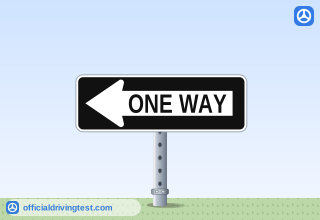
- A cross street has traffic running in one direction only
- The street ahead ends at a dead end after one block
- You may park on only one side of the street here
- The cross street has just two lanes of traffic
Show answer
Correct answer: A cross street has traffic running in one direction only
The One Way Street sign tells you when a cross street has traffic running in one direction only.
Source: West Virginia Driver's Licensing Handbook (Revised July 2026), page 35 · Open this page in the manual (Manual page 35)
-
When there are one-way streets, which way does each consecutive block usually run?
- In the same direction
- In both directions
- In the opposite direction
- Toward the center of town
Show answer
Correct answer: In the opposite direction
Usually every consecutive block runs in the opposite direction when there are one-way streets.
Source: West Virginia Driver's Licensing Handbook (Revised July 2026), page 35 · Open this page in the manual (Manual page 35)
-
A yellow diamond sign shows a bent arrow turning sharply to the right. What does it tell you?
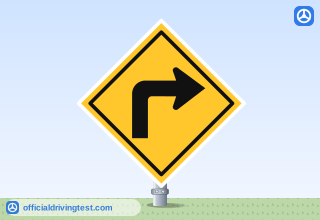
- The road ahead is closed beyond the curve
- The curve is too sharp to take at the regular highway speed
- The curve is gentle and may be taken at highway speed
- The road bends and then enters a school zone
Show answer
Correct answer: The curve is too sharp to take at the regular highway speed
A curve or sharp turn sign warns that the curve is too sharp to take at the regular highway speed.
Source: West Virginia Driver's Licensing Handbook (Revised July 2026), page 36 · Open this page in the manual (Manual page 36)
-
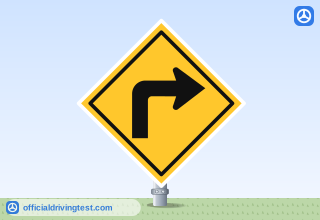
What may be attached to a curve or sharp turn warning sign?
- A stop sign
- A lane direction sign
- A yield sign
- An advisory speed sign
Show answer
Correct answer: An advisory speed sign
An advisory speed sign may be attached to a curve or sharp turn sign.
Source: West Virginia Driver's Licensing Handbook (Revised July 2026), page 36 · Open this page in the manual (Manual page 36)
-
What should you watch for when you see a yellow diamond sign showing a cross or a T-shaped symbol?
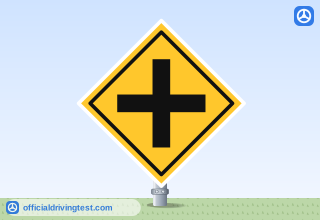
- Other vehicles entering or leaving the highway
- Trains crossing the road at this spot
- Children crossing the street at this spot
- Water or ice on the road
Show answer
Correct answer: Other vehicles entering or leaving the highway
A crossroads or side roads sign tells you to watch for other vehicles entering or leaving the highway.
Source: West Virginia Driver's Licensing Handbook (Revised July 2026), page 36 · Open this page in the manual (Manual page 36)
-
A yellow diamond sign shows a straight arrow pointing up with a shorter line joining it from the side. What does it tell you?
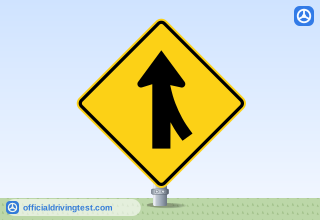
- The road ahead is closed to all traffic
- The highway ahead becomes a one way street
- Traffic may be moving into your lane
- Work is under way ahead in your lane
Show answer
Correct answer: Traffic may be moving into your lane
The sign warns that traffic may be moving into your lane, so be ready to change your speed or lane to avoid a crash.
Source: West Virginia Driver's Licensing Handbook (Revised July 2026), page 36 · Open this page in the manual (Manual page 36)
-
A yellow diamond sign shows one arrow pointing up beside one arrow pointing down. What does it indicate?
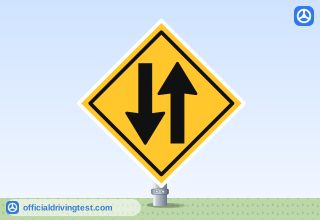
- That you are on a one way road
- That you are on a two-way road
- That you are leaving an interstate
- That a railroad crossing is ahead
Show answer
Correct answer: That you are on a two-way road
A yellow diamond sign with one arrow pointing up and one pointing down indicates that you are on a two-way road.
Source: West Virginia Driver's Licensing Handbook (Revised July 2026), page 36 · Open this page in the manual (Manual page 36)