West Virginia: Pedestrians Practice Test
Yielding to pedestrians at crosswalks and sidewalks, blind pedestrians, and pedestrian signals.
Independent educational site · not affiliated with any government agency or DMV
Ready? Test yourself
Answer to start, or tap Start below:
In the handbook’s definitions, who is a pedestrian?
- Instant feedback with an explanation
- Every answer cites its source in the manual
- Your best score is saved on this device
- Keyboard: press 1 to 4 to answer and Enter for the next question
Questions are original and based on the official manual "West Virginia Driver's Licensing Handbook" (Revised July 2026), West Virginia Division of Motor Vehicles (DMV).
All 16 questions in this practice test
Take the test above first, then use this list to study. Tap “Show answer” to see the correct answer and explanation.
Show the questions and answersHide the questions
-
In the handbook’s definitions, who is a pedestrian?
- Only a person crossing at a marked crosswalk
- Only a person walking on a sidewalk
- Any person traveling on foot
- Any person traveling by foot or on a motorcycle
Show answer
Correct answer: Any person traveling on foot
A pedestrian is any person traveling on foot.
Source: West Virginia Driver's Licensing Handbook (Revised July 2026)
-
Where should you scan and check traffic for pedestrians?
- In high-volume areas where pedestrians are expected to be present
- Only in areas with no pedestrian crosswalks
- Only on roads that have a posted speed limit under 25 mph
- Only at intersections that have traffic signals
Show answer
Correct answer: In high-volume areas where pedestrians are expected to be present
You scan and check traffic in high-volume areas where pedestrians are expected.
Source: West Virginia Driver's Licensing Handbook (Revised July 2026), page 31 · Open this page in the manual (Manual page 31)
-
What does a yellow diamond sign showing a walking person warn you to do?
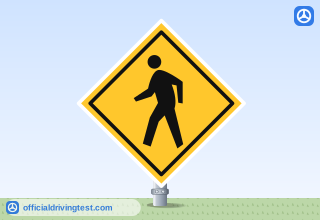
- Honk your horn to warn people before you reach the crossing
- Watch out for, and yield to, people walking across the road
- Stop only if a person is already in your lane
- Speed up to clear the crossing quickly
Show answer
Correct answer: Watch out for, and yield to, people walking across the road
The sign warns of a crosswalk or pedestrian path, and you should watch out for and yield to people walking across the road.
Source: West Virginia Driver's Licensing Handbook (Revised July 2026), page 36 · Open this page in the manual (Manual page 36)
-
Crosswalks at intersections and in school zones are indicators of what?
- A zone where parking is allowed
- A zone where passing is allowed
- A high pedestrian traffic zone
- A zone with limited sight distance
Show answer
Correct answer: A high pedestrian traffic zone
Crosswalks at intersections and in school zones show you are in a high pedestrian traffic zone, where being alert reduces crash risk.
Source: West Virginia Driver's Licensing Handbook (Revised July 2026), page 40 · Open this page in the manual (Manual page 40)
-
A blind person on foot using a guide dog or other service animal, or carrying a white cane or walking stick, has the right-of-way when?
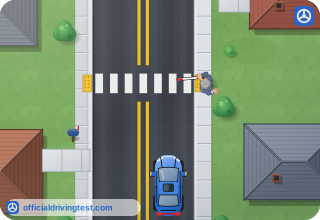
- Only when they are crossing within a marked crosswalk
- On a highway, street, or road, whether or not in a crosswalk
- Only at intersections with traffic signals
- Only when crossing in front of stopped traffic
Show answer
Correct answer: On a highway, street, or road, whether or not in a crosswalk
Such a pedestrian has the right-of-way on a highway, street, or road regardless of whether they are in a crosswalk or not.
Source: West Virginia Driver's Licensing Handbook (Revised July 2026), page 40 · Open this page in the manual (Manual page 40)
-
What may drivers do to warn pedestrians, if necessary?
- Flash their high beams
- Tap the brakes repeatedly
- Use their horns
- Pull onto the shoulder
Show answer
Correct answer: Use their horns
The handbook says drivers may use their horns to warn pedestrians if necessary.
Source: West Virginia Driver's Licensing Handbook (Revised July 2026), page 50 · Open this page in the manual (Manual page 50)
-
Pedestrians have the right of way when crossing a sidewalk that crosses what?
- An alley entrance or a driveway
- A railroad crossing or bridge
- A freeway on-ramp or exit ramp
- A construction zone or work area
Show answer
Correct answer: An alley entrance or a driveway
A pedestrian crossing a sidewalk that crosses an alley entrance or driveway has the right of way.
Source: West Virginia Driver's Licensing Handbook (Revised July 2026), page 50 · Open this page in the manual (Manual page 50)
-
Which pedestrians have the right of way when crossing with a white or metal cane, or when led by a guide dog?
- Children walking to school
- Pedestrians walking on the shoulder
- Joggers using a park path
- Pedestrians who are blind
Show answer
Correct answer: Pedestrians who are blind
Blind pedestrians crossing with a white or metal cane, with or without a red tip, or led by a guide dog have the right of way.
Source: West Virginia Driver's Licensing Handbook (Revised July 2026), page 50 · Open this page in the manual (Manual page 50)
-
Who has the right of way when a pedestrian is in a crosswalk?
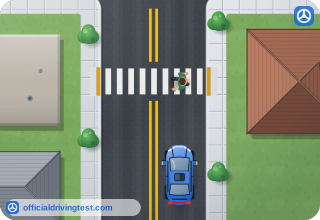
- The driver who arrived first
- The pedestrian
- The driver, if the vehicle is turning
- Whoever is moving faster
Show answer
Correct answer: The pedestrian
Pedestrians have the right of way when they are in a crosswalk.
Source: West Virginia Driver's Licensing Handbook (Revised July 2026), page 50 · Open this page in the manual (Manual page 50)
-
When walking along a road with no sidewalk, on which side should a pedestrian walk?
- The left side, facing oncoming traffic
- The right side, with their back to traffic
- Either side, whichever has the wider shoulder
- The side with more streetlights
Show answer
Correct answer: The left side, facing oncoming traffic
Pedestrians on a road with no sidewalk must walk on the left side facing oncoming traffic, on the shoulder if possible.
Source: West Virginia Driver's Licensing Handbook (Revised July 2026), page 50 · Open this page in the manual (Manual page 50)
-
What must pedestrians do at night?
- Walk in the middle of the road where drivers look
- Stay on the right side of the road, facing away from traffic
- Wear white or light-colored clothing or carry a light
- Avoid crosswalks and cross between intersections
Show answer
Correct answer: Wear white or light-colored clothing or carry a light
At night pedestrians must always wear white or light-colored clothing or carry a light so drivers can see them.
Source: West Virginia Driver's Licensing Handbook (Revised July 2026), page 50 · Open this page in the manual (Manual page 50)
-
Where must pedestrians not walk?
- On the shoulder of a road with no sidewalk
- On interstate highways
- In a crosswalk at an intersection
- On a sidewalk beside a road
Show answer
Correct answer: On interstate highways
Pedestrians must not walk on interstate highways or other areas where signs to that effect are posted.
Source: West Virginia Driver's Licensing Handbook (Revised July 2026), page 50 · Open this page in the manual (Manual page 50)
-
Before crossing the street, what must pedestrians do?
- Wait until all vehicles have stopped
- Raise a hand so drivers can see them
- Call out to nearby drivers
- Look in both directions
Show answer
Correct answer: Look in both directions
Pedestrians must look in both directions before crossing the street.
Source: West Virginia Driver's Licensing Handbook (Revised July 2026), page 50 · Open this page in the manual (Manual page 50)
-
When backing in or out of a driveway, what should you be extra watchful for?
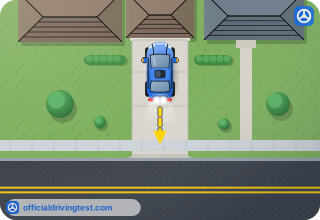
- Other drivers waiting for your parking space
- Bicyclists riding on the sidewalk behind you
- Delivery trucks stopped in the street
- Children who may have run behind the vehicle
Show answer
Correct answer: Children who may have run behind the vehicle
You should be extra watchful for children who may have run behind the vehicle when backing in or out of a driveway.
Source: West Virginia Driver's Licensing Handbook (Revised July 2026), page 54 · Open this page in the manual (Manual page 54)
-
When does the handbook say to teach your own children the rights and duties of pedestrians?
- At an early age
- Once they start school
- When they begin to drive
- When they turn 12
Show answer
Correct answer: At an early age
The handbook says to teach your own children the rights and duties of pedestrians at an early age.
Source: West Virginia Driver's Licensing Handbook (Revised July 2026), page 54 · Open this page in the manual (Manual page 54)
-
The vehicle in front of you has stopped at an intersection to let a pedestrian cross. What does the law say about passing it?
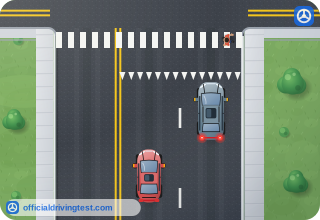
- Pass it on the left if no traffic is coming
- Passing it is prohibited
- Pass it on the right at a slow speed
- Sound your horn, then pass it slowly
Show answer
Correct answer: Passing it is prohibited
Passing is prohibited when a vehicle in front of you has stopped at an intersection to allow a pedestrian to cross.
Source: West Virginia Driver's Licensing Handbook (Revised July 2026), page 49 · Open this page in the manual (Manual page 49)