Washington: Traffic signals Practice Test
Red, yellow and green lights and arrows, flashing signals, turns on red, and a signal that is not working.
Independent educational site · not affiliated with any government agency or DMV
Ready? Test yourself
Answer to start, or tap Start below:
Which of these people can direct traffic in special circumstances and overrule traffic signals?
- Instant feedback with an explanation
- Every answer cites its source in the manual
- Your best score is saved on this device
- Keyboard: press 1 to 4 to answer and Enter for the next question
Questions are original and based on the official manual "Washington Driver Guide" (© 2025), Washington State Department of Licensing (DOL).
All 23 questions in this practice test
Take the test above first, then use this list to study. Tap “Show answer” to see the correct answer and explanation.
Show the questions and answersHide the questions
-
Which of these people can direct traffic in special circumstances and overrule traffic signals?
- School crossing guards
- Delivery drivers
- Pedestrians at the crossing
- Taxi drivers
Show answer
Correct answer: School crossing guards
Law enforcement, construction workers, maintenance personnel and school crossing guards can direct traffic.
Source: Washington Driver Guide (© 2025), page 109 · Open this page in the manual (Manual page 109)
-
A school crossing guard's directions conflict with a traffic signal. What must you do?
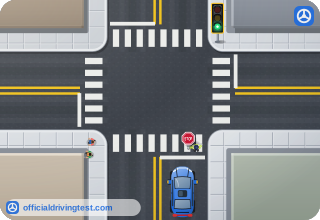
- Obey the traffic signal
- Stop and wait for the signal to change
- Follow the crossing guard's directions
- Follow the vehicle ahead of you
Show answer
Correct answer: Follow the crossing guard's directions
People who direct traffic can overrule signals, and their orders or directions must be followed.
Source: Washington Driver Guide (© 2025), page 109 · Open this page in the manual (Manual page 109)
-
A traffic signal isn't working. How should you treat the intersection?
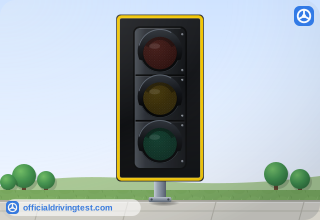
- Like a yield sign for all drivers
- Like a four-way stop
- Like an intersection where the larger road goes first
- Like a road with no traffic control
Show answer
Correct answer: Like a four-way stop
When a signal isn't working, treat the intersection like a four-way stop.
Source: Washington Driver Guide (© 2025), page 109 · Open this page in the manual (Manual page 109)
-
At an intersection with a non-working traffic signal, whom should you yield to after coming to a complete stop?
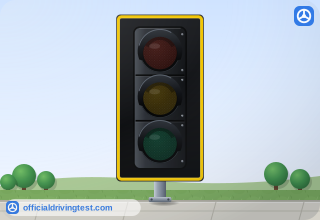
- Traffic on your left
- Traffic going straight only
- The largest vehicle
- Traffic on your right
Show answer
Correct answer: Traffic on your right
After a complete stop, yield to traffic on your right and proceed cautiously when it is safe.
Source: Washington Driver Guide (© 2025), page 109 · Open this page in the manual (Manual page 109)
-
What must happen before you move ahead at a solid red light?
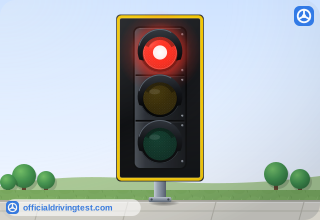
- The light turns green, even if pedestrians are still crossing the intersection
- Cross traffic stops, and then you may go while the light is still red
- The light turns green and no vehicles or pedestrians remain in the intersection
- One minute passes, and then you may go if nothing is coming
Show answer
Correct answer: The light turns green and no vehicles or pedestrians remain in the intersection
At a solid red light you must stop and wait for green, and the intersection must also be free of vehicles and pedestrians.
Source: Washington Driver Guide (© 2025), page 110 · Open this page in the manual (Manual page 110)
-
After coming to a complete stop at a red light, when may you turn right?
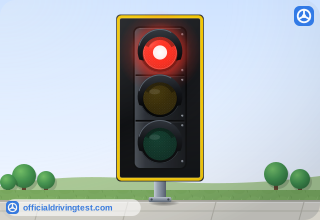
- When there is no “no turn on red” sign and you have plenty of room to enter traffic
- Only when the light shows a green arrow, because a solid red light never allows a turn
- Only when no other vehicle can be seen for a full block
- Only when a law enforcement officer waves you through
Show answer
Correct answer: When there is no “no turn on red” sign and you have plenty of room to enter traffic
A right turn on red is allowed after a full stop if no sign prohibits it and there is enough room to enter traffic.
Source: Washington Driver Guide (© 2025), page 110 · Open this page in the manual (Manual page 110)
-
After a complete stop at a red light, where may you turn left?
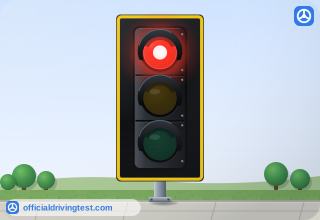
- Onto any street, if there is no “no turn on red” sign and you have plenty of room
- Onto a two-way street only, if no oncoming vehicles are in sight
- Nowhere, because a left turn requires a green light
- Onto a one-way street, if there is no “no turn on red” sign and you have plenty of room
Show answer
Correct answer: Onto a one-way street, if there is no “no turn on red” sign and you have plenty of room
A left turn on red is only described for turning onto a one-way street, after a full stop, with no sign against it and room to enter traffic.
Source: Washington Driver Guide (© 2025), page 110 · Open this page in the manual (Manual page 110)
-
How does a flashing red traffic light work?
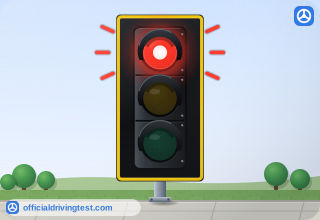
- It functions as a yield sign: slow down and go whenever the way is clear
- It functions as a stop sign: come to a full stop, then go when it is your turn
- It warns that the signal is broken, so you may proceed with caution
- It means stop only if other vehicles are waiting at the intersection
Show answer
Correct answer: It functions as a stop sign: come to a full stop, then go when it is your turn
A flashing red light is treated like a stop sign, so you stop completely and proceed when it is your turn.
Source: Washington Driver Guide (© 2025), page 110 · Open this page in the manual (Manual page 110)
-
What does a red arrow signal mean?
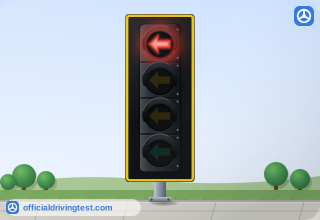
- You may go in the direction of the arrow after yielding to others
- You cannot go in the direction of the arrow
- The arrow will soon change, so slow down and prepare to stop
- Stop first, and then go in the direction of the arrow when it is clear
Show answer
Correct answer: You cannot go in the direction of the arrow
A red arrow means stop: you may not travel in the direction the arrow points.
Source: Washington Driver Guide (© 2025), page 110 · Open this page in the manual (Manual page 110)
-
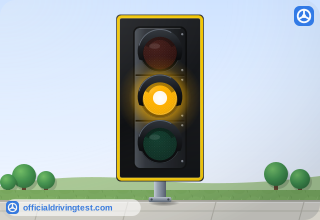
What does a solid yellow traffic light mean?
- The light is about to turn green, so speed up to clear the intersection
- You must stop immediately, even if you are already in the intersection
- Treat the intersection as uncontrolled and go when you have the right-of-way
- The light is changing to red, so slow down and prepare to stop
Show answer
Correct answer: The light is changing to red, so slow down and prepare to stop
A solid yellow light warns that red is coming, so you slow down and get ready to stop.
Source: Washington Driver Guide (© 2025), page 111 · Open this page in the manual (Manual page 111)
-
What should you do if you are already in the intersection when a solid yellow light comes on?
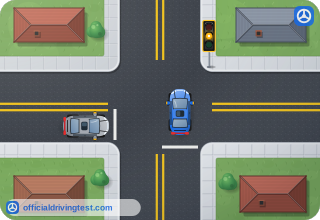
- Continue through the intersection at the posted speed
- Stop where you are until the light turns green again
- Slow to a crawl so cross traffic can see you
- Back up behind the stop line if you can do it safely
Show answer
Correct answer: Continue through the intersection at the posted speed
A driver already in the intersection keeps going through at the posted speed.
Source: Washington Driver Guide (© 2025), page 111 · Open this page in the manual (Manual page 111)
-
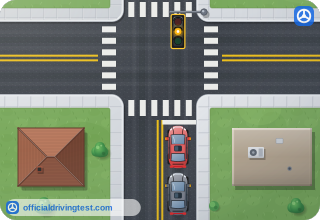
Are you allowed to go faster than the posted speed limit to clear an intersection when the light is yellow?
- Yes, but only to clear an intersection that you have already entered
- Yes, as long as no law enforcement officer is nearby
- No, accelerating beyond the posted speed to enter or clear it is not allowed
- Yes, but only if the intersection is a wide one with several lanes to cross
Show answer
Correct answer: No, accelerating beyond the posted speed to enter or clear it is not allowed
Speeding up past the limit on yellow is not permitted, whether you are entering or clearing the intersection.
Source: Washington Driver Guide (© 2025), page 111 · Open this page in the manual (Manual page 111)
-
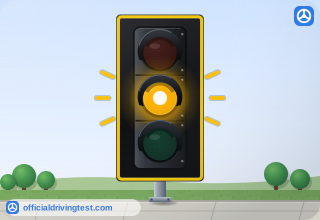
What does a flashing yellow light mean?
- The same as a stop sign: stop fully and go when it is your turn
- The light will turn red soon, so you must stop at the line
- You have the right-of-way, so cross traffic must stop for you
- The same as a yield sign: go when you have the right-of-way
Show answer
Correct answer: The same as a yield sign: go when you have the right-of-way
A flashing yellow light is handled like a yield sign at an uncontrolled intersection, so you go only when you have the right-of-way.
Source: Washington Driver Guide (© 2025), page 111 · Open this page in the manual (Manual page 111)
-
What does a yellow arrow signal mean?
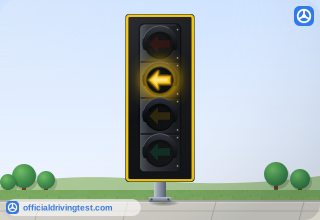
- Go in the direction of the arrow, because you have the right-of-way over others
- The light will turn red soon, so prepare to stop and give the right-of-way to oncoming traffic
- Stop and wait until the arrow turns green again before you move at all
- Go in the direction of the arrow, because oncoming traffic must yield to you
Show answer
Correct answer: The light will turn red soon, so prepare to stop and give the right-of-way to oncoming traffic
A yellow arrow is a warning that the signal is about to turn red, so you prepare to stop and yield to oncoming traffic.
Source: Washington Driver Guide (© 2025), page 111 · Open this page in the manual (Manual page 111)
-
Which of these should you yield to when you go ahead on a solid green light?
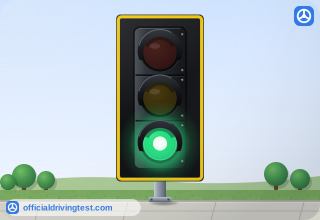
- Only vehicles that entered the intersection on a red light
- Only oncoming vehicles that are turning right
- Emergency vehicles, as required by law, and pedestrians
- Nothing, because a green light gives you absolute right-of-way
Show answer
Correct answer: Emergency vehicles, as required by law, and pedestrians
On green you still wait for the intersection to clear and yield to emergency vehicles and pedestrians.
Source: Washington Driver Guide (© 2025), page 112 · Open this page in the manual (Manual page 112)
-
When you turn left at a green light, who has the right-of-way?
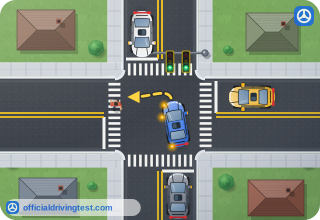
- Oncoming traffic
- You, because the light is green for your lane
- Vehicles waiting behind you at the light
- Vehicles on the cross street that are stopped
Show answer
Correct answer: Oncoming traffic
A left-turning driver must yield to approaching vehicles because oncoming traffic has the right-of-way.
Source: Washington Driver Guide (© 2025), page 112 · Open this page in the manual (Manual page 112)
-
Where should you pause when you turn left at a green light?
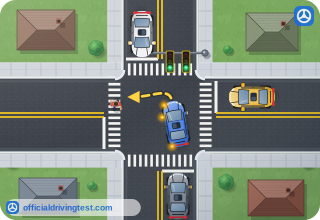
- In a place that gives you a clear view of approaching traffic
- Behind the stop line until the light turns red
- In the path of oncoming vehicles so they must slow down
- As close to the crosswalk as you can get
Show answer
Correct answer: In a place that gives you a clear view of approaching traffic
You wait where you can see approaching traffic and finish the turn when there is a safe break.
Source: Washington Driver Guide (© 2025), page 112 · Open this page in the manual (Manual page 112)
-
Which traffic light will you not see in Washington state?
- A flashing red light
- A flashing yellow light
- A flashing green light
- A green arrow
Show answer
Correct answer: A flashing green light
The guide says a flashing green light is not used in Washington, while flashing red, flashing yellow and green arrow signals are.
Source: Washington Driver Guide (© 2025), page 112 · Open this page in the manual (Manual page 112)
-
In British Columbia, Canada, what might a flashing green light warn you of?
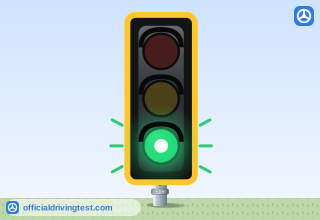
- A train approaching a railroad crossing
- Pedestrians waiting to cross
- A lane that is closing ahead
- An emergency vehicle approaching
Show answer
Correct answer: Pedestrians waiting to cross
In British Columbia a flashing green light can be a warning that pedestrians are waiting to cross.
Source: Washington Driver Guide (© 2025), page 112 · Open this page in the manual (Manual page 112)
-
What does a green arrow give you?
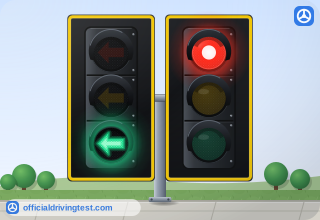
- A warning that the signal will soon turn red
- Permission to go only after you yield to oncoming vehicles
- Permission to go only after you stop first
- The right-of-way to travel in the direction of the arrow
Show answer
Correct answer: The right-of-way to travel in the direction of the arrow
A green arrow gives you the right-of-way in that direction, with no oncoming vehicles, crossing traffic, or pedestrians expected.
Source: Washington Driver Guide (© 2025), page 112 · Open this page in the manual (Manual page 112)
-
Where do you stop when the light at a freeway ramp meter is red?
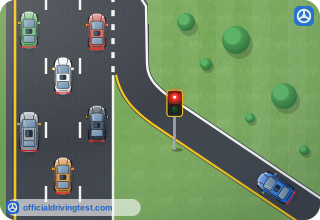
- At the end of the on-ramp
- At the point where the ramp joins the freeway
- At the white stop line
- Beside the signal pole
Show answer
Correct answer: At the white stop line
Ramp meters work like regular traffic signals, so on red you stop at the white stop line and go on green.
Source: Washington Driver Guide (© 2025), page 113 · Open this page in the manual (Manual page 113)
-
Which of these violations do automated traffic safety cameras record?
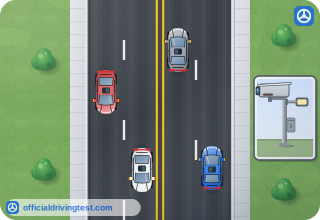
- Failing to stop at a steady red light
- Following another vehicle too closely
- Failing to signal before a lane change
- Driving without a seatbelt
Show answer
Correct answer: Failing to stop at a steady red light
Automated traffic safety cameras record images of drivers who fail to stop at a steady red light.
Source: Washington Driver Guide (© 2025), page 115 · Open this page in the manual (Manual page 115)
-
Automated traffic safety cameras automatically record images if you fail to stop at which of these?
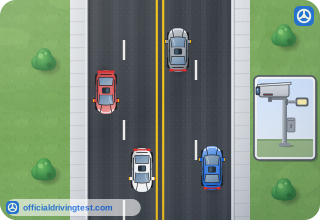
- A pedestrian crosswalk with no signal
- A flashing yellow light
- A freeway ramp merge point
- A railroad crossing signal
Show answer
Correct answer: A railroad crossing signal
The cameras also record drivers who fail to stop at a railroad crossing signal.
Source: Washington Driver Guide (© 2025), page 115 · Open this page in the manual (Manual page 115)