Washington: Pedestrians Practice Test
Crosswalks, marked and unmarked, yielding to people on foot, and white canes and guide dogs.
Independent educational site · not affiliated with any government agency or DMV
Ready? Test yourself
Answer to start, or tap Start below:
What does the guide say about interfering with a service animal?
- Instant feedback with an explanation
- Every answer cites its source in the manual
- Your best score is saved on this device
- Keyboard: press 1 to 4 to answer and Enter for the next question
Questions are original and based on the official manual "Washington Driver Guide" (© 2025), Washington State Department of Licensing (DOL).
All 14 questions in this practice test
Take the test above first, then use this list to study. Tap “Show answer” to see the correct answer and explanation.
Show the questions and answersHide the questions
-
A crosswalk or intersection has no painted crosswalk lines. Do pedestrians and bicyclists have the right-of-way there?
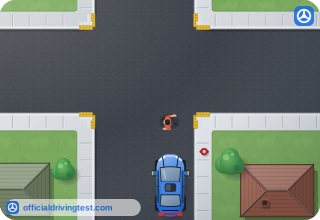
- Yes, whether or not the road is marked
- No, only at crosswalks that are painted on the road
- No, only at intersections with a traffic signal
- Yes, but only during daylight hours
Show answer
Correct answer: Yes, whether or not the road is marked
Pedestrians and bicyclists have the right-of-way at crosswalks and intersections whether the road is marked or not.
Source: Washington Driver Guide (© 2025), page 93 · Open this page in the manual (Manual page 93)
-
When a pedestrian is crossing in front of you, you should wait until the pedestrian has cleared:
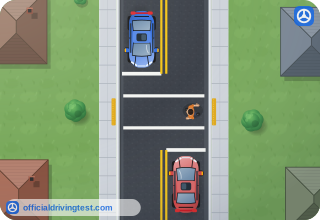
- your lane only
- your lane and two additional lanes
- your lane and one additional lane
- the center line of the road
Show answer
Correct answer: your lane and one additional lane
Do not proceed until the pedestrian has cleared your lane and one additional lane.
Source: Washington Driver Guide (© 2025), page 93 · Open this page in the manual (Manual page 93)
-
A pedestrian using a wheelchair, cane, guide dog, or other service animal is crossing the street. What should you do?
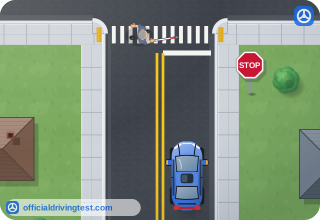
- Proceed as soon as they have cleared your lane and one more lane
- Wait until they have completely crossed the street before continuing
- Honk briefly so they know you are waiting for them
- Move slowly past them on the side away from the curb
Show answer
Correct answer: Wait until they have completely crossed the street before continuing
For these pedestrians you wait until they have completely crossed the street, not just your lane.
Source: Washington Driver Guide (© 2025), page 93 · Open this page in the manual (Manual page 93)
-
Why should you not honk at a pedestrian who is using a service animal?
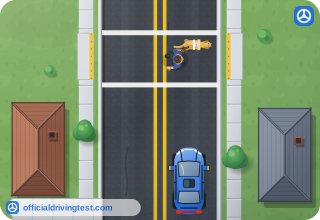
- It could permanently damage the hearing of the animal
- It could make other drivers think you are turning
- It could signal that you will not yield to the pedestrian
- It could confuse or frighten the animal or pedestrian
Show answer
Correct answer: It could confuse or frighten the animal or pedestrian
A horn can confuse or frighten the service animal or the pedestrian, so you should not honk.
Source: Washington Driver Guide (© 2025), page 94 · Open this page in the manual (Manual page 94)
-
What does the guide say about interfering with a service animal?
- It is unlawful
- It is allowed if the animal is in the roadway
- It is allowed if you do not touch the animal
- It is a violation only on school grounds
Show answer
Correct answer: It is unlawful
Interfering with a service animal is unlawful.
Source: Washington Driver Guide (© 2025), page 94 · Open this page in the manual (Manual page 94)
-
Legally, what is every intersection, whether it is marked or unmarked?
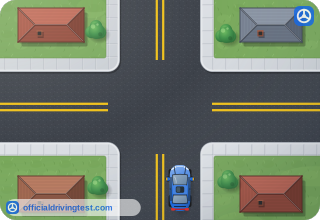
- A yield zone for vehicles only
- A no-passing zone for pedestrians
- A crosswalk
- A no-parking zone only for large trucks
Show answer
Correct answer: A crosswalk
Every intersection is legally a crosswalk, so you must be ready to yield to pedestrians at all of them.
Source: Washington Driver Guide (© 2025), page 121 · Open this page in the manual (Manual page 121)
-
What is a mid-block crossing?
- A stop line placed in the middle of a block
- A crosswalk in the middle of the roadway
- A median opening for left turns midway along a block
- A bicycle lane that crosses the roadway midway along a block
Show answer
Correct answer: A crosswalk in the middle of the roadway
Mid-block crossings are crosswalks located in the middle of the roadway rather than at an intersection.
Source: Washington Driver Guide (© 2025), page 125 · Open this page in the manual (Manual page 125)
-
Who always has the right-of-way in a marked crosswalk?
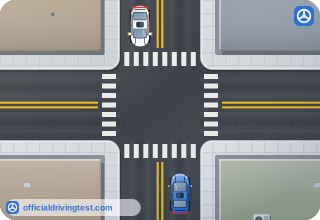
- Drivers who are already moving
- Pedestrians
- Whichever vehicle is larger
- Drivers who arrived first
Show answer
Correct answer: Pedestrians
The guide says pedestrians always have the right-of-way in a marked crosswalk.
Source: Washington Driver Guide (© 2025), page 125 · Open this page in the manual (Manual page 125)
-
A mid-block crosswalk has no stop sign. What should drivers do when pedestrians or bicyclists want to cross?
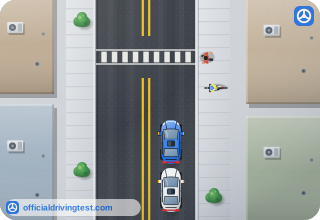
- Slow down and let them wait for a gap
- Continue, because there is no stop sign
- Honk to warn them and keep going
- Stop to allow them to cross
Show answer
Correct answer: Stop to allow them to cross
Drivers should stop for pedestrians and bicyclists whether or not the crosswalk has a stop sign.
Source: Washington Driver Guide (© 2025), page 125 · Open this page in the manual (Manual page 125)
-
At a crosswalk, to whom must you yield?
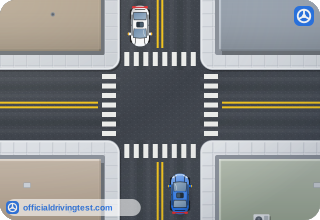
- Only people already in the crosswalk
- People in or about to enter the crosswalk
- Only pedestrians, not bicyclists
- Only people who have a walk signal
Show answer
Correct answer: People in or about to enter the crosswalk
You must yield to people in a crosswalk and also to those about to enter it.
Source: Washington Driver Guide (© 2025), page 137 · Open this page in the manual (Manual page 137)
-
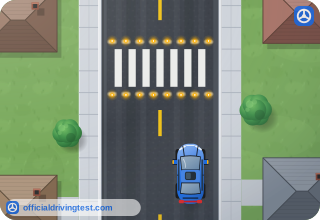
What must you do when in-pavement crosswalk lights are flashing?
- Slow down but keep moving
- Yield
- Stop only if a pedestrian is directly in front of you
- Ignore them, because they are meant for pedestrians
Show answer
Correct answer: Yield
In-pavement lights are activated by crossing pedestrians, and you must yield while they flash.
Source: Washington Driver Guide (© 2025), page 137 · Open this page in the manual (Manual page 137)
-
What is a school zone?
- The roads around a school building or playground
- Only the parking lot inside the school grounds
- Only the crosswalk right in front of the school door
- A road closed to traffic during school hours
Show answer
Correct answer: The roads around a school building or playground
A school zone is the roads around a school building or playground.
Source: Washington Driver Guide (© 2025), page 140 · Open this page in the manual (Manual page 140)
-
How can a school zone be marked?
- Only with painted curbs in front of the school
- Only with a sign posted at the school door
- School zones are never marked on the road
- With signs, pavement markings, and flashing lights
Show answer
Correct answer: With signs, pavement markings, and flashing lights
School zones can be marked with signs, pavement markings, and flashing lights.
Source: Washington Driver Guide (© 2025), page 140 · Open this page in the manual (Manual page 140)
-
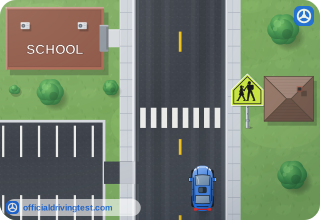
Why should you slow down and watch out near a school even after the school day ends?
- Students might attend after-school activities or use the playground
- School zone speed limits always drop even lower in the evening
- School buses stay parked along the road until after dark every day
- Crossing guards remain on duty at the school until sunset
Show answer
Correct answer: Students might attend after-school activities or use the playground
Students may be at sports, activities or the playground after hours, so extra care is needed near a school.
Source: Washington Driver Guide (© 2025), page 141 · Open this page in the manual (Manual page 141)