Washington: Freeway driving Practice Test
Keeping right, entering and leaving a freeway, carpool lanes, shoulders and toll roads.
Independent educational site · not affiliated with any government agency or DMV
Ready? Test yourself
Answer to start, or tap Start below:
If you need to stop, what should you do to avoid blocking travel lanes?
- Instant feedback with an explanation
- Every answer cites its source in the manual
- Your best score is saved on this device
- Keyboard: press 1 to 4 to answer and Enter for the next question
Questions are original and based on the official manual "Washington Driver Guide" (© 2025), Washington State Department of Licensing (DOL).
All 30 questions in this practice test
Take the test above first, then use this list to study. Tap “Show answer” to see the correct answer and explanation.
Show the questions and answersHide the questions
-
On a road with multiple lanes traveling in the same direction, which lane should you drive in?
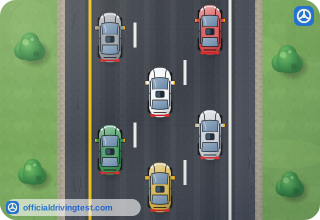
- The left lane, whenever traffic is light enough
- The center lane, whenever one is available
- The right lane, using the left lane to pass
- Whichever lane has the fewest vehicles in it
Show answer
Correct answer: The right lane, using the left lane to pass
Keep right except to pass: drive in the right lane and use the left lane to pass slower traffic.
Source: Washington Driver Guide (© 2025), page 108 · Open this page in the manual (Manual page 108)
-
Which statement about carpool lanes is true?
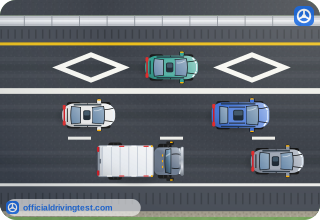
- They may be used for passing when traffic is slow
- They are passing lanes for vehicles with passengers
- They may be used for passing at night
- They are not passing lanes
Show answer
Correct answer: They are not passing lanes
Carpool lanes are not passing lanes.
Source: Washington Driver Guide (© 2025), page 108 · Open this page in the manual (Manual page 108)
-
When should you drive on the shoulder of the road?
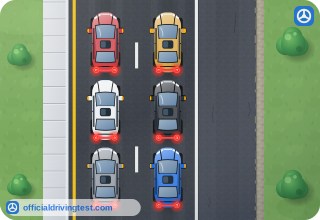
- Only when directed by officials or signs
- When your lane is congested
- When you need to pass a slower vehicle
- When the traffic ahead is moving slowly
Show answer
Correct answer: Only when directed by officials or signs
You should not use the shoulders to pass and should not drive on the shoulder unless officials or signs direct you to.
Source: Washington Driver Guide (© 2025), page 108 · Open this page in the manual (Manual page 108)
-
If you need to stop, what should you do to avoid blocking travel lanes?
- Stop at once and turn on your hazard lights
- Stop in the lane and wait for traffic to clear
- Keep moving until you can safely pull over
- Slow to a crawl and stay in your lane
Show answer
Correct answer: Keep moving until you can safely pull over
Avoid blocking travel lanes by continuing to move until you can safely pull over.
Source: Washington Driver Guide (© 2025), page 108 · Open this page in the manual (Manual page 108)
-
What does the guide say about backing up on a shoulder or freeway?
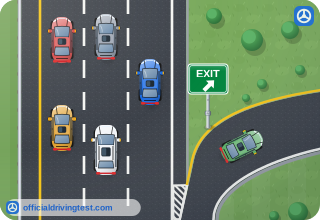
- It's allowed to reach a missed exit
- It's illegal
- It's allowed if you turn on your hazard lights
- It's allowed if there is no traffic ahead
Show answer
Correct answer: It's illegal
Even if you miss your turn or exit, it is illegal to back up on a shoulder or freeway.
Source: Washington Driver Guide (© 2025), page 108 · Open this page in the manual (Manual page 108)
-
What does the guide say about hitchhiking or picking up hitchhikers on Washington freeways?
- It's legal only in daylight hours
- It's legal if you stay on the shoulder
- It's legal with a permit
- It's illegal and dangerous
Show answer
Correct answer: It's illegal and dangerous
Hitchhiking or picking up hitchhikers on Washington freeways is illegal and dangerous.
Source: Washington Driver Guide (© 2025), page 109 · Open this page in the manual (Manual page 109)
-
Which vehicles are HOV lanes reserved for?
- Taxis, rental cars, and buses
- Carpools, vanpools, and buses
- Trucks, delivery vans, and buses
- Emergency vehicles, school buses, and taxis
Show answer
Correct answer: Carpools, vanpools, and buses
HOV lanes are for carpools, vanpools, and buses, and motorcycles are also allowed.
Source: Washington Driver Guide (© 2025), page 134 · Open this page in the manual (Manual page 134)
-
What symbol identifies HOV lanes on signs and on the pavement?
- A white X
- A diamond
- A triangle
- A bicycle
Show answer
Correct answer: A diamond
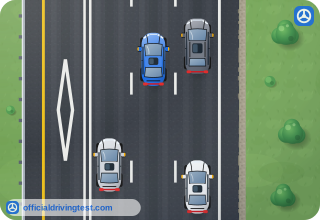
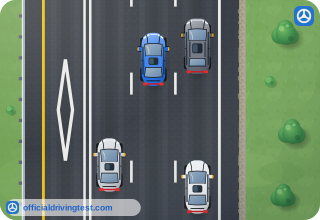
HOV lanes are marked with a diamond on the signs and on the pavement.
Source: Washington Driver Guide (© 2025), page 134 · Open this page in the manual (Manual page 134)
-
How are HOV lanes separated from the other lanes on the highway?
- By a double solid yellow line
- By a dashed white line
- By a raised concrete median
- By a solid white line
Show answer
Correct answer: By a solid white line
HOV lanes are separated from other lanes by a solid white line.
Source: Washington Driver Guide (© 2025), page 134 · Open this page in the manual (Manual page 134)
-
What must a vehicle meet to travel in an HOV lane?
- The occupancy requirements posted on the signs
- A minimum engine size
- A permit issued by the Department of Licensing
- A fuel-efficiency rating
Show answer
Correct answer: The occupancy requirements posted on the signs
The signs post how many occupants a vehicle needs, and the vehicle must meet that requirement.
Source: Washington Driver Guide (© 2025), page 134 · Open this page in the manual (Manual page 134)
-
Are motorcycles allowed to use HOV lanes?
- No, HOV lanes are only for carpools, vanpools, and buses
- No, unless the motorcycle carries a passenger
- Yes, they are also allowed to use HOV lanes
- Yes, but only during commuting hours
Show answer
Correct answer: Yes, they are also allowed to use HOV lanes
The guide states that motorcycles are also allowed in HOV lanes.
Source: Washington Driver Guide (© 2025), page 134 · Open this page in the manual (Manual page 134)
-
What do reversible lanes do?
- Switch the travel direction of one or more lanes when additional capacity is needed
- Switch between carpool-only and general use depending on the day of the week
- Let drivers reverse out of a lane that is blocked ahead
- Change from toll use to toll-free use during the evening hours
Show answer
Correct answer: Switch the travel direction of one or more lanes when additional capacity is needed
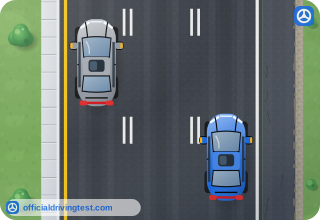
Reversible lanes help with congestion by changing the direction of one or more lanes when more capacity is required.
Source: Washington Driver Guide (© 2025), page 135 · Open this page in the manual (Manual page 135)
-
How are reversible lanes typically operated?
- Only when a traffic officer directs traffic
- Only during major events or incidents, never on a schedule
- On regular, fixed schedules that reflect daily commuting patterns
- On a schedule that changes every hour without notice
Show answer
Correct answer: On regular, fixed schedules that reflect daily commuting patterns
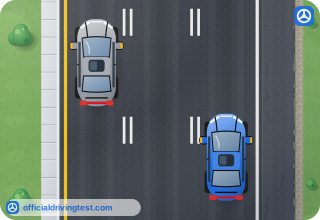
Reversible lanes usually follow fixed schedules matching daily commutes, though they can also be activated for major events or incidents.
Source: Washington Driver Guide (© 2025), page 135 · Open this page in the manual (Manual page 135)
-
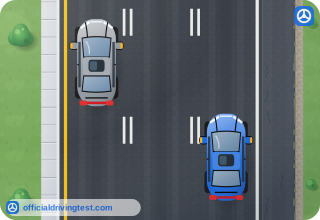
How are reversible lanes usually marked?
- By a solid white line
- By double-dashed white lines
- By double solid yellow lines
- By a diamond symbol on the pavement
Show answer
Correct answer: By double-dashed white lines
The guide says reversible lanes are usually marked by double-dashed white lines.
Source: Washington Driver Guide (© 2025), page 135 · Open this page in the manual (Manual page 135)
-
What should you check before you start driving in a reversible lane?
- The pavement arrows only
- The posted occupancy requirement
- The vehicles in the lane beside you
- The overhead signs
Show answer
Correct answer: The overhead signs
Overhead signs tell you whether the lane is open to you at that moment.
Source: Washington Driver Guide (© 2025), page 135 · Open this page in the manual (Manual page 135)
-
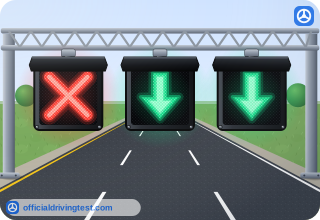
What does a green arrow over a reversible lane mean?
- The lane is changing direction
- The lane is for buses only
- You must exit at the next ramp
- You can use the lane
Show answer
Correct answer: You can use the lane
A green arrow means the lane is open for you to use.
Source: Washington Driver Guide (© 2025), page 135 · Open this page in the manual (Manual page 135)
-
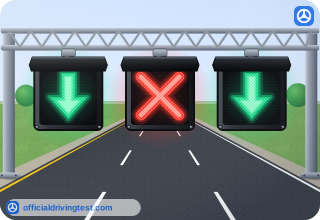
What does a red X over a reversible lane mean?
- You may use the lane if you are in a carpool
- You cannot use the lane
- The lane is changing direction
- You may use the lane only if you signal
Show answer
Correct answer: You cannot use the lane
A red X means you may not use the lane.
Source: Washington Driver Guide (© 2025), page 135 · Open this page in the manual (Manual page 135)
-
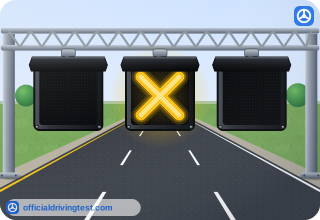
What does a steady yellow X over a reversible lane mean?
- The lane is still open, but you must slow down and watch for merging traffic
- The lane is closed for the rest of the day and will not reopen until tomorrow
- The lane is changing direction, and you should move out of it as soon as it is safe
- The lane is for emergency vehicles only until the signal changes
Show answer
Correct answer: The lane is changing direction, and you should move out of it as soon as it is safe
A steady yellow X warns that the lane is switching direction, so you leave it as soon as you safely can.
Source: Washington Driver Guide (© 2025), page 135 · Open this page in the manual (Manual page 135)
-
Who gets toll-free trips in express toll lanes and high occupancy toll lanes?
- Buses, vanpools, carpools, and motorcycles
- Individual drivers in any vehicle
- Only buses and emergency vehicles
- Only vehicles with a Good To Go! account
Show answer
Correct answer: Buses, vanpools, carpools, and motorcycles
Those lanes are toll-free for buses, vanpools, carpools, and motorcycles, while individual drivers can pay the toll for a faster trip.
Source: Washington Driver Guide (© 2025), page 136 · Open this page in the manual (Manual page 136)
-
According to the guide, what is the best way to pay tolls in Washington?
- Paying cash in each toll lane
- Mailing a check after each trip
- Paying a fee at the Department of Licensing
- Using a Good To Go! account
Show answer
Correct answer: Using a Good To Go! account
The guide says a Good To Go! account is the best way to pay tolls, saves money on every toll road, and pays automatically.
Source: Washington Driver Guide (© 2025), page 136 · Open this page in the manual (Manual page 136)
-
When you merge, how much space should you enter traffic with?
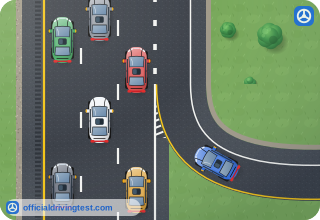
- Any space that is wide enough for your vehicle
- Only a space big enough for the driver behind you to pass
- Enough space that you do not cause others to swerve, slow, or stop
- The smallest space your vehicle can fit into
Show answer
Correct answer: Enough space that you do not cause others to swerve, slow, or stop
Merging into a gap that is too small can force others to swerve, slow down or stop, which is dangerous.
Source: Washington Driver Guide (© 2025), page 160 · Open this page in the manual (Manual page 160)
-
Who has the right-of-way when you merge onto an interstate?
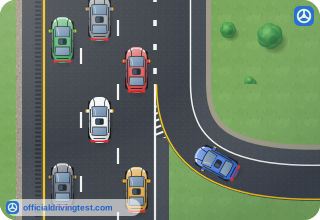
- Drivers entering from the on-ramp
- Drivers already on the interstate
- The vehicle that is going faster
- The vehicle that signals first
Show answer
Correct answer: Drivers already on the interstate
Drivers already on the interstate have the right-of-way, so you may need to adjust your speed to merge.
Source: Washington Driver Guide (© 2025), page 160 · Open this page in the manual (Manual page 160)
-
How might you need to change your speed to create space to merge onto the interstate?
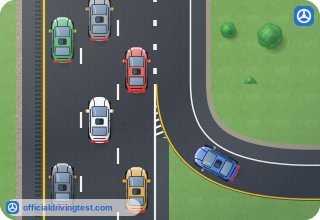
- Only faster
- Only slower
- You should hold the same speed you entered the ramp at
- Faster or slower, depending on the traffic
Show answer
Correct answer: Faster or slower, depending on the traffic
Because drivers on the interstate have the right-of-way, creating space can mean speeding up or slowing down.
Source: Washington Driver Guide (© 2025), page 160 · Open this page in the manual (Manual page 160)
-
How much of the on-ramp should you use when merging onto the interstate?
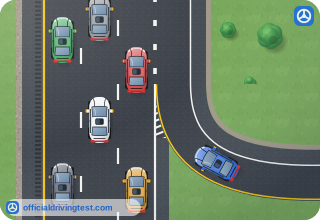
- Only the first half of the on-ramp
- Only the part of the on-ramp that has a painted line
- The entire on-ramp
- Just enough to reach the speed limit
Show answer
Correct answer: The entire on-ramp
The guide says to use the entire on-ramp, your turn signal and your mirrors to merge into a safe space.
Source: Washington Driver Guide (© 2025), page 160 · Open this page in the manual (Manual page 160)
-
When does the guide say zipper merging is important?
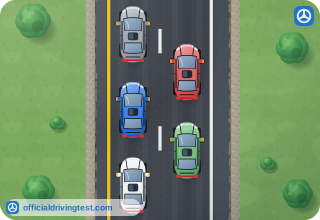
- When traffic is moving slowly or is stopped due to a lane closure
- When traffic is moving at full speed on an open freeway
- When a lane is open and no vehicles are ahead of you
- When you are leaving the interstate on an off-ramp
Show answer
Correct answer: When traffic is moving slowly or is stopped due to a lane closure
Zipper merging is for slow or stopped traffic at a lane closure, where a smooth, efficient merge is needed.
Source: Washington Driver Guide (© 2025), page 160 · Open this page in the manual (Manual page 160)
-
Which is a benefit of zipper merging?
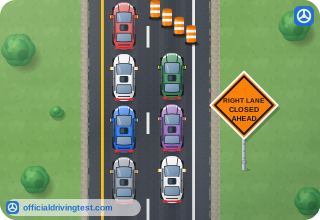
- It lets drivers in the ending lane skip the line
- It lets you stop sooner than other drivers
- It gives the ending lane the right-of-way over the open lane
- It creates a predictable merging pattern and reduces collision risk
Show answer
Correct answer: It creates a predictable merging pattern and reduces collision risk
A predictable pattern means fewer collisions from sudden lane changes, and fewer drivers tempted to cut in line.
Source: Washington Driver Guide (© 2025), page 160 · Open this page in the manual (Manual page 160)
-
When you zipper merge, until where should you continue using both lanes?
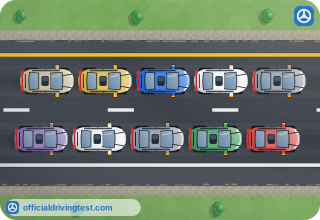
- Until you see the first lane closure sign
- Until you reach the designated merge area
- Until traffic ahead of you has cleared
- Until the vehicle behind you has signaled
Show answer
Correct answer: Until you reach the designated merge area
In a zipper merge you stay in your lane and use both lanes until the designated merge area.
Source: Washington Driver Guide (© 2025), page 160 · Open this page in the manual (Manual page 160)
-
What does the "take turns" step of zipper merging mean?
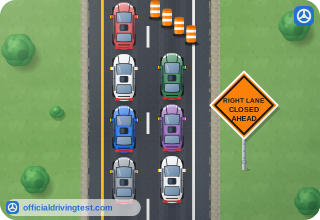
- Alternate merging with vehicles from the other lane
- Let all the vehicles in the open lane go first
- Merge in front of any vehicle that is slower than you
- Wait for the vehicle behind you to merge first
Show answer
Correct answer: Alternate merging with vehicles from the other lane
Zipper merging works by alternating vehicles from the two lanes, like the teeth of a zipper coming together.
Source: Washington Driver Guide (© 2025), page 161 · Open this page in the manual (Manual page 161)
-
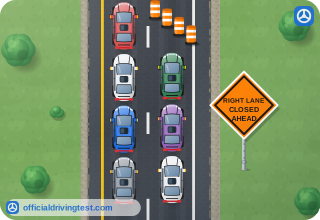
When zipper merging, how many vehicles from the ending lane should you allow to merge in front of you?
- Two
- Three
- One
- None
Show answer
Correct answer: One
The guide says to allow one vehicle from the ending lane to merge in front of you, and then you merge into the open lane.
Source: Washington Driver Guide (© 2025), page 161 · Open this page in the manual (Manual page 161)
-
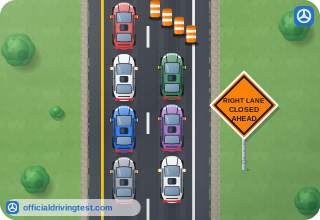
What speed should you keep while zipper merging?
- The posted speed limit, even if traffic is slower
- A steady pace that matches the speed of the open lane
- A crawl, so others can merge ahead of you
- The speed of the lane that is ending
Show answer
Correct answer: A steady pace that matches the speed of the open lane
The guide says to maintain speed by merging at a steady pace that matches the traffic in the open lane.
Source: Washington Driver Guide (© 2025), page 161 · Open this page in the manual (Manual page 161)