Washington: Parking rules — Part 2 Practice Test
Questions in this part include: “What does locking your door do when you leave your vehicle?” · “Who may use a parking spot reserved for disabled parking?”
Independent educational site · not affiliated with any government agency or DMV
Ready? Test yourself
Answer to start, or tap Start below:
What does locking your door do when you leave your vehicle?
- Instant feedback with an explanation
- Every answer cites its source in the manual
- Your best score is saved on this device
- Keyboard: press 1 to 4 to answer and Enter for the next question
Questions are original and based on the official manual "Washington Driver Guide" (© 2025), Washington State Department of Licensing (DOL).
All 22 questions in this practice test
Take the test above first, then use this list to study. Tap “Show answer” to see the correct answer and explanation.
Show the questions and answersHide the questions
-
What does locking your door do when you leave your vehicle?
- It prevents theft and keeps out intruders
- It keeps the parking brake set
- It stops the engine from restarting
- It prevents the doors from freezing shut overnight
Show answer
Correct answer: It prevents theft and keeps out intruders
Taking your keys and locking the door prevents theft and protects your vehicle against unwanted intruders.
Source: Washington Driver Guide (© 2025), page 145 · Open this page in the manual (Manual page 145)
-
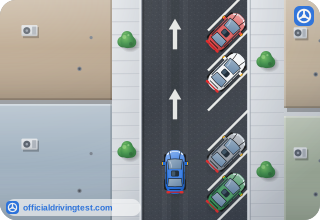
When entering a perpendicular or angled parking space, what do you do right after identifying the space and checking traffic?
- Back slowly into the space
- Sound your horn once
- Signal your intention to turn
- Set your parking brake
Show answer
Correct answer: Signal your intention to turn
After identifying the space and checking traffic, you signal your intention to turn.
Source: Washington Driver Guide (© 2025), page 146 · Open this page in the manual (Manual page 146)
-
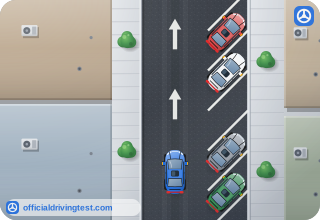
Where should you position your vehicle in a perpendicular or angled parking space?
- Close to the line on the driver’s side
- Centered between the painted lines
- Straddling a painted line
- Angled across two spaces
Show answer
Correct answer: Centered between the painted lines
You center the vehicle between the painted lines.
Source: Washington Driver Guide (© 2025), page 146 · Open this page in the manual (Manual page 146)
-
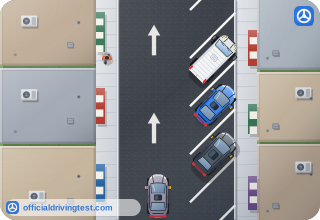
When backing out of a perpendicular or angled parking space, how far straight back do you move first?
- Until your rear bumper reaches the center of the lane
- Only a few inches, then turn sharply
- Until your mirrors show an empty lane
- Until your bumper clears the vehicle parked beside you
Show answer
Correct answer: Until your bumper clears the vehicle parked beside you
You move straight back until your bumper is past the vehicle parked beside you, then you turn.
Source: Washington Driver Guide (© 2025), page 146 · Open this page in the manual (Manual page 146)
-
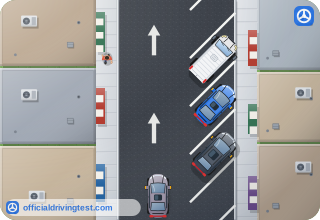
After your bumper clears the vehicle beside you when backing out of an angled space, how do you turn the steering wheel?
- Slowly, away from the direction you want to move
- Gently, then straighten it immediately
- Sharply, in the direction you want your vehicle to move
- Not at all until you have stopped and checked mirrors
Show answer
Correct answer: Sharply, in the direction you want your vehicle to move
Once your bumper is clear you turn the wheel sharply toward the direction you want to go.
Source: Washington Driver Guide (© 2025), page 146 · Open this page in the manual (Manual page 146)
-
When entering a perpendicular or angled space, how do you move forward?
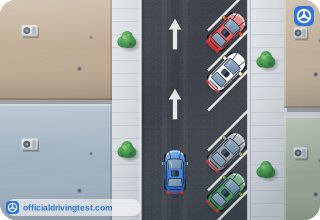
- Slowly, until the vehicle reaches the middle of the space
- Quickly, to clear the lane right away
- At normal speed until you touch the curb
- In reverse until the rear bumper reaches the line
Show answer
Correct answer: Slowly, until the vehicle reaches the middle of the space
You move forward slowly, steering left or right as needed, until the vehicle reaches the middle of the space.
Source: Washington Driver Guide (© 2025), page 146 · Open this page in the manual (Manual page 146)
-
When entering a parallel parking space, you back slowly until your front bumper is in line with what?
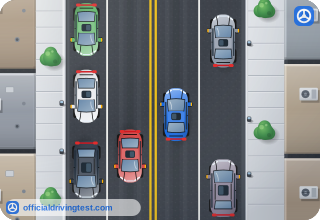
- The front bumper of the vehicle you’re parking behind
- The center of the empty space
- The curb ahead of the space
- The rear bumper of the vehicle you’re parking behind
Show answer
Correct answer: The rear bumper of the vehicle you’re parking behind
You back until your front bumper lines up with the rear bumper of the vehicle you are parking behind.
Source: Washington Driver Guide (© 2025), page 147 · Open this page in the manual (Manual page 147)
-
When you reverse into a parallel parking space, where should you look?
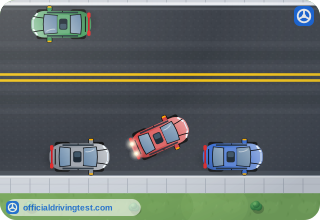
- Only at the vehicle ahead of you
- In the direction the vehicle will be moving
- Straight ahead through the windshield
- At the curb in front of you
Show answer
Correct answer: In the direction the vehicle will be moving
You reverse and look in the direction the vehicle will be moving.
Source: Washington Driver Guide (© 2025), page 147 · Open this page in the manual (Manual page 147)
-
When exiting a parallel parking space, how far do you first move backward?
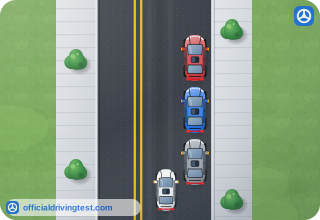
- As much as possible toward the vehicle behind you
- Just far enough to turn the steering wheel
- Only half the distance to the vehicle behind you
- Not at all; steer into the lane right away
Show answer
Correct answer: As much as possible toward the vehicle behind you
You first back up as far as you can toward the vehicle behind you, then pull out.
Source: Washington Driver Guide (© 2025), page 147 · Open this page in the manual (Manual page 147)
-
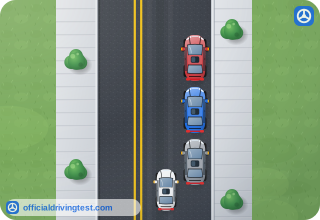
If your front bumper will not clear the vehicle ahead when exiting a parallel space, what should you do?
- Accelerate to swing around it
- Honk and pull out anyway
- Reverse and adjust the steering wheel
- Turn on your hazard lights and wait
Show answer
Correct answer: Reverse and adjust the steering wheel
You should reverse and adjust the steering wheel instead of pulling out.
Source: Washington Driver Guide (© 2025), page 148 · Open this page in the manual (Manual page 148)
-
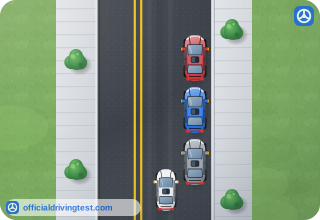
When leaving a parallel space, when can you move forward into the closest lane of traffic?
- When your rear bumper clears the vehicle parked behind you
- When your front door clears the rear bumper of the vehicle parked ahead
- When your front bumper is even with the car ahead’s rear bumper
- As soon as you have signaled and checked traffic
Show answer
Correct answer: When your front door clears the rear bumper of the vehicle parked ahead
You move into the closest lane once your front door has cleared the rear bumper of the vehicle ahead.
Source: Washington Driver Guide (© 2025), page 148 · Open this page in the manual (Manual page 148)
-
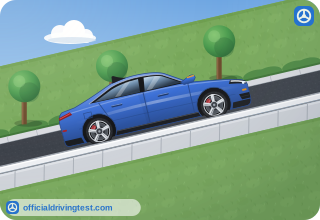
When parked facing up a hill with a tall curb, you turn your steering wheel away from the curb until what touches the curb?
- The front of your front tire
- Your rear bumper
- The back of your front tire
- The back of your rear tire
Show answer
Correct answer: The back of your front tire
You turn the wheel away from the curb until the back of the front tire touches the curb.
Source: Washington Driver Guide (© 2025), page 148 · Open this page in the manual (Manual page 148)
-
Parked facing up a hill with a tall curb and wheels turned away from it, where does the vehicle go if it starts to roll?
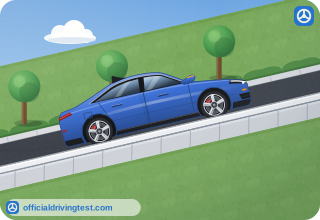
- Backward into the curb
- Forward into traffic
- Forward into the curb
- Backward into the road
Show answer
Correct answer: Backward into the curb
With the wheels turned that way, a rolling vehicle rolls backward into the curb.
Source: Washington Driver Guide (© 2025), page 148 · Open this page in the manual (Manual page 148)
-
When parked facing up a hill with a lower or rounded curb, what might be safer?
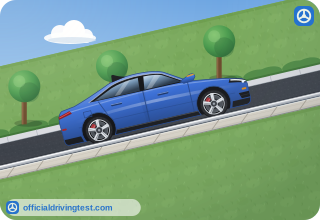
- Leaving the wheels straight
- Parking with the wheels turned into the road
- Skipping the parking brake
- Turning the steering wheel toward the curb
Show answer
Correct answer: Turning the steering wheel toward the curb
With a low or rounded curb, turning toward the curb may let the vehicle roll away from the road if the brake fails.
Source: Washington Driver Guide (© 2025), page 148 · Open this page in the manual (Manual page 148)
-
When parked facing down a hill, which way do you turn the steering wheel, and until when?
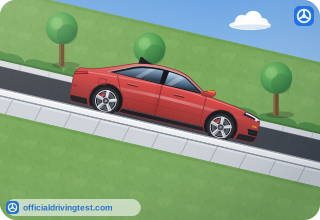
- Toward the curb, until the back of your front tire touches it
- Toward the curb, until the front of your front tire touches the curb
- Away from the curb, until your rear tire touches it
- Straight ahead, with your tires parallel to the curb
Show answer
Correct answer: Toward the curb, until the front of your front tire touches the curb
Facing down a hill you turn toward the curb until the front of the front tire touches it, so a rolling vehicle goes forward into the curb.
Source: Washington Driver Guide (© 2025), page 149 · Open this page in the manual (Manual page 149)
-
When parking on a hill where there is no curb, where do you turn your steering wheel and tires?
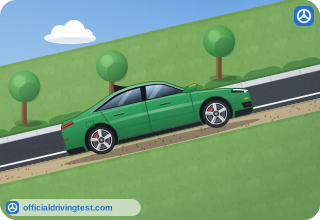
- Toward the edge of the road
- Toward the center of the road
- Straight ahead
- Parallel with the road
Show answer
Correct answer: Toward the edge of the road
Turning toward the edge of the road means that a rolling vehicle rolls away from traffic.
Source: Washington Driver Guide (© 2025), page 149 · Open this page in the manual (Manual page 149)
-
What are the white stripes next to a reserved disabled parking space called?
- A loading lane
- A buffer strip
- An access aisle
- A fire lane
Show answer
Correct answer: An access aisle
The white stripes beside a reserved space are called an access aisle and must be kept clear.
Source: Washington Driver Guide (© 2025), page 149 · Open this page in the manual (Manual page 149)
-
For what can you be fined at a reserved disabled parking space?
- Parking there with the engine running more than a minute
- Parking without a placard or blocking the access aisle
- Parking there for longer than two hours at a time
- Leaving a vehicle there overnight with a placard displayed
Show answer
Correct answer: Parking without a placard or blocking the access aisle
You can be fined for using a reserved stall without the required placard or for blocking the access aisle.
Source: Washington Driver Guide (© 2025), page 149 · Open this page in the manual (Manual page 149)
-
Who may use a parking spot reserved for disabled parking?
- Any vehicle if the driver stays inside it
- Any vehicle for a short stop only
- Any vehicle with its hazard lights on
- Vehicles with disabled plates or a placard
Show answer
Correct answer: Vehicles with disabled plates or a placard
Reserved spots are for vehicles with disabled parking plates or a disabled parking placard.
Source: Washington Driver Guide (© 2025), page 149 · Open this page in the manual (Manual page 149)
-
A person with a disability that limits or impairs their ability to walk may apply for what?
- A permit to park in any no-parking zone
- Exemption from all parking rules on public streets
- Temporary or permanent disabled parking privileges
- A permit to park in front of fire hydrants
Show answer
Correct answer: Temporary or permanent disabled parking privileges
Someone with such a disability can apply for temporary or permanent disabled parking privileges.
Source: Washington Driver Guide (© 2025), page 149 · Open this page in the manual (Manual page 149)
-
Why should you not hang a parking placard from your rearview mirror while you are driving?
- It will obstruct your view
- It will damage the mirror
- It makes the placard expire sooner
- It is hard to read from outside
Show answer
Correct answer: It will obstruct your view
A placard hanging from the mirror blocks your view while driving.
Source: Washington Driver Guide (© 2025), page 149 · Open this page in the manual (Manual page 149)
-
When is it illegal to park in an electric vehicle charging station?
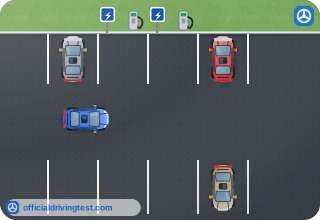
- If it stays longer than one hour
- If the driver is not sitting inside the vehicle
- If its headlights are on
- If it isn’t connected to charging equipment
Show answer
Correct answer: If it isn’t connected to charging equipment
Parking in a charging station is illegal when the vehicle is not connected to the charging equipment.
Source: Washington Driver Guide (© 2025), page 150 · Open this page in the manual (Manual page 150)