Washington: Parking rules — Part 1 Practice Test
Questions in this part include: “What are you responsible for when you leave your vehicle parked?” · “You must not park within how many feet of a railroad crossing?”
Independent educational site · not affiliated with any government agency or DMV
Ready? Test yourself
Answer to start, or tap Start below:
What are you responsible for when you leave your vehicle parked?
- Instant feedback with an explanation
- Every answer cites its source in the manual
- Your best score is saved on this device
- Keyboard: press 1 to 4 to answer and Enter for the next question
Questions are original and based on the official manual "Washington Driver Guide" (© 2025), Washington State Department of Licensing (DOL).
All 22 questions in this practice test
Take the test above first, then use this list to study. Tap “Show answer” to see the correct answer and explanation.
Show the questions and answersHide the questions
-
What is the rule for fire lanes?
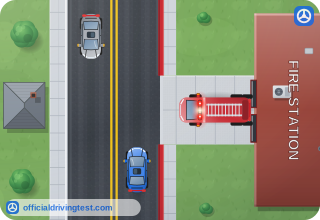
- You may park there briefly if you stay with your vehicle
- Do not park or stop in them
- You may stop there to drop off passengers
- You may park there when no fire vehicle is nearby
Show answer
Correct answer: Do not park or stop in them
Fire lanes must be left clear, so neither parking nor stopping is allowed.
Source: Washington Driver Guide (© 2025), page 138 · Open this page in the manual (Manual page 138)
-
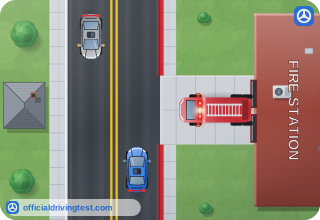
Why is the road in front of a fire station marked as a fire lane in some communities?
- To mark where fire trucks may park overnight
- To warn drivers that a school zone begins
- To show where pedestrians cross the road
- To keep the path clear for aid vehicles
Show answer
Correct answer: To keep the path clear for aid vehicles
Marking the road in front of a fire station as a fire lane keeps the way open for aid vehicles.
Source: Washington Driver Guide (© 2025), page 138 · Open this page in the manual (Manual page 138)
-
What are you responsible for when you leave your vehicle parked?
- Making sure it isn’t a hazard to others
- Leaving a note with your name on the windshield
- Keeping the engine idling
- Leaving the hazard lights on
Show answer
Correct answer: Making sure it isn’t a hazard to others
The driver is responsible for making sure a parked vehicle is not a hazard to others.
Source: Washington Driver Guide (© 2025), page 143 · Open this page in the manual (Manual page 143)
-
Where should you park?
- Anywhere without a no-parking sign
- On any shoulder with enough room
- In designated areas only
- On any street with no painted curb
Show answer
Correct answer: In designated areas only
You should park only in designated areas and check for signs that prohibit or limit parking.
Source: Washington Driver Guide (© 2025), page 143 · Open this page in the manual (Manual page 143)
-
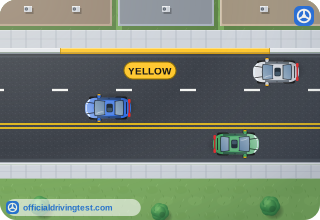
What can colored curb markings indicate?
- The speed limit
- Parking restrictions
- A one-way street
- Bicycle-only lanes
Show answer
Correct answer: Parking restrictions
A curb's color can show that parking is restricted there.
Source: Washington Driver Guide (© 2025), page 143 · Open this page in the manual (Manual page 143)
-
You must not park within how many feet of a traffic signal, stop sign, or yield sign?
- 10 feet
- 40 feet
- 60 feet
- 30 feet
Show answer
Correct answer: 30 feet
Parking is not allowed within 30 feet of a traffic signal, stop sign or yield sign.
Source: Washington Driver Guide (© 2025), page 143 · Open this page in the manual (Manual page 143)
-
You must not park within how many feet of a driveway, alley, or private road?
- 2 feet
- 10 feet
- 5 feet
- 25 feet
Show answer
Correct answer: 5 feet
Parking within 5 feet of a driveway, alley or private road is prohibited.
Source: Washington Driver Guide (© 2025), page 143 · Open this page in the manual (Manual page 143)
-
You must not park within how many feet of a fire station driveway on the opposite side of the street?
- 75 feet
- 25 feet
- 100 feet
- 150 feet
Show answer
Correct answer: 75 feet
Parking within 75 feet of a fire station driveway on the opposite side of the street is not allowed.
Source: Washington Driver Guide (© 2025), page 143 · Open this page in the manual (Manual page 143)
-
You must not park within how many feet of a pedestrian safety zone?
- 10 feet
- 40 feet
- 100 feet
- 20 feet
Show answer
Correct answer: 20 feet
Parking is not allowed within 20 feet of pedestrian safety zones.
Source: Washington Driver Guide (© 2025), page 144 · Open this page in the manual (Manual page 144)
-
You must not park within how many feet of a railroad crossing?
- 10 feet
- 50 feet
- 100 feet
- 200 feet
Show answer
Correct answer: 50 feet
Parking within 50 feet of a railroad crossing is prohibited.
Source: Washington Driver Guide (© 2025), page 144 · Open this page in the manual (Manual page 144)
-
You must not park within how many feet of a fire hydrant?
- 15 feet
- 8 feet
- 25 feet
- 40 feet
Show answer
Correct answer: 15 feet
Parking within 15 feet of a fire hydrant is prohibited.
Source: Washington Driver Guide (© 2025), page 144 · Open this page in the manual (Manual page 144)
-
You must not park more than how far from the curb?
- 6 inches
- 18 inches
- 12 inches
- 24 inches
Show answer
Correct answer: 12 inches
Parking more than 12 inches from the curb is not allowed.
Source: Washington Driver Guide (© 2025), page 144 · Open this page in the manual (Manual page 144)
-
What is double parking?
- Parking in two spaces at once
- Parking next to an already parked vehicle
- Parking with two wheels on the curb
- Parking a second vehicle behind yours
Show answer
Correct answer: Parking next to an already parked vehicle
Parking next to an already parked vehicle is called double parking, and it is not allowed.
Source: Washington Driver Guide (© 2025), page 144 · Open this page in the manual (Manual page 144)
-
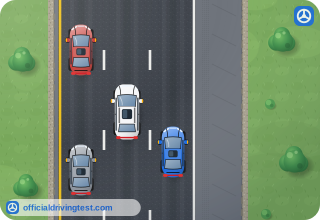
When may you park on the shoulder of a freeway?
- When traffic is light
- If you stay inside the vehicle
- When you are near an exit ramp
- Only if you have an emergency
Show answer
Correct answer: Only if you have an emergency
Parking on a freeway shoulder is not allowed unless you have an emergency.
Source: Washington Driver Guide (© 2025), page 144 · Open this page in the manual (Manual page 144)
-
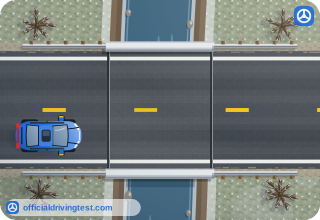
What is the rule about parking on a bridge, overpass, or in a tunnel or underpass?
- Park only for short stops
- Park only with hazard lights on
- Do not park there
- Park only on the right side
Show answer
Correct answer: Do not park there
Parking on a bridge, overpass, tunnel or underpass is prohibited.
Source: Washington Driver Guide (© 2025), page 144 · Open this page in the manual (Manual page 144)
-
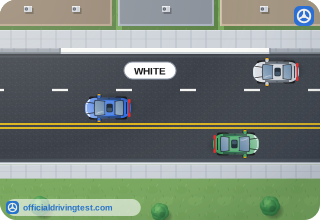
What does a white curb indicate?
- Only short stops are permitted
- A loading zone only
- Parking is allowed all day
- A space reserved for disabled parking
Show answer
Correct answer: Only short stops are permitted
White curb markings mean only short stops are permitted.
Source: Washington Driver Guide (© 2025), page 144 · Open this page in the manual (Manual page 144)
-
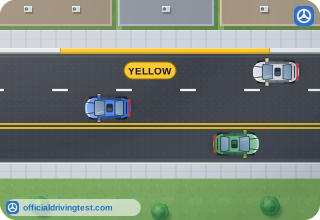
What does a yellow or red curb indicate?
- Parking is allowed for any length of time
- Parking is reserved for bicyclists
- Parking is limited to electric vehicles
- A loading zone or some other restriction
Show answer
Correct answer: A loading zone or some other restriction
A yellow or red curb marks a loading zone or some other parking restriction.
Source: Washington Driver Guide (© 2025), page 144 · Open this page in the manual (Manual page 144)
-
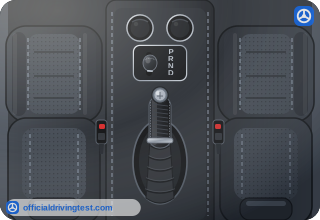
When should you set your parking brake?
- Only on a hill
- Always, especially on a hill
- Only when you leave the vehicle for a long time
- Only when parked facing downhill
Show answer
Correct answer: Always, especially on a hill
You should always set the parking brake, and especially on a hill.
Source: Washington Driver Guide (© 2025), page 144 · Open this page in the manual (Manual page 144)
-
What should you check before you open your door?
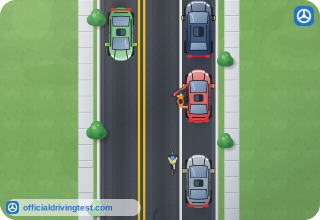
- Your rear and side-view mirror
- Your fuel gauge
- Your tire pressure
- Only the vehicle ahead of you
Show answer
Correct answer: Your rear and side-view mirror
Before opening the door you check your rear and side-view mirror for approaching traffic and bicyclists.
Source: Washington Driver Guide (© 2025), page 144 · Open this page in the manual (Manual page 144)
-
Which hand do you use to open the door with the “Dutch Reach” method?
- The hand closest to the door
- Both hands together
- The hand farthest from the door
- Whichever hand holds the keys
Show answer
Correct answer: The hand farthest from the door
The Dutch Reach means opening the door with the hand that is farthest from it.
Source: Washington Driver Guide (© 2025), page 144 · Open this page in the manual (Manual page 144)
-
How does the “Dutch Reach” help you see approaching bicyclists?
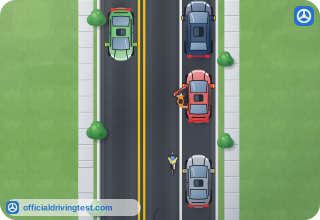
- It makes the door open wider
- It forces your body to turn
- It turns on a side-view camera
- It locks the door until the road is clear
Show answer
Correct answer: It forces your body to turn
Opening the door with the far hand turns your body, so you can see bicyclists coming and avoid opening the door too quickly.
Source: Washington Driver Guide (© 2025), page 144 · Open this page in the manual (Manual page 144)
-
When is it a crime to leave an animal unattended in a vehicle?
- If it could be harmed or killed by heat, cold, or lack of air or water
- If it is left in the vehicle for more than ten minutes at a time
- If the windows are rolled up and all of the doors are locked
- If it is not wearing a harness or kept in a pet carrier
Show answer
Correct answer: If it could be harmed or killed by heat, cold, or lack of air or water
It is a crime when the animal could be harmed or killed by excessive heat, cold, lack of ventilation or lack of necessary water.
Source: Washington Driver Guide (© 2025), page 145 · Open this page in the manual (Manual page 145)