Washington: Distracted and tired driving — Part 2 Practice Test
Questions in this part include: “Before a trip, how many hours of sleep do most people need to stay alert?” · “All drivers need to prioritize safety-focused decisions over what?”
Independent educational site · not affiliated with any government agency or DMV
Ready? Test yourself
Answer to start, or tap Start below:
Before a trip, how many hours of sleep do most people need to stay alert?
- Instant feedback with an explanation
- Every answer cites its source in the manual
- Your best score is saved on this device
- Keyboard: press 1 to 4 to answer and Enter for the next question
Questions are original and based on the official manual "Washington Driver Guide" (© 2025), Washington State Department of Licensing (DOL).
All 17 questions in this practice test
Take the test above first, then use this list to study. Tap “Show answer” to see the correct answer and explanation.
Show the questions and answersHide the questions
-
Before a trip, how many hours of sleep do most people need to stay alert?
- 4 to 6 hours
- 5 to 7 hours
- 7 to 9 hours
- 10 to 12 hours
Show answer
Correct answer: 7 to 9 hours
The guide says most people need 7 to 9 hours of sleep to stay alert.
Source: Washington Driver Guide (© 2025), page 76 · Open this page in the manual (Manual page 76)
-
How often should you plan to stop during long trips?
- Only when you feel too tired to continue
- About every 100 miles or 2 hours
- Only when you need fuel
- Only after you have driven all day
Show answer
Correct answer: About every 100 miles or 2 hours
The guide recommends planning to stop about every 100 miles or 2 hours on long trips.
Source: Washington Driver Guide (© 2025), page 76 · Open this page in the manual (Manual page 76)
-
Why does the guide suggest arranging for a travel companion on a long trip?
- To pay for fuel, food, and tolls during the long trip
- To make it unnecessary to take any breaks along the way
- To keep you talking nonstop at a steady, even pace
- To help you stay alert, watch for trouble, and share driving
Show answer
Correct answer: To help you stay alert, watch for trouble, and share driving
The guide suggests a travel companion who can help you stay alert, watch for trouble, and share the driving.
Source: Washington Driver Guide (© 2025), page 76 · Open this page in the manual (Manual page 76)
-
What does anticipating potential problems help you do?
- Reduce the risk of collisions
- Avoid the need to signal
- Drive faster in heavy traffic
- Skip mirror checks on familiar roads
Show answer
Correct answer: Reduce the risk of collisions
The guide says anticipating potential problems helps you reduce the risk of collisions.
Source: Washington Driver Guide (© 2025), page 81 · Open this page in the manual (Manual page 81)
-
Making informed decisions requires constant analysis of your surroundings. What does this improve?
- Your vehicle’s overall fuel economy
- The amount of wear on your tires
- Your overall situational awareness
- The size of your vehicle’s blind zones
Show answer
Correct answer: Your overall situational awareness
The guide says constant analysis of your surroundings improves your overall situational awareness.
Source: Washington Driver Guide (© 2025), page 81 · Open this page in the manual (Manual page 81)
-
Which of these impacts informed decisions, according to the guide?
- The total number of miles on your odometer
- Capabilities based on age and brain development
- The color and make of your vehicle
- The brand and age of your tires
Show answer
Correct answer: Capabilities based on age and brain development
The guide lists knowledge of traffic laws, experience, and capabilities based on age and brain development as impacts on informed decisions.
Source: Washington Driver Guide (© 2025), page 81 · Open this page in the manual (Manual page 81)
-
Why can teen drivers be more prone to taking risks or miscalculating situations?
- Their eyesight is usually weaker than the eyesight of adults
- Their reflexes are usually slower than those of adult drivers
- They usually drive more miles each day than other drivers
- The brain’s judgment and decision-making part is still developing
Show answer
Correct answer: The brain’s judgment and decision-making part is still developing
The guide says the part of a teen’s brain responsible for judgment and decision making is still developing.
Source: Washington Driver Guide (© 2025), page 81 · Open this page in the manual (Manual page 81)
-
All drivers need to prioritize safety-focused decisions over what?
- Speed and social pressures
- Fuel costs and parking convenience
- Travel time and scenery
- Vehicle appearance and sound systems
Show answer
Correct answer: Speed and social pressures
The guide says all drivers, especially teens, need to put safety-focused decisions ahead of speed and social pressures.
Source: Washington Driver Guide (© 2025), page 81 · Open this page in the manual (Manual page 81)
-
What must all drivers commit to every time they are behind the wheel, regardless of age or experience?
- Driving the same route each day
- Staying focused and engaged
- Keeping music on to stay awake
- Avoiding all highway driving
Show answer
Correct answer: Staying focused and engaged
The guide says all drivers must commit to staying focused and engaged every time they drive.
Source: Washington Driver Guide (© 2025), page 81 · Open this page in the manual (Manual page 81)
-
When making good decisions, what does preparing the vehicle mean?
- Arriving at the hazard with your hazard lights flashing in warning
- Arriving at the hazard in the far left lane at whatever speed you like
- Arriving at the hazard with your high beams on to warn others
- Arriving at the hazard in the right road position and at the right speed
Show answer
Correct answer: Arriving at the hazard in the right road position and at the right speed
The guide says to prepare the vehicle so you arrive at the hazard in the right road position and at the right speed.
Source: Washington Driver Guide (© 2025), page 82 · Open this page in the manual (Manual page 82)
-
Why does the guide say to inform others of what you intend to do?
- So they become aware of your intentions and can prepare for them
- So they will move out of your way and let you merge
- So they will let you skip your final check before maneuvering
- So they will slow down and always let you go ahead of them
Show answer
Correct answer: So they become aware of your intentions and can prepare for them
The guide says informing others lets them become aware of your intentions and prepare for them.
Source: Washington Driver Guide (© 2025), page 82 · Open this page in the manual (Manual page 82)
-
What should you always aim to be when making a change on the road?
- Quick, direct, and confident
- Alert, competitive, and flexible
- Aware, predictable, and smooth
- Fast, assertive, and cautious
Show answer
Correct answer: Aware, predictable, and smooth
The guide says you should always aim to be aware, predictable, and smooth.
Source: Washington Driver Guide (© 2025), page 82 · Open this page in the manual (Manual page 82)
-
The guide groups cell phones, eating, adjusting the radio, and interacting with passengers under which kind of distraction?
- Inside the vehicle
- Outside the vehicle
- Physical
- Mental
Show answer
Correct answer: Inside the vehicle
The guide lists these as distractions inside the vehicle.
Source: Washington Driver Guide (© 2025), page 84 · Open this page in the manual (Manual page 84)
-
Billboards, crashes, and other people’s behaviors are examples of which kind of distraction?
- Inside the vehicle
- Physical
- Outside the vehicle
- Mental
Show answer
Correct answer: Outside the vehicle
The guide names billboards, crashes, and other people’s behaviors as distractions outside the vehicle.
Source: Washington Driver Guide (© 2025), page 84 · Open this page in the manual (Manual page 84)
-
Fatigue, discomfort, and physical impairments are what kind of distraction?
- Mental
- Physical
- Outside the vehicle
- Inside the vehicle
Show answer
Correct answer: Physical
The guide calls fatigue, discomfort, and physical impairments physical distractions.
Source: Washington Driver Guide (© 2025), page 84 · Open this page in the manual (Manual page 84)
-
Daydreaming, worrying, and strong emotions are what kind of distraction?
- Physical
- Outside the vehicle
- Inside the vehicle
- Mental
Show answer
Correct answer: Mental
The guide calls daydreaming, worrying, and strong emotions mental distractions.
Source: Washington Driver Guide (© 2025), page 84 · Open this page in the manual (Manual page 84)
-
Which of these are distracted drivers more prone to doing?
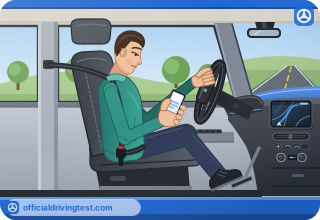
- Swerving out of their lane
- Reacting faster to hazards
- Making better decisions on the road
- Noticing more of what is around them
Show answer
Correct answer: Swerving out of their lane
The guide lists swerving out of the lane among the things distracted drivers are more prone to; the other choices are benefits of full attention.
Source: Washington Driver Guide (© 2025), page 85 · Open this page in the manual (Manual page 85)