Washington: Alcohol and drugs — Part 2 Practice Test
Questions in this part include: “Which penalties does the guide list for impaired driving under the influence of alcohol or drugs?” · “What does the guide say about driving after using a drug that is legal?”
Independent educational site · not affiliated with any government agency or DMV
Ready? Test yourself
Answer to start, or tap Start below:
Which penalties does the guide list for impaired driving under the influence of alcohol or drugs?
- Instant feedback with an explanation
- Every answer cites its source in the manual
- Your best score is saved on this device
- Keyboard: press 1 to 4 to answer and Enter for the next question
Questions are original and based on the official manual "Washington Driver Guide" (© 2025), Washington State Department of Licensing (DOL).
All 18 questions in this practice test
Take the test above first, then use this list to study. Tap “Show answer” to see the correct answer and explanation.
Show the questions and answersHide the questions
-
Which penalties does the guide list for impaired driving under the influence of alcohol or drugs?
- A written warning for a first offense, with no other penalty and no record
- Expensive fines, higher insurance rates, license suspension or withdrawal, and jail
- Community service only, with no effect on your license or insurance rates
- A short delay when you renew your driver license, but no fine or jail
Show answer
Correct answer: Expensive fines, higher insurance rates, license suspension or withdrawal, and jail
The guide calls the penalties very tough and lists fines, higher insurance rates, license suspension or withdrawal, and jail.
Source: Washington Driver Guide (© 2025), page 72 · Open this page in the manual (Manual page 72)
-
Who can drive safely after drinking alcohol or using drugs?
- An experienced driver who drives slowly
- Anyone who has eaten a full meal first
- Anyone who has had only a small amount
- No one, not even an experienced driver
Show answer
Correct answer: No one, not even an experienced driver
The guide says even an experienced driver cannot drive safely after drinking alcohol or using drugs.
Source: Washington Driver Guide (© 2025), page 72 · Open this page in the manual (Manual page 72)
-
Which of these can alcohol cause in a driver?
- Overconfidence, which can lead to risky driving behavior
- Sharper concentration on the road and the vehicles ahead
- Faster reaction times than you normally have when sober
- A better ability to scan the environment around you
Show answer
Correct answer: Overconfidence, which can lead to risky driving behavior
The guide lists overconfidence leading to risky driving behavior among alcohol effects, along with reduced reaction time and concentration.
Source: Washington Driver Guide (© 2025), page 72 · Open this page in the manual (Manual page 72)
-
Alcohol can make it difficult to do multiple tasks at once. Which example does the guide give?
- Checking your speedometer and changing the radio
- Reading a map and finding a parking space
- Staying in a lane and avoiding other traffic
- Backing up and listening for sirens
Show answer
Correct answer: Staying in a lane and avoiding other traffic
The guide gives staying in a lane while avoiding other traffic as the example of multitasking that alcohol makes harder.
Source: Washington Driver Guide (© 2025), page 72 · Open this page in the manual (Manual page 72)
-
What should you do about other drivers who show impaired driving behavior?
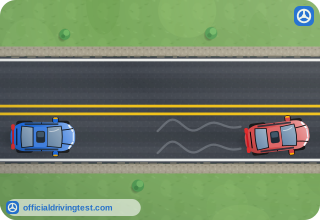
- Follow closely so you can report their plate number
- Be alert and give them lots of room
- Pass them quickly and flash your headlights
- Honk repeatedly to get their attention
Show answer
Correct answer: Be alert and give them lots of room
The guide tells you to be alert for impaired driving behavior of others and give them lots of room.
Source: Washington Driver Guide (© 2025), page 72 · Open this page in the manual (Manual page 72)
-
How much of an impairing substance must a driver have had before you should refuse to ride with them?
- Only a large amount
- Enough to make them feel dizzy
- Enough to slur their speech
- Any kind or amount
Show answer
Correct answer: Any kind or amount
The guide says not to ride with a driver who has had any kind or amount of impairing substances.
Source: Washington Driver Guide (© 2025), page 73 · Open this page in the manual (Manual page 73)
-
At what age is recreational use of marijuana, THC, and other cannabis products legal, according to the guide?
- 21 years or over
- 18 years or over
- 19 years or over
- 16 years or over
Show answer
Correct answer: 21 years or over
The guide says recreational use of cannabis products is legal for those 21 years or over.
Source: Washington Driver Guide (© 2025), page 73 · Open this page in the manual (Manual page 73)
-
According to the guide, how much cannabis is safe for driving?
- A small amount if you drive slowly
- Any amount taken as an edible instead of smoked
- No amount is safe
- An amount that does not make you feel drowsy
Show answer
Correct answer: No amount is safe
The guide states there is no safe amount of cannabis for driving.
Source: Washington Driver Guide (© 2025), page 73 · Open this page in the manual (Manual page 73)
-
Which of these can cannabis cause in a driver?
- Improved hand-eye coordination
- Inability to judge distances
- Faster reaction times than usual
- Less drowsiness than usual
Show answer
Correct answer: Inability to judge distances
Research cited in the guide says cannabis can cause an inability to judge distances, along with reduced attention and coordination.
Source: Washington Driver Guide (© 2025), page 73 · Open this page in the manual (Manual page 73)
-
What does the guide say about driving after using a drug that is legal?
- Legal drugs never affect your driving
- Only illegal drugs count as impaired driving
- A drug is safe to use if its label does not mention driving
- A drug being legal does not mean it is safe to use while driving
Show answer
Correct answer: A drug being legal does not mean it is safe to use while driving
The guide says that just because a drug is legal does not mean it is safe to use while driving.
Source: Washington Driver Guide (© 2025), page 74 · Open this page in the manual (Manual page 74)
-
How does the guide describe impaired driving, even when the drug is prescribed or bought over the counter?
- A criminal behavior
- A minor paperwork matter
- A civil dispute with your insurer
- Acceptable with a doctor’s note
Show answer
Correct answer: A criminal behavior
The guide says impaired driving is a criminal behavior regardless of whether the drug is prescribed, over-the-counter, or illicit.
Source: Washington Driver Guide (© 2025), page 74 · Open this page in the manual (Manual page 74)
-
What can over-the-counter drugs taken for headaches, colds, or allergies do?
- Increase your alertness for several hours
- Improve your judgment while driving
- Make a person drowsy, which could affect driving
- Sharpen your reflexes for a short time
Show answer
Correct answer: Make a person drowsy, which could affect driving
The guide notes these common drugs can make a person drowsy, which could affect driving.
Source: Washington Driver Guide (© 2025), page 74 · Open this page in the manual (Manual page 74)
-
What should you do before driving after you start taking a new prescription medicine?
- Drive only in daylight until you feel normal again after each dose
- Wait until you know how it affects your judgment, coordination, and reaction time
- Drive only on short trips close to home until you feel normal again
- Drive only with another adult in the vehicle for the first few weeks
Show answer
Correct answer: Wait until you know how it affects your judgment, coordination, and reaction time
The guide says to wait until you know how a new medicine affects your judgment, coordination, and reaction time.
Source: Washington Driver Guide (© 2025), page 74 · Open this page in the manual (Manual page 74)
-
Warnings on medicine against “operating heavy machinery” include which activity?
- Operating only farm equipment
- Driving only commercial vehicles
- Using power tools only
- Driving a vehicle
Show answer
Correct answer: Driving a vehicle
The guide says warnings against operating heavy machinery include driving a vehicle.
Source: Washington Driver Guide (© 2025), page 74 · Open this page in the manual (Manual page 74)
-
What can happen when a medication that is harmless on its own is taken with a second medication or alcohol?
- It could cause severe impairment
- It always cancels out the effect of the alcohol
- It makes you more alert
- Nothing, because each drug works separately
Show answer
Correct answer: It could cause severe impairment
The guide warns that some medications that do not affect you alone could cause severe impairment when taken with a second medication or alcohol.
Source: Washington Driver Guide (© 2025), page 74 · Open this page in the manual (Manual page 74)
-
What is polydrug use?
- Taking a single drug in a very large dose
- Using a drug that was prescribed for someone else
- Mixing or taking more than one type of drug
- Taking a drug for longer than recommended
Show answer
Correct answer: Mixing or taking more than one type of drug
The guide defines polydrug use as the mixing or taking of more than one type of drug.
Source: Washington Driver Guide (© 2025), page 75 · Open this page in the manual (Manual page 75)
-
What can mixing alcohol, cannabis, or other drugs produce?
- Weaker effects than either drug alone
- Effects greater than any drug on its own
- Effects that last only a few minutes
- The same effects as one drug taken alone
Show answer
Correct answer: Effects greater than any drug on its own
The guide says mixing drugs can produce effects greater than any drug on its own.
Source: Washington Driver Guide (© 2025), page 75 · Open this page in the manual (Manual page 75)
-
Polydrug use can lead to an increased probability of which of these?
- Lower insurance rates
- Faster reaction times
- Better judgment
- Overdose
Show answer
Correct answer: Overdose
The guide says polydrug use can lead to increased probability of overdose, mental health troubles, risky behavior, serious injuries, and crashes.
Source: Washington Driver Guide (© 2025), page 75 · Open this page in the manual (Manual page 75)