Virginia: Sharing the road — Part 3 Practice Test
Questions in this part include: “How much clear road may you need to pass a truck and its trailer?” · “Which kind of passing is a sign of aggressive driving?”
Independent educational site · not affiliated with any government agency or DMV
Ready? Test yourself
- Instant feedback with an explanation
- Every answer cites its source in the manual
- Your best score is saved on this device
- Keyboard: press 1 to 4 to answer and Enter for the next question
Questions are original and based on the official manual "Virginia Driver's Manual" (DMV 39 (April 27, 2026)), Virginia Department of Motor Vehicles (DMV).
All 21 questions in this practice test
Take the test above first, then use this list to study. Tap “Show answer” to see the correct answer and explanation.
Show the questions and answersHide the questions
-
How much clear road may you need to pass a truck and its trailer?
- About one block
- About a tenth of a mile
- About 200 feet
- More than half a mile
Show answer
Correct answer: More than half a mile
Because of its length, it may take you more than half a mile of clear road to pass a truck and trailer.
Source: Virginia Driver's Manual (DMV 39 (April 27, 2026)), page 21 · Open this page in the manual (Manual page 21)
-
After passing a truck, how should you know it is safe to pull in front of it?
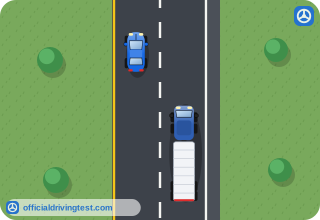
- Look for the entire front of the truck in your rearview mirror
- Wait until the truck driver flashes the headlights
- Wait until you see the truck’s front wheels in your mirror
- Pull in as soon as the truck’s cab is beside your rear bumper
Show answer
Correct answer: Look for the entire front of the truck in your rearview mirror
You should see the entire front of the truck in your rearview mirror before pulling in front, and then maintain your speed.
Source: Virginia Driver's Manual (DMV 39 (April 27, 2026)), page 21 · Open this page in the manual (Manual page 21)
-
After you pull in front of a truck you have passed, what should you do?
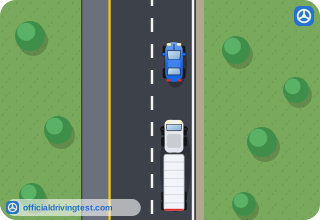
- Slow down at once to let the truck driver see you
- Brake lightly to flash your brake lights
- Maintain your speed
- Speed up to get far ahead of the truck
Show answer
Correct answer: Maintain your speed
Cutting in front and slowing down suddenly forces the truck to brake hard, so maintain your speed.
Source: Virginia Driver's Manual (DMV 39 (April 27, 2026)), page 21 · Open this page in the manual (Manual page 21)
-
How far in front of the cab may the blind spots of trucks, buses and RVs stretch?
- Up to 5 feet
- Up to 20 feet
- Up to 50 feet
- Up to 100 feet
Show answer
Correct answer: Up to 20 feet
Their blind spots may stretch up to 20 feet in front of the cab.
Source: Virginia Driver's Manual (DMV 39 (April 27, 2026)), page 21 · Open this page in the manual (Manual page 21)
-
About how far behind a truck, bus or RV may its blind spot stretch?
- Approximately 20 feet
- Approximately 50 feet
- Approximately 100 feet
- Approximately 200 feet
Show answer
Correct answer: Approximately 200 feet
The blind spot may stretch approximately 200 feet behind the vehicle.
Source: Virginia Driver's Manual (DMV 39 (April 27, 2026)), page 21 · Open this page in the manual (Manual page 21)
-
Aggressive driving is defined by Virginia law as the intent to do what while committing one or more traffic offenses?
- Pass another vehicle in order to reach a destination sooner
- Warn, delay or instruct other drivers about road conditions
- Avoid a crash by driving faster than the traffic around you
- Harass, intimidate, injure or obstruct another person
Show answer
Correct answer: Harass, intimidate, injure or obstruct another person
Virginia law ties aggressive driving to an intent to harass, intimidate, injure or obstruct another person while breaking traffic laws.
Source: Virginia Driver's Manual (DMV 39 (April 27, 2026)), page 23 · Open this page in the manual (Manual page 23)
-
Which of these is something aggressive drivers do?
- Signal every lane change well in advance
- Weave in and out of traffic
- Stay in the middle of their lane
- Keep a safe following distance
Show answer
Correct answer: Weave in and out of traffic
Weaving in and out of traffic is one of the ways aggressive drivers break the law.
Source: Virginia Driver's Manual (DMV 39 (April 27, 2026)), page 23 · Open this page in the manual (Manual page 23)
-
Which kind of passing is a sign of aggressive driving?
- Passing on the left when the way is clear
- Passing after signaling and checking your mirrors
- Passing on the right, including on the shoulder
- Passing a slow vehicle on a two-lane road
Show answer
Correct answer: Passing on the right, including on the shoulder
Aggressive drivers pass on the right, including on the shoulder and unpaved parts of the road.
Source: Virginia Driver's Manual (DMV 39 (April 27, 2026)), page 23 · Open this page in the manual (Manual page 23)
-
If you see an aggressive driver, what should you do?
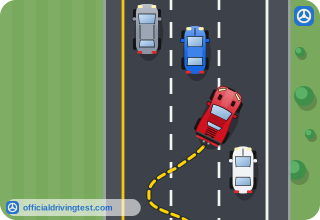
- Stay out of the way
- Speed up to get ahead of him
- Flash your lights at him
- Pull alongside to talk to him
Show answer
Correct answer: Stay out of the way
The manual says to protect yourself by staying out of the aggressive driver’s way.
Source: Virginia Driver's Manual (DMV 39 (April 27, 2026)), page 23 · Open this page in the manual (Manual page 23)
-
How should you respond to an aggressive driver’s gestures and shouting?
- Answer with a gesture of your own
- Avoid eye contact and ignore them
- Slow down and let him get close behind you
- Shout back so he knows you are not afraid
Show answer
Correct answer: Avoid eye contact and ignore them
You protect yourself by avoiding eye contact and ignoring the aggressive driver’s gestures and shouting.
Source: Virginia Driver's Manual (DMV 39 (April 27, 2026)), page 23 · Open this page in the manual (Manual page 23)
-
A truck, bus or RV is making a wide turn. What should you never try to do?
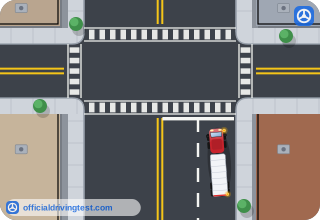
- Squeeze between the vehicle and the curb or another vehicle
- Stay back and let the vehicle complete its turn
- Stop behind the vehicle until it has finished turning
- Keep a safe following distance behind the vehicle
Show answer
Correct answer: Squeeze between the vehicle and the curb or another vehicle
These vehicles swing wide and cannot see cars beside or behind them, so never squeeze in beside them.
Source: Virginia Driver's Manual (DMV 39 (April 27, 2026)), page 21 · Open this page in the manual (Manual page 21)
-
How much longer does it take a vehicle towing a light to medium trailer to pass, stop, accelerate and turn?
- Half again as long
- Three times as long
- Twice as long
- Four times as long
Show answer
Correct answer: Twice as long
Towing places additional stress on the vehicle and it takes twice as long to pass, stop, accelerate and turn.
Source: Virginia Driver's Manual (DMV 39 (April 27, 2026)), page 21 · Open this page in the manual (Manual page 21)
-
What are generally needed to increase visibility when towing a light to medium trailer?
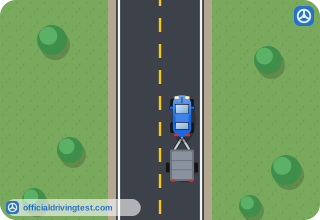
- Extra headlights
- Large side mirrors
- A larger rear window
- Tinted side windows
Show answer
Correct answer: Large side mirrors
Large side mirrors are generally needed to increase visibility when towing.
Source: Virginia Driver's Manual (DMV 39 (April 27, 2026)), page 21 · Open this page in the manual (Manual page 21)
-
Before each trip with a light to medium trailer, which of these should you make sure is intact?
- The weld joining the trailer frame to the axle
- The strap securing the load to the trailer floor
- The lock securing the trailer tires to the wheels
- The pin securing the ball mount to the receiver
Show answer
Correct answer: The pin securing the ball mount to the receiver
The pre-trip safety inspection includes making sure the pin securing the ball mount to the receiver is intact.
Source: Virginia Driver's Manual (DMV 39 (April 27, 2026)), page 21 · Open this page in the manual (Manual page 21)
-
Before towing a light to medium trailer, which lights should you make sure are functioning properly?
- Brake lights, turn signals, and license plate lights
- Fog lights, interior lights, and hazard flashers
- Headlights, high beams, and dome lights
- Back-up lights, fog lights, and interior lights
Show answer
Correct answer: Brake lights, turn signals, and license plate lights
The pre-trip inspection includes brake lights, turn signals and license plate lights.
Source: Virginia Driver's Manual (DMV 39 (April 27, 2026)), page 21 · Open this page in the manual (Manual page 21)
-
Before pulling a trailer on public roads, what does the manual recommend?
- Drive several miles on an interstate highway at a moderate speed to test how your trailer handles
- Ask a licensed trailer driver to ride with you on the road
- Practice in a place such as a vacant parking lot to get the feel for how the vehicle and trailer handle
- Drive on a quiet residential street at a slow speed
Show answer
Correct answer: Practice in a place such as a vacant parking lot to get the feel for how the vehicle and trailer handle
Practice first in a place like a vacant parking lot to learn how the vehicle and trailer handle.
Source: Virginia Driver's Manual (DMV 39 (April 27, 2026)), page 21 · Open this page in the manual (Manual page 21)
-
What should you allow for when you change lanes while towing a light to medium trailer?
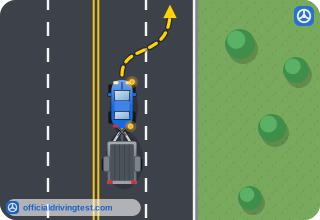
- The added weight of the trailer
- The added length of the trailer
- The added width of your side mirrors
- The added height of the trailer
Show answer
Correct answer: The added length of the trailer
Always allow for the trailer’s added length when changing lanes.
Source: Virginia Driver's Manual (DMV 39 (April 27, 2026)), page 21 · Open this page in the manual (Manual page 21)
-
Your trailer starts to sway. What should you do?
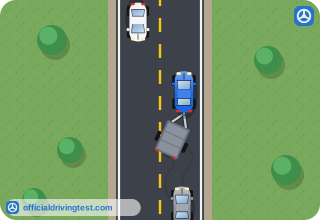
- Speed up
- Brake hard
- Steer sharply from side to side
- Slow down
Show answer
Correct answer: Slow down
If a trailer starts to sway, slow down.
Source: Virginia Driver's Manual (DMV 39 (April 27, 2026)), page 21 · Open this page in the manual (Manual page 21)
-
When backing up with a trailer, where should you place your hand on the steering wheel?
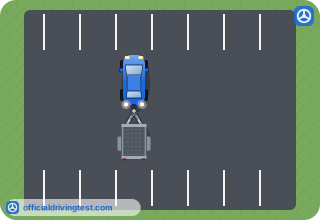
- On the bottom of the steering wheel
- On the top of the steering wheel
- On the side of the steering wheel closest to the trailer
- On the center of the steering wheel
Show answer
Correct answer: On the bottom of the steering wheel
When backing with a trailer, put your hand on the bottom of the wheel.
Source: Virginia Driver's Manual (DMV 39 (April 27, 2026)), page 21 · Open this page in the manual (Manual page 21)
-
You cannot see where you are backing up with a trailer. What should you do?
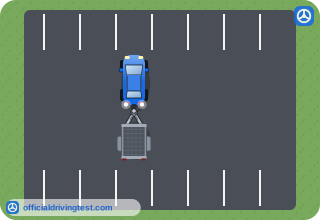
- Back up slowly and sound the horn
- Use only your side mirrors
- Have someone outside to help guide you
- Ask a passenger to steer
Show answer
Correct answer: Have someone outside to help guide you
If you cannot see where you are backing, have someone outside guide you.
Source: Virginia Driver's Manual (DMV 39 (April 27, 2026)), page 21 · Open this page in the manual (Manual page 21)
-
To back a trailer to the left, how should you move the steering wheel?
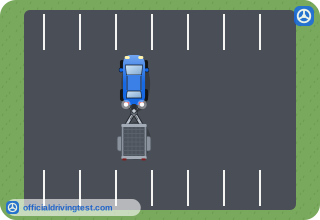
- Use your right hand to move the wheel left
- Use your left hand to move the wheel left
- Use your left hand to move the wheel right
- Use your right hand to move the wheel right
Show answer
Correct answer: Use your left hand to move the wheel left
To back the trailer left, use your left hand to move the wheel left; for right, use the right hand to move it right.
Source: Virginia Driver's Manual (DMV 39 (April 27, 2026)), page 21 · Open this page in the manual (Manual page 21)