Virginia: Sharing the road — Part 1 Practice Test
Questions in this part include: “Where must drivers stop for a red traffic signal at an intersection with a bicycle box?” · “Which of the following is a vulnerable road user?”
Independent educational site · not affiliated with any government agency or DMV
Ready? Test yourself
- Instant feedback with an explanation
- Every answer cites its source in the manual
- Your best score is saved on this device
- Keyboard: press 1 to 4 to answer and Enter for the next question
Questions are original and based on the official manual "Virginia Driver's Manual" (DMV 39 (April 27, 2026)), Virginia Department of Motor Vehicles (DMV).
All 21 questions in this practice test
Take the test above first, then use this list to study. Tap “Show answer” to see the correct answer and explanation.
Show the questions and answersHide the questions
-
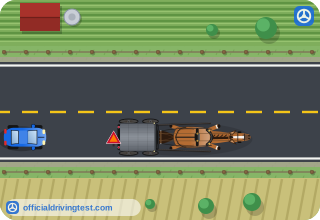
How much clearance does state law require when passing a horse-drawn buggy when the way is clear?
- At least three feet
- At least one foot
- At least five feet
- At least ten feet
Show answer
Correct answer: At least three feet
State law requires passing with at least three feet of clearance when the way is clear.
Source: Virginia Driver's Manual (DMV 39 (April 27, 2026)), page 8 · Open this page in the manual (Manual page 8)
-
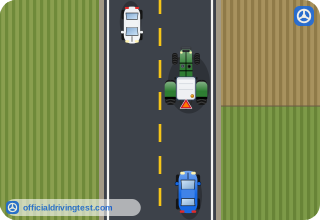
Slow moving vehicles must display an orange triangle emblem when traveling at what speed?
- 35 MPH or less
- 25 MPH or less
- 15 MPH or less
- 45 MPH or less
Show answer
Correct answer: 25 MPH or less
Vehicles such as farm equipment, horse-drawn vehicles and highway work vehicles that travel at 25 MPH or less must display the emblem on a public highway.
Source: Virginia Driver's Manual (DMV 39 (April 27, 2026)), page 11 · Open this page in the manual (Manual page 11)
-
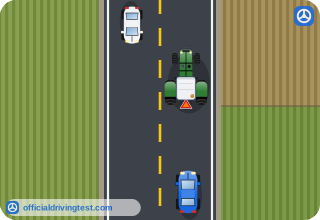
What should you be prepared to do when you see a vehicle displaying a slow moving vehicle sign?
- Sound your horn to warn the driver
- Stop until the vehicle leaves the road
- Follow closely so you can pass quickly
- Adjust your speed or position
Show answer
Correct answer: Adjust your speed or position
The manual tells you to be ready to adjust your speed or position around a vehicle displaying the sign.
Source: Virginia Driver's Manual (DMV 39 (April 27, 2026)), page 11 · Open this page in the manual (Manual page 11)
-
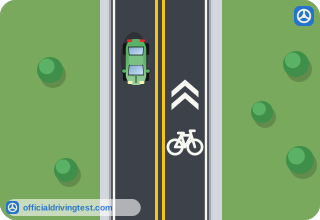
What does a shared lane marking, or sharrow, remind drivers to do?
- Expect bicyclists on the road
- Stay out of the lane
- Pass bicyclists on the right
- Stop for bicyclists at the marking
Show answer
Correct answer: Expect bicyclists on the road
Sharrows show where bicyclists are encouraged to ride and remind drivers to expect them.
Source: Virginia Driver's Manual (DMV 39 (April 27, 2026)), page 12 · Open this page in the manual (Manual page 12)
-
What should you do before turning across a bicycle lane?
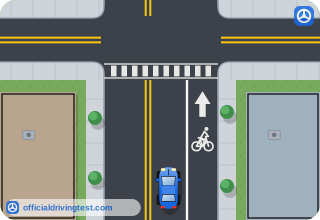
- Speed up and turn quickly so that you are ahead of bicyclists behind you
- Sound your horn to warn bicyclists
- Signal only after you have started to turn
- Check your mirrors for bicyclists behind you and yield to bicycles in the lane
Show answer
Correct answer: Check your mirrors for bicyclists behind you and yield to bicycles in the lane
Before turning, you should check mirrors for bicyclists behind you and yield to bicycles in the lane.
Source: Virginia Driver's Manual (DMV 39 (April 27, 2026)), page 12 · Open this page in the manual (Manual page 12)
-
Where must drivers stop for a red traffic signal at an intersection with a bicycle box?
- Behind the bicycle box, not inside it
- Inside the bicycle box, at the front of the intersection
- Beside the bicycle box
- Past the stop line, in the crosswalk
Show answer
Correct answer: Behind the bicycle box, not inside it
Drivers must stop behind all bicycle boxes at a red light, because riders move into the box in front of drivers.
Source: Virginia Driver's Manual (DMV 39 (April 27, 2026)), page 13 · Open this page in the manual (Manual page 13)
-
What is true about right turns on red at intersections with a bicycle box?
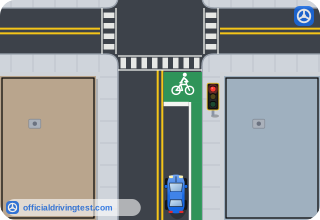
- They are allowed after a complete stop
- They are allowed only for bicyclists
- Right turns on red are not allowed
- They are allowed only if no bicyclist is in the box
Show answer
Correct answer: Right turns on red are not allowed
Right turns on red are not allowed at intersections that have bicycle boxes.
Source: Virginia Driver's Manual (DMV 39 (April 27, 2026)), page 13 · Open this page in the manual (Manual page 13)
-
You are turning right on a green light at an intersection with a bicycle box. What must you do?
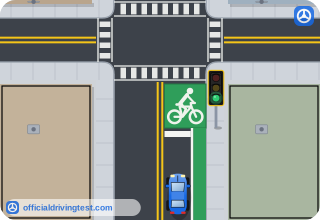
- Speed up to turn ahead of the bicycles
- Stop inside the box and wait for bicycles to pass
- Signal and yield to bicycles on the right
- Turn without signaling because the light is green
Show answer
Correct answer: Signal and yield to bicycles on the right
When turning right on a green light there, you must signal and yield to bicycles on your right.
Source: Virginia Driver's Manual (DMV 39 (April 27, 2026)), page 13 · Open this page in the manual (Manual page 13)
-
What do bicycle boxes painted at intersections contain?
- A white bicycle symbol
- A red bicycle symbol
- A yellow diamond
- The words BIKE ONLY in red
Show answer
Correct answer: A white bicycle symbol
Bicycle boxes contain a white bicycle symbol, and the box and approaching lanes may be painted green.
Source: Virginia Driver's Manual (DMV 39 (April 27, 2026)), page 13 · Open this page in the manual (Manual page 13)
-
From which directions must you stop for a stopped school bus with flashing red lights and an extended stop sign?
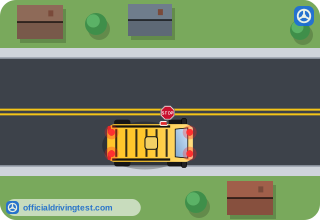
- Only when you approach the bus from behind on a highway
- Only when traveling in the same direction as the bus
- Only on public highways, not on private roads
- From any direction on a highway, private road or school driveway
Show answer
Correct answer: From any direction on a highway, private road or school driveway
You stop when you approach from any direction on a highway, private road or school driveway.
Source: Virginia Driver's Manual (DMV 39 (April 27, 2026)), page 15 · Open this page in the manual (Manual page 15)
-
How long must you remain stopped for a school bus with flashing red lights and an extended stop sign?
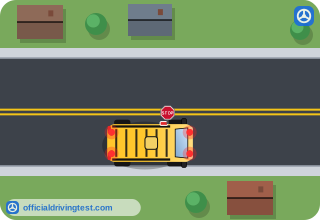
- Until the bus driver signals that you may go on
- Until all persons are clear and the bus moves again
- Until two minutes have passed
- Until no other vehicles are approaching
Show answer
Correct answer: Until all persons are clear and the bus moves again
You stay stopped until everyone is clear of the roadway and the bus moves again.
Source: Virginia Driver's Manual (DMV 39 (April 27, 2026)), page 15 · Open this page in the manual (Manual page 15)
-
A school bus is loading or unloading passengers but its signals are not on. What must you do?
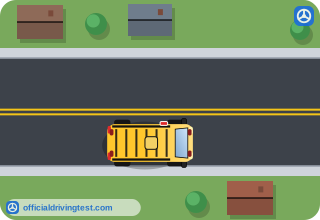
- Pass slowly while watching for children
- Stop, just as if the signals were on
- Proceed only if no children are in sight
- Slow down and sound your horn once
Show answer
Correct answer: Stop, just as if the signals were on
You must also stop for a bus that is loading or unloading even when its signals are off.
Source: Virginia Driver's Manual (DMV 39 (April 27, 2026)), page 15 · Open this page in the manual (Manual page 15)
-
When do you not have to stop for a stopped school bus with flashing red lights?
- When you travel the opposite way on a road with no median or barrier and the bus is across the road
- When you travel the same way as the bus on a road divided by a physical barrier
- When you are on a private road or school driveway and no children are in sight
- When you travel the opposite way on a road divided by a physical barrier and the bus is on the other side
Show answer
Correct answer: When you travel the opposite way on a road divided by a physical barrier and the bus is on the other side
You do not have to stop only when you travel in the opposite direction on a road divided by a barrier and the bus is on the other side; still be ready for people leaving the bus.
Source: Virginia Driver's Manual (DMV 39 (April 27, 2026)), page 15 · Open this page in the manual (Manual page 15)
-
When approaching or passing a person riding a bicycle, moped or power-assisted bicycle, what should you do?
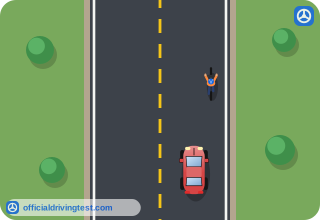
- Reduce speed and pass at least six feet to the left
- Reduce speed and pass at least three feet to the left
- Keep your speed and pass at least one foot to the left
- Sound your horn and pass at least two feet to the left
Show answer
Correct answer: Reduce speed and pass at least three feet to the left
You must slow down and leave at least three feet of space to the left of the rider.
Source: Virginia Driver's Manual (DMV 39 (April 27, 2026)), page 17 · Open this page in the manual (Manual page 17)
-
What should you do about driving in another driver’s blind spot?
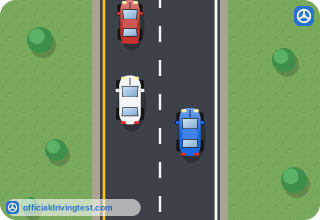
- Stay there so the driver knows you are close
- Stay there as long as you are signaling
- Avoid it by speeding up or dropping back
- Stay there when traffic is heavy
Show answer
Correct answer: Avoid it by speeding up or dropping back
Driving in another driver’s blind spot is as dangerous as not checking your own, so speed up or drop back.
Source: Virginia Driver's Manual (DMV 39 (April 27, 2026)), page 20 · Open this page in the manual (Manual page 20)
-
Which of the following is a vulnerable road user?
- A person driving a truck
- A person riding a skateboard
- A person driving a bus
- A person driving a recreational vehicle
Show answer
Correct answer: A person riding a skateboard
Vulnerable road users include pedestrians and people on bicycles, wheel chairs, skateboards, roller skates, scooters, animals and animal-drawn vehicles.
Source: Virginia Driver's Manual (DMV 39 (April 27, 2026)), page 20 · Open this page in the manual (Manual page 20)
-
What is illegal around vulnerable road users?
- Driving at the posted speed limit
- Driving with your headlights on
- Driving in the right lane
- Driving distracted and carelessly
Show answer
Correct answer: Driving distracted and carelessly
The manual says it is illegal to drive distracted and carelessly around vulnerable road users.
Source: Virginia Driver's Manual (DMV 39 (April 27, 2026)), page 20 · Open this page in the manual (Manual page 20)
-
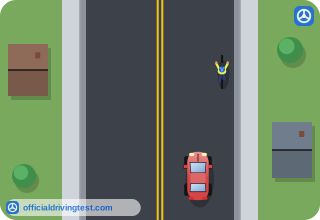
Compared with the driver of a motor vehicle, what right-of-way does a bicyclist on a roadway generally have?
- A greater right-of-way
- A lesser right-of-way
- The same right-of-way
- No right-of-way
Show answer
Correct answer: The same right-of-way
Bicyclists on a roadway generally have the same right-of-way as the driver of a motor vehicle.
Source: Virginia Driver's Manual (DMV 39 (April 27, 2026)), page 20 · Open this page in the manual (Manual page 20)
-
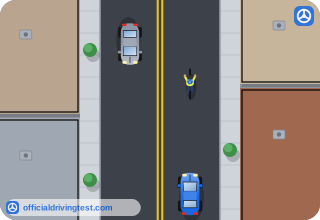
When may a bicyclist ride in the center of the lane?
- Only when there are no other vehicles anywhere behind the bicyclist on the roadway
- When necessary, such as when the lane is too narrow to share side-by-side with a car
- Only on roads with a speed limit above 35 MPH
- Only when riding in a group of bicyclists
Show answer
Correct answer: When necessary, such as when the lane is too narrow to share side-by-side with a car
Bicyclists may ride in the center of the lane when necessary, for example when about to turn left or when the lane is too narrow to share.
Source: Virginia Driver's Manual (DMV 39 (April 27, 2026)), page 20 · Open this page in the manual (Manual page 20)
-
On which roads are bicyclists legally allowed?
- Only roads with a posted bicycle route sign
- Only roads with a speed limit of 35 MPH or less
- Only residential streets and roads outside cities
- All public roads except interstates and most freeways
Show answer
Correct answer: All public roads except interstates and most freeways
Bicyclists may use all public roads except interstates and most freeways (limited access highways).
Source: Virginia Driver's Manual (DMV 39 (April 27, 2026)), page 20 · Open this page in the manual (Manual page 20)
-
Where should drivers be aware of bicyclists riding in either direction?
- On sidewalks, shared-use paths, or two-way separated bike lanes
- On interstates and limited access highways
- Only on one-way streets in business districts and city centers
- Only in marked crosswalks at intersections
Show answer
Correct answer: On sidewalks, shared-use paths, or two-way separated bike lanes
Drivers should watch for bicyclists riding both ways on sidewalks, shared-use paths and two-way separated bike lanes.
Source: Virginia Driver's Manual (DMV 39 (April 27, 2026)), page 20 · Open this page in the manual (Manual page 20)