Traffic signals in Virginia
The Virginia Driver's Manual shows or names everything on this page: 18 in all, on pages 5–6.
Independent educational site · not affiliated with any government agency or DMV
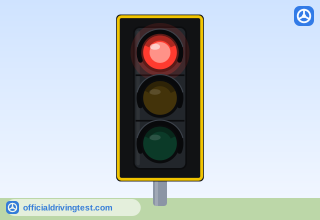
Steady Red Light
At a red light, come to a complete stop at the stop line or, if there is no stop line, before entering the intersection or before reaching the crosswalk. Remain stopped as long as the signal is red, unless turns are allowed. Right turn on red: You may turn right while the traffic signal displays a red light. Before turning, you must come to a complete stop. Look both ways and yield the right-of-way to pedestrians and other traffic. (p5) / Left turn on red: You may turn left at a red light if you are on a one-way street and turning left onto another one-way street while the traffic signal displays a red light. Before turning, you must come to a complete stop. (p5) / You must always stop your vehicle: at all stop signs, red traffic lights and flashing red signals (p15)
Manual page 5 · Open this page in the manual (Manual page 5)
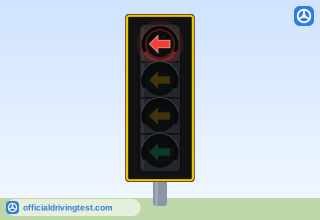
Red Arrow (Left)
A red arrow means you must stop if you intend to move in the direction of the arrow. / You may not turn right on red if signs are posted at the intersection that read “No Turn on Red,” or if a red arrow pointing to the right is displayed. / You may not turn left on red if signs are posted at the intersection that read “No Turn on Red,” or if a red arrow pointing to the left is displayed.
Manual page 5 · Open this page in the manual (Manual page 5)
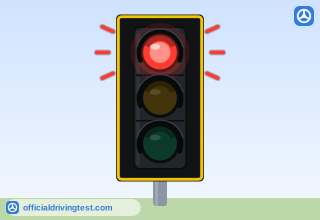
Flashing Red Light
At a flashing red light, come to a complete stop and yield to oncoming vehicles and pedestrians. You may go when the way is clear. At a railroad crossing, you must come to a complete stop even if you don’t see a train. (p5) / You must always stop your vehicle: at all stop signs, red traffic lights and flashing red signals (p15)
Manual page 5 · Open this page in the manual (Manual page 5)
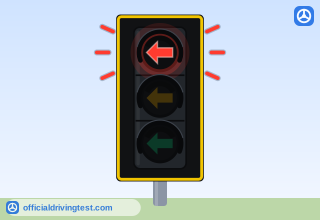
Flashing Red Arrow
Flashing red arrow: At a flashing red arrow, come to a complete stop, yield the right-of-way to vehicles coming from the other direction and pedestrians in the intersection, and proceed in the direction of the arrow when the way is clear.
Manual page 5 · Open this page in the manual (Manual page 5)
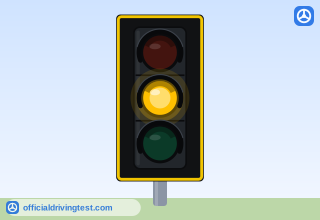
Steady Yellow Light
A yellow light or arrow are cautions warning that the light is about to change. If you have not entered the intersection, stop; or, if unsafe to stop, cautiously go through it. If you are already in the intersection, go through it cautiously. Do not speed up to beat the light.
Manual page 5 · Open this page in the manual (Manual page 5)
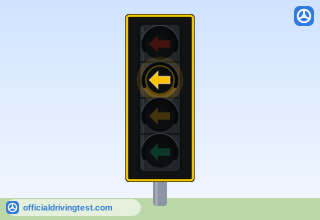
Yellow Arrow (Left)
A yellow light or arrow are cautions warning that the light is about to change. If you have not entered the intersection, stop; or, if unsafe to stop, cautiously go through it. If you are already in the intersection, go through it cautiously. Do not speed up to beat the light.
Manual page 5 · Open this page in the manual (Manual page 5)
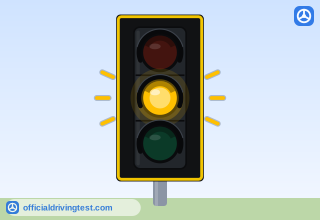
Flashing Yellow Light
A flashing yellow light means slow down and proceed with caution. Flashing yellow lights are at locations with higher-than-normal hazardous conditions.
Manual page 5 · Open this page in the manual (Manual page 5)
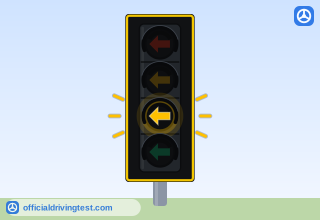
Flashing Yellow Arrow
Flashing yellow arrow: At a flashing yellow arrow, you may turn in the direction of the arrow, if the way is clear. Yield the right-of-way to vehicles coming from the other direction and pedestrians in the intersection. Be sure to check for less visible vehicles such as motorcycles, bicycles, and mopeds. If a traffic light changes from red to flashing yellow arrow while a pedestrian is in the intersection, allow the pedestrian to cross the street before turning.
Manual page 5 · Open this page in the manual (Manual page 5)
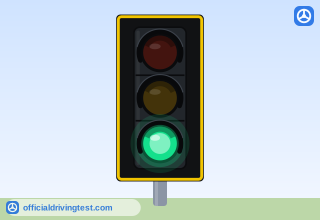
Steady Green Light
At a green light, you may go if the way is clear. ... If you are turning without a green arrow, you must yield the right-of-way to vehicles coming from the other direction and pedestrians in the intersection. Be sure to check for less visible vehicles such as motorcycles, bicycles, and mopeds. If a traffic light changes from red to green while a pedestrian is in the street, allow the pedestrian to cross the street before turning.
Manual page 6 · Open this page in the manual (Manual page 6)
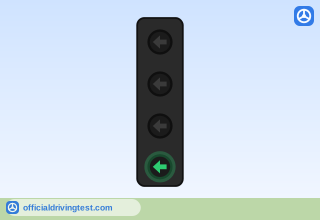
Green Arrow (Left)
At a green arrow, you may go in the direction of the arrow if the way is clear.
Manual page 6 · Open this page in the manual (Manual page 6)
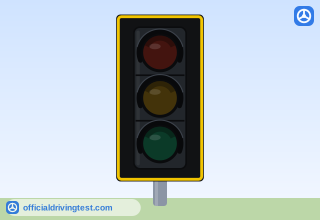
Signal Not Working (No Lights)
Out of service signals: When traffic signals are not working because of a power outage or other problem and not displaying any lights, you are required to stop, proceeding through the intersection as though it were an all-way stop. This does not apply if a law enforcement officer or other authorized person is directing traffic at the intersection, or if portable stop signs are in use. (p6) / If the traffic lights at an intersection are not working, all vehicles coming to the intersection must stop. The driver on the left must yield to the driver on the right. (p16)
Manual page 6 · Open this page in the manual (Manual page 6)
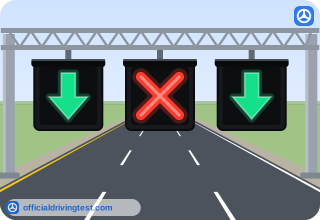
Red X (Lane Control)
Lane use signals indicate lanes where you can and cannot drive during different hours of the day. / Red X: Never drive in a lane marked with a red X signal.
Manual page 6 · Open this page in the manual (Manual page 6)
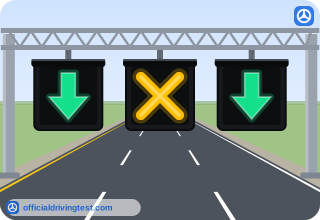
Yellow X (Lane Control)
Yellow X or Yellow Diagonal Downward Arrow: These signals mean that you should move out of the lane as soon as safely possible.
Manual page 6 · Open this page in the manual (Manual page 6)
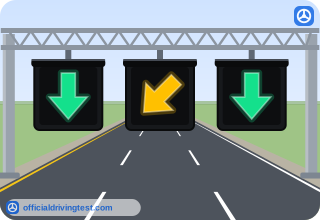
Yellow Diagonal Downward Arrow (Lane Control)
Yellow X or Yellow Diagonal Downward Arrow: These signals mean that you should move out of the lane as soon as safely possible.
Manual page 6 · Open this page in the manual (Manual page 6)
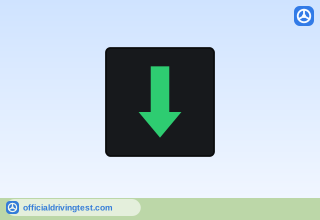
Green Arrow (Lane Control)
Green Arrow: You are permitted to drive in a lane marked with a green arrow signal.
Manual page 6 · Open this page in the manual (Manual page 6)
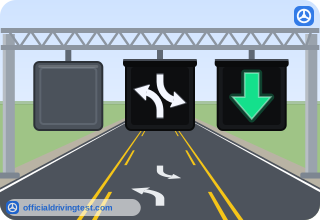
Two-Way Left-Turn Arrows
Left-turn Arrow: You are permitted to enter in a lane marked with a one-way or two-way arrow only to turn in the direction of the arrow.
Manual page 6 · Open this page in the manual (Manual page 6)
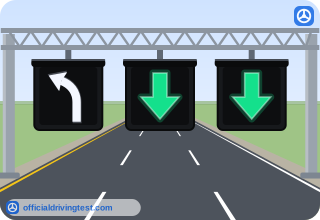
One-Way Left-Turn Arrow
Left-turn Arrow: You are permitted to enter in a lane marked with a one-way or two-way arrow only to turn in the direction of the arrow.
Manual page 6 · Open this page in the manual (Manual page 6)
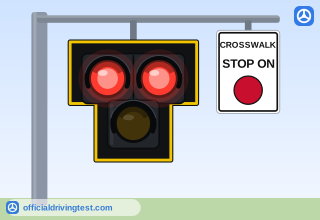
Pedestrian Hybrid Beacon
PHBs appear over intersections without stoplights and alert drivers when pedestrians are at a crosswalk. One yellow light at the bottom flashes when a pedestrian activates the PHB. Next, the yellow light turns solid to alert drivers to prepare to stop. Then, the top two red lights on the PHB turn solid while a walk signal appears at the crosswalk, and drivers must stop. Lastly, while the walk signal counts down for the pedestrians, the PHB’s two red lights alternate flashing, telling the driver that if the crosswalk is now clear, they may proceed with caution.
Manual page 6 · Open this page in the manual (Manual page 6)