Utah: Speed and space — Part 3 Practice Test
Questions in this part include: “Which of these can block your view on a rural road?” · “Which road condition does the handbook call a particular problem in Utah?”
Independent educational site · not affiliated with any government agency or DMV
Ready? Test yourself
- Instant feedback with an explanation
- Every answer cites its source in the manual
- Your best score is saved on this device
- Keyboard: press 1 to 4 to answer and Enter for the next question
Questions are original and based on the official manual "Utah Driver Handbook" (2026 edition (new 2026 laws effective May 6, 2026)), Utah Department of Public Safety, Driver License Division.
All 20 questions in this practice test
Take the test above first, then use this list to study. Tap “Show answer” to see the correct answer and explanation.
Show the questions and answersHide the questions
-
How should you adjust your driving on a gravel or dirt road?
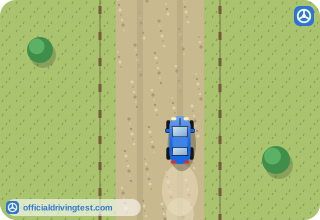
- Keep your speed and shorten your following distance
- Speed up to keep the tires from sinking
- Slow down and shorten your following distance
- Slow down and increase your following distance
Show answer
Correct answer: Slow down and increase your following distance
Gravel and dirt give less traction, so the handbook says to slow down and leave more space.
Source: Utah Driver Handbook (2026 edition (new 2026 laws effective May 6, 2026)), page 61 · Open this page in the manual (Manual page 61)
-
What may happen when you stop your vehicle on a gravel or dirt road?
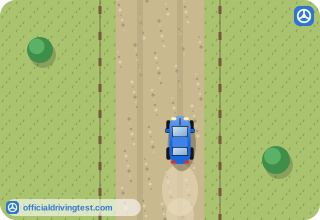
- You may skid
- The brakes may lock the doors
- The tires may gain extra traction
- The engine may stall
Show answer
Correct answer: You may skid
Gravel and dirt roads have less traction, so you may skid when stopping.
Source: Utah Driver Handbook (2026 edition (new 2026 laws effective May 6, 2026)), page 61 · Open this page in the manual (Manual page 61)
-
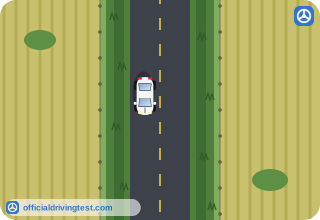
What should you do on a narrow rural road that has ditches or drop-offs instead of shoulders?
- Speed up to get past the narrow part
- Keep your speed and use the center line
- Slow down and center your vehicle in your lane
- Drive near the ditch to avoid oncoming cars
Show answer
Correct answer: Slow down and center your vehicle in your lane
The handbook says to slow down and center your vehicle, watching for oncoming traffic in your lane.
Source: Utah Driver Handbook (2026 edition (new 2026 laws effective May 6, 2026)), page 61 · Open this page in the manual (Manual page 61)
-
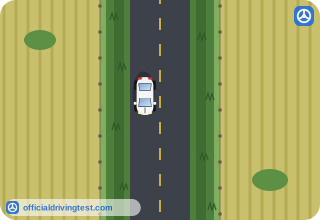
Rural roads are narrower and may have ditches or drop-offs instead of what?
- Center lines
- Shoulders
- Guardrails
- Warning signs
Show answer
Correct answer: Shoulders
The handbook notes that narrow rural roads may have ditches or drop-offs where shoulders would be.
Source: Utah Driver Handbook (2026 edition (new 2026 laws effective May 6, 2026)), page 61 · Open this page in the manual (Manual page 61)
-
What should you do with the steering wheel on open bridge gratings or steel bridges?
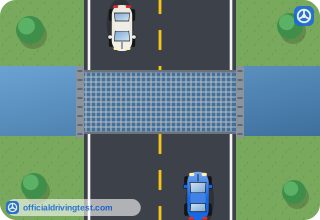
- Hold it loosely to let the tires settle
- Steer toward the left edge of the bridge
- Keep a firm grip on it
- Let the vehicle follow the grating
Show answer
Correct answer: Keep a firm grip on it
Open gratings and steel bridges can affect control, so keep a firm grip on the wheel.
Source: Utah Driver Handbook (2026 edition (new 2026 laws effective May 6, 2026)), page 61 · Open this page in the manual (Manual page 61)
-
How should you adjust your speed and following distance on open bridge gratings or steel bridges?
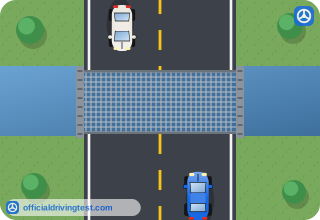
- Keep speed and increase following distance
- Reduce speed and increase following distance
- Increase speed and keep following distance
- Reduce speed and decrease following distance
Show answer
Correct answer: Reduce speed and increase following distance
The handbook says to reduce your speed and increase your following distance on these bridges.
Source: Utah Driver Handbook (2026 edition (new 2026 laws effective May 6, 2026)), page 61 · Open this page in the manual (Manual page 61)
-
Which of these can block your view on a rural road?
- Painted center lines
- Gravel shoulders
- Open bridge gratings
- Crops growing in fields
Show answer
Correct answer: Crops growing in fields
The handbook lists wooded areas, crops growing in fields and steep hills as view blockers on rural roads.
Source: Utah Driver Handbook (2026 edition (new 2026 laws effective May 6, 2026)), page 61 · Open this page in the manual (Manual page 61)
-
Where wooded areas, crops or steep hills limit your view on a rural road, what should you do?
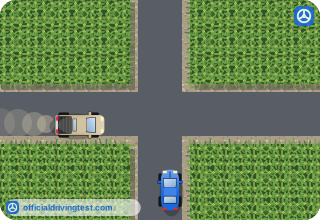
- Slow down and be ready to stop
- Sound the horn and keep your speed
- Move to the center of the road
- Speed up to pass the area quickly
Show answer
Correct answer: Slow down and be ready to stop
With a limited view, the handbook says to slow down and be ready to stop.
Source: Utah Driver Handbook (2026 edition (new 2026 laws effective May 6, 2026)), page 61 · Open this page in the manual (Manual page 61)
-
How should you approach an uncontrolled intersection on a rural road?
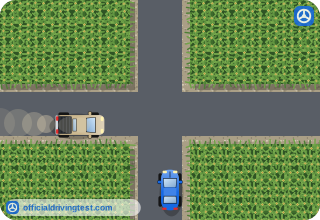
- Keep your speed if no one is visible
- Speed up to clear it quickly
- Slow down and be ready to stop
- Stop only if a sign requires it
Show answer
Correct answer: Slow down and be ready to stop
Uncontrolled intersections are very dangerous, so slow down and be ready to stop for crossing or oncoming traffic.
Source: Utah Driver Handbook (2026 edition (new 2026 laws effective May 6, 2026)), page 61 · Open this page in the manual (Manual page 61)
-
Your car may start to hydroplane at speeds over what?
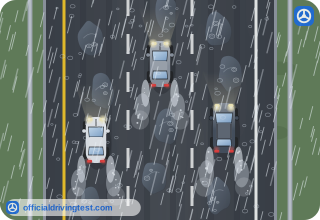
- 25 mph
- 35 mph
- 45 mph
- 55 mph
Show answer
Correct answer: 35 mph
The handbook says a car may start to hydroplane at speeds over 35 mph.
Source: Utah Driver Handbook (2026 edition (new 2026 laws effective May 6, 2026)), page 61 · Open this page in the manual (Manual page 61)
-
What is hydroplaning?
- Your tires lose air pressure on a hot road
- Your rear tires lock when you brake
- Your car slides because of ice on the road
- Your front tires ride on water instead of the road
Show answer
Correct answer: Your front tires ride on water instead of the road
Hydroplaning is when the front tires ride on water rather than on the road surface.
Source: Utah Driver Handbook (2026 edition (new 2026 laws effective May 6, 2026)), page 61 · Open this page in the manual (Manual page 61)
-
What happens to hydroplaning as you go faster?
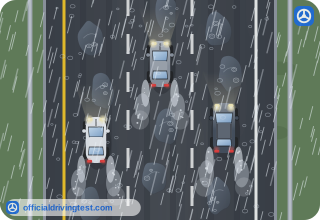
- It worsens and you lose steering control
- The tires grip the road better
- The problem stays the same
- The problem goes away above 55 mph
Show answer
Correct answer: It worsens and you lose steering control
The faster you go, the worse hydroplaning gets, until you lose steering control.
Source: Utah Driver Handbook (2026 edition (new 2026 laws effective May 6, 2026)), page 61 · Open this page in the manual (Manual page 61)
-
Besides ice and snow, where can skidding also happen?
- Only on gravel roads
- Only on freshly paved roads
- On wet roads
- Only on roads with no center line
Show answer
Correct answer: On wet roads
The handbook reminds drivers that skidding can also happen on wet roads.
Source: Utah Driver Handbook (2026 edition (new 2026 laws effective May 6, 2026)), page 61 · Open this page in the manual (Manual page 61)
-
How does black ice appear on the roadway?
- Like a bright white sheet of frost
- More like a wet spot than a patch of ice
- Like a layer of packed snow
- Like a dry, dusty patch of pavement
Show answer
Correct answer: More like a wet spot than a patch of ice
Black ice is hard to see and looks more like a wet spot than ice.
Source: Utah Driver Handbook (2026 edition (new 2026 laws effective May 6, 2026)), page 61 · Open this page in the manual (Manual page 61)
-
Which road condition does the handbook call a particular problem in Utah?
- Dense fog
- Flooded roadways
- Wildlife crossings
- Black ice
Show answer
Correct answer: Black ice
The handbook singles out black ice as a particular problem in Utah that causes many crashes.
Source: Utah Driver Handbook (2026 edition (new 2026 laws effective May 6, 2026)), page 61 · Open this page in the manual (Manual page 61)
-
The average passenger car traveling at 55 mph can stop in about how many feet?
- 60-70 feet
- 200-250 feet
- 130-140 feet
- 300-350 feet
Show answer
Correct answer: 130-140 feet
An average passenger car at 55 mph can stop in about 130-140 feet, less than half the length of a football field.
Source: Utah Driver Handbook (2026 edition (new 2026 laws effective May 6, 2026)), page 79 · Open this page in the manual (Manual page 79)
-
A fully loaded tractor-trailer may take more than how many feet to come to a complete stop?
- 200 feet
- 400 feet
- 300 feet
- 600 feet
Show answer
Correct answer: 400 feet
A fully loaded tractor-trailer may need more than 400 feet to stop.
Source: Utah Driver Handbook (2026 edition (new 2026 laws effective May 6, 2026)), page 79 · Open this page in the manual (Manual page 79)
-
What is the least time gap you should leave when following a motorcycle?
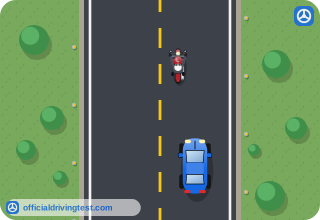
- One second
- One and a half seconds
- Half a second
- Two seconds
Show answer
Correct answer: Two seconds
The handbook says to stay at least two seconds behind a motorcycle.
Source: Utah Driver Handbook (2026 edition (new 2026 laws effective May 6, 2026)), page 81 · Open this page in the manual (Manual page 81)
-
What should you do with your following distance behind a motorcycle when the roadway is wet?
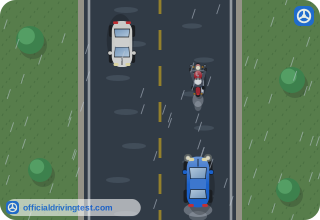
- Increase it
- Keep it the same
- Reduce it
- Move to the next lane
Show answer
Correct answer: Increase it
A wet roadway calls for a longer distance behind a motorcycle, because riders may change speed or lane position suddenly.
Source: Utah Driver Handbook (2026 edition (new 2026 laws effective May 6, 2026)), page 81 · Open this page in the manual (Manual page 81)
-
A street-legal ATV/UTV operating on a highway may not exceed which speed?
- The lesser of the posted speed limit or 50 miles per hour
- The greater of the posted speed limit or 55 miles per hour
- 35 miles per hour on every highway
- The posted speed limit, with no other cap
Show answer
Correct answer: The lesser of the posted speed limit or 50 miles per hour
On a highway, a street-legal ATV/UTV is capped at the lower of the posted limit and 50 miles per hour.
Source: Utah Driver Handbook (2026 edition (new 2026 laws effective May 6, 2026)), page 86 · Open this page in the manual (Manual page 86)