Utah: Speed and space — Part 2 Practice Test
Questions in this part include: “With no sign and no special hazards, what speed is permitted in any business or residential area?” · “What may a peace officer do if you drive so slowly that you impede the normal flow of traffic?”
Independent educational site · not affiliated with any government agency or DMV
Ready? Test yourself
- Instant feedback with an explanation
- Every answer cites its source in the manual
- Your best score is saved on this device
- Keyboard: press 1 to 4 to answer and Enter for the next question
Questions are original and based on the official manual "Utah Driver Handbook" (2026 edition (new 2026 laws effective May 6, 2026)), Utah Department of Public Safety, Driver License Division.
All 21 questions in this practice test
Take the test above first, then use this list to study. Tap “Show answer” to see the correct answer and explanation.
Show the questions and answersHide the questions
-
With no sign and no special hazards, what speed is permitted while children are going to or leaving school or when flashing lights are operating?
- 20 miles per hour
- 10 miles per hour
- 25 miles per hour
- 35 miles per hour
Show answer
Correct answer: 20 miles per hour
During school opening or closing hours or when flashing lights are operating, the permitted speed is 20 miles per hour.
Source: Utah Driver Handbook (2026 edition (new 2026 laws effective May 6, 2026)), page 44 · Open this page in the manual (Manual page 44)
-
With no sign and no special hazards, what speed is permitted in any business or residential area?
- 20 miles per hour
- 30 miles per hour
- 25 miles per hour
- 35 miles per hour
Show answer
Correct answer: 25 miles per hour
The permitted speed in any business or residential area is 25 miles per hour.
Source: Utah Driver Handbook (2026 edition (new 2026 laws effective May 6, 2026)), page 44 · Open this page in the manual (Manual page 44)
-
Which speed does the handbook list for major highways, as posted?
- 45 miles per hour
- 55 miles per hour
- 60 miles per hour
- 65 miles per hour
Show answer
Correct answer: 55 miles per hour
The handbook lists 55 miles per hour on major highways, as posted.
Source: Utah Driver Handbook (2026 edition (new 2026 laws effective May 6, 2026)), page 44 · Open this page in the manual (Manual page 44)
-
Which set of speeds does the handbook list for rural interstate highways?
- 55, 60, 65, or 70 miles per hour
- 60, 65, 70, or 75 miles per hour
- 70, 75, 80, or 85 miles per hour
- 65, 70, 75, or 80 miles per hour
Show answer
Correct answer: 65, 70, 75, or 80 miles per hour
Rural interstates are listed at 65, 70, 75 or 80 miles per hour.
Source: Utah Driver Handbook (2026 edition (new 2026 laws effective May 6, 2026)), page 44 · Open this page in the manual (Manual page 44)
-
How are the transition zones between Utah speed limits indicated?
- With flashing lights only
- With a flagger at each zone
- With markings and additional signs
- With raised rumble strips only
Show answer
Correct answer: With markings and additional signs
Transition zones are indicated by pavement markings and additional signs.
Source: Utah Driver Handbook (2026 edition (new 2026 laws effective May 6, 2026)), page 44 · Open this page in the manual (Manual page 44)
-
The handbook says the law requires you to slow down in certain situations. What does it say about driving 10 miles per hour on an icy road?
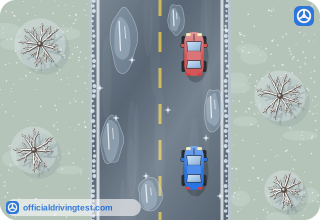
- It may be too fast for the conditions
- It is the lowest speed allowed on an icy road
- It is always a safe speed on ice
- It is required by law whenever a road is icy
Show answer
Correct answer: It may be too fast for the conditions
The handbook gives driving 10 mph on an icy road as an example of a speed that may be too fast for the conditions.
Source: Utah Driver Handbook (2026 edition (new 2026 laws effective May 6, 2026)), page 45 · Open this page in the manual (Manual page 45)
-
On an open highway on a rainy night, what does the handbook say about driving 25 miles per hour?
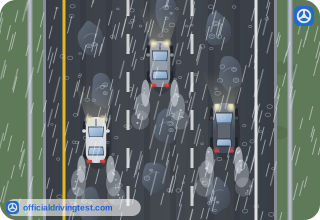
- It is the speed limit in rain
- It is too slow and always illegal
- It may be too fast
- It is always safe if you use headlights
Show answer
Correct answer: It may be too fast
The handbook says that on an open highway on a rainy night, even 25 mph may be too fast.
Source: Utah Driver Handbook (2026 edition (new 2026 laws effective May 6, 2026)), page 45 · Open this page in the manual (Manual page 45)
-
What may a peace officer do if you drive so slowly that you impede the normal flow of traffic?
- Take your license on the spot
- Require you to retake the written test
- Nothing, because slow driving is never a violation
- Issue you a citation
Show answer
Correct answer: Issue you a citation
The handbook warns against driving so slowly that you become a danger, and says peace officers may cite you for impeding traffic.
Source: Utah Driver Handbook (2026 edition (new 2026 laws effective May 6, 2026)), page 45 · Open this page in the manual (Manual page 45)
-
What must you do when coming down steep hills or mountains?
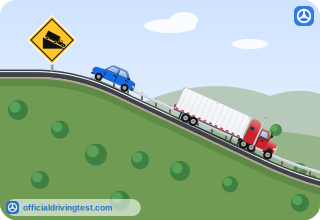
- Use a high gear and brake only at the bottom of the hill
- Speed up on the downgrade to keep your momentum
- Let gravity set your speed and brake only for curves
- Select a safe speed, use proper braking, and use a low gear
Show answer
Correct answer: Select a safe speed, use proper braking, and use a low gear
Gravity makes your speed increase going downhill, so you must select a safe speed, use proper braking techniques and use a low gear.
Source: Utah Driver Handbook (2026 edition (new 2026 laws effective May 6, 2026)), page 60 · Open this page in the manual (Manual page 60)
-
If your vehicle has difficulty traveling up a steep roadway, what does the handbook say to do?
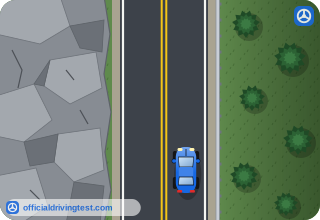
- Move to the left lane so others can pass on your right
- Pull off safely or stay in the right lane to let others pass
- Stop in your lane and wait for traffic to clear
- Speed up so traffic cannot pass you on the grade
Show answer
Correct answer: Pull off safely or stay in the right lane to let others pass
The handbook says to pull off the road at a safe place or stay in the right lane to allow other vehicles to pass.
Source: Utah Driver Handbook (2026 edition (new 2026 laws effective May 6, 2026)), page 60 · Open this page in the manual (Manual page 60)
-
In the mountains, what should you do if a speed limit is posted or a sign indicates the maximum safe speed?
- Never exceed the speed shown
- Exceed it on upgrades to keep your momentum
- Treat it as a suggestion in clear weather
- Exceed it only when passing another vehicle
Show answer
Correct answer: Never exceed the speed shown
The handbook says that if a speed limit is posted or a sign shows a maximum safe speed, you should never exceed the speed shown.
Source: Utah Driver Handbook (2026 edition (new 2026 laws effective May 6, 2026)), page 60 · Open this page in the manual (Manual page 60)
-
Which of these should you not do when driving downhill on a mountain road?
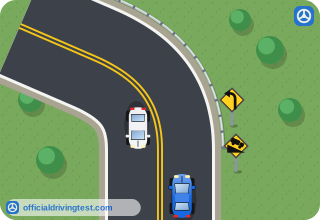
- Select a safe speed before starting down the grade
- Coast by shifting into neutral or disengaging the clutch
- Stay close to the right edge to avoid oncoming traffic
- Use a low gear and proper braking techniques
Show answer
Correct answer: Coast by shifting into neutral or disengaging the clutch
The handbook says not to coast downhill by shifting into neutral or disengaging the clutch.
Source: Utah Driver Handbook (2026 edition (new 2026 laws effective May 6, 2026)), page 60 · Open this page in the manual (Manual page 60)
-
On a narrow mountain road, where does the handbook say to stay to avoid oncoming traffic?
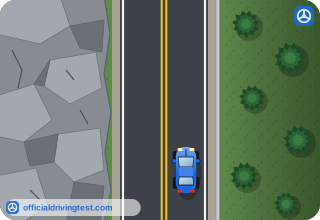
- On the center line of the road
- On the left edge of the road
- Straddling the lane line
- Close to the right edge of the road
Show answer
Correct answer: Close to the right edge of the road
The handbook advises staying close to the right edge of the road to avoid oncoming traffic.
Source: Utah Driver Handbook (2026 edition (new 2026 laws effective May 6, 2026)), page 60 · Open this page in the manual (Manual page 60)
-
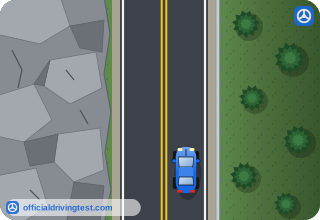
When should you sound the horn on a narrow mountain road?
- Whenever you pass another vehicle on the road
- At every intersection you come to on the road
- At a sharp curve where the view is blocked
- Only when you approach an animal near the road
Show answer
Correct answer: At a sharp curve where the view is blocked
The handbook says to sound the horn when approaching any sharp curve on a narrow road where the view is obstructed.
Source: Utah Driver Handbook (2026 edition (new 2026 laws effective May 6, 2026)), page 60 · Open this page in the manual (Manual page 60)
-
What does the handbook say you should try to do about long steep grades along your planned travel route?
- Plan and get information about them before you travel
- Ignore them unless a sign warns of a steep grade
- Drive them at night when traffic is light
- Learn about them only when you reach the first one
Show answer
Correct answer: Plan and get information about them before you travel
The handbook says to plan and obtain information about any long steep grades on your route and, if possible, ask other drivers familiar with them about safe speeds.
Source: Utah Driver Handbook (2026 edition (new 2026 laws effective May 6, 2026)), page 60 · Open this page in the manual (Manual page 60)
-
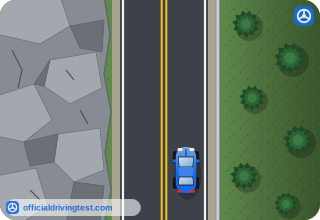
Which of these is listed as a mountain driving hazard?
- Frequent traffic signals
- Heavy freeway traffic
- Wide, straight lanes
- Rocks in the roadway
Show answer
Correct answer: Rocks in the roadway
The handbook lists steep hills, wildlife, rocks in the roadway and changing weather conditions as mountain driving hazards.
Source: Utah Driver Handbook (2026 edition (new 2026 laws effective May 6, 2026)), page 60 · Open this page in the manual (Manual page 60)
-
When driving at night, what should you do about the headlights of oncoming vehicles?
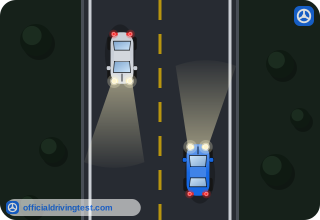
- Look straight at them to judge distance
- Watch them closely until they pass
- Avoid looking directly into them
- Look at them briefly to check speed
Show answer
Correct answer: Avoid looking directly into them
The handbook says to avoid looking directly into headlights at night.
Source: Utah Driver Handbook (2026 edition (new 2026 laws effective May 6, 2026)), page 61 · Open this page in the manual (Manual page 61)
-
When driving at night, what should your eyes keep searching for on the road in front of you?
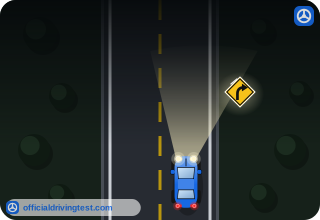
- Only the lane lines ahead
- Dark shapes on the roadway
- Only the taillights ahead
- Only the glare of headlights
Show answer
Correct answer: Dark shapes on the roadway
The handbook tells night drivers to keep searching the road and look for dark shapes on the roadway.
Source: Utah Driver Handbook (2026 edition (new 2026 laws effective May 6, 2026)), page 61 · Open this page in the manual (Manual page 61)
-
While searching the road ahead at night, what else should you glance to the right and left to check for?
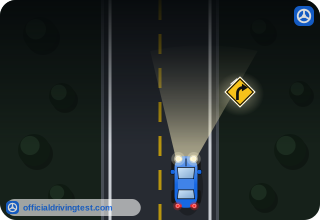
- Only other vehicles in the next lane
- Where the nearest rest area is located
- The posted speed limit on side roads
- The pavement edge and hazards on the sides
Show answer
Correct answer: The pavement edge and hazards on the sides
The handbook says to glance to both sides for the pavement edge and hazards.
Source: Utah Driver Handbook (2026 edition (new 2026 laws effective May 6, 2026)), page 61 · Open this page in the manual (Manual page 61)
-
By how much should you increase your following distance at night?
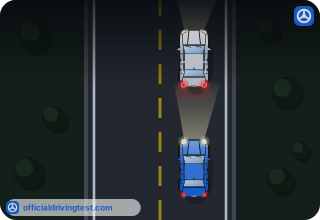
- At least one second
- At least four seconds
- At least two seconds
- At least six seconds
Show answer
Correct answer: At least two seconds
The handbook says to add at least two seconds to your following distance at night.
Source: Utah Driver Handbook (2026 edition (new 2026 laws effective May 6, 2026)), page 61 · Open this page in the manual (Manual page 61)
-
The law requires you to drive at a reasonable and prudent speed. What does this mean, especially at night?
- You must drive 10 mph under the limit
- The posted speed limit may be too fast
- You must always drive the posted limit
- You may drive any speed you can see
Show answer
Correct answer: The posted speed limit may be too fast
A reasonable and prudent speed depends on conditions, so at night the posted limit may be too fast.
Source: Utah Driver Handbook (2026 edition (new 2026 laws effective May 6, 2026)), page 61 · Open this page in the manual (Manual page 61)