Utah: Speed and space
Utah speed limits, school zones, the two-second rule, space around your vehicle, and driving on rural and mountain roads. Split into 3 shorter tests so you're not stuck in one long quiz.
Independent educational site · not affiliated with any government agency or DMV
Choose a part
Speed and space — Part 1
Questions in this part include: “Which rule do the safe driving tips say to use to follow at a safe distance?”
StartSpeed and space — Part 2
Questions in this part include: “With no sign and no special hazards, what speed is permitted in any business or residential area?”
StartSpeed and space — Part 3
Questions in this part include: “Which of these can block your view on a rural road?”
StartAll 62 Speed and space questions with answers
Choose a part above to take a practice test, or study every question and answer here.
Show the questions and answersHide the questions
-
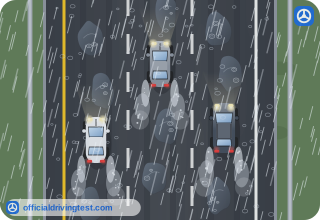
According to the safe driving tips, what should you do with your speed to adjust for weather, road, and other traffic conditions?
- Match the fastest vehicle nearby
- Stay at the posted limit no matter what
- Reduce your speed if needed
- Increase your speed to leave the area sooner
Show answer
Correct answer: Reduce your speed if needed
Always obey posted speed limits and, if needed, reduce your speed to adjust for weather, road, and traffic conditions.
Source: Utah Driver Handbook (2026 edition (new 2026 laws effective May 6, 2026)), page 26 · Open this page in the manual (Manual page 26)
-
Which rule do the safe driving tips say to use to follow at a safe distance?
- The one-second rule
- The two-second rule
- The three-second rule
- The five-second rule
Show answer
Correct answer: The two-second rule
The tips say to follow at a safe distance by using the two-second rule.
Source: Utah Driver Handbook (2026 edition (new 2026 laws effective May 6, 2026)), page 26 · Open this page in the manual (Manual page 26)
-
When do the safe driving tips say to increase your following distance?
- On dry roads in clear daylight
- When the road is empty
- When driving in residential areas
- In bad weather or poor visibility
Show answer
Correct answer: In bad weather or poor visibility
Following distance should be increased in bad weather or poor visibility.
Source: Utah Driver Handbook (2026 edition (new 2026 laws effective May 6, 2026)), page 26 · Open this page in the manual (Manual page 26)
-
What do the safe driving tips say about driving defensively?
- Expect other drivers to always follow the rules
- Anticipate another driver’s errors
- Assume other drivers will yield to you
- Rely on other drivers to signal their moves
Show answer
Correct answer: Anticipate another driver’s errors
Driving defensively means anticipating another driver’s errors.
Source: Utah Driver Handbook (2026 edition (new 2026 laws effective May 6, 2026)), page 26 · Open this page in the manual (Manual page 26)
-
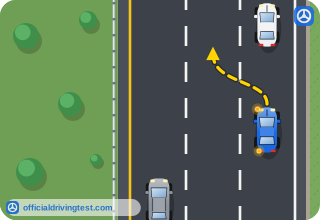
After completing a lane change, how should you adjust your speed?
- Slow down to let following vehicles pass
- Maintain or adjust it to go with the flow of traffic
- Speed up until you are the fastest vehicle in the lane
- Hold the speed you had before you signaled, whatever traffic does
Show answer
Correct answer: Maintain or adjust it to go with the flow of traffic
After the change you should maintain or adjust your speed to go with the flow of traffic.
Source: Utah Driver Handbook (2026 edition (new 2026 laws effective May 6, 2026)), page 31 · Open this page in the manual (Manual page 31)
-
On a multi-lane road, what is the left lane for?
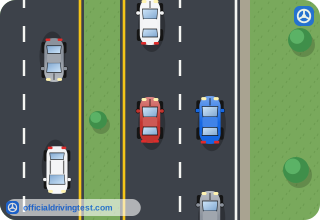
- Passing slower vehicles
- Stopping briefly to check directions
- Turning right at the next intersection
- Driving at the speed of the slowest vehicle
Show answer
Correct answer: Passing slower vehicles
The handbook says the left lane on multi-lane roads is for passing slower vehicles.
Source: Utah Driver Handbook (2026 edition (new 2026 laws effective May 6, 2026)), page 34 · Open this page in the manual (Manual page 34)
-
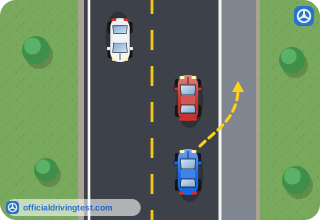
When may you pass another vehicle by driving on the shoulder?
- When the shoulder is paved and wide enough
- When the vehicle ahead is turning left
- Never
- When traffic ahead has stopped
Show answer
Correct answer: Never
The handbook says never to pass on the shoulder.
Source: Utah Driver Handbook (2026 edition (new 2026 laws effective May 6, 2026)), page 34 · Open this page in the manual (Manual page 34)
-
When you finish passing, how far from oncoming vehicles must you be when you return to the right-hand lane?
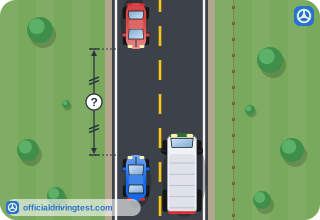
- No less than 50 feet
- No less than 200 feet
- No less than 100 feet
- No less than 500 feet
Show answer
Correct answer: No less than 200 feet
You must return to the right-hand lane no less than 200 feet from oncoming vehicles.
Source: Utah Driver Handbook (2026 edition (new 2026 laws effective May 6, 2026)), page 34 · Open this page in the manual (Manual page 34)
-
Before you return to the right-hand lane after passing, what should you wait until you can see?
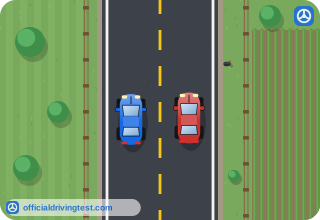
- The passed vehicle slow down to a stop
- The next intersection ahead
- A solid white line on the road
- The passed vehicles in your rear view mirror
Show answer
Correct answer: The passed vehicles in your rear view mirror
You wait until the passed vehicles show in your rear view mirror, then do a head check before returning to the lane.
Source: Utah Driver Handbook (2026 edition (new 2026 laws effective May 6, 2026)), page 34 · Open this page in the manual (Manual page 34)
-
What is illegal when you pass another vehicle on the right?
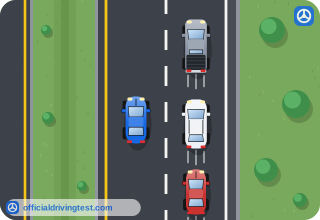
- Using your turn signal
- Leaving the roadway
- Checking your mirrors
- Moving back into your lane
Show answer
Correct answer: Leaving the roadway
The handbook says that when passing on the right it is illegal to leave the roadway.
Source: Utah Driver Handbook (2026 edition (new 2026 laws effective May 6, 2026)), page 34 · Open this page in the manual (Manual page 34)
-
What should you do if another driver is passing you?
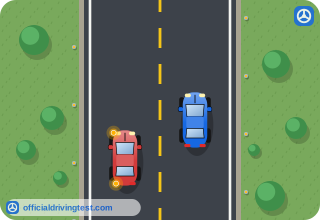
- Stay in your lane and keep your speed steady
- Slow down sharply and move onto the shoulder
- Speed up to stay even with the passing driver
- Move into the left lane to give more room
Show answer
Correct answer: Stay in your lane and keep your speed steady
You stay in your lane and keep a steady speed so the other driver can pass.
Source: Utah Driver Handbook (2026 edition (new 2026 laws effective May 6, 2026)), page 34 · Open this page in the manual (Manual page 34)
-
In which situation must you never pass another vehicle?
- In the left lane of a multi-lane road when it is clear
- On a road where a dashed line is on your side of the center line
- On a straight road after you have checked mirrors and signaled
- Before a railroad crossing or bridge
Show answer
Correct answer: Before a railroad crossing or bridge
The handbook lists the approach to a railroad crossing or bridge among the places where you must never pass.
Source: Utah Driver Handbook (2026 edition (new 2026 laws effective May 6, 2026)), page 34 · Open this page in the manual (Manual page 34)
-
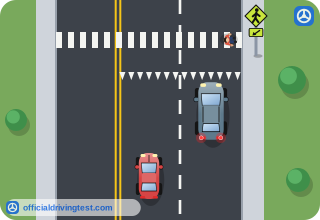
You see a car stopped at a crosswalk. What does the handbook say about passing it?
- Pass it only on the right
- Pass it if you slow down
- Never pass it
- Pass it if the crosswalk looks empty
Show answer
Correct answer: Never pass it
The handbook says never to pass another car that is stopped at a crosswalk.
Source: Utah Driver Handbook (2026 edition (new 2026 laws effective May 6, 2026)), page 34 · Open this page in the manual (Manual page 34)
-
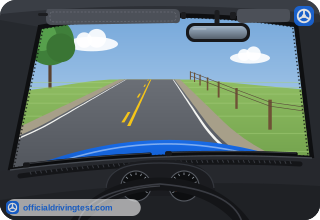
If a curve or hill blocks your view of the road ahead, what does the handbook say about passing?
- Never pass
- Pass only if you sound your horn
- Pass only in the left lane at a slower speed
- Pass only if you signal early enough
Show answer
Correct answer: Never pass
A curve or hill that blocks your view is one of the situations where you must never pass.
Source: Utah Driver Handbook (2026 edition (new 2026 laws effective May 6, 2026)), page 34 · Open this page in the manual (Manual page 34)
-
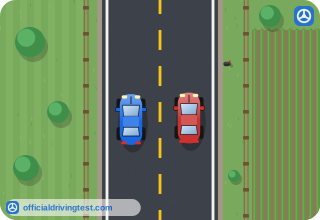
How long should you stay alongside the other vehicle while passing?
- Until the other driver sees you
- No longer than you have to
- Long enough to check the other driver's speed
- Until the next intersection
Show answer
Correct answer: No longer than you have to
The handbook tells you not to stay alongside the vehicle you are passing any longer than necessary.
Source: Utah Driver Handbook (2026 edition (new 2026 laws effective May 6, 2026)), page 34 · Open this page in the manual (Manual page 34)
-
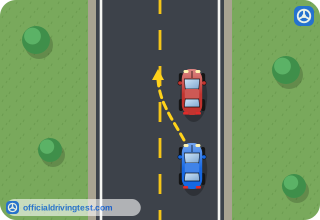
Before you pass, how should you check for vehicles following or passing you?
- Check only your rearview mirror
- Sound your horn and wait for a reply
- Look at your left side mirror only
- Check your mirrors and do a head check
Show answer
Correct answer: Check your mirrors and do a head check
The steps for passing include checking mirrors and doing a head check for vehicles following or passing you.
Source: Utah Driver Handbook (2026 edition (new 2026 laws effective May 6, 2026)), page 34 · Open this page in the manual (Manual page 34)
-
On the freeway, what is the least following distance you should always keep behind the vehicle ahead of you?
- At least four seconds
- At least six seconds
- At least two seconds
- At least one second
Show answer
Correct answer: At least two seconds
The handbook says to keep at least two seconds of following distance, more under adverse conditions.
Source: Utah Driver Handbook (2026 edition (new 2026 laws effective May 6, 2026)), page 39 · Open this page in the manual (Manual page 39)
-
Which statement about speed when getting off the freeway is true?
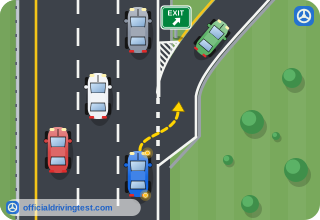
- You may not legally drive faster than the posted speed limit
- You may exceed the limit until you reach the end of the exit ramp
- The posted limit no longer applies once you signal to exit
- The limit rises by 5 miles per hour on exit lanes
Show answer
Correct answer: You may not legally drive faster than the posted speed limit
The rule against driving faster than the posted limit also applies to getting off the freeway.
Source: Utah Driver Handbook (2026 edition (new 2026 laws effective May 6, 2026)), page 39 · Open this page in the manual (Manual page 39)
-
As you approach an intersection, how should you brake?
- Quickly and firmly
- Lightly, then hard
- Only at the stop line
- Smoothly and evenly
Show answer
Correct answer: Smoothly and evenly
Approaching an intersection, brake smoothly and evenly and maintain lane position.
Source: Utah Driver Handbook (2026 edition (new 2026 laws effective May 6, 2026)), page 42 · Open this page in the manual (Manual page 42)
-
Under Utah’s basic speed law, you may never drive faster than what?
- The average speed of the vehicles around you
- The maximum speed set for your vehicle’s class
- The speed of the fastest vehicle in your lane
- A speed that is reasonable and prudent
Show answer
Correct answer: A speed that is reasonable and prudent
The basic speed law forbids driving faster than is reasonable and prudent under the existing conditions.
Source: Utah Driver Handbook (2026 edition (new 2026 laws effective May 6, 2026)), page 44 · Open this page in the manual (Manual page 44)
-
With no sign and no special hazards, what speed is permitted when passing a school building or grounds during school recess?
- 15 miles per hour
- 20 miles per hour
- 25 miles per hour
- 30 miles per hour
Show answer
Correct answer: 20 miles per hour
The permitted speed passing a school during recess is 20 miles per hour.
Source: Utah Driver Handbook (2026 edition (new 2026 laws effective May 6, 2026)), page 44 · Open this page in the manual (Manual page 44)
-
With no sign and no special hazards, what speed is permitted while children are going to or leaving school or when flashing lights are operating?
- 20 miles per hour
- 10 miles per hour
- 25 miles per hour
- 35 miles per hour
Show answer
Correct answer: 20 miles per hour
During school opening or closing hours or when flashing lights are operating, the permitted speed is 20 miles per hour.
Source: Utah Driver Handbook (2026 edition (new 2026 laws effective May 6, 2026)), page 44 · Open this page in the manual (Manual page 44)
-
With no sign and no special hazards, what speed is permitted in any business or residential area?
- 20 miles per hour
- 30 miles per hour
- 25 miles per hour
- 35 miles per hour
Show answer
Correct answer: 25 miles per hour
The permitted speed in any business or residential area is 25 miles per hour.
Source: Utah Driver Handbook (2026 edition (new 2026 laws effective May 6, 2026)), page 44 · Open this page in the manual (Manual page 44)
-
Which speed does the handbook list for major highways, as posted?
- 45 miles per hour
- 55 miles per hour
- 60 miles per hour
- 65 miles per hour
Show answer
Correct answer: 55 miles per hour
The handbook lists 55 miles per hour on major highways, as posted.
Source: Utah Driver Handbook (2026 edition (new 2026 laws effective May 6, 2026)), page 44 · Open this page in the manual (Manual page 44)
-
Which set of speeds does the handbook list for rural interstate highways?
- 55, 60, 65, or 70 miles per hour
- 60, 65, 70, or 75 miles per hour
- 70, 75, 80, or 85 miles per hour
- 65, 70, 75, or 80 miles per hour
Show answer
Correct answer: 65, 70, 75, or 80 miles per hour
Rural interstates are listed at 65, 70, 75 or 80 miles per hour.
Source: Utah Driver Handbook (2026 edition (new 2026 laws effective May 6, 2026)), page 44 · Open this page in the manual (Manual page 44)
-
How are the transition zones between Utah speed limits indicated?
- With flashing lights only
- With a flagger at each zone
- With markings and additional signs
- With raised rumble strips only
Show answer
Correct answer: With markings and additional signs
Transition zones are indicated by pavement markings and additional signs.
Source: Utah Driver Handbook (2026 edition (new 2026 laws effective May 6, 2026)), page 44 · Open this page in the manual (Manual page 44)
-
The handbook says the law requires you to slow down in certain situations. What does it say about driving 10 miles per hour on an icy road?
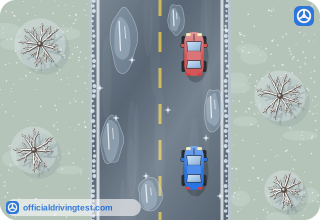
- It may be too fast for the conditions
- It is the lowest speed allowed on an icy road
- It is always a safe speed on ice
- It is required by law whenever a road is icy
Show answer
Correct answer: It may be too fast for the conditions
The handbook gives driving 10 mph on an icy road as an example of a speed that may be too fast for the conditions.
Source: Utah Driver Handbook (2026 edition (new 2026 laws effective May 6, 2026)), page 45 · Open this page in the manual (Manual page 45)
-
On an open highway on a rainy night, what does the handbook say about driving 25 miles per hour?
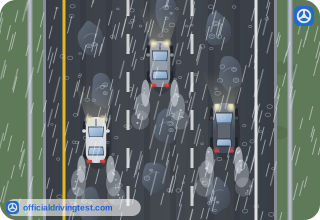
- It is the speed limit in rain
- It is too slow and always illegal
- It may be too fast
- It is always safe if you use headlights
Show answer
Correct answer: It may be too fast
The handbook says that on an open highway on a rainy night, even 25 mph may be too fast.
Source: Utah Driver Handbook (2026 edition (new 2026 laws effective May 6, 2026)), page 45 · Open this page in the manual (Manual page 45)
-
What may a peace officer do if you drive so slowly that you impede the normal flow of traffic?
- Take your license on the spot
- Require you to retake the written test
- Nothing, because slow driving is never a violation
- Issue you a citation
Show answer
Correct answer: Issue you a citation
The handbook warns against driving so slowly that you become a danger, and says peace officers may cite you for impeding traffic.
Source: Utah Driver Handbook (2026 edition (new 2026 laws effective May 6, 2026)), page 45 · Open this page in the manual (Manual page 45)
-
What must you do when coming down steep hills or mountains?
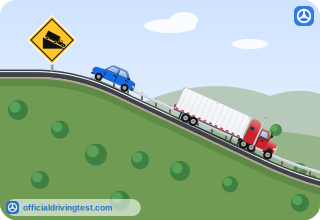
- Use a high gear and brake only at the bottom of the hill
- Speed up on the downgrade to keep your momentum
- Let gravity set your speed and brake only for curves
- Select a safe speed, use proper braking, and use a low gear
Show answer
Correct answer: Select a safe speed, use proper braking, and use a low gear
Gravity makes your speed increase going downhill, so you must select a safe speed, use proper braking techniques and use a low gear.
Source: Utah Driver Handbook (2026 edition (new 2026 laws effective May 6, 2026)), page 60 · Open this page in the manual (Manual page 60)
-
If your vehicle has difficulty traveling up a steep roadway, what does the handbook say to do?
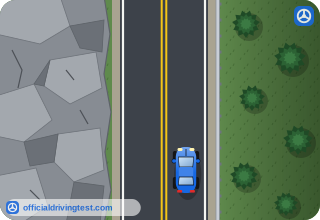
- Move to the left lane so others can pass on your right
- Pull off safely or stay in the right lane to let others pass
- Stop in your lane and wait for traffic to clear
- Speed up so traffic cannot pass you on the grade
Show answer
Correct answer: Pull off safely or stay in the right lane to let others pass
The handbook says to pull off the road at a safe place or stay in the right lane to allow other vehicles to pass.
Source: Utah Driver Handbook (2026 edition (new 2026 laws effective May 6, 2026)), page 60 · Open this page in the manual (Manual page 60)
-
In the mountains, what should you do if a speed limit is posted or a sign indicates the maximum safe speed?
- Never exceed the speed shown
- Exceed it on upgrades to keep your momentum
- Treat it as a suggestion in clear weather
- Exceed it only when passing another vehicle
Show answer
Correct answer: Never exceed the speed shown
The handbook says that if a speed limit is posted or a sign shows a maximum safe speed, you should never exceed the speed shown.
Source: Utah Driver Handbook (2026 edition (new 2026 laws effective May 6, 2026)), page 60 · Open this page in the manual (Manual page 60)
-
Which of these should you not do when driving downhill on a mountain road?
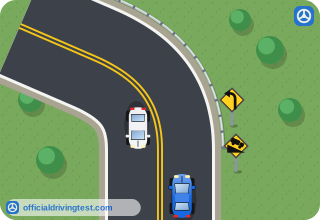
- Select a safe speed before starting down the grade
- Coast by shifting into neutral or disengaging the clutch
- Stay close to the right edge to avoid oncoming traffic
- Use a low gear and proper braking techniques
Show answer
Correct answer: Coast by shifting into neutral or disengaging the clutch
The handbook says not to coast downhill by shifting into neutral or disengaging the clutch.
Source: Utah Driver Handbook (2026 edition (new 2026 laws effective May 6, 2026)), page 60 · Open this page in the manual (Manual page 60)
-
On a narrow mountain road, where does the handbook say to stay to avoid oncoming traffic?
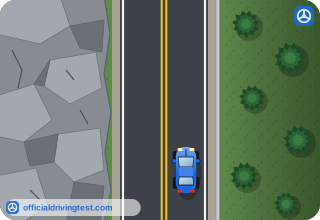
- On the center line of the road
- On the left edge of the road
- Straddling the lane line
- Close to the right edge of the road
Show answer
Correct answer: Close to the right edge of the road
The handbook advises staying close to the right edge of the road to avoid oncoming traffic.
Source: Utah Driver Handbook (2026 edition (new 2026 laws effective May 6, 2026)), page 60 · Open this page in the manual (Manual page 60)
-
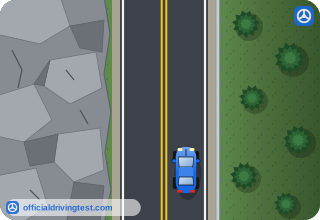
When should you sound the horn on a narrow mountain road?
- Whenever you pass another vehicle on the road
- At every intersection you come to on the road
- At a sharp curve where the view is blocked
- Only when you approach an animal near the road
Show answer
Correct answer: At a sharp curve where the view is blocked
The handbook says to sound the horn when approaching any sharp curve on a narrow road where the view is obstructed.
Source: Utah Driver Handbook (2026 edition (new 2026 laws effective May 6, 2026)), page 60 · Open this page in the manual (Manual page 60)
-
What does the handbook say you should try to do about long steep grades along your planned travel route?
- Plan and get information about them before you travel
- Ignore them unless a sign warns of a steep grade
- Drive them at night when traffic is light
- Learn about them only when you reach the first one
Show answer
Correct answer: Plan and get information about them before you travel
The handbook says to plan and obtain information about any long steep grades on your route and, if possible, ask other drivers familiar with them about safe speeds.
Source: Utah Driver Handbook (2026 edition (new 2026 laws effective May 6, 2026)), page 60 · Open this page in the manual (Manual page 60)
-
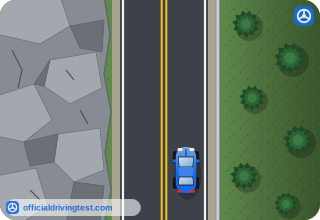
Which of these is listed as a mountain driving hazard?
- Frequent traffic signals
- Heavy freeway traffic
- Wide, straight lanes
- Rocks in the roadway
Show answer
Correct answer: Rocks in the roadway
The handbook lists steep hills, wildlife, rocks in the roadway and changing weather conditions as mountain driving hazards.
Source: Utah Driver Handbook (2026 edition (new 2026 laws effective May 6, 2026)), page 60 · Open this page in the manual (Manual page 60)
-
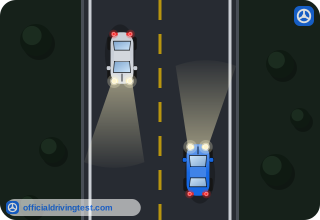
When driving at night, what should you do about the headlights of oncoming vehicles?
- Look straight at them to judge distance
- Watch them closely until they pass
- Avoid looking directly into them
- Look at them briefly to check speed
Show answer
Correct answer: Avoid looking directly into them
The handbook says to avoid looking directly into headlights at night.
Source: Utah Driver Handbook (2026 edition (new 2026 laws effective May 6, 2026)), page 61 · Open this page in the manual (Manual page 61)
-
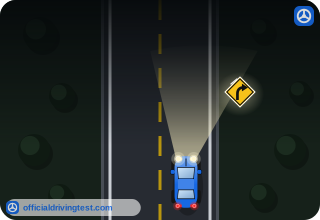
When driving at night, what should your eyes keep searching for on the road in front of you?
- Only the lane lines ahead
- Dark shapes on the roadway
- Only the taillights ahead
- Only the glare of headlights
Show answer
Correct answer: Dark shapes on the roadway
The handbook tells night drivers to keep searching the road and look for dark shapes on the roadway.
Source: Utah Driver Handbook (2026 edition (new 2026 laws effective May 6, 2026)), page 61 · Open this page in the manual (Manual page 61)
-
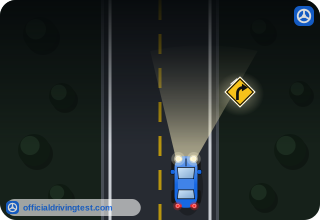
While searching the road ahead at night, what else should you glance to the right and left to check for?
- Only other vehicles in the next lane
- Where the nearest rest area is located
- The posted speed limit on side roads
- The pavement edge and hazards on the sides
Show answer
Correct answer: The pavement edge and hazards on the sides
The handbook says to glance to both sides for the pavement edge and hazards.
Source: Utah Driver Handbook (2026 edition (new 2026 laws effective May 6, 2026)), page 61 · Open this page in the manual (Manual page 61)
-
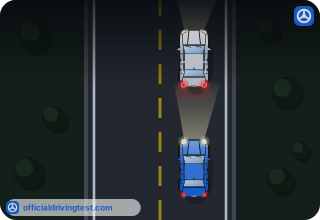
By how much should you increase your following distance at night?
- At least one second
- At least four seconds
- At least two seconds
- At least six seconds
Show answer
Correct answer: At least two seconds
The handbook says to add at least two seconds to your following distance at night.
Source: Utah Driver Handbook (2026 edition (new 2026 laws effective May 6, 2026)), page 61 · Open this page in the manual (Manual page 61)
-
The law requires you to drive at a reasonable and prudent speed. What does this mean, especially at night?
- You must drive 10 mph under the limit
- The posted speed limit may be too fast
- You must always drive the posted limit
- You may drive any speed you can see
Show answer
Correct answer: The posted speed limit may be too fast
A reasonable and prudent speed depends on conditions, so at night the posted limit may be too fast.
Source: Utah Driver Handbook (2026 edition (new 2026 laws effective May 6, 2026)), page 61 · Open this page in the manual (Manual page 61)
-
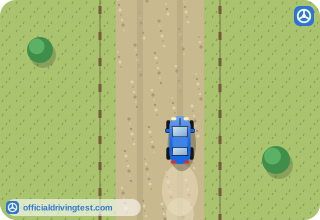
How should you adjust your driving on a gravel or dirt road?
- Keep your speed and shorten your following distance
- Speed up to keep the tires from sinking
- Slow down and shorten your following distance
- Slow down and increase your following distance
Show answer
Correct answer: Slow down and increase your following distance
Gravel and dirt give less traction, so the handbook says to slow down and leave more space.
Source: Utah Driver Handbook (2026 edition (new 2026 laws effective May 6, 2026)), page 61 · Open this page in the manual (Manual page 61)
-
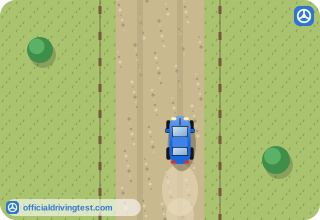
What may happen when you stop your vehicle on a gravel or dirt road?
- You may skid
- The brakes may lock the doors
- The tires may gain extra traction
- The engine may stall
Show answer
Correct answer: You may skid
Gravel and dirt roads have less traction, so you may skid when stopping.
Source: Utah Driver Handbook (2026 edition (new 2026 laws effective May 6, 2026)), page 61 · Open this page in the manual (Manual page 61)
-
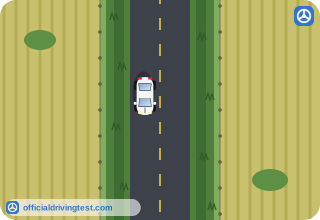
What should you do on a narrow rural road that has ditches or drop-offs instead of shoulders?
- Speed up to get past the narrow part
- Keep your speed and use the center line
- Slow down and center your vehicle in your lane
- Drive near the ditch to avoid oncoming cars
Show answer
Correct answer: Slow down and center your vehicle in your lane
The handbook says to slow down and center your vehicle, watching for oncoming traffic in your lane.
Source: Utah Driver Handbook (2026 edition (new 2026 laws effective May 6, 2026)), page 61 · Open this page in the manual (Manual page 61)
-
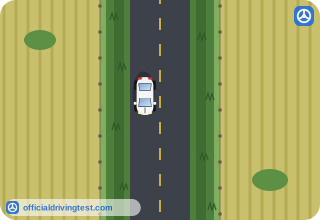
Rural roads are narrower and may have ditches or drop-offs instead of what?
- Center lines
- Shoulders
- Guardrails
- Warning signs
Show answer
Correct answer: Shoulders
The handbook notes that narrow rural roads may have ditches or drop-offs where shoulders would be.
Source: Utah Driver Handbook (2026 edition (new 2026 laws effective May 6, 2026)), page 61 · Open this page in the manual (Manual page 61)
-
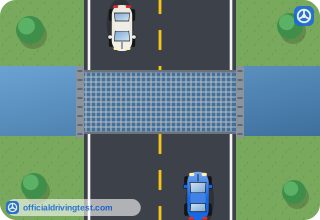
What should you do with the steering wheel on open bridge gratings or steel bridges?
- Hold it loosely to let the tires settle
- Steer toward the left edge of the bridge
- Keep a firm grip on it
- Let the vehicle follow the grating
Show answer
Correct answer: Keep a firm grip on it
Open gratings and steel bridges can affect control, so keep a firm grip on the wheel.
Source: Utah Driver Handbook (2026 edition (new 2026 laws effective May 6, 2026)), page 61 · Open this page in the manual (Manual page 61)
-
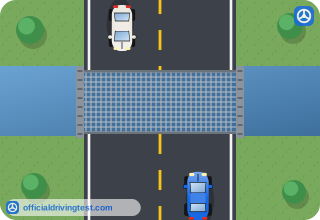
How should you adjust your speed and following distance on open bridge gratings or steel bridges?
- Keep speed and increase following distance
- Reduce speed and increase following distance
- Increase speed and keep following distance
- Reduce speed and decrease following distance
Show answer
Correct answer: Reduce speed and increase following distance
The handbook says to reduce your speed and increase your following distance on these bridges.
Source: Utah Driver Handbook (2026 edition (new 2026 laws effective May 6, 2026)), page 61 · Open this page in the manual (Manual page 61)
-
Which of these can block your view on a rural road?
- Painted center lines
- Gravel shoulders
- Open bridge gratings
- Crops growing in fields
Show answer
Correct answer: Crops growing in fields
The handbook lists wooded areas, crops growing in fields and steep hills as view blockers on rural roads.
Source: Utah Driver Handbook (2026 edition (new 2026 laws effective May 6, 2026)), page 61 · Open this page in the manual (Manual page 61)
-
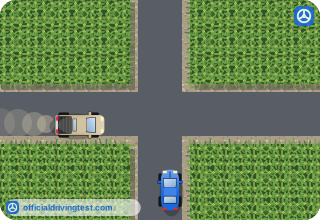
Where wooded areas, crops or steep hills limit your view on a rural road, what should you do?
- Slow down and be ready to stop
- Sound the horn and keep your speed
- Move to the center of the road
- Speed up to pass the area quickly
Show answer
Correct answer: Slow down and be ready to stop
With a limited view, the handbook says to slow down and be ready to stop.
Source: Utah Driver Handbook (2026 edition (new 2026 laws effective May 6, 2026)), page 61 · Open this page in the manual (Manual page 61)
-
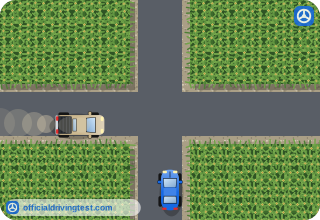
How should you approach an uncontrolled intersection on a rural road?
- Keep your speed if no one is visible
- Speed up to clear it quickly
- Slow down and be ready to stop
- Stop only if a sign requires it
Show answer
Correct answer: Slow down and be ready to stop
Uncontrolled intersections are very dangerous, so slow down and be ready to stop for crossing or oncoming traffic.
Source: Utah Driver Handbook (2026 edition (new 2026 laws effective May 6, 2026)), page 61 · Open this page in the manual (Manual page 61)
-
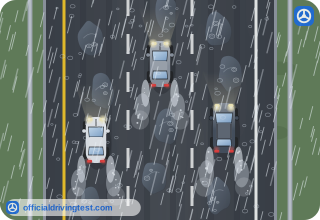
Your car may start to hydroplane at speeds over what?
- 25 mph
- 35 mph
- 45 mph
- 55 mph
Show answer
Correct answer: 35 mph
The handbook says a car may start to hydroplane at speeds over 35 mph.
Source: Utah Driver Handbook (2026 edition (new 2026 laws effective May 6, 2026)), page 61 · Open this page in the manual (Manual page 61)
-
What is hydroplaning?
- Your tires lose air pressure on a hot road
- Your rear tires lock when you brake
- Your car slides because of ice on the road
- Your front tires ride on water instead of the road
Show answer
Correct answer: Your front tires ride on water instead of the road
Hydroplaning is when the front tires ride on water rather than on the road surface.
Source: Utah Driver Handbook (2026 edition (new 2026 laws effective May 6, 2026)), page 61 · Open this page in the manual (Manual page 61)
-
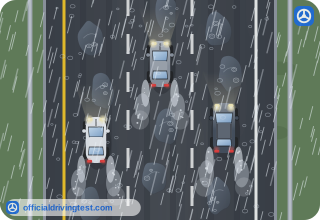
What happens to hydroplaning as you go faster?
- It worsens and you lose steering control
- The tires grip the road better
- The problem stays the same
- The problem goes away above 55 mph
Show answer
Correct answer: It worsens and you lose steering control
The faster you go, the worse hydroplaning gets, until you lose steering control.
Source: Utah Driver Handbook (2026 edition (new 2026 laws effective May 6, 2026)), page 61 · Open this page in the manual (Manual page 61)
-
Besides ice and snow, where can skidding also happen?
- Only on gravel roads
- Only on freshly paved roads
- On wet roads
- Only on roads with no center line
Show answer
Correct answer: On wet roads
The handbook reminds drivers that skidding can also happen on wet roads.
Source: Utah Driver Handbook (2026 edition (new 2026 laws effective May 6, 2026)), page 61 · Open this page in the manual (Manual page 61)
-
How does black ice appear on the roadway?
- Like a bright white sheet of frost
- More like a wet spot than a patch of ice
- Like a layer of packed snow
- Like a dry, dusty patch of pavement
Show answer
Correct answer: More like a wet spot than a patch of ice
Black ice is hard to see and looks more like a wet spot than ice.
Source: Utah Driver Handbook (2026 edition (new 2026 laws effective May 6, 2026)), page 61 · Open this page in the manual (Manual page 61)
-
Which road condition does the handbook call a particular problem in Utah?
- Dense fog
- Flooded roadways
- Wildlife crossings
- Black ice
Show answer
Correct answer: Black ice
The handbook singles out black ice as a particular problem in Utah that causes many crashes.
Source: Utah Driver Handbook (2026 edition (new 2026 laws effective May 6, 2026)), page 61 · Open this page in the manual (Manual page 61)
-
The average passenger car traveling at 55 mph can stop in about how many feet?
- 60-70 feet
- 200-250 feet
- 130-140 feet
- 300-350 feet
Show answer
Correct answer: 130-140 feet
An average passenger car at 55 mph can stop in about 130-140 feet, less than half the length of a football field.
Source: Utah Driver Handbook (2026 edition (new 2026 laws effective May 6, 2026)), page 79 · Open this page in the manual (Manual page 79)
-
A fully loaded tractor-trailer may take more than how many feet to come to a complete stop?
- 200 feet
- 400 feet
- 300 feet
- 600 feet
Show answer
Correct answer: 400 feet
A fully loaded tractor-trailer may need more than 400 feet to stop.
Source: Utah Driver Handbook (2026 edition (new 2026 laws effective May 6, 2026)), page 79 · Open this page in the manual (Manual page 79)
-
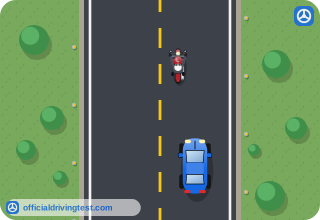
What is the least time gap you should leave when following a motorcycle?
- One second
- One and a half seconds
- Half a second
- Two seconds
Show answer
Correct answer: Two seconds
The handbook says to stay at least two seconds behind a motorcycle.
Source: Utah Driver Handbook (2026 edition (new 2026 laws effective May 6, 2026)), page 81 · Open this page in the manual (Manual page 81)
-
What should you do with your following distance behind a motorcycle when the roadway is wet?
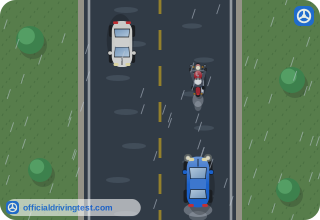
- Increase it
- Keep it the same
- Reduce it
- Move to the next lane
Show answer
Correct answer: Increase it
A wet roadway calls for a longer distance behind a motorcycle, because riders may change speed or lane position suddenly.
Source: Utah Driver Handbook (2026 edition (new 2026 laws effective May 6, 2026)), page 81 · Open this page in the manual (Manual page 81)
-
A street-legal ATV/UTV operating on a highway may not exceed which speed?
- The lesser of the posted speed limit or 50 miles per hour
- The greater of the posted speed limit or 55 miles per hour
- 35 miles per hour on every highway
- The posted speed limit, with no other cap
Show answer
Correct answer: The lesser of the posted speed limit or 50 miles per hour
On a highway, a street-legal ATV/UTV is capped at the lower of the posted limit and 50 miles per hour.
Source: Utah Driver Handbook (2026 edition (new 2026 laws effective May 6, 2026)), page 86 · Open this page in the manual (Manual page 86)