Texas: Freeway driving
Merging, exiting, passing, and highway driving rules. Split into 2 shorter tests so you're not stuck in one long quiz.
Independent educational site · not affiliated with any government agency or DMV
Choose a part
Freeway driving — Part 1
Questions in this part include: “You should never drive on the left side of the road when pavement markings or signs indicate what?”
Freeway driving — Part 2
Questions in this part include: “Exit signs on a highway are usually placed how far ahead of the exit?”
Questions are original and based on the official manual "Texas Driver Handbook" (Revised January 2026), Texas Department of Public Safety (DPS).
All 39 Freeway driving questions with answers
Choose a part above to take a practice test, or study every question and answer here.
Show the questions and answersHide the questions
1Part 120 questions
-
You should never drive on the left side of the road when pavement markings or signs indicate what?
- A "No Passing Zone"
- A broken white lane line
- A speed limit sign
- A yield sign
Show answer
Correct answer: A "No Passing Zone"
You should never drive on the left side of the road when pavement markings or signs prohibit it, such as a "No Passing Zone" or solid lane lines.
Source: Texas Driver Handbook (Revised January 2026), page 38
-
You should never drive on the left side of the road when there are how many traffic lanes in each direction?
- Two or more
- Exactly one
- None, it is always allowed
- Only on a divided highway
Show answer
Correct answer: Two or more
You should never drive on the left side of the road when there are two or more traffic lanes in each direction.
Source: Texas Driver Handbook (Revised January 2026), page 38
-
You should never drive on the left side of the road within how many feet of, or while crossing, an intersection or railroad crossing?
- 10 feet
- 1,000 feet
- 100 feet
- 500 feet
Show answer
Correct answer: 100 feet
You should never drive on the left side of the road within 100 feet of, or while crossing, an intersection or railroad crossing.
Source: Texas Driver Handbook (Revised January 2026), page 38
-
You should never drive on the left side of the road on a hill, curve, or any other place where what condition exists?
- The road was recently repaved
- Your vision is limited
- There is a speed bump
- There is a school nearby
Show answer
Correct answer: Your vision is limited
You should never drive on the left side of the road on a hill, curve, or any other place where your vision is limited.
Source: Texas Driver Handbook (Revised January 2026), page 38
-
You should never drive on the left side of the road within 100 feet of which of these structures?
- A shopping center
- A residential driveway
- A bridge, viaduct, or tunnel
- A gas station or car wash
Show answer
Correct answer: A bridge, viaduct, or tunnel
You should never drive on the left side of the road within 100 feet of a bridge, viaduct, or tunnel.
Source: Texas Driver Handbook (Revised January 2026), page 38
-
Which of the following is an exception that allows you to drive somewhere other than the right side of the road?
- Passing another vehicle on a two- or three-lane street
- Approaching a school zone during school hours
- Driving near a hospital or a fire station
- Driving during the morning or evening rush hour
Show answer
Correct answer: Passing another vehicle on a two- or three-lane street
You may keep other than to the right when passing another vehicle on a two- or three-lane street.
Source: Texas Driver Handbook (Revised January 2026), page 38
-
You are also excused from keeping to the right when doing which of these?
- Driving on a one-way street
- Driving through a construction zone at high speed
- Driving in heavy rain
- Driving at night with your high beams on
Show answer
Correct answer: Driving on a one-way street
The handbook also excuses keeping to the right when driving on a one-way street or when the right side of the road is blocked.
Source: Texas Driver Handbook (Revised January 2026), page 38
-
What is the first basic safety rule you should follow before passing another vehicle?
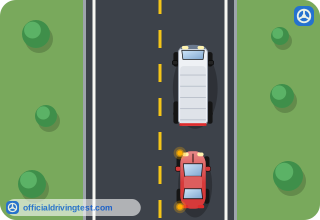
- Sound your horn continuously
- Flash your high beams repeatedly
- Make certain the way is clear
- Accelerate immediately to close the gap
Show answer
Correct answer: Make certain the way is clear
The handbook's basic safety rules for passing begin with making certain the way is clear.
Source: Texas Driver Handbook (Revised January 2026), page 38
-
Before changing lanes to pass, and after you have passed, what should you do according to the basic safety rules?
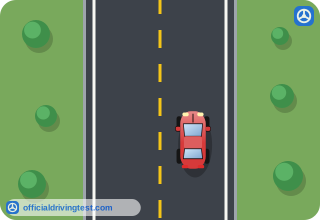
- Signal before changing lanes, and don't cut in too quickly when you return
- Nothing is required since you have the right of way while passing
- Only check your mirror, signaling is not necessary
- Wait for the other driver to flash their lights first
Show answer
Correct answer: Signal before changing lanes, and don't cut in too quickly when you return
Give the proper signal before changing lanes to pass, and avoid cutting in too quickly if you must return to your original lane.
Source: Texas Driver Handbook (Revised January 2026), page 38
-
What should you do with your horn when necessary to avoid surprising the driver ahead while passing?
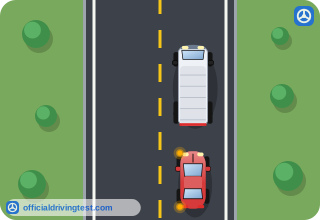
- Keep it fully pressed until you pass
- Avoid using it under any circumstance
- Only use it after you have already passed
- Tap your horn
Show answer
Correct answer: Tap your horn
Tap your horn when necessary to avoid surprising the driver ahead.
Source: Texas Driver Handbook (Revised January 2026), page 38
-
Before passing on a two-lane road, why should you check your rearview mirror, side mirrors, and look over your shoulder?
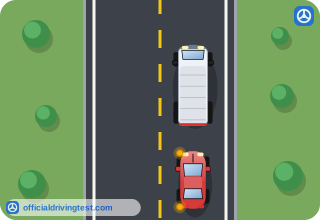
- To see whether a police car is following you
- To find a safe place to pull over and park
- It is not necessary before passing on a two-lane road
- To make sure the road is clear and no vehicle is passing you
Show answer
Correct answer: To make sure the road is clear and no vehicle is passing you
Checking your mirrors and blind spot ensures the roadway is clear and that no other vehicles are already passing you before you begin.
Source: Texas Driver Handbook (Revised January 2026), page 39
-
Before passing on a two-lane road, you should check well ahead for signs and pavement markings for what, and also check for what on the road?
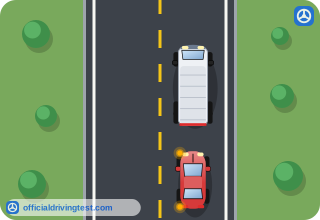
- Gas stations, and bicycle lanes
- Speed bumps, and school zones
- No passing zones, and oncoming traffic in the left lane
- Parking meters, and pedestrians on the sidewalk
Show answer
Correct answer: No passing zones, and oncoming traffic in the left lane
Check well ahead for signs and pavement markings for no passing zones, and always check for oncoming traffic in the left lane.
Source: Texas Driver Handbook (Revised January 2026), page 39
-
When passing on a two-lane road, you should have enough time and space to return to the right lane before an approaching car comes within how many feet of you?
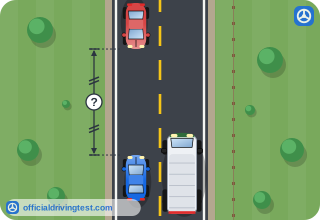
- 500 feet
- 50 feet
- 200 feet
- 20 feet
Show answer
Correct answer: 200 feet
Be sure you have enough time and space to overtake the car ahead and return to the right lane before an approaching car comes within 200 feet of you.
Source: Texas Driver Handbook (Revised January 2026), page 39
-
When passing on a two-lane road, on which side should you pass, and when should you return to the right lane?
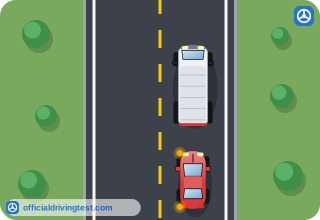
- Pass on the right, and return as soon as your front bumper clears theirs
- Pass on either side, and return immediately
- Pass on the left, and return as soon as the other driver honks
- Pass on the left, and wait until you see the passed car in your rearview mirror
Show answer
Correct answer: Pass on the left, and wait until you see the passed car in your rearview mirror
Pass on the left and do not return to the right lane until you have safely cleared the overtaken vehicle, waiting until you can see it in your rearview mirror.
Source: Texas Driver Handbook (Revised January 2026), page 39
-
After passing and before returning to the right lane, what should you do with your turn signal?
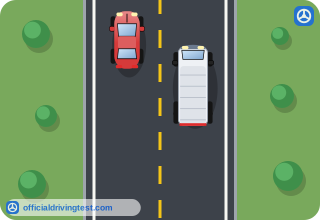
- No signal is needed since you are returning to your own lane
- Flash your hazard lights
- Turn on your right signal, then turn it off after the lane change
- Leave your left turn signal on
Show answer
Correct answer: Turn on your right signal, then turn it off after the lane change
Turn on your right turn signal and return to the right lane, then turn your signal off after completing the lane change.
Source: Texas Driver Handbook (Revised January 2026), page 39
-
In Texas, when is it legal to pass another vehicle on the right?
- Only on interstate highways
- Only if the vehicle ahead signals you to do so
- Only when it is safe, such as on a one-way road
- Never under any circumstance
Show answer
Correct answer: Only when it is safe, such as on a one-way road
In Texas, you can pass on the right only when conditions permit you to do so safely, such as when the road is clear and wide enough for two or more lanes in each direction, or on a one-way road.
Source: Texas Driver Handbook (Revised January 2026), page 39
-
You may pass on the right using a paved shoulder when the vehicle you are passing is doing which of these?
- Passing another car itself
- Slowing, stopped, disabled, or about to turn left
- Simply driving at the speed limit
- Turning on its hazard lights for no reason
Show answer
Correct answer: Slowing, stopped, disabled, or about to turn left
You may pass on a paved shoulder when the vehicle you are passing is slowing or stopped on the main traveled portion of the highway, disabled, or preparing to make a left turn.
Source: Texas Driver Handbook (Revised January 2026), page 39
-
When passing on the right, what should you never do?
- Signal your intention
- Watch for the vehicle you're passing to slow down
- Pass by driving off the paved portion of the highway
- Check that the shoulder is wide enough
Show answer
Correct answer: Pass by driving off the paved portion of the highway
Do not pass on the right by driving off the paved portion of the highway.
Source: Texas Driver Handbook (Revised January 2026), page 39
-
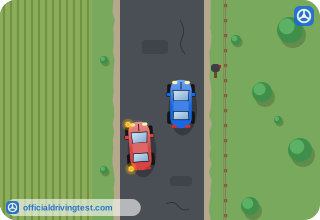
When another vehicle is passing you and the lanes are not marked, what should you do?
- Speed up to make the pass quicker for both of you
- Move toward the center of the road
- Brake suddenly to let them pass faster
- Don't speed up, and safely move as far right as you can
Show answer
Correct answer: Don't speed up, and safely move as far right as you can
When another vehicle is passing you, do not increase your speed, stay in your lane, and safely move as far to the right as you can when being passed on the left and the lanes are not marked; make it as safe and easy as possible for the other driver to pass.
Source: Texas Driver Handbook (Revised January 2026), page 39
-
When you are passing another vehicle, what should you avoid doing regarding the other driver's blind spot?
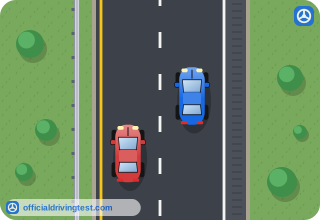
- Lingering in it rather than passing or slowing down
- Using your turn signal before changing lanes
- Checking your own blind spot before changing lanes
- Maintaining a safe following distance
Show answer
Correct answer: Lingering in it rather than passing or slowing down
When passing, do not drive or linger in the other driver's blind spot; either pass the other driver or slow down, since they likely cannot see you there.
Source: Texas Driver Handbook (Revised January 2026), page 39
2Part 219 questions
-
In Texas, a highway is legally defined as:
- Any paved road that has a posted speed limit over 55 mph
- Only divided roads that have at least four lanes for vehicle travel
- Any privately owned road
- A publicly maintained way, any part of it open to public vehicular travel
Show answer
Correct answer: A publicly maintained way, any part of it open to public vehicular travel
Texas defines a highway as the width between the boundary lines of a publicly maintained way, any part of which is open to the public for vehicular travel.
Source: Texas Driver Handbook (Revised January 2026), page 47
-
Before using a highway, you should:
- Decide your route only after you are already merging
- Fill your tank only if it drops below empty
- Avoid checking your vehicle's condition beforehand
- Plan your trip so you know your entrance, direction, and exit
Show answer
Correct answer: Plan your trip so you know your entrance, direction, and exit
Plan your trip in advance so you know your entrance, direction, and exit, and make sure you and your car are in good condition.
Source: Texas Driver Handbook (Revised January 2026), page 47
-
If you cannot or do not want to drive at or above the minimum speed limit, you should:
- Drive in the far left lane
- Use your hazard lights the entire trip
- Drive on the shoulder
- Not use the highway
Show answer
Correct answer: Not use the highway
If you cannot or do not want to drive at or above the minimum speed limit, do not use the highway.
Source: Texas Driver Handbook (Revised January 2026), page 47
-
When entering a highway, who has the right-of-way?
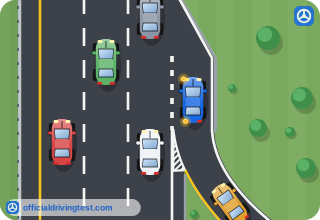
- Vehicles already on the highway
- The vehicle entering the highway
- Whichever vehicle is moving faster
- Whichever vehicle is larger
Show answer
Correct answer: Vehicles already on the highway
You must yield the right-of-way to vehicles already on the highway when entering.
Source: Texas Driver Handbook (Revised January 2026), page 47
-
The correct way to enter a highway is to:
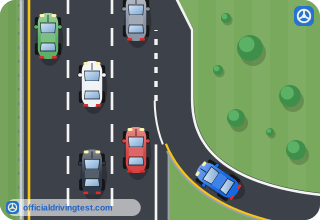
- Enter the speed change lane, stay right, signal left, and speed up to merge when clear
- Stop at the end of the entrance ramp and wait for a full break in traffic
- Merge at a much slower speed than the flow of traffic
- Enter directly into the far left lane
Show answer
Correct answer: Enter the speed change lane, stay right, signal left, and speed up to merge when clear
Enter the speed change lane, stay to the right, signal left, and when it is clear, increase your speed to merge with the flow of traffic.
Source: Texas Driver Handbook (Revised January 2026), page 47
-
On a highway, the right lane should be used to:
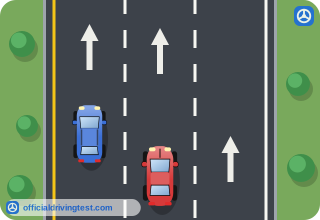
- Drive at the minimum speed limit or below normal traffic flow
- Pass other vehicles
- Drive faster than the rest of traffic
- Park temporarily while checking a map or directions
Show answer
Correct answer: Drive at the minimum speed limit or below normal traffic flow
Use the right lane to drive at the minimum posted speed limit or below the normal flow of traffic.
Source: Texas Driver Handbook (Revised January 2026), page 47
-
You should use the middle or left lane of a highway when you are:
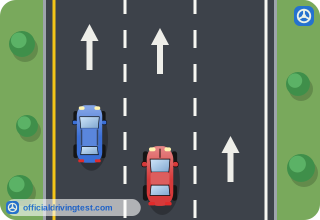
- Towing a slow-moving trailer
- Passing or traveling faster than other traffic
- Driving at the minimum posted speed limit
- About to exit within the next mile
Show answer
Correct answer: Passing or traveling faster than other traffic
Use the middle or left lane if you are traveling faster than other traffic or passing other vehicles.
Source: Texas Driver Handbook (Revised January 2026), page 47
-
If you plan to leave the freeway soon, you should:
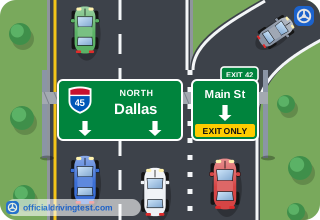
- Stay in the far left lane until the last moment
- Slow to a stop on the shoulder before the exit
- Change to the exit lane as soon as possible
- Wait until you reach the exit ramp to change lanes
Show answer
Correct answer: Change to the exit lane as soon as possible
If you plan to leave the freeway soon, change to the exit lane as soon as possible.
Source: Texas Driver Handbook (Revised January 2026), page 47
-
Once you are in the proper highway lane, you should:
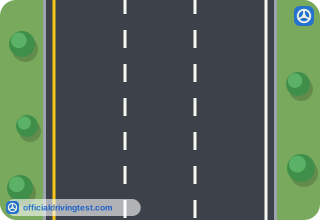
- Stay in the middle of your lane and do not weave in and out
- Straddle the lane line to see around traffic better
- Frequently change lanes to find the fastest gap
- Drive along the left edge of your lane
Show answer
Correct answer: Stay in the middle of your lane and do not weave in and out
Once in the proper lane, stay in the middle of your lane and do not weave in and out of traffic.
Source: Texas Driver Handbook (Revised January 2026), page 48
-
While driving on a highway, you should maintain a constant speed and:
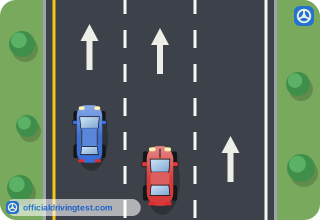
- Accelerate to pass every car ahead of you
- Brake often to test your reaction time
- Not speed up and slow down unnecessarily
- Vary your speed frequently to stay alert
Show answer
Correct answer: Not speed up and slow down unnecessarily
Maintain a constant speed and keep pace with traffic; don't speed up and slow down unnecessarily.
Source: Texas Driver Handbook (Revised January 2026), page 48
-
On a highway, vehicles in any lane except the right lane used for slower traffic should:
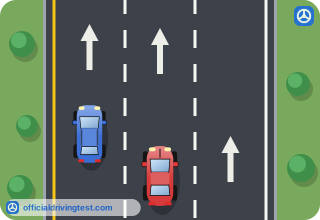
- Be prepared to change lanes to let faster traffic pass
- Stay in place regardless of faster traffic approaching
- Speed up to block faster vehicles
- Flash their brake lights at faster traffic
Show answer
Correct answer: Be prepared to change lanes to let faster traffic pass
Vehicles in any lane, except the right lane used for slower traffic, should be prepared to move to another lane to allow faster traffic to pass.
Source: Texas Driver Handbook (Revised January 2026), page 48
-
Exit signs on a highway are usually placed how far ahead of the exit?
- At least 10 yards
- At least 5 miles
- Exactly at the exit ramp
- At least 1,000 yards
Show answer
Correct answer: At least 1,000 yards
Exit signs are usually placed at least 1,000 yards ahead of the exit, so move into the proper lane well in advance, especially in heavy traffic.
Source: Texas Driver Handbook (Revised January 2026), page 48
-
When leaving the highway, you should slow down on the exit ramp so that:
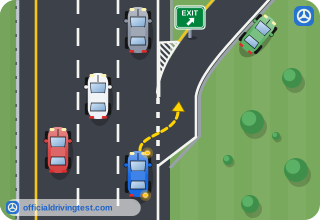
- You can accelerate quickly once you reach the street
- Other drivers behind you must also slow down immediately
- You maintain highway speed until you stop completely
- You are within the new, slower speed limit once off the highway
Show answer
Correct answer: You are within the new, slower speed limit once off the highway
Slow down on the exit ramp so that by the time you are off the highway, you are within the new, slower speed limit.
Source: Texas Driver Handbook (Revised January 2026), page 48
-
Highway hypnosis is best described as:
- A legal requirement to hypnotize passengers for safety
- A visual illusion caused only by the glare of oncoming headlights
- A type of engine malfunction
- Drowsiness or unawareness from reduced activity and steady sounds
Show answer
Correct answer: Drowsiness or unawareness from reduced activity and steady sounds
Highway hypnosis is a condition of drowsiness or unawareness brought on by reduced activity and the steady sounds of wind, engine, and tire hum.
Source: Texas Driver Handbook (Revised January 2026), page 48
-
To fight highway hypnosis on a long trip, you should stop at least:
- Once per day regardless of distance driven
- Only when you feel extremely tired
- Every two hours or 100 miles, and drive no more than eight hours a day
- Every 30 minutes, and never drive more than two hours a day
Show answer
Correct answer: Every two hours or 100 miles, and drive no more than eight hours a day
You should stop at least every two hours or every 100 miles and get out to walk around, and you should not drive more than eight hours per day.
Source: Texas Driver Handbook (Revised January 2026), page 48
-
If another driver ahead of you cannot see your vehicle in their mirrors, you are most likely:
- In that driver's blind spot
- Following at a safe two-second distance
- In the correct passing position
- Properly using your turn signal
Show answer
Correct answer: In that driver's blind spot
Stay out of another driver's blind spot; traveling where the driver ahead cannot see your vehicle can be dangerous, so stay behind or go around, not to the side.
Source: Texas Driver Handbook (Revised January 2026), page 48
-
According to the handbook, cell phone use while driving:
- Is always legal as long as you keep both hands on the wheel
- Is only restricted for drivers over 65
- Is encouraged to help drivers stay alert
- Is illegal under age 18, even hands-free, except in an emergency
Show answer
Correct answer: Is illegal under age 18, even hands-free, except in an emergency
Avoid using a cell phone while driving. If you are under 18, it is illegal to use a cell phone while driving even with a hands-free device, except in an emergency.
Source: Texas Driver Handbook (Revised January 2026), page 48
-
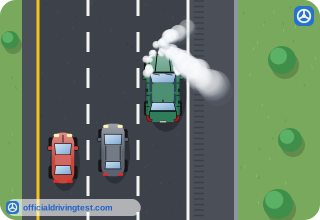
If your car breaks down and you cannot get it off the road, you should:
- Leave the car and walk away without any warning devices
- Direct traffic yourself from the middle of the road
- Get everyone out and off the road and use portable warning devices
- Stay inside the vehicle with the doors locked
Show answer
Correct answer: Get everyone out and off the road and use portable warning devices
If you can't get the car off the road, get everyone out of the car and off the road, and use portable warning devices to warn oncoming traffic.
Source: Texas Driver Handbook (Revised January 2026), page 48
-
If your car breaks down at night, in addition to your taillights and warning lights you should also:
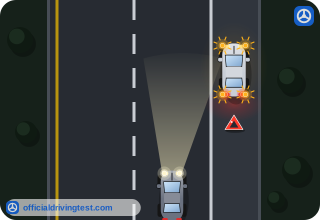
- Turn on the lights inside the car
- Turn off all lights completely to conserve the battery
- Honk the horn continuously until help arrives
- Stand behind the vehicle waving your arms
Show answer
Correct answer: Turn on the lights inside the car
At night, in addition to your taillights and warning lights, turn the lights on inside the car.
Source: Texas Driver Handbook (Revised January 2026), page 48