Texas: Freeway driving — Part 2 Practice Test
Questions in this part include: “Exit signs on a highway are usually placed how far ahead of the exit?”
Independent educational site · not affiliated with any government agency or DMV
Ready? Test yourself
- Instant feedback with an explanation
- Every answer cites its source in the manual
- Your best score is saved on this device
Questions are original and based on the official manual "Texas Driver Handbook" (Revised January 2026), Texas Department of Public Safety (DPS).
All 19 questions in this practice test
Take the test above first, then use this list to study. Tap “Show answer” to see the correct answer and explanation.
Show the questions and answersHide the questions
-
In Texas, a highway is legally defined as:
- Any paved road that has a posted speed limit over 55 mph
- Only divided roads that have at least four lanes for vehicle travel
- Any privately owned road
- A publicly maintained way, any part of it open to public vehicular travel
Show answer
Correct answer: A publicly maintained way, any part of it open to public vehicular travel
Texas defines a highway as the width between the boundary lines of a publicly maintained way, any part of which is open to the public for vehicular travel.
Source: Texas Driver Handbook (Revised January 2026), page 47
-
Before using a highway, you should:
- Decide your route only after you are already merging
- Fill your tank only if it drops below empty
- Avoid checking your vehicle's condition beforehand
- Plan your trip so you know your entrance, direction, and exit
Show answer
Correct answer: Plan your trip so you know your entrance, direction, and exit
Plan your trip in advance so you know your entrance, direction, and exit, and make sure you and your car are in good condition.
Source: Texas Driver Handbook (Revised January 2026), page 47
-
If you cannot or do not want to drive at or above the minimum speed limit, you should:
- Drive in the far left lane
- Use your hazard lights the entire trip
- Drive on the shoulder
- Not use the highway
Show answer
Correct answer: Not use the highway
If you cannot or do not want to drive at or above the minimum speed limit, do not use the highway.
Source: Texas Driver Handbook (Revised January 2026), page 47
-
When entering a highway, who has the right-of-way?
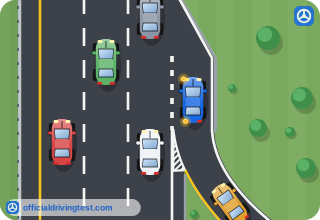
- Vehicles already on the highway
- The vehicle entering the highway
- Whichever vehicle is moving faster
- Whichever vehicle is larger
Show answer
Correct answer: Vehicles already on the highway
You must yield the right-of-way to vehicles already on the highway when entering.
Source: Texas Driver Handbook (Revised January 2026), page 47
-
The correct way to enter a highway is to:
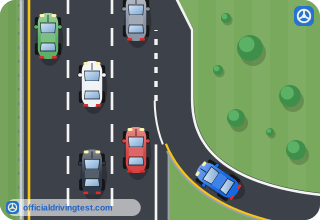
- Enter the speed change lane, stay right, signal left, and speed up to merge when clear
- Stop at the end of the entrance ramp and wait for a full break in traffic
- Merge at a much slower speed than the flow of traffic
- Enter directly into the far left lane
Show answer
Correct answer: Enter the speed change lane, stay right, signal left, and speed up to merge when clear
Enter the speed change lane, stay to the right, signal left, and when it is clear, increase your speed to merge with the flow of traffic.
Source: Texas Driver Handbook (Revised January 2026), page 47
-
On a highway, the right lane should be used to:
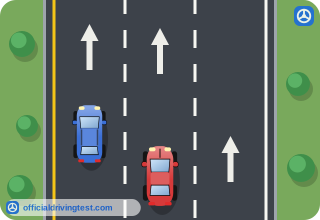
- Drive at the minimum speed limit or below normal traffic flow
- Pass other vehicles
- Drive faster than the rest of traffic
- Park temporarily while checking a map or directions
Show answer
Correct answer: Drive at the minimum speed limit or below normal traffic flow
Use the right lane to drive at the minimum posted speed limit or below the normal flow of traffic.
Source: Texas Driver Handbook (Revised January 2026), page 47
-
You should use the middle or left lane of a highway when you are:
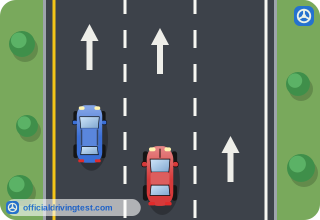
- Towing a slow-moving trailer
- Passing or traveling faster than other traffic
- Driving at the minimum posted speed limit
- About to exit within the next mile
Show answer
Correct answer: Passing or traveling faster than other traffic
Use the middle or left lane if you are traveling faster than other traffic or passing other vehicles.
Source: Texas Driver Handbook (Revised January 2026), page 47
-
If you plan to leave the freeway soon, you should:
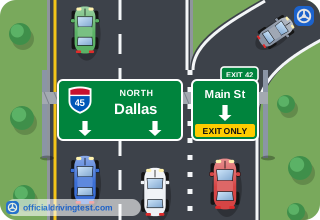
- Stay in the far left lane until the last moment
- Slow to a stop on the shoulder before the exit
- Change to the exit lane as soon as possible
- Wait until you reach the exit ramp to change lanes
Show answer
Correct answer: Change to the exit lane as soon as possible
If you plan to leave the freeway soon, change to the exit lane as soon as possible.
Source: Texas Driver Handbook (Revised January 2026), page 47
-
Once you are in the proper highway lane, you should:
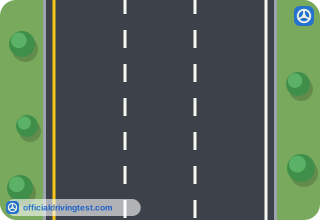
- Stay in the middle of your lane and do not weave in and out
- Straddle the lane line to see around traffic better
- Frequently change lanes to find the fastest gap
- Drive along the left edge of your lane
Show answer
Correct answer: Stay in the middle of your lane and do not weave in and out
Once in the proper lane, stay in the middle of your lane and do not weave in and out of traffic.
Source: Texas Driver Handbook (Revised January 2026), page 48
-
While driving on a highway, you should maintain a constant speed and:
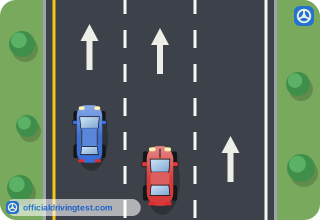
- Accelerate to pass every car ahead of you
- Brake often to test your reaction time
- Not speed up and slow down unnecessarily
- Vary your speed frequently to stay alert
Show answer
Correct answer: Not speed up and slow down unnecessarily
Maintain a constant speed and keep pace with traffic; don't speed up and slow down unnecessarily.
Source: Texas Driver Handbook (Revised January 2026), page 48
-
On a highway, vehicles in any lane except the right lane used for slower traffic should:
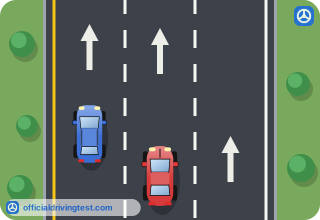
- Be prepared to change lanes to let faster traffic pass
- Stay in place regardless of faster traffic approaching
- Speed up to block faster vehicles
- Flash their brake lights at faster traffic
Show answer
Correct answer: Be prepared to change lanes to let faster traffic pass
Vehicles in any lane, except the right lane used for slower traffic, should be prepared to move to another lane to allow faster traffic to pass.
Source: Texas Driver Handbook (Revised January 2026), page 48
-
Exit signs on a highway are usually placed how far ahead of the exit?
- At least 10 yards
- At least 5 miles
- Exactly at the exit ramp
- At least 1,000 yards
Show answer
Correct answer: At least 1,000 yards
Exit signs are usually placed at least 1,000 yards ahead of the exit, so move into the proper lane well in advance, especially in heavy traffic.
Source: Texas Driver Handbook (Revised January 2026), page 48
-
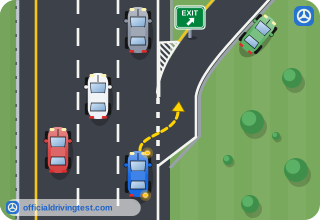
When leaving the highway, you should slow down on the exit ramp so that:
- You can accelerate quickly once you reach the street
- Other drivers behind you must also slow down immediately
- You maintain highway speed until you stop completely
- You are within the new, slower speed limit once off the highway
Show answer
Correct answer: You are within the new, slower speed limit once off the highway
Slow down on the exit ramp so that by the time you are off the highway, you are within the new, slower speed limit.
Source: Texas Driver Handbook (Revised January 2026), page 48
-
Highway hypnosis is best described as:
- A legal requirement to hypnotize passengers for safety
- A visual illusion caused only by the glare of oncoming headlights
- A type of engine malfunction
- Drowsiness or unawareness from reduced activity and steady sounds
Show answer
Correct answer: Drowsiness or unawareness from reduced activity and steady sounds
Highway hypnosis is a condition of drowsiness or unawareness brought on by reduced activity and the steady sounds of wind, engine, and tire hum.
Source: Texas Driver Handbook (Revised January 2026), page 48
-
To fight highway hypnosis on a long trip, you should stop at least:
- Once per day regardless of distance driven
- Only when you feel extremely tired
- Every two hours or 100 miles, and drive no more than eight hours a day
- Every 30 minutes, and never drive more than two hours a day
Show answer
Correct answer: Every two hours or 100 miles, and drive no more than eight hours a day
You should stop at least every two hours or every 100 miles and get out to walk around, and you should not drive more than eight hours per day.
Source: Texas Driver Handbook (Revised January 2026), page 48
-
If another driver ahead of you cannot see your vehicle in their mirrors, you are most likely:
- In that driver's blind spot
- Following at a safe two-second distance
- In the correct passing position
- Properly using your turn signal
Show answer
Correct answer: In that driver's blind spot
Stay out of another driver's blind spot; traveling where the driver ahead cannot see your vehicle can be dangerous, so stay behind or go around, not to the side.
Source: Texas Driver Handbook (Revised January 2026), page 48
-
According to the handbook, cell phone use while driving:
- Is always legal as long as you keep both hands on the wheel
- Is only restricted for drivers over 65
- Is encouraged to help drivers stay alert
- Is illegal under age 18, even hands-free, except in an emergency
Show answer
Correct answer: Is illegal under age 18, even hands-free, except in an emergency
Avoid using a cell phone while driving. If you are under 18, it is illegal to use a cell phone while driving even with a hands-free device, except in an emergency.
Source: Texas Driver Handbook (Revised January 2026), page 48
-
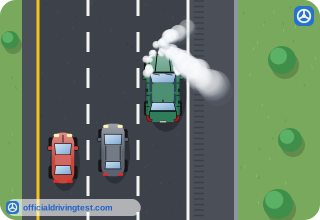
If your car breaks down and you cannot get it off the road, you should:
- Leave the car and walk away without any warning devices
- Direct traffic yourself from the middle of the road
- Get everyone out and off the road and use portable warning devices
- Stay inside the vehicle with the doors locked
Show answer
Correct answer: Get everyone out and off the road and use portable warning devices
If you can't get the car off the road, get everyone out of the car and off the road, and use portable warning devices to warn oncoming traffic.
Source: Texas Driver Handbook (Revised January 2026), page 48
-
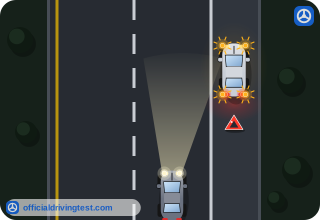
If your car breaks down at night, in addition to your taillights and warning lights you should also:
- Turn on the lights inside the car
- Turn off all lights completely to conserve the battery
- Honk the horn continuously until help arrives
- Stand behind the vehicle waving your arms
Show answer
Correct answer: Turn on the lights inside the car
At night, in addition to your taillights and warning lights, turn the lights on inside the car.
Source: Texas Driver Handbook (Revised January 2026), page 48