Texas: Parking rules — Part 1 Practice Test
Questions in this part include: “Which of the following locations is prohibited for stopping, standing, or parking?” · “You may not park or stand within 30 feet of the approach to which of these?”
Independent educational site · not affiliated with any government agency or DMV
Ready? Test yourself
Answer to start, or tap Start below:
You must never stop, stand, or park a vehicle:
- Instant feedback with an explanation
- Every answer cites its source in the manual
- Your best score is saved on this device
- Keyboard: press 1 to 4 to answer and Enter for the next question
Questions are original and based on the official manual "Texas Driver Handbook" (Revised January 2026), Texas Department of Public Safety (DPS).
All 22 questions in this practice test
Take the test above first, then use this list to study. Tap “Show answer” to see the correct answer and explanation.
Show the questions and answersHide the questions
-
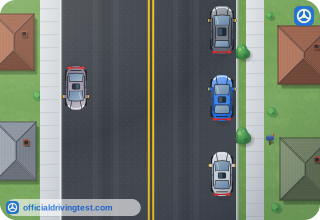
Before opening your car door after parking, what should you always do first?
- Turn on your hazard lights
- Honk your horn
- Roll down all the windows
- Look back for oncoming traffic
Show answer
Correct answer: Look back for oncoming traffic
When you leave your vehicle, turn the motor off, set the parking brake, remove the key, and be sure to look behind you for any oncoming traffic before opening your car door.
Source: Texas Driver Handbook (Revised January 2026), page 42
-
You must never stop, stand, or park a vehicle:
- In a rest area off the highway
- On the road side of a vehicle parked at the curb
- Inside a marked parking space in a parking lot
- In your own private driveway
Show answer
Correct answer: On the road side of a vehicle parked at the curb
The handbook prohibits parking, stopping, or standing on the road side of any vehicle stopped or parked at the edge or curb of a street (double parking).
Source: Texas Driver Handbook (Revised January 2026), page 42
-
According to the Texas Driver Handbook, you must never stop, stand, or park a vehicle on a:
- Sidewalk or crosswalk
- Gravel shoulder of a rural road
- Parking lot aisle
- Grass strip beside a private driveway
Show answer
Correct answer: Sidewalk or crosswalk
It is illegal to park, stop, or stand a vehicle on a sidewalk or crosswalk.
Source: Texas Driver Handbook (Revised January 2026), page 42
-
It is illegal to stop, stand, or park a vehicle:
- In a residential driveway with permission
- In a metered parking space during paid hours
- Within an intersection
- Within a shopping center parking lot
Show answer
Correct answer: Within an intersection
The handbook specifically lists stopping, standing, or parking within an intersection as prohibited.
Source: Texas Driver Handbook (Revised January 2026), page 42
-
Near a safety zone, you may not park, stop, or stand between the safety zone and the adjacent curb, or within how many feet of a point on the curb directly opposite the end of the safety zone?
- 20 feet
- 50 feet
- 30 feet
- 15 feet
Show answer
Correct answer: 30 feet
You may not stop, stand, or park between a safety zone and the adjacent curb, or within 30 feet of a point on the curb immediately opposite the end of the safety zone.
Source: Texas Driver Handbook (Revised January 2026), page 42
-
You may not stop, stand, or park alongside or opposite a street excavation or obstruction if doing so would:
- Obstruct traffic
- Block a mailbox
- Cover a storm drain
- Shade a fire hydrant
Show answer
Correct answer: Obstruct traffic
You may not stop, stand, or park alongside or opposite any street excavation or obstruction when doing so would obstruct traffic.
Source: Texas Driver Handbook (Revised January 2026), page 42
-
Which of the following locations is prohibited for stopping, standing, or parking?
- In a public parking garage
- On a residential street with no sidewalk
- On a gravel road shoulder
- On a bridge or in a highway tunnel
Show answer
Correct answer: On a bridge or in a highway tunnel
You may not stop, stand, or park on a bridge or other elevated structure on a highway, or within a highway tunnel.
Source: Texas Driver Handbook (Revised January 2026), page 42
-
You must never stop, stand, or park a vehicle:
- Within 300 feet of a train station
- Within sight of railroad tracks
- On any railroad track
- Near railroad warning signs
Show answer
Correct answer: On any railroad track
The handbook lists 'on any railroad track' as a location where you must never stop, stand, or park.
Source: Texas Driver Handbook (Revised January 2026), page 42
-
Besides the specific distances set by law, when else are you prohibited from stopping, standing, or parking a vehicle?
- Only during rush hour
- Only if a police officer is directing traffic
- Only on state holidays
- Wherever an official sign prohibits it
Show answer
Correct answer: Wherever an official sign prohibits it
In addition to the specific situations and distances listed, you must not stop, stand, or park at any place where an official sign prohibits it.
Source: Texas Driver Handbook (Revised January 2026), page 42
-
Whether occupied or not, you may not park or stand a vehicle:
- In front of any driveway
- Beside a public park
- Across the street from a school
- Near a bus stop bench
Show answer
Correct answer: In front of any driveway
Whether occupied or not, you may not park or stand a vehicle in front of a public or private driveway.
Source: Texas Driver Handbook (Revised January 2026), page 42
-
How close to a fire hydrant may you legally park a vehicle?
- You may not park within 10 feet of a fire hydrant
- You may not park within 25 feet of a fire hydrant
- You may not park within 5 feet of a fire hydrant
- You may not park within 15 feet of a fire hydrant
Show answer
Correct answer: You may not park within 15 feet of a fire hydrant
You may not park or stand a vehicle within 15 feet of a fire hydrant.
Source: Texas Driver Handbook (Revised January 2026), page 42
-
You may not park or stand within how many feet of a crosswalk at an intersection?
- 10 feet
- 15 feet
- 30 feet
- 20 feet
Show answer
Correct answer: 20 feet
You may not park or stand within 20 feet of a crosswalk at an intersection.
Source: Texas Driver Handbook (Revised January 2026), page 42
-
You may not park or stand within 30 feet of the approach to which of these?
- A speed limit sign
- A street name sign
- A no-passing zone sign
- A stop sign or yield sign
Show answer
Correct answer: A stop sign or yield sign
You may not park or stand within 30 feet upon the approach to any flashing signal, stop sign, yield sign, or other traffic control signal located at the side of a road.
Source: Texas Driver Handbook (Revised January 2026), page 42
-
You may not park within how many feet of the driveway entrance to a fire station?
- 50 feet
- 30 feet
- 20 feet
- 10 feet
Show answer
Correct answer: 20 feet
You may not park or stand within 20 feet of the driveway entrance to any fire station.
Source: Texas Driver Handbook (Revised January 2026), page 42
-
On the side of a street directly opposite a fire station entrance, you may not park within how many feet of the entrance?
- 20 feet
- 50 feet
- 100 feet
- 75 feet
Show answer
Correct answer: 75 feet
You may not park on the side of a street opposite the entrance to any fire station within 75 feet of the entrance.
Source: Texas Driver Handbook (Revised January 2026), page 42
-
You may not park a vehicle within how many feet of the nearest rail of a railroad crossing?
- 75 feet
- 100 feet
- 50 feet
- 25 feet
Show answer
Correct answer: 50 feet
Do not park a vehicle, occupied or not, within 50 feet of the nearest rail of a railroad crossing.
Source: Texas Driver Handbook (Revised January 2026), page 42
-
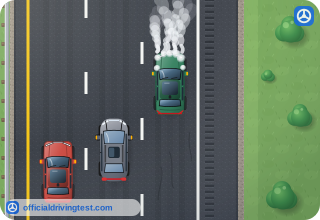
If you must stop on the paved part of a highway outside an urban area, your vehicle should be visible from each direction for at least how many feet?
- 150 feet
- 300 feet
- 200 feet
- 100 feet
Show answer
Correct answer: 200 feet
If you cannot park off the road, be sure your vehicle can be seen for at least 200 feet from each direction.
Source: Texas Driver Handbook (Revised January 2026), page 42
-
If you must stop on a highway outside an urban area at night, you should:
- Use your parking lights or leave your headlights on dim
- Turn off all your lights to avoid blinding other drivers
- Leave your high beams on continuously
- Use only your interior dome light
Show answer
Correct answer: Use your parking lights or leave your headlights on dim
If stopped at night on a highway outside an urban area, use your parking lights or leave your headlights on dim.
Source: Texas Driver Handbook (Revised January 2026), page 42
-
A person may stop, stand, or park a bicycle on a sidewalk if:
- It does not impede pedestrian or other traffic
- It is locked to a street sign or a light pole
- It is after 9 p.m.
- It has reflectors installed
Show answer
Correct answer: It does not impede pedestrian or other traffic
A person may stop, stand, or park a bicycle on a sidewalk if the bicycle does not impede the normal and reasonable movement of pedestrian or other traffic on the sidewalk.
Source: Texas Driver Handbook (Revised January 2026), page 42
-
According to the Texas Driver Handbook, temporarily stopping to obey a traffic sign or signal is:
- Allowed only for up to 5 minutes
- Only allowed with hazard lights on
- Not considered parking or standing
- Considered illegal parking
Show answer
Correct answer: Not considered parking or standing
The handbook notes that temporarily stopping to obey traffic signs, signals, etc. is not considered parking or standing.
Source: Texas Driver Handbook (Revised January 2026), page 42
-
Illegally parking in a space reserved for individuals with disabilities is a misdemeanor punishable by a fine of what amount for a first offense?
- $500 to $750
- $100 to $200
- $250 to $500
- $1,000 to $1,250
Show answer
Correct answer: $500 to $750
Illegally parking in a space reserved for individuals with disabilities is a misdemeanor punishable by a fine of $500 to $750 for the first offense.
Source: Texas Driver Handbook (Revised January 2026), page 42
-
The fine for illegally parking in a disabled parking space can increase up to what amount for five or more offenses?
- $1,000, plus a license suspension
- $1,500, plus jail time
- $1,250, plus community service
- $750, with no additional penalty
Show answer
Correct answer: $1,250, plus community service
This fine increases with additional offenses up to $1,250 for five or more offenses, and additional offenses also include community service.
Source: Texas Driver Handbook (Revised January 2026), page 42