Pavement markings in Tennessee
The Tennessee Comprehensive Driver License Manual shows or names everything on this page: 18 in all, on pages 42–43, 58, 60, 66, 76.
Independent educational site · not affiliated with any government agency or DMV
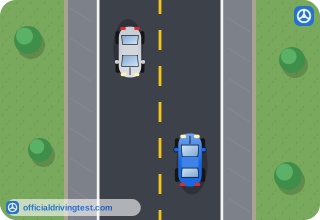
Solid White Edge Line
Lines along the side of the road show you where the edge of the road is located. A solid white line indicates the right edge of the traffic lane on a road. A solid or broken yellow line indicates the left edge of traffic lanes going in your direction.
Manual page 42 · Open this page in the manual (Manual page 42)
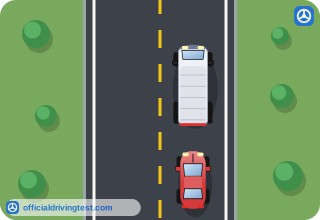
Broken Yellow Center Line (Passing Permitted)
Broken yellow lines mean that you MAY cross the line to pass if there is no oncoming traffic and it is safe to do so. (p59: Two-lane highways have a single broken yellow center line.)
Manual page 42 · Open this page in the manual (Manual page 42)
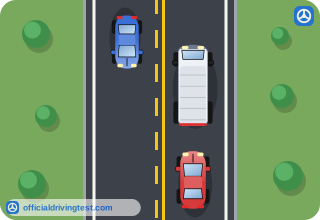
Solid and Broken Yellow Lines
One solid yellow line and one broken yellow: Where there is both a solid and a broken yellow line between opposing lanes of traffic, you may not pass if the solid yellow line is on your side. If the broken yellow line is on your side, you are in the “passing zone” and may pass if it is safe to do so.
Manual page 42 · Open this page in the manual (Manual page 42)
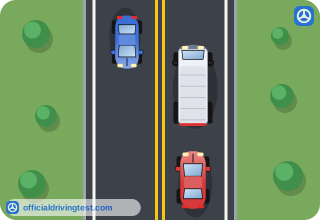
Double Solid Yellow Line (No Passing)
Two solid yellow lines between lanes of traffic mean you MAY NOT cross the lines from either direction, even if no oncoming traffic is in view. You may cross a solid yellow line to turn into a driveway or side road if it is safe to do so.
Manual page 42 · Open this page in the manual (Manual page 42)
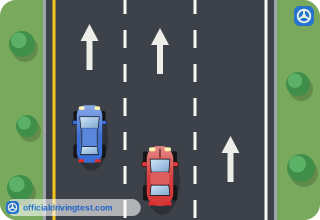
Broken White Lane Line
Multiple lanes of traffic that flow in the same direction are separated by white lane markings. Broken white lines between lanes of traffic mean you may cross the lines to pass or change lanes if it is safe to do so.
Manual page 43 · Open this page in the manual (Manual page 43)
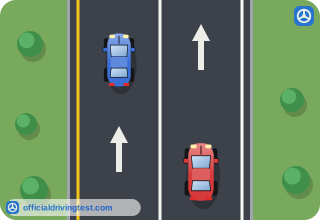
Solid White Line
One solid white line between lanes of traffic means that you should stay in your lane and should not cross the line to pass (unless an emergency situation requires you to change lanes). Also, you should not cross a double solid white line.
Manual page 43 · Open this page in the manual (Manual page 43)
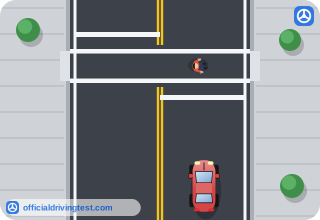
Crosswalk (Two Parallel Lines)
Crosswalks - White crosswalk lines are painted across a road to indicate pedestrian crossing areas. Crosswalks define the area where pedestrians may cross the roadway and may be located at intersections or in the middle of a block. However, not all crosswalks are marked.
Manual page 43 · Open this page in the manual (Manual page 43)
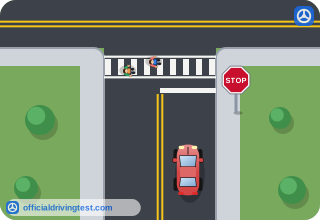
Stop Line
Stop Lines - White stop lines are painted on the pavement across traffic lanes, usually at intersections, to indicate the vehicle stopping position, before traffic signs or signals. (A) If the motorist is required to stop at the intersection, the vehicle must be stopped behind this stop line. If no stop line is painted on the pavement, all vehicles required to stop must: (B) Stop the vehicle before crossing the first line of the crosswalk (if the crosswalk is marked).
Manual page 43 · Open this page in the manual (Manual page 43)
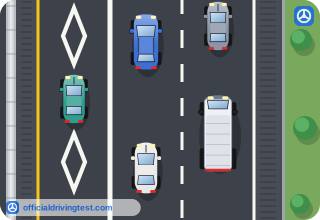
HOV Lane Diamond Markings
High Occupancy Vehicle (HOV) Lanes are designated on highways by a diamond-shaped marking in the center of the lane. During heavy traffic periods, HOV lanes are reserved for buses, vanpools, motorcycles, carpools and other high occupancy vehicles.
Manual page 43 · Open this page in the manual (Manual page 43)
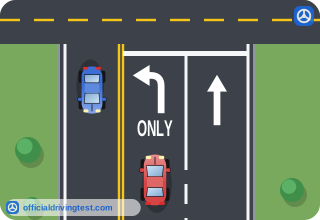
Left Turn Arrow with ONLY
If you are traveling in a lane marked with a curved arrow and the word ONLY, you must turn in the direction of the arrow. Single arrows indicate only one mandatory direction is allowed.
Manual page 43 · Open this page in the manual (Manual page 43)
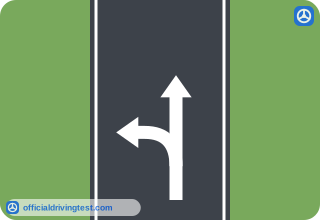
Lane-Use Arrows (Combined Arrow)
If your lane is marked with both a curved and a straight arrow, you may turn in the direction of the arrow or you may go straight. Double or triple arrows indicate more than one movement is permitted.
Manual page 43 · Open this page in the manual (Manual page 43)
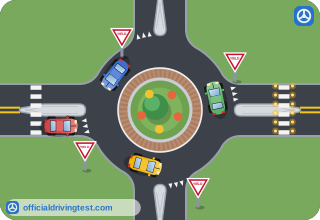
Roundabout (Central Island and Splitter Islands)
On approaching the roundabout, stay in your lane and to the right of the splitter island or yellow pavement markings/curbs directing traffic to the right. These islands are used to prevent vehicles from attempting to travel left around the circle.
Manual page 58 · Open this page in the manual (Manual page 58)
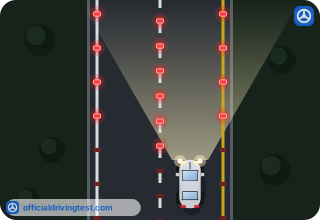
Red Reflectors (Wrong Way)
Red reflectors always mean you are facing traffic the wrong way and could have a head-on collision. If you see red reflectors on the lines on the edge of the road, you are on the wrong interstate or highway ramp. Pull over immediately!
Manual page 60 · Open this page in the manual (Manual page 60)
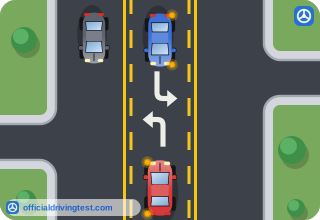
Two-Way Left-Turn Center Lane
On the pavement, left turn arrows for traffic in one direction alternate with left turn arrows for traffic coming from the other direction. These lanes are marked on each side by solid yellow and broken yellow lines.
Manual page 60 · Open this page in the manual (Manual page 60)
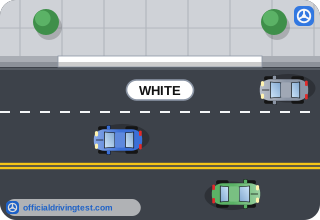
White Curb
WHITE 1. Stop only long enough to pick up or drop off passengers.
Manual page 66 · Open this page in the manual (Manual page 66)
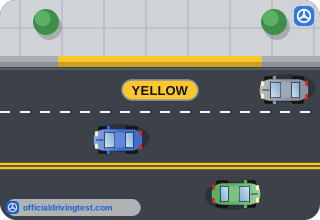
Yellow Curb
YELLOW 2. Stop only long enough to load or unload. Stay with your car.
Manual page 66 · Open this page in the manual (Manual page 66)
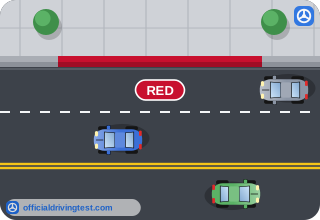
Red Curb
RED 3. Do not stop, stand or park in this space under any condition.
Manual page 66 · Open this page in the manual (Manual page 66)
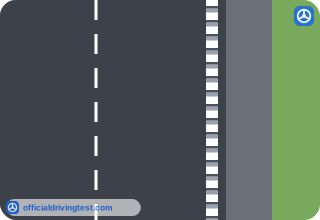
Rumble Strips (Edge Line)
Rumble Stripes are a series of indentations where the edge line is striped overtop the indentations. It has a secondary effect of the vibration and noise, however, its primary function is to improve wet-night visibility of the edge line.
Manual page 76 · Open this page in the manual (Manual page 76)