Tennessee: Pavement markings
Yellow and white lines, no-passing zones, crosswalks and stop lines, lane arrows, and reversible and center turn lanes. Split into 3 shorter tests so you're not stuck in one long quiz.
Independent educational site · not affiliated with any government agency or DMV
Choose a part
Pavement markings — Part 1
Questions in this part include: “Because states continue to update signage to meet federal requirements, what may drivers encounter?”
StartPavement markings — Part 2
Questions in this part include: “What marks a High Occupancy Vehicle (HOV) lane on the pavement?”
StartPavement markings — Part 3
Questions in this part include: “On a four-lane highway, what divides the two lanes on each side?”
StartAll 50 Pavement markings questions with answers
Choose a part above to take a practice test, or study every question and answer here.
Show the questions and answersHide the questions
-
The manual’s information on pavement markings is based on which publication, which all states’ highway agencies must use in marking and signing roadways?
- The State Highway Patrol Field Handbook
- The Manual on Uniform Traffic Control Devices
- The National Driver Register Guide
- The Standard Highway Signing Directory
Show answer
Correct answer: The Manual on Uniform Traffic Control Devices
The chapter follows the Federal Highway Administration’s Manual on Uniform Traffic Control Devices.
Source: Tennessee Comprehensive Driver License Manual (March 2025 printing), page 42 · Open this page in the manual (Manual page 42)
-
Because states continue to update signage to meet federal requirements, what may drivers encounter?
- Only new markings and signs
- Markings that differ in every county
- Signs with no federal standard
- Both old and new markings and signs
Show answer
Correct answer: Both old and new markings and signs
Drivers may meet both old and new markings and signs while states update them, so they should stay alert and follow directions.
Source: Tennessee Comprehensive Driver License Manual (March 2025 printing), page 42 · Open this page in the manual (Manual page 42)
-
What do line colors tell you about the road you are on?
- How many lanes it has ahead
- Whether it is a one-way or two-way roadway
- Whether it is a state or a county road
- How steep the road ahead is
Show answer
Correct answer: Whether it is a one-way or two-way roadway
Line colors show whether you are on a one-way or two-way roadway.
Source: Tennessee Comprehensive Driver License Manual (March 2025 printing), page 42 · Open this page in the manual (Manual page 42)
-
A solid white line along the side of the road indicates what?
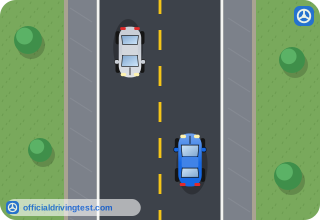
- The left edge of the lanes going in your direction
- A boundary between opposing traffic
- A place where passing is permitted
- The right edge of the traffic lane
Show answer
Correct answer: The right edge of the traffic lane
A solid white line marks the right edge of the traffic lane.
Source: Tennessee Comprehensive Driver License Manual (March 2025 printing), page 42 · Open this page in the manual (Manual page 42)
-
A solid or broken yellow line along the side of a road indicates what?
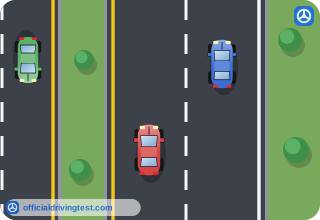
- The left edge of the traffic lanes going in your direction
- The right edge of the traffic lane that you are in
- The edge of a pedestrian walkway next to the road
- The start of a railroad crossing ahead of you
Show answer
Correct answer: The left edge of the traffic lanes going in your direction
A solid or broken yellow line marks the left edge of the lanes going your way.
Source: Tennessee Comprehensive Driver License Manual (March 2025 printing), page 42 · Open this page in the manual (Manual page 42)
-
You find yourself with a yellow line to your right and a white line to your left. What does this mean?
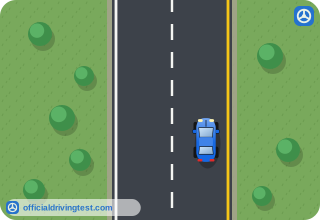
- You are in a passing zone
- You are in an HOV lane
- You are going the wrong way
- You are approaching a railroad crossing
Show answer
Correct answer: You are going the wrong way
Yellow on your right and white on your left means you are driving the wrong way.
Source: Tennessee Comprehensive Driver License Manual (March 2025 printing), page 42 · Open this page in the manual (Manual page 42)
-
On a divided highway, what color line is always on the side of the roadway to the left of the driver, nearest the median?
- A white line
- A broken white line
- No line at all
- A yellow line
Show answer
Correct answer: A yellow line
On a divided highway the line nearest the median, to the driver’s left, is always yellow.
Source: Tennessee Comprehensive Driver License Manual (March 2025 printing), page 42 · Open this page in the manual (Manual page 42)
-
What color are the lines that separate traffic moving in opposite directions?
- Yellow
- White
- Red
- Blue
Show answer
Correct answer: Yellow
Lines separating traffic moving in opposite directions are yellow.
Source: Tennessee Comprehensive Driver License Manual (March 2025 printing), page 42 · Open this page in the manual (Manual page 42)
-
Besides separating traffic moving in opposite directions, what else are yellow lines used for?
- Marking where pedestrians may cross the roadway
- Showing the right edge of the road
- Marking a boundary at a hazard such as bridge supports
- Separating lanes of traffic moving in the same direction
Show answer
Correct answer: Marking a boundary at a hazard such as bridge supports
Yellow lines also mark a boundary or barrier at a particular hazard, such as bridge supports.
Source: Tennessee Comprehensive Driver License Manual (March 2025 printing), page 42 · Open this page in the manual (Manual page 42)
-
What do broken yellow lines between lanes of traffic mean?
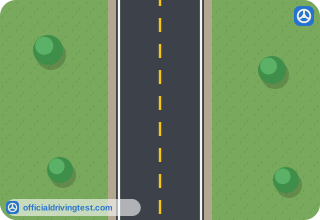
- You may never cross the line, even to pass another car
- You may cross to pass if it is safe and no traffic is oncoming
- You may cross the line only to turn left into a driveway
- You must slow down before crossing the line to pass
Show answer
Correct answer: You may cross to pass if it is safe and no traffic is oncoming
Broken yellow lines allow you to cross to pass when there is no oncoming traffic and it is safe.
Source: Tennessee Comprehensive Driver License Manual (March 2025 printing), page 42 · Open this page in the manual (Manual page 42)
-
What do two solid yellow lines between lanes of traffic mean?
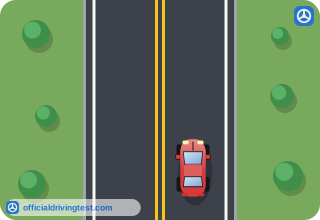
- You may not cross them to pass from either direction
- You may cross them to pass if no oncoming traffic is in view
- Only the driver in the lane next to the line may cross them
- You may cross them only during daylight hours
Show answer
Correct answer: You may not cross them to pass from either direction
Two solid yellow lines may not be crossed from either direction, even with no oncoming traffic in sight.
Source: Tennessee Comprehensive Driver License Manual (March 2025 printing), page 42 · Open this page in the manual (Manual page 42)
-
When may you cross a solid yellow line?
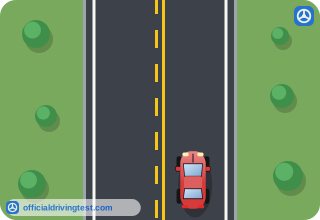
- To pass a slower vehicle when no oncoming traffic is in view
- To change lanes when traffic is heavy
- To turn into a driveway or side road if it is safe
- To pass any vehicle that is below the speed limit
Show answer
Correct answer: To turn into a driveway or side road if it is safe
You may cross a solid yellow line to turn into a driveway or side road when it is safe to do so.
Source: Tennessee Comprehensive Driver License Manual (March 2025 printing), page 42 · Open this page in the manual (Manual page 42)
-
Between opposing lanes there is a solid yellow line and a broken yellow line. The solid line is on your side. What does that mean?
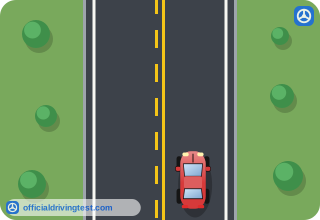
- You are in a passing zone
- You may not pass
- You may pass if no oncoming traffic is in view
- You may pass only during daylight hours
Show answer
Correct answer: You may not pass
With the solid yellow line on your side you may not pass.
Source: Tennessee Comprehensive Driver License Manual (March 2025 printing), page 43 · Open this page in the manual (Manual page 43)
-
Between opposing lanes there is a solid yellow line and a broken yellow line. The broken line is on your side. What does that mean?
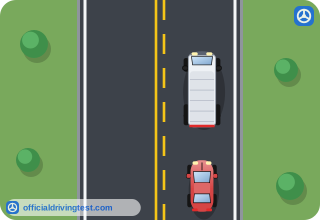
- You may not pass until the solid line ends
- You must slow down and stay in your lane
- You may pass only if the vehicle ahead signals
- You are in the passing zone and may pass if it is safe
Show answer
Correct answer: You are in the passing zone and may pass if it is safe
The broken line on your side means a passing zone, where you may pass when it is safe.
Source: Tennessee Comprehensive Driver License Manual (March 2025 printing), page 43 · Open this page in the manual (Manual page 43)
-
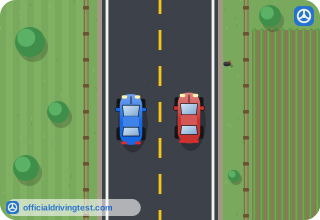
When you pass in a passing zone, by when must you safely return to your side of the roadway?
- Before you reach the next side road
- Before the passing zone ends
- Within a few seconds of starting to pass
- After the vehicle you passed signals
Show answer
Correct answer: Before the passing zone ends
You must return safely to your side before the passing zone ends.
Source: Tennessee Comprehensive Driver License Manual (March 2025 printing), page 43 · Open this page in the manual (Manual page 43)
-
What color lane markings separate multiple lanes of traffic that flow in the same direction?
- Yellow
- Red
- Blue
- White
Show answer
Correct answer: White
Multiple lanes flowing in the same direction are separated by white lane markings.
Source: Tennessee Comprehensive Driver License Manual (March 2025 printing), page 43 · Open this page in the manual (Manual page 43)
-
What do broken white lines between lanes of traffic mean?
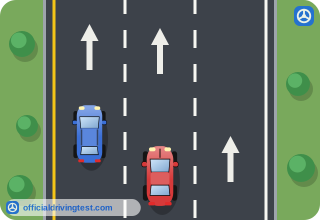
- You may cross the lines to pass or change lanes if it is safe
- You may never cross the lines
- You may cross the lines only to turn into a driveway
- You may cross the lines only on a freeway
Show answer
Correct answer: You may cross the lines to pass or change lanes if it is safe
Broken white lines allow you to cross to pass or change lanes when it is safe.
Source: Tennessee Comprehensive Driver License Manual (March 2025 printing), page 43 · Open this page in the manual (Manual page 43)
-
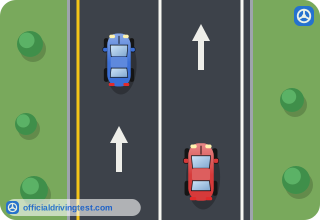
What does one solid white line between lanes of traffic mean?
- You may cross the line to pass if it is safe to do so
- You are in a zone where passing is permitted
- You should stay in your lane and not cross the line to pass
- You are going the wrong way on this road
Show answer
Correct answer: You should stay in your lane and not cross the line to pass
A solid white line means stay in your lane and do not cross it to pass, unless an emergency requires a lane change.
Source: Tennessee Comprehensive Driver License Manual (March 2025 printing), page 43 · Open this page in the manual (Manual page 43)
-
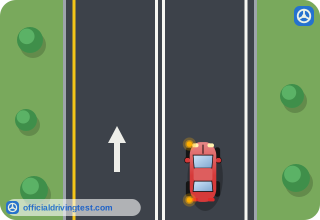
What should you do about a double solid white line?
- Cross it only to pass
- Cross it only at night
- Cross it if traffic is light
- Not cross it
Show answer
Correct answer: Not cross it
You should not cross a double solid white line.
Source: Tennessee Comprehensive Driver License Manual (March 2025 printing), page 43 · Open this page in the manual (Manual page 43)
-
What does a white stop line painted across a traffic lane show?
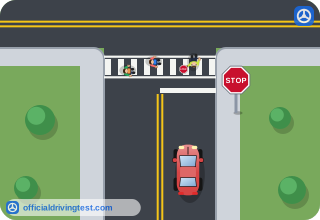
- Where a vehicle stops before a sign or signal
- The start of a pedestrian walkway ahead of you
- The place where passing is permitted by law
- The edge of the right-hand lane of traffic
Show answer
Correct answer: Where a vehicle stops before a sign or signal
White stop lines show where a vehicle stops before traffic signs or signals.
Source: Tennessee Comprehensive Driver License Manual (March 2025 printing), page 43 · Open this page in the manual (Manual page 43)
-
A stop line is painted where you are required to stop at an intersection. Where must your vehicle be stopped?
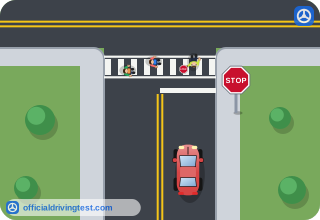
- Just past the stop line
- With the front wheels on the line
- Behind the stop line
- Beyond the crosswalk
Show answer
Correct answer: Behind the stop line
If you must stop and there is a stop line, the vehicle must be stopped behind it.
Source: Tennessee Comprehensive Driver License Manual (March 2025 printing), page 43 · Open this page in the manual (Manual page 43)
-
You must stop at an intersection with no stop line, but the crosswalk is marked. Where must you stop?
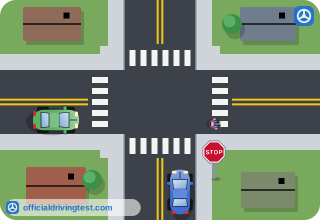
- Past the crosswalk, at the edge of the cross street
- Before crossing the first line of the crosswalk
- On the far side of the crosswalk
- At the curb of the cross street
Show answer
Correct answer: Before crossing the first line of the crosswalk
With no stop line, stop before crossing the first line of a marked crosswalk.
Source: Tennessee Comprehensive Driver License Manual (March 2025 printing), page 43 · Open this page in the manual (Manual page 43)
-
What marks a High Occupancy Vehicle (HOV) lane on the pavement?
- A solid white arrow with the word ONLY in it
- A diamond-shaped marking in the center of the lane
- A white crossbuck with the letters RR on it
- Two parallel yellow arrows along each lane
Show answer
Correct answer: A diamond-shaped marking in the center of the lane
HOV lanes are designated by a diamond-shaped marking in the center of the lane.
Source: Tennessee Comprehensive Driver License Manual (March 2025 printing), page 43 · Open this page in the manual (Manual page 43)
-
Which vehicles are HOV lanes reserved for during heavy traffic periods?
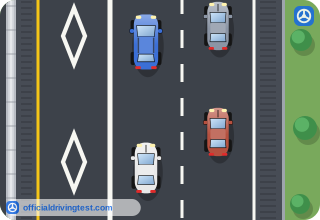
- Only buses, taxis and emergency vehicles that are responding to calls
- Only vehicles that have paid a special fee to use the lane
- Commercial trucks and vehicles that are pulling trailers or campers
- Buses, vanpools, motorcycles, carpools and other high occupancy vehicles
Show answer
Correct answer: Buses, vanpools, motorcycles, carpools and other high occupancy vehicles
During heavy traffic periods HOV lanes are for buses, vanpools, motorcycles, carpools and other high occupancy vehicles.
Source: Tennessee Comprehensive Driver License Manual (March 2025 printing), page 43 · Open this page in the manual (Manual page 43)
-
How do you find out the minimum number of passengers a vehicle must carry to use an HOV lane?
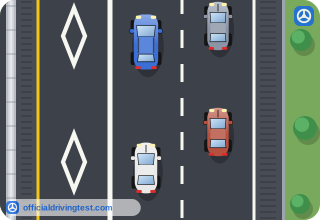
- Road signs show it
- A painted number inside the diamond
- It is printed on the registration
- A traffic officer at the lane entrance
Show answer
Correct answer: Road signs show it
Road signs state the minimum number of passengers and the times the HOV restrictions are in effect.
Source: Tennessee Comprehensive Driver License Manual (March 2025 printing), page 43 · Open this page in the manual (Manual page 43)
-
Your lane is marked with a curved arrow and the word ONLY. What must you do?
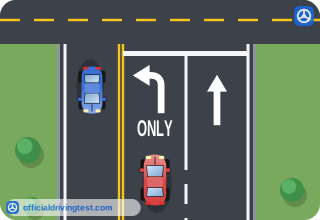
- Turn or go straight, as you choose
- Go straight through the intersection
- Turn in the direction of the arrow
- Turn only if there is no traffic
Show answer
Correct answer: Turn in the direction of the arrow
A lane marked with a curved arrow and ONLY requires you to turn in the arrow’s direction.
Source: Tennessee Comprehensive Driver License Manual (March 2025 printing), page 43 · Open this page in the manual (Manual page 43)
-
Your lane is marked with both a curved arrow and a straight arrow. What may you do?
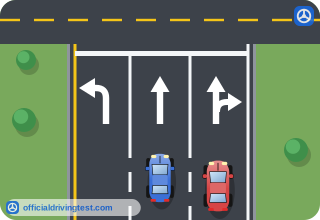
- Turn only in the direction of the curved arrow
- Go straight only, with no turns allowed
- Turn around at the next opening in the median
- Turn in the curved arrow’s direction or go straight
Show answer
Correct answer: Turn in the curved arrow’s direction or go straight
A lane with both a curved and a straight arrow lets you turn that way or go straight.
Source: Tennessee Comprehensive Driver License Manual (March 2025 printing), page 43 · Open this page in the manual (Manual page 43)
-
What do double or triple arrows on the pavement indicate?
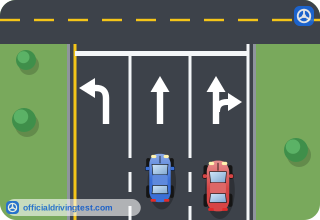
- More than one movement is permitted
- Only one direction is allowed
- The lane is closing ahead
- The lane is reserved for buses
Show answer
Correct answer: More than one movement is permitted
Double or triple arrows show that more than one movement is permitted from that lane.
Source: Tennessee Comprehensive Driver License Manual (March 2025 printing), page 43 · Open this page in the manual (Manual page 43)
-
What do single arrows on the pavement indicate?
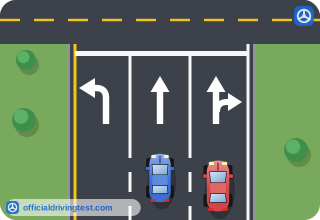
- More than one movement is permitted
- The direction is only a suggestion
- Only one mandatory direction is allowed
- The lane is closing ahead
Show answer
Correct answer: Only one mandatory direction is allowed
Single arrows mean only one mandatory direction is allowed.
Source: Tennessee Comprehensive Driver License Manual (March 2025 printing), page 43 · Open this page in the manual (Manual page 43)
-
What color are the center lines on one-way streets?
- Yellow
- Red
- Green
- White
Show answer
Correct answer: White
Center lines on one-way streets are white, while those on two-way streets are yellow.
Source: Tennessee Comprehensive Driver License Manual (March 2025 printing), page 57 · Open this page in the manual (Manual page 57)
-
You find yourself driving with the yellow line on your right. What should you do?
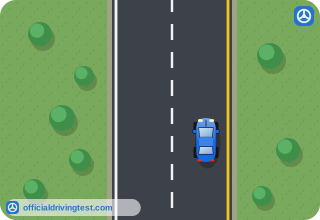
- Speed up and merge left
- Pull over immediately
- Keep going to the next intersection
- Flash your headlights and continue
Show answer
Correct answer: Pull over immediately
A yellow line on your right means you are on the wrong side of the road, so you pull over immediately.
Source: Tennessee Comprehensive Driver License Manual (March 2025 printing), page 59 · Open this page in the manual (Manual page 59)
-
The center lane of a two-way, three-lane or five-lane highway is used only for what?
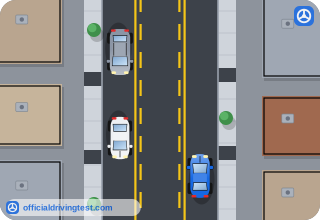
- Turning left
- Passing
- Turning right
- Slow vehicles
Show answer
Correct answer: Turning left
The center lane of such a highway is used only for turning left.
Source: Tennessee Comprehensive Driver License Manual (March 2025 printing), page 59 · Open this page in the manual (Manual page 59)
-
What kind of center line do two-lane highways have?
- A single solid white line
- Two solid white lines
- A single broken yellow line
- A broken white line
Show answer
Correct answer: A single broken yellow line
Two-lane highways have a single broken yellow center line, and you drive to its right except to pass safely.
Source: Tennessee Comprehensive Driver License Manual (March 2025 printing), page 59 · Open this page in the manual (Manual page 59)
-
What divides a four-lane (or more) highway in half in the center?
- A single broken yellow line
- Two solid yellow lines
- A single solid white line
- Two broken white lines
Show answer
Correct answer: Two solid yellow lines
A four-lane or wider highway is divided in half by two solid yellow lines in the center.
Source: Tennessee Comprehensive Driver License Manual (March 2025 printing), page 59 · Open this page in the manual (Manual page 59)
-
On a four-lane highway, what divides the two lanes on each side?
- A solid yellow line
- A double yellow line
- A solid white line
- A dashed white line
Show answer
Correct answer: A dashed white line
The two lanes going the same direction on each side are separated by a dashed white line.
Source: Tennessee Comprehensive Driver License Manual (March 2025 printing), page 60 · Open this page in the manual (Manual page 60)
-
What do red reflectors facing you on the lane lines mean?
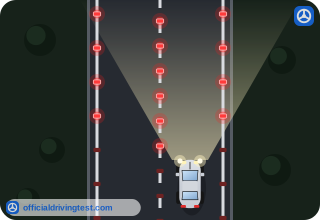
- A lane is reserved for buses
- You are on the wrong side of the road
- The lane ahead is closed
- You are approaching a school zone
Show answer
Correct answer: You are on the wrong side of the road
Red reflectors facing you on the lane lines, like red Wrong Way and Do Not Enter signs, mean you are on the wrong side of the road.
Source: Tennessee Comprehensive Driver License Manual (March 2025 printing), page 60 · Open this page in the manual (Manual page 60)
-
What do red reflectors on the lines at the edge of the road mean?
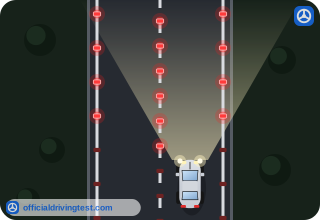
- The shoulder is closed to all traffic ahead
- The road ahead has a sharp curve in it
- You are approaching an exit ramp ahead
- You are on the wrong interstate or highway ramp
Show answer
Correct answer: You are on the wrong interstate or highway ramp
Red reflectors on the edge lines mean you are on the wrong interstate or highway ramp, so you pull over immediately.
Source: Tennessee Comprehensive Driver License Manual (March 2025 printing), page 60 · Open this page in the manual (Manual page 60)
-
A lane has both a turn arrow and a straight arrow. What may you do from this lane?
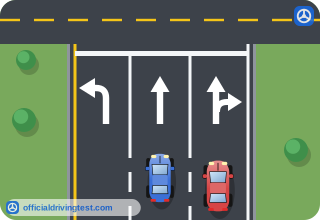
- Make only the turn that is shown
- Go straight only, without turning
- Go straight or make the indicated turn
- Make a U-turn only, never a turn
Show answer
Correct answer: Go straight or make the indicated turn
From a dual use lane you can proceed straight or make the indicated turn, as the markings or signs show.
Source: Tennessee Comprehensive Driver License Manual (March 2025 printing), page 60 · Open this page in the manual (Manual page 60)
-
How are shared center turn lanes marked on each side?
- By two solid white lines on each side
- By a single broken white line
- By solid yellow and broken yellow lines
- By solid white lines only
Show answer
Correct answer: By solid yellow and broken yellow lines
These lanes are marked on each side by solid yellow and broken yellow lines.
Source: Tennessee Comprehensive Driver License Manual (March 2025 printing), page 60 · Open this page in the manual (Manual page 60)
-
How are reversible lanes usually marked?
- By double solid yellow lines
- By single solid white lines
- By double-broken yellow lines
- By broken white lines
Show answer
Correct answer: By double-broken yellow lines
Reversible lanes, which carry traffic in opposite directions at different times, are usually marked by double-broken yellow lines.
Source: Tennessee Comprehensive Driver License Manual (March 2025 printing), page 61 · Open this page in the manual (Manual page 61)
-
You are driving on a two-lane road and a solid yellow line is in your lane. May you pass?
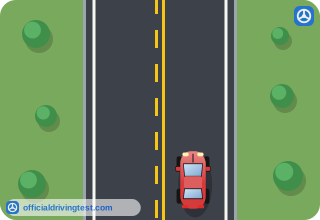
- Yes, if the way is clear
- Yes, if you signal first
- No, you cannot pass
- Yes, if the vehicle ahead is slow
Show answer
Correct answer: No, you cannot pass
A solid yellow line in your lane means you cannot pass.
Source: Tennessee Comprehensive Driver License Manual (March 2025 printing), page 62 · Open this page in the manual (Manual page 62)
-
On a two-lane road, double solid yellow lines separate the two directions of traffic. May you pass?
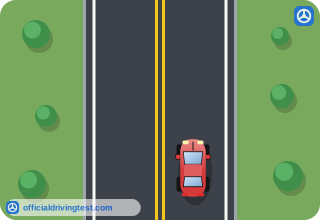
- Yes, if the way is clear
- No, you cannot pass
- Yes, if you signal first
- Yes, if the vehicle ahead is slow
Show answer
Correct answer: No, you cannot pass
Double yellow lines separating traffic mark a no-passing zone, so a driver cannot pass.
Source: Tennessee Comprehensive Driver License Manual (March 2025 printing), page 62 · Open this page in the manual (Manual page 62)
-
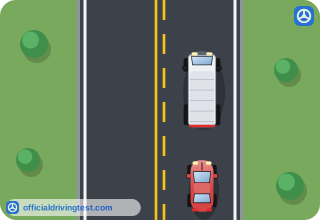
Your lane has a broken line and a solid yellow line is in the oncoming lane. When may you pass?
- Never, under any conditions
- Only if you are a slow-moving vehicle
- Only after sounding your horn
- If the way is clear
Show answer
Correct answer: If the way is clear
A solid yellow line only in the oncoming lane means you may pass with care if the way is clear.
Source: Tennessee Comprehensive Driver License Manual (March 2025 printing), page 62 · Open this page in the manual (Manual page 62)
-
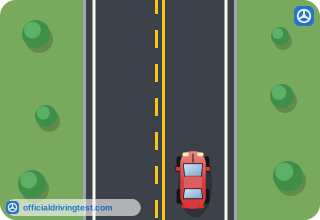
A solid yellow line is on your side of the center line marking. What does that mean for passing?
- You may cross it to pass if no vehicle is oncoming
- You may not cross the center line to pass another vehicle
- You may cross it to pass only on a straight road
- You may cross it to pass if you tap your horn first
Show answer
Correct answer: You may not cross the center line to pass another vehicle
A solid yellow line on your side means you may not cross the center line to pass.
Source: Tennessee Comprehensive Driver License Manual (March 2025 printing), page 63 · Open this page in the manual (Manual page 63)
-
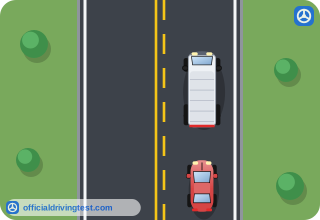
You may begin a pass only if you can complete it without interfering with an oncoming vehicle and before what happens?
- The vehicle you are passing begins to slow down
- The car behind you begins to pass you too
- The posted speed limit changes along the road
- The solid yellow line reappears in your traffic lane
Show answer
Correct answer: The solid yellow line reappears in your traffic lane
The pass must be finished before the solid yellow line returns to your lane.
Source: Tennessee Comprehensive Driver License Manual (March 2025 printing), page 63 · Open this page in the manual (Manual page 63)
-
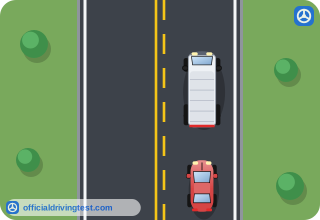
What does the end of a no-passing zone mean?
- It is now safe to pass, because the road ahead is clear of oncoming traffic
- You must now pass any slower vehicle that is ahead of you
- The speed limit ahead is higher than it was in the zone
- There is more visibility ahead, but you must still decide whether passing is safe
Show answer
Correct answer: There is more visibility ahead, but you must still decide whether passing is safe
The end of a no-passing zone only means visibility increases; the driver must still judge whether a pass is safe.
Source: Tennessee Comprehensive Driver License Manual (March 2025 printing), page 63 · Open this page in the manual (Manual page 63)
-
In a no-passing zone marked by a solid yellow line, when are you allowed to cross the center line?
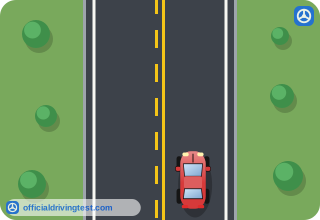
- To make a left turn into or out of a private road or driveway
- To pass a vehicle that is traveling well below the speed limit
- To pass a vehicle when you have signaled and the road looks clear
- To pass when the oncoming lane has been clear for a long distance
Show answer
Correct answer: To make a left turn into or out of a private road or driveway
The solid yellow line bars passing, but you may cross it to turn left into or out of an alley, intersection, private road or driveway.
Source: Tennessee Comprehensive Driver License Manual (March 2025 printing), page 63 · Open this page in the manual (Manual page 63)
-
What is the primary function of Rumble Stripes?
- To mark the center of a two-lane road
- To show drivers where a railroad crossing begins
- To improve wet-night visibility of the edge line
- To mark where passing is permitted
Show answer
Correct answer: To improve wet-night visibility of the edge line
Vibration and noise are only a secondary effect; the main purpose is to make the edge line easier to see on wet nights.
Source: Tennessee Comprehensive Driver License Manual (March 2025 printing), page 76 · Open this page in the manual (Manual page 76)
-
What are Rumble Stripes?
- Raised bumps placed across the travel lane
- Indentations with the edge line striped over them
- Painted lines that glow in the dark
- Rows of reflectors set in the center of the road
Show answer
Correct answer: Indentations with the edge line striped over them
Rumble Stripes are a series of indentations with the edge line striped over the top.
Source: Tennessee Comprehensive Driver License Manual (March 2025 printing), page 76 · Open this page in the manual (Manual page 76)
-
How do the indentations in Rumble Stripes improve the visibility of the line?
- They reflect headlights upward
- They keep snow from covering the line
- They make the paint glow in the dark
- They allow water to drain off the markings
Show answer
Correct answer: They allow water to drain off the markings
Water drains off the markings through the indentations, which helps the line show especially on wet nights.
Source: Tennessee Comprehensive Driver License Manual (March 2025 printing), page 76 · Open this page in the manual (Manual page 76)