Tennessee: Right-of-way, turning and passing — Passing Other Vehicles Practice Test
Questions in this part include: “The manual recommends not even considering passing several vehicles unless you are on what kind of road?” · “Where does the manual say not to pass on the right using the emergency lane?”
Independent educational site · not affiliated with any government agency or DMV
Ready? Test yourself
- Instant feedback with an explanation
- Every answer cites its source in the manual
- Your best score is saved on this device
- Keyboard: press 1 to 4 to answer and Enter for the next question
Questions are original and based on the official manual "Tennessee Comprehensive Driver License Manual" (March 2025 printing), Tennessee Department of Safety and Homeland Security.
All 21 questions in this practice test
Take the test above first, then use this list to study. Tap “Show answer” to see the correct answer and explanation.
Show the questions and answersHide the questions
-
What risk do you face if you cut back to your lane too soon after passing?
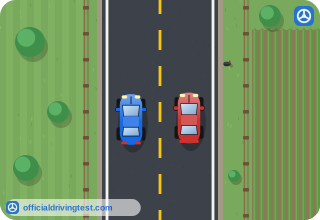
- Being rear-ended by a vehicle behind you
- Sideswiping the vehicle you are passing
- Running off the pavement on the right
- Stalling at the next intersection
Show answer
Correct answer: Sideswiping the vehicle you are passing
Cutting back too soon risks sideswiping the vehicle you are passing.
Source: Tennessee Comprehensive Driver License Manual (March 2025 printing), page 61 · Open this page in the manual (Manual page 61)
-
What risk do you face if you do not cut back to your lane soon enough after passing?
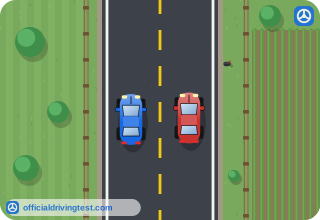
- Sideswiping the passed vehicle
- Being rear-ended by a vehicle behind you
- Running off the pavement on the right
- A head-on collision
Show answer
Correct answer: A head-on collision
Not cutting back soon enough risks a head-on collision.
Source: Tennessee Comprehensive Driver License Manual (March 2025 printing), page 61 · Open this page in the manual (Manual page 61)
-
As a rule, what should you do if you see any sign of an oncoming vehicle when deciding whether to pass?
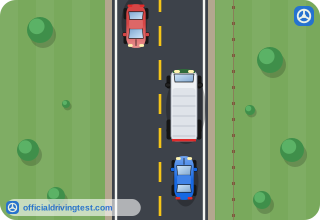
- Treat it as too close to risk a pass
- Pass if you can finish quickly
- Pass only if the other driver slows
- Pass only if you flash your headlights
Show answer
Correct answer: Treat it as too close to risk a pass
Any sign of an oncoming vehicle means it is too close for you to risk a pass.
Source: Tennessee Comprehensive Driver License Manual (March 2025 printing), page 62 · Open this page in the manual (Manual page 62)
-
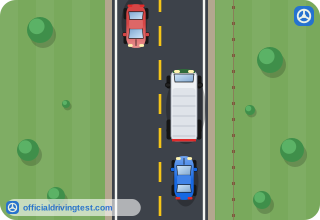
When in doubt about passing, what should you do?
- Speed up and pass quickly
- Pass on the shoulder
- Stay in your lane
- Flash your lights and pass
Show answer
Correct answer: Stay in your lane
When you are not sure a pass is safe, you stay in your lane.
Source: Tennessee Comprehensive Driver License Manual (March 2025 printing), page 62 · Open this page in the manual (Manual page 62)
-
Why should you stay well behind the vehicle you want to pass?
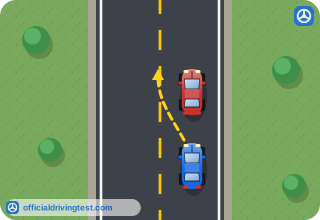
- To keep its exhaust out of your car
- To get a better view of the road ahead
- To warn the driver you will pass
- To let your engine speed up first
Show answer
Correct answer: To get a better view of the road ahead
Staying well back gives you a better view of the road ahead, so you can check for a no-passing zone and oncoming vehicles.
Source: Tennessee Comprehensive Driver License Manual (March 2025 printing), page 62 · Open this page in the manual (Manual page 62)
-
On a two-lane road, which side of a same-direction vehicle should you pass on?
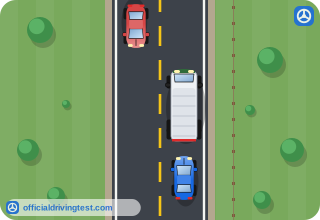
- The right
- Either side
- The shoulder
- The left
Show answer
Correct answer: The left
When overtaking a vehicle going your way on a two-lane road, you should pass only to its left.
Source: Tennessee Comprehensive Driver License Manual (March 2025 printing), page 62 · Open this page in the manual (Manual page 62)
-
You feel you must swing out across the center line for a look before passing. What does the manual say this means?
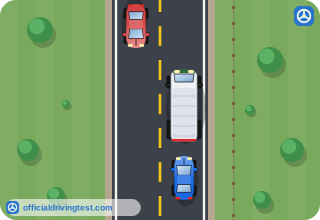
- The driver ahead is driving faster than the speed limit allows
- Your mirrors are not adjusted well enough to show the lane
- You are following too closely or cannot see far enough to pass safely
- You should give the driver ahead a longer warning signal
Show answer
Correct answer: You are following too closely or cannot see far enough to pass safely
Needing to swing out for a look means you are following too closely or attempting a pass where your sight distance is too limited.
Source: Tennessee Comprehensive Driver License Manual (March 2025 printing), page 62 · Open this page in the manual (Manual page 62)
-
Why should you check your blind spot before moving left to pass?
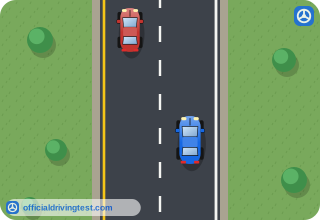
- Pedestrians may be crossing the road ahead
- A vehicle may be starting to pass around you
- A parked car may be on your right
- Oncoming traffic may be turning left
Show answer
Correct answer: A vehicle may be starting to pass around you
Another vehicle may already be starting a pass around yours, and it can sit in your blind spot.
Source: Tennessee Comprehensive Driver License Manual (March 2025 printing), page 62 · Open this page in the manual (Manual page 62)
-
When may you return to the right lane after passing?
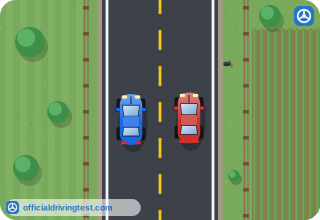
- As soon as your front bumper is past the other vehicle
- As soon as the other driver slows down to let you in
- Right after you flash your headlights at the other driver
- Once you can see the whole passed vehicle in your rearview mirror
Show answer
Correct answer: Once you can see the whole passed vehicle in your rearview mirror
You return when you can see the entire vehicle you passed in your rearview mirror; you then signal right and move over.
Source: Tennessee Comprehensive Driver License Manual (March 2025 printing), page 62 · Open this page in the manual (Manual page 62)
-
Is it illegal in Tennessee to pass more than one vehicle at a time?
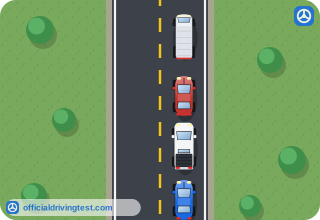
- Yes, it is illegal on two-lane roads
- Yes, it is illegal except on interstates
- No, but as a general rule it is not safe
- No, and it is always safe on straight roads
Show answer
Correct answer: No, but as a general rule it is not safe
The manual says it is not safe as a general rule to pass several vehicles at once, though it is not illegal in Tennessee.
Source: Tennessee Comprehensive Driver License Manual (March 2025 printing), page 62 · Open this page in the manual (Manual page 62)
-
If you consider passing several vehicles, you should be back in the right lane before coming within how far of no-passing markings or oncoming vehicles?
- 50 feet
- 100 feet
- 200 feet
- 300 feet
Show answer
Correct answer: 100 feet
The manual recommends completing the pass and returning to the right lane before coming within 100 feet of no-passing markings or oncoming vehicles.
Source: Tennessee Comprehensive Driver License Manual (March 2025 printing), page 62 · Open this page in the manual (Manual page 62)
-
The manual recommends not even considering passing several vehicles unless you are on what kind of road?
- A winding road with a slight hill ahead of you
- A road where a curve hides the oncoming lane
- A road with a solid yellow line in your lane
- A straight, level road with excellent visibility ahead
Show answer
Correct answer: A straight, level road with excellent visibility ahead
One condition is a straight, level roadway where your vision of oncoming traffic is excellent.
Source: Tennessee Comprehensive Driver License Manual (March 2025 printing), page 62 · Open this page in the manual (Manual page 62)
-
Why should you take extra precautions when passing in inclement weather and at twilight?
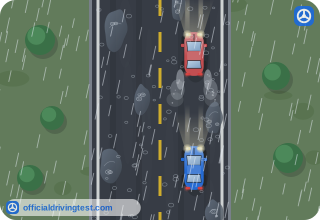
- Some oncoming vehicles may not be easily visible
- Headlights are not allowed in such conditions
- Passing is illegal in those conditions
- Other drivers cannot see your signals
Show answer
Correct answer: Some oncoming vehicles may not be easily visible
In bad weather and twilight, oncoming vehicles may be hard to see, especially if they are not using their headlights as required.
Source: Tennessee Comprehensive Driver License Manual (March 2025 printing), page 62 · Open this page in the manual (Manual page 62)
-
Why is passing at night harder if you do not know the road?
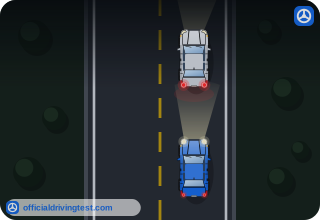
- Center lines are not painted at night
- Oncoming vehicles always use high beams
- It is harder to see where the passing zone ends
- Your headlights reflect off the road signs
Show answer
Correct answer: It is harder to see where the passing zone ends
At night it is more difficult to see where the passing zone ends, and a hill or curve ahead could prove deadly.
Source: Tennessee Comprehensive Driver License Manual (March 2025 printing), page 62 · Open this page in the manual (Manual page 62)
-
May you pass another vehicle on the right by driving off the pavement of the roadway?
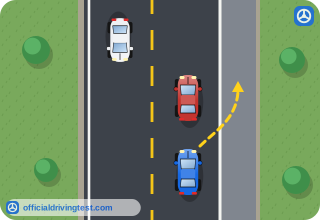
- Yes, if the shoulder is wide
- No, never
- Yes, if the other vehicle is slow
- Yes, if the other driver signals
Show answer
Correct answer: No, never
Passing on the right is never permitted by driving off the pavement of the roadway.
Source: Tennessee Comprehensive Driver License Manual (March 2025 printing), page 62 · Open this page in the manual (Manual page 62)
-
Under which condition may you pass another vehicle on the right?
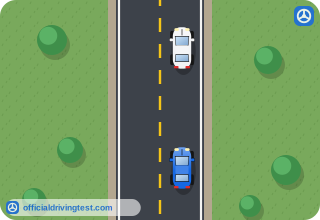
- The vehicle ahead is driving below the speed limit
- A solid yellow line is in the oncoming lane
- The vehicle ahead is a truck or a bus
- The vehicle ahead has signaled a left turn
Show answer
Correct answer: The vehicle ahead has signaled a left turn
You may pass on the right when the vehicle overtaken has signaled, or is about to make, a left turn.
Source: Tennessee Comprehensive Driver License Manual (March 2025 printing), page 62 · Open this page in the manual (Manual page 62)
-
What should you never do to a driver who has signaled a left turn?
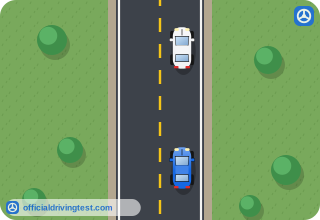
- Pass on the left of that driver
- Pass on the right of that driver
- Stop behind that driver
- Signal a turn yourself
Show answer
Correct answer: Pass on the left of that driver
The manual says never to pass on the left of a driver who has signaled a left turn.
Source: Tennessee Comprehensive Driver License Manual (March 2025 printing), page 62 · Open this page in the manual (Manual page 62)
-
On which kind of road may you pass on the right if the pavement is free from obstruction and wide enough for two or more lanes?
- A two-way road with one lane each way
- A road with parked vehicles on the right
- A one-way street restricted to one direction
- A road that is under construction
Show answer
Correct answer: A one-way street restricted to one direction
Passing on the right is allowed on a one-way street that is free from obstruction and paved for two or more lanes of moving vehicles.
Source: Tennessee Comprehensive Driver License Manual (March 2025 printing), page 62 · Open this page in the manual (Manual page 62)
-
May you pass on the right using a bike lane or a parking lane?
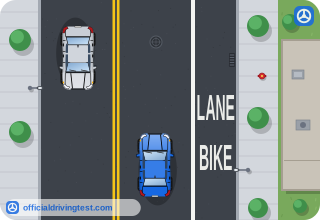
- Yes, if no cyclists are present
- No, not at any location
- Yes, on streets under 25 m.p.h.
- Yes, if you signal first
Show answer
Correct answer: No, not at any location
The manual says not to pass on the right using a bike lane or parking lane at any location.
Source: Tennessee Comprehensive Driver License Manual (March 2025 printing), page 62 · Open this page in the manual (Manual page 62)
-
Where does the manual say not to pass on the right using the emergency lane?
- On any road without a paved shoulder
- Only on the interstate highway or its ramps
- Within one mile of a school zone
- Within sight of a traffic light or stop sign
Show answer
Correct answer: Within sight of a traffic light or stop sign
You do not pass on the right in the emergency lane within sight of a traffic light or stop sign, as at intersections with stopped vehicles.
Source: Tennessee Comprehensive Driver License Manual (March 2025 printing), page 62 · Open this page in the manual (Manual page 62)
-
A driver passes on the right and crashes into a car ahead that starts a right turn when the light changes. Who is “at fault”?
- The person passing on the right
- The driver who was turning right
- Neither driver
- Both drivers equally
Show answer
Correct answer: The person passing on the right
The person passing on the right is at fault because the vehicle turning right was properly traveling within the marked lane of traffic.
Source: Tennessee Comprehensive Driver License Manual (March 2025 printing), page 62 · Open this page in the manual (Manual page 62)