Tennessee: Right-of-way, turning and passing
Who yields at intersections, turns and U-turns, roundabouts, lane use and passing other vehicles. Split into 7 shorter tests so you're not stuck in one long quiz.
Independent educational site · not affiliated with any government agency or DMV
Choose a part
Right-of-way, turning and passing — Stops, Malfunctioning Lights and Intersections
Questions in this part include: “To avoid being stranded inside a busy intersection, when should you pull in to make a turn?”
StartRight-of-way, turning and passing — Right-of-Way Procedures
Questions in this part include: “What does the manual say the law does about the right-of-way?”
StartRight-of-way, turning and passing — Turning Basics
Questions in this part include: “Which of these is listed among the most common faults when making turns?”
StartRight-of-way, turning and passing — Left Turns
Questions in this part include: “Before making a left turn, whom must you yield to?”
StartRight-of-way, turning and passing — Right Turns, Roundabouts and U-Turns
Questions in this part include: “What else are roundabouts, traffic circles and rotaries known as?”
StartRight-of-way, turning and passing — Traffic Lanes and Lane Usage
Questions in this part include: “On a divided four-lane highway, how should you treat a crossover when you use it for a left turn?”
StartRight-of-way, turning and passing — Passing Other Vehicles
Questions in this part include: “The manual recommends not even considering passing several vehicles unless you are on what kind of road?”
StartAll 129 Right-of-way, turning and passing questions with answers
Choose a part above to take a practice test, or study every question and answer here.
Show the questions and answersHide the questions
-
You are turning left on a green light without an arrow. What must you do?
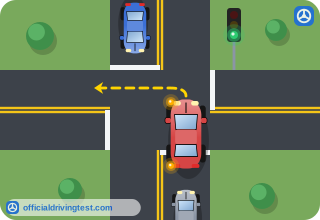
- Turn quickly before oncoming traffic arrives
- Yield to oncoming vehicles
- Turn first, because left turns have priority
- Stop and wait for a green arrow to appear
Show answer
Correct answer: Yield to oncoming vehicles
A green light does not remove the right-of-way laws, so a left-turning driver yields to oncoming vehicles.
Source: Tennessee Comprehensive Driver License Manual (March 2025 printing), page 41 · Open this page in the manual (Manual page 41)
-
To avoid being stranded inside a busy intersection, when should you pull in to make a turn?
- Only when your path is clear
- As soon as your light turns green
- Whenever you have your turn signal on
- As soon as the vehicle ahead of you moves
Show answer
Correct answer: Only when your path is clear
Do not enter an intersection to turn until your path through it is clear, so you are not left stranded there.
Source: Tennessee Comprehensive Driver License Manual (March 2025 printing), page 41 · Open this page in the manual (Manual page 41)
-
According to Tennessee state law, how must you treat an intersection where the traffic signal is not working?
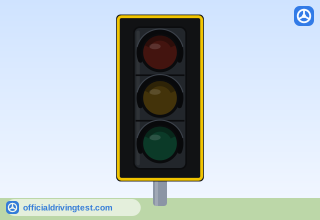
- As a yield intersection
- As an intersection with a flashing yellow signal
- As an all-way stop intersection
- As an intersection where the larger road has the right-of-way
Show answer
Correct answer: As an all-way stop intersection
If a signal is out, Tennessee law requires you to treat the intersection as an all-way stop and not proceed until it is safe.
Source: Tennessee Comprehensive Driver License Manual (March 2025 printing), page 41 · Open this page in the manual (Manual page 41)
-
Two or more vehicles stop at the same time at an intersection where the signal is out. Who yields?
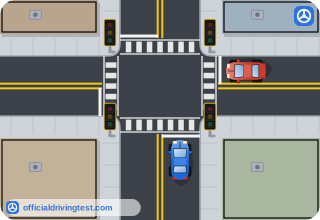
- The driver on the right yields to the driver on the left
- The driver on the left yields to the driver on the right
- The driver in the faster vehicle yields to the slower one
- The driver who has the louder horn goes first
Show answer
Correct answer: The driver on the left yields to the driver on the right
When vehicles reach the intersection together, the driver on the left yields to the driver on the right.
Source: Tennessee Comprehensive Driver License Manual (March 2025 printing), page 42 · Open this page in the manual (Manual page 42)
-
In the United States, which way do drivers turn when going around a traffic circle or roundabout?
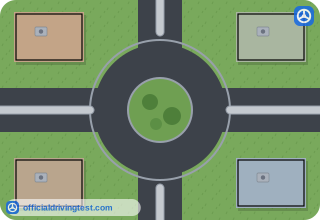
- To the right
- To the left
- Whichever way is shorter
- Toward the center island first
Show answer
Correct answer: To the right
Right-hand traffic is the rule, so drivers keep to the right side of the road and turn right around circles, roundabouts and town squares.
Source: Tennessee Comprehensive Driver License Manual (March 2025 printing), page 45 · Open this page in the manual (Manual page 45)
-
According to Tennessee law, where must every driver approaching a stop sign stop?
- Past the crosswalk, in the middle of the intersection
- Only at the sign itself, even if a line is painted
- Before the nearest side of a crosswalk, or at a stop line
- Wherever traffic first appears from the sides
Show answer
Correct answer: Before the nearest side of a crosswalk, or at a stop line
The driver must stop before the nearest side of a crosswalk, or at a clearly marked stop line.
Source: Tennessee Comprehensive Driver License Manual (March 2025 printing), page 49 · Open this page in the manual (Manual page 49)
-
How does Tennessee Code define "stop"?
- Slowing to under 5 m.p.h.
- Slowing enough to see cross traffic
- Complete cessation of movement
- Lifting your foot off the gas pedal
Show answer
Correct answer: Complete cessation of movement
Tennessee Code defines a stop as complete cessation of movement, not a rolling stop.
Source: Tennessee Comprehensive Driver License Manual (March 2025 printing), page 49 · Open this page in the manual (Manual page 49)
-
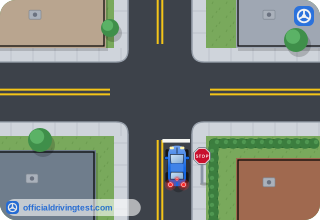
At a stop sign, what should you do if you cannot see whether the intersection is clear of crossing traffic?
- Accelerate quickly through the intersection
- Sound your horn and proceed
- Back up and approach again at a higher speed
- Edge up slowly until you can see traffic both ways
Show answer
Correct answer: Edge up slowly until you can see traffic both ways
You should edge up slowly until you can clearly see traffic from both directions.
Source: Tennessee Comprehensive Driver License Manual (March 2025 printing), page 50 · Open this page in the manual (Manual page 50)
-
What is a rolling stop?
- Only slowing down at a stop sign or signal
- Stopping with your wheels turned toward the curb
- Stopping a short distance past the stop line
- Stopping and then backing up
Show answer
Correct answer: Only slowing down at a stop sign or signal
A rolling stop is only slowing down for a stop sign or signal and going on without coming to a full stop; it is dangerous and illegal.
Source: Tennessee Comprehensive Driver License Manual (March 2025 printing), page 50 · Open this page in the manual (Manual page 50)
-
Most law enforcement officers and driver education instructors agree a vehicle has not come to a complete stop until when?
- The brake lights turn on
- The driver feels the car lurch forward
- The driver counts to two
- The driver sees the cross traffic clear
Show answer
Correct answer: The driver feels the car lurch forward
You have stopped completely only when you feel the car lurch forward after all motion has ceased.
Source: Tennessee Comprehensive Driver License Manual (March 2025 printing), page 50 · Open this page in the manual (Manual page 50)
-
Which of these does the manual list as an intersection?
- A stretch of interstate with no ramps
- A bridge over a river
- The shoulder of a rural road
- A shopping center or parking lot entrance
Show answer
Correct answer: A shopping center or parking lot entrance
The manual counts cross streets, side streets, driveways and shopping center or parking lot entrances as intersections.
Source: Tennessee Comprehensive Driver License Manual (March 2025 printing), page 52 · Open this page in the manual (Manual page 52)
-
Which advice does the manual give about approaching any intersection or driveway?
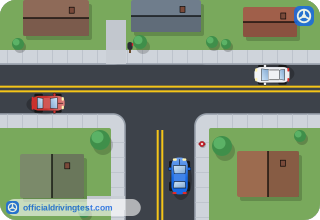
- Never assume the other driver will yield the right-of-way to you
- Assume cross traffic will stop if you have a green light
- Assume the driver on your right will wait for you
- Assume oncoming drivers will see your turn signal
Show answer
Correct answer: Never assume the other driver will yield the right-of-way to you
You should never assume another driver will yield and should always be ready to stop.
Source: Tennessee Comprehensive Driver License Manual (March 2025 printing), page 52 · Open this page in the manual (Manual page 52)
-
What does the manual mean by “traffic checks”?
- Looking often and carefully for traffic approaching from each direction
- Stopping at every intersection to count the vehicles that pass
- Checking that your signals and brake lights work before driving
- Reading the signs posted before an intersection for warnings
Show answer
Correct answer: Looking often and carefully for traffic approaching from each direction
Traffic checks means looking often and carefully for traffic coming from every direction, especially when merging, changing lanes and at intersections.
Source: Tennessee Comprehensive Driver License Manual (March 2025 printing), page 52 · Open this page in the manual (Manual page 52)
-
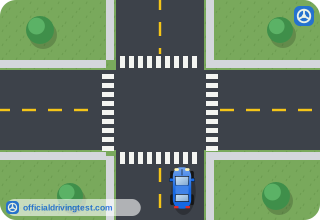
Under the Left-Right-Left Rule, which way do you look first as you approach an intersection?
- To the right, to see who is coming from that side
- To the left, to make sure cross traffic is yielding
- Straight ahead, at the signal
- Behind you, at traffic you are leaving
Show answer
Correct answer: To the left, to make sure cross traffic is yielding
You look left first to see that cross traffic is yielding, then to the right, and then check again.
Source: Tennessee Comprehensive Driver License Manual (March 2025 printing), page 52 · Open this page in the manual (Manual page 52)
-
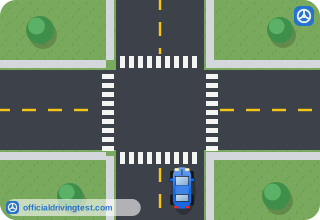
How should you handle your speed when approaching and crossing an intersection?
- Keep a steady speed all the way through and brake only if the light turns red
- Speed up as you approach it so that you clear it as quickly as possible
- Slow before the intersection, slowest just before entering, then speed up gradually
- Slow down only when you see another vehicle close to the intersection
Show answer
Correct answer: Slow before the intersection, slowest just before entering, then speed up gradually
The manual says to slow down before the intersection, drive at your slowest just before entering and gradually increase speed as you cross.
Source: Tennessee Comprehensive Driver License Manual (March 2025 printing), page 52 · Open this page in the manual (Manual page 52)
-
Where should you be before you reach an intersection?
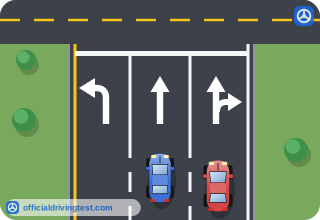
- In the left lane whatever your direction
- In the lane with the fewest vehicles
- In the center lane until the intersection is clear
- In the proper lane for the direction you intend to travel
Show answer
Correct answer: In the proper lane for the direction you intend to travel
Be in the proper lane before the intersection and avoid last-minute lane changes.
Source: Tennessee Comprehensive Driver License Manual (March 2025 printing), page 52 · Open this page in the manual (Manual page 52)
-
What does the manual say about passing another vehicle in an intersection?
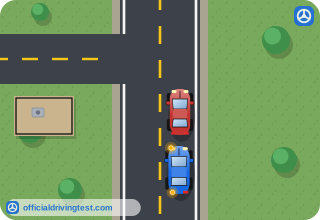
- Allowed when the road is clear
- Allowed only on the right
- Do not do it
- Allowed if you signal first
Show answer
Correct answer: Do not do it
The manual says not to pass a vehicle in an intersection.
Source: Tennessee Comprehensive Driver License Manual (March 2025 printing), page 52 · Open this page in the manual (Manual page 52)
-
When is it illegal to block an intersection after the traffic light has changed?
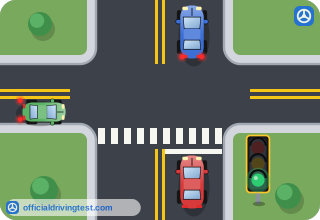
- Only where a “Do Not Block Intersection” sign is posted
- Only during rush hour
- Only when a police officer is present
- Always, whether or not the intersection is marked
Show answer
Correct answer: Always, whether or not the intersection is marked
Blocking an intersection is illegal everywhere, with or without a sign.
Source: Tennessee Comprehensive Driver License Manual (March 2025 printing), page 53 · Open this page in the manual (Manual page 53)
-
What does the manual say the law does about the right-of-way?
- It gives the right-of-way to the faster vehicle
- It only says who must yield the right-of-way
- It gives the right-of-way to the larger vehicle
- It gives the right-of-way to the driver who signals first
Show answer
Correct answer: It only says who must yield the right-of-way
The law does not really give anyone the right-of-way; it only says who must yield.
Source: Tennessee Comprehensive Driver License Manual (March 2025 printing), page 53 · Open this page in the manual (Manual page 53)
-
Another driver does not follow the right-of-way rules. What does the manual say you should do?
- Give that driver the right-of-way
- Insist on your right-of-way and sound the horn
- Hold your speed so the other driver must stop
- Flash your headlights and proceed first
Show answer
Correct answer: Give that driver the right-of-way
The right-of-way is something to be given, not taken, so you yield to a driver who ignores the rules.
Source: Tennessee Comprehensive Driver License Manual (March 2025 printing), page 53 · Open this page in the manual (Manual page 53)
-
When meeting other traffic at an intersection or when entering the roadway, what does the manual advise?
- Sound your horn before you enter the roadway or intersection
- Make sure the other driver sees you; make eye contact if you can
- Flash your headlights and pull out ahead of the other driver
- Speed up so the other driver has less time to react to you
Show answer
Correct answer: Make sure the other driver sees you; make eye contact if you can
The manual says to make sure the other driver sees you and to make eye contact when you can.
Source: Tennessee Comprehensive Driver License Manual (March 2025 printing), page 53 · Open this page in the manual (Manual page 53)
-
You are starting from a parked position. What must you do?
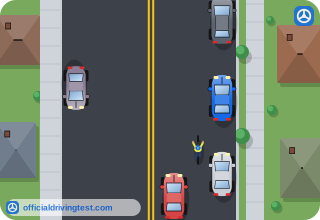
- Signal and pull out ahead of slower vehicles
- Move out as soon as the nearest car passes
- Pull out first if you are the larger vehicle
- Wait for all moving traffic to pass
Show answer
Correct answer: Wait for all moving traffic to pass
The manual says to wait for all moving traffic to pass when starting from a parked position.
Source: Tennessee Comprehensive Driver License Manual (March 2025 printing), page 53 · Open this page in the manual (Manual page 53)
-
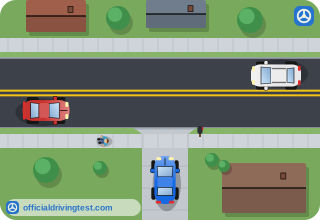
You are entering a main road from a driveway, alley, parking lot or roadside. Who must you yield to?
- Only vehicles approaching from your right
- Only vehicles in the lane nearest you
- All vehicles already on the main road
- Only vehicles traveling faster than you
Show answer
Correct answer: All vehicles already on the main road
The driver entering from a driveway, alley, parking lot or roadside yields to all vehicles already on the main road.
Source: Tennessee Comprehensive Driver License Manual (March 2025 printing), page 53 · Open this page in the manual (Manual page 53)
-
You are entering a roundabout, traffic circle or rotary. Who must you yield to?
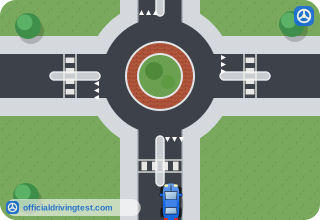
- Traffic already in the roundabout
- Traffic waiting to enter on your left
- Traffic entering at the same time on your right
- No one, because entering vehicles go first
Show answer
Correct answer: Traffic already in the roundabout
Drivers entering a roundabout yield to the traffic already circulating in it.
Source: Tennessee Comprehensive Driver License Manual (March 2025 printing), page 53 · Open this page in the manual (Manual page 53)
-
What else are roundabouts, traffic circles and rotaries known as?
- “Cross junctions”
- “Town squares”
- “Loop ramps”
- “Merge areas”
Show answer
Correct answer: “Town squares”
The manual says roundabouts, traffic circles and rotaries are also known as town squares.
Source: Tennessee Comprehensive Driver License Manual (March 2025 printing), page 53 · Open this page in the manual (Manual page 53)
-
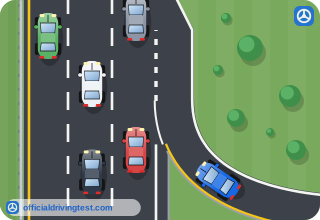
You are approaching a merge onto a busy highway or interstate. What must you do?
- Stop at the end of the ramp and wait for a gap in traffic
- Hold a steady speed and let the other drivers adjust to you
- Increase or decrease speed as needed, and yield if necessary
- Move onto the highway first if you are using your turn signal
Show answer
Correct answer: Increase or decrease speed as needed, and yield if necessary
At a merge you adjust your speed as needed and yield the right-of-way if necessary.
Source: Tennessee Comprehensive Driver License Manual (March 2025 printing), page 53 · Open this page in the manual (Manual page 53)
-
You have the right-of-way and another driver yields it to you. What does the manual say to do?
- Wait for the other driver to wave twice
- Wait until the other driver has gone
- Proceed immediately
- Stop and signal your thanks first
Show answer
Correct answer: Proceed immediately
If another driver yields the right-of-way to you, you proceed immediately.
Source: Tennessee Comprehensive Driver License Manual (March 2025 printing), page 53 · Open this page in the manual (Manual page 53)
-
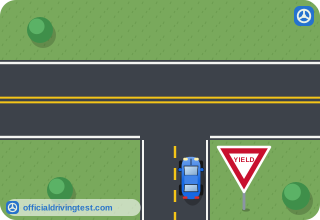
At an intersection with YIELD signs posted, what must the driver do?
- Always come to a complete stop and wait for a clear road
- Speed up so you can merge ahead of oncoming traffic
- Stop only if a pedestrian is crossing in front of you
- Slow down or stop to avoid a crash with oncoming traffic
Show answer
Correct answer: Slow down or stop to avoid a crash with oncoming traffic
At a YIELD sign the driver slows down or stops as needed to avoid a crash with oncoming traffic.
Source: Tennessee Comprehensive Driver License Manual (March 2025 printing), page 54 · Open this page in the manual (Manual page 54)
-
You have a green traffic light, but a vehicle is still in the intersection. What must you do?
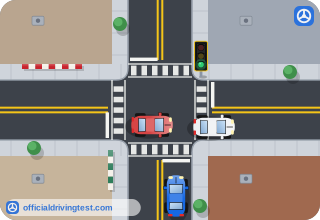
- Go ahead, because you have the green light
- Yield to the vehicle already in the intersection
- Sound your horn and proceed
- Go first if you are in the right lane
Show answer
Correct answer: Yield to the vehicle already in the intersection
You yield to any vehicles already in the intersection, even when your light is green.
Source: Tennessee Comprehensive Driver License Manual (March 2025 printing), page 54 · Open this page in the manual (Manual page 54)
-
At a “T” intersection where one road dead-ends into a main crossing road, who must yield?
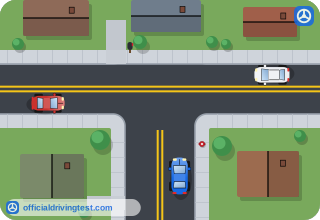
- Vehicles on the road that ends, to traffic from both directions
- Vehicles on the main road, to those entering from the ending road
- The vehicle arriving last, whichever road it happens to be on
- Vehicles turning left, to vehicles turning right and no one else
Show answer
Correct answer: Vehicles on the road that ends, to traffic from both directions
Vehicles on the dead-end road yield to oncoming traffic from both directions on the main road.
Source: Tennessee Comprehensive Driver License Manual (March 2025 printing), page 54 · Open this page in the manual (Manual page 54)
-
When may you turn left at an intersection without yielding to oncoming vehicles going straight or turning right?
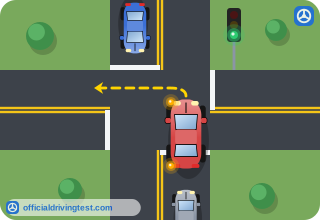
- When you have a steady green light and the road looks clear
- When your turn signal has been flashing for at least 50 feet
- When you are the first vehicle in line at the intersection
- When you have a protected green arrow for your left turn
Show answer
Correct answer: When you have a protected green arrow for your left turn
You yield to oncoming vehicles when turning left unless your left turn is on a protected green arrow.
Source: Tennessee Comprehensive Driver License Manual (March 2025 printing), page 54 · Open this page in the manual (Manual page 54)
-
At an intersection marked as an all-way stop, who goes first?
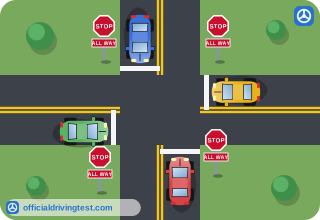
- The vehicle that reaches the intersection first
- The vehicle that approaches from the left
- The largest vehicle that is at the intersection
- The vehicle that is going straight ahead
Show answer
Correct answer: The vehicle that reaches the intersection first
At an all-way stop the first vehicle to reach the intersection goes first, though all vehicles must stop.
Source: Tennessee Comprehensive Driver License Manual (March 2025 printing), page 54 · Open this page in the manual (Manual page 54)
-
At an all-way stop, more than one vehicle arrives at the same time. Which one yields to which?
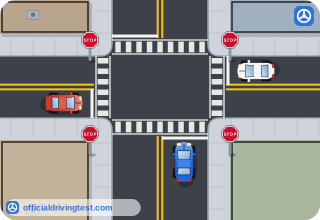
- Yield to the vehicle on your left
- Yield to the vehicle on your right
- Yield to the larger vehicle
- Yield to the vehicle that signals first
Show answer
Correct answer: Yield to the vehicle on your right
When vehicles arrive together at an all-way stop, you yield the right-of-way to the vehicle on your right.
Source: Tennessee Comprehensive Driver License Manual (March 2025 printing), page 54 · Open this page in the manual (Manual page 54)
-
Roads cross and there are no stop signs or signals. Two vehicles arrive at the same time. What must you do?
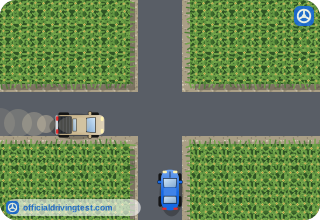
- Yield to the vehicle coming on your left
- Yield to the vehicle that is moving faster
- Yield to the vehicle coming on your right
- Go first if you are on the wider road
Show answer
Correct answer: Yield to the vehicle coming on your right
Where roads cross without signs or signals, you yield to any vehicle coming at the same time on your right.
Source: Tennessee Comprehensive Driver License Manual (March 2025 printing), page 54 · Open this page in the manual (Manual page 54)
-
When may you enter an intersection, according to the manual?
- Whenever your light is green, even if traffic ahead is stopped
- Whenever you have signaled, even if the crossing is blocked
- Only when you can get through it without having to stop
- Only when you are in the right lane
Show answer
Correct answer: Only when you can get through it without having to stop
You should wait until traffic in front of you clears so you do not block the intersection, or you could be ticketed.
Source: Tennessee Comprehensive Driver License Manual (March 2025 printing), page 54 · Open this page in the manual (Manual page 54)
-
Which of these is listed among the most common faults when making turns?
- Slowing down before the turn
- Turning on a green light
- Checking mirrors before the turn
- Turning from the wrong lane
Show answer
Correct answer: Turning from the wrong lane
The common turning faults include failing to signal, not signaling long enough, failing to search for hazards, turning from the wrong lane and failing to turn properly.
Source: Tennessee Comprehensive Driver License Manual (March 2025 printing), page 55 · Open this page in the manual (Manual page 55)
-
Where do the rules for turning apply?
- At all locations, even driveways and alleys
- Only at intersections
- Only at intersections with traffic signals
- Only on roads with painted lane lines
Show answer
Correct answer: At all locations, even driveways and alleys
The manual says turning rules apply at all locations, not just at intersections.
Source: Tennessee Comprehensive Driver License Manual (March 2025 printing), page 55 · Open this page in the manual (Manual page 55)
-
What is the first rule of turning?
- From the center lane into whichever lane happens to be open and clear
- From the closest lane in your direction to the closest legal lane
- From the left lane into the farthest lane in the direction you want
- From whichever lane has the least traffic into the nearest open lane
Show answer
Correct answer: From the closest lane in your direction to the closest legal lane
The first rule is to turn from the closest lane in your direction to the closest legal lane in the direction you want to go.
Source: Tennessee Comprehensive Driver License Manual (March 2025 printing), page 55 · Open this page in the manual (Manual page 55)
-
Before making a turn, where should you check for traffic?
- Ahead only
- Ahead and to the right only
- Ahead, behind and to the side
- Behind only
Show answer
Correct answer: Ahead, behind and to the side
The manual says to check traffic ahead, behind and to the side before making a turn.
Source: Tennessee Comprehensive Driver License Manual (March 2025 printing), page 56 · Open this page in the manual (Manual page 56)
-
How does the speed of traffic affect when you should move into the correct turn lane?
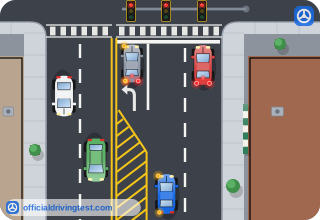
- The faster the traffic is moving, the later you should move into the proper lane
- The faster the traffic is moving, the sooner you should move into the proper lane
- You should always wait until you reach the intersection
- You should move only when the car ahead has turned
Show answer
Correct answer: The faster the traffic is moving, the sooner you should move into the proper lane
Move into the correct turn lane as soon as possible, and sooner when traffic moves faster.
Source: Tennessee Comprehensive Driver License Manual (March 2025 printing), page 56 · Open this page in the manual (Manual page 56)
-
How should you move from one lane to another when getting into a turn lane?
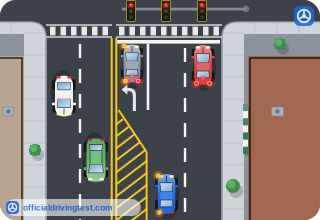
- Gradually, drifting across several lanes at the same time
- By weaving back and forth between lanes to find a gap
- By slowing to a stop in the lane and then crossing over
- As directly as possible, without interfering with traffic
Show answer
Correct answer: As directly as possible, without interfering with traffic
Go from one lane to the other as directly as possible without crossing lane lines or interfering with traffic.
Source: Tennessee Comprehensive Driver License Manual (March 2025 printing), page 56 · Open this page in the manual (Manual page 56)
-
When should you select the proper gear for a turn?
- While you are in the middle of the intersection
- Before entering the intersection
- While you are turning the wheel
- After you finish the turn
Show answer
Correct answer: Before entering the intersection
Select the gear before entering the intersection and accelerate slightly through the turn; do not shift in the intersection.
Source: Tennessee Comprehensive Driver License Manual (March 2025 printing), page 56 · Open this page in the manual (Manual page 56)
-
Which of these should you avoid while actually turning?
- Checking for pedestrians and cyclists
- Maintaining a safe speed
- Braking or depressing the clutch
- Staying in the proper lane
Show answer
Correct answer: Braking or depressing the clutch
The manual says not to brake or depress the clutch while actually turning.
Source: Tennessee Comprehensive Driver License Manual (March 2025 printing), page 56 · Open this page in the manual (Manual page 56)
-
Why should you not shift gears in an intersection?
- If you stall, you could cause an accident or block the intersection
- It uses more fuel than shifting before you reach the intersection
- It can damage the clutch and the transmission of the vehicle
- It is not allowed on any road that has painted lane lines
Show answer
Correct answer: If you stall, you could cause an accident or block the intersection
Stalling in the intersection could cause an accident or block other traffic.
Source: Tennessee Comprehensive Driver License Manual (March 2025 printing), page 56 · Open this page in the manual (Manual page 56)
-
After you have completed a turn, what does the manual say about changing lanes?
- Change lanes in the middle of the turn whenever it saves time
- Always stay in the lane where the turn ended for several blocks
- Change lanes right away, before you check the traffic behind
- Finish the turn in the proper lane; change lanes later if you need to
Show answer
Correct answer: Finish the turn in the proper lane; change lanes later if you need to
Finish the turn in the proper lane and only then change to another lane if needed and clear.
Source: Tennessee Comprehensive Driver License Manual (March 2025 printing), page 56 · Open this page in the manual (Manual page 56)
-
When you approach a left turn on a two-way street, where should the left side of your vehicle be?
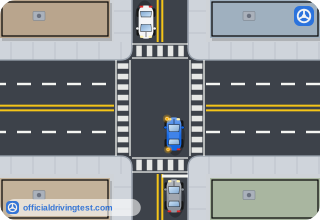
- As close to the center line as possible
- About one lane width from the center line
- Close to the right curb to leave room
- Over the center line to see oncoming cars
Show answer
Correct answer: As close to the center line as possible
The manual says to approach a left turn with the left side of the vehicle as close to the center line as possible.
Source: Tennessee Comprehensive Driver License Manual (March 2025 printing), page 57 · Open this page in the manual (Manual page 57)
-
Before making a left turn, whom must you yield to?
- Only vehicles coming from behind you
- Oncoming cars and pedestrians
- Only oncoming trucks and buses
- No one, as long as you signaled
Show answer
Correct answer: Oncoming cars and pedestrians
You look for pedestrians and other traffic in your turn path and yield to any oncoming cars or pedestrians.
Source: Tennessee Comprehensive Driver License Manual (March 2025 printing), page 57 · Open this page in the manual (Manual page 57)
-
When you turn left onto a two-way street, which lane should you turn into?
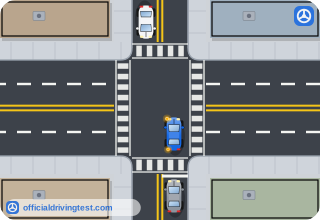
- The lane closest to the right curb
- The lane farthest from the center line
- Whichever lane has the least traffic
- The first lane past the center line
Show answer
Correct answer: The first lane past the center line
You drive just right of the center line of the street you enter and turn into the first lane past the center line.
Source: Tennessee Comprehensive Driver License Manual (March 2025 printing), page 57 · Open this page in the manual (Manual page 57)
-
Why should you never turn “wide” into the right lane when making a left turn?
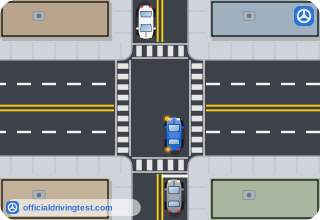
- Oncoming vehicles turning right will use that lane
- Drivers behind you cannot see your signal there
- That lane is always reserved for buses
- Pedestrians are not allowed to cross there
Show answer
Correct answer: Oncoming vehicles turning right will use that lane
The right lane is used by oncoming vehicles making a right turn, so turning wide into it causes a conflict.
Source: Tennessee Comprehensive Driver License Manual (March 2025 printing), page 57 · Open this page in the manual (Manual page 57)
-
An intersection has a lane signed or marked for making left turns. From which lane should you make your left turn?
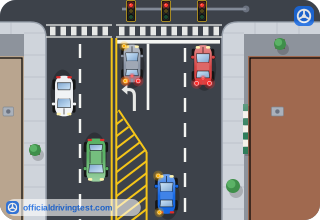
- From any lane, if you signal early
- From the lane nearest the right curb
- Only from the lane marked for left turns
- From the lane with the fewest cars
Show answer
Correct answer: Only from the lane marked for left turns
When a lane is signed or marked for left turns, you must not make the turn from any other lane.
Source: Tennessee Comprehensive Driver License Manual (March 2025 printing), page 57 · Open this page in the manual (Manual page 57)
-
At an intersection with several lanes for turning, where should you keep your vehicle during the turn?
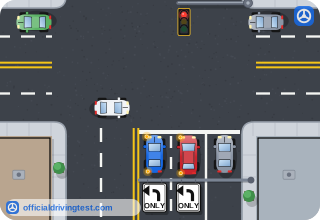
- In the least crowded lane as you turn
- In the lane you started from
- In the outer lane once you cross the line
- In the inside lane after the crosswalk
Show answer
Correct answer: In the lane you started from
If there are multiple lanes, you keep your vehicle in the lane you start from throughout the turn.
Source: Tennessee Comprehensive Driver License Manual (March 2025 printing), page 57 · Open this page in the manual (Manual page 57)
-
When you turn left from a two-way street onto a one-way street, which lane should you turn into?
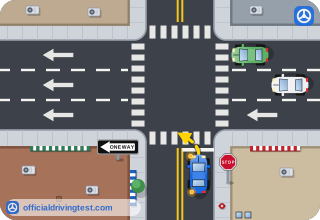
- The first lane, closest to the left curb
- The lane closest to the right curb
- The center lane of the one-way street
- The lane farthest from the left curb
Show answer
Correct answer: The first lane, closest to the left curb
Both lanes on the one-way street travel the same way, so you turn sharply into the first lane closest to the left curb.
Source: Tennessee Comprehensive Driver License Manual (March 2025 printing), page 57 · Open this page in the manual (Manual page 57)
-
When you turn left from a one-way street onto another one-way street, which lane should you approach in?
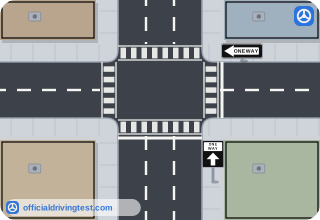
- The lane closest to the right curb
- The center lane of the street
- The lane farthest to the left, by the left curb
- Any lane, then merge left in the intersection
Show answer
Correct answer: The lane farthest to the left, by the left curb
You make the approach in the traffic lane furthest to the left curb and turn sharply into the first lane on the left.
Source: Tennessee Comprehensive Driver License Manual (March 2025 printing), page 57 · Open this page in the manual (Manual page 57)
-
When you turn left from a one-way street onto a two-way street, which lane should you turn into?
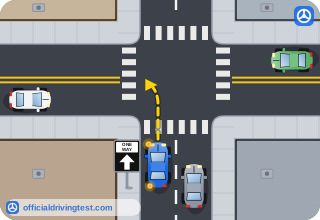
- The first lane right of the yellow line
- The lane nearest the left curb
- The lane farthest from the yellow line
- The lane nearest the right curb
Show answer
Correct answer: The first lane right of the yellow line
You drive into the intersection and turn sharply into the first lane to the right of the yellow line on the two-way street.
Source: Tennessee Comprehensive Driver License Manual (March 2025 printing), page 57 · Open this page in the manual (Manual page 57)
-
You turn left from a one-way street onto a two-way street with several lanes. When may you move into the right lane?
- Right away, before you have finished the turn itself
- Only when no other vehicle is behind your own car
- Only after signaling and checking traffic to your right
- Only after you have passed the next intersection
Show answer
Correct answer: Only after signaling and checking traffic to your right
You may move to the right lane only after giving the proper signal and checking traffic to your right.
Source: Tennessee Comprehensive Driver License Manual (March 2025 printing), page 57 · Open this page in the manual (Manual page 57)
-
When may a vehicle in the second lane make the same turn as a vehicle in the first lane?
- Whenever the first lane is badly crowded with cars
- Only when a lane use control sign or marking permits it
- Whenever its driver signals early enough to turn
- Whenever no pedestrian is in the crosswalk ahead
Show answer
Correct answer: Only when a lane use control sign or marking permits it
A second-lane vehicle may make the same turn only when a lane use control sign or marking permits it.
Source: Tennessee Comprehensive Driver License Manual (March 2025 printing), page 58 · Open this page in the manual (Manual page 58)
-
Why should you avoid swinging wide to the left before a right turn?
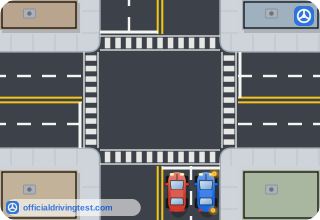
- Your tires may leave the pavement and scuff the curb
- Your vehicle will use more fuel than a tight turn
- You will block other drivers' view of the signal
- Others may think you are turning left or changing lanes
Show answer
Correct answer: Others may think you are turning left or changing lanes
A wide swing can make the driver behind think you are changing lanes or turning left, and that driver may try to pass you on the right.
Source: Tennessee Comprehensive Driver License Manual (March 2025 printing), page 58 · Open this page in the manual (Manual page 58)
-
After you complete a right turn, which lane should you move into?
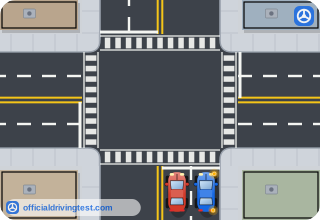
- The center lane
- The lane closest to the center line
- The travel lane closest to the right curb
- Whichever lane has the fewest cars
Show answer
Correct answer: The travel lane closest to the right curb
You move around the corner and into the travel lane closest to the right curb.
Source: Tennessee Comprehensive Driver License Manual (March 2025 printing), page 58 · Open this page in the manual (Manual page 58)
-
What is one reason roundabouts are used?
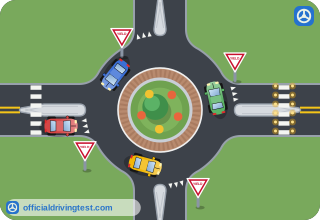
- To increase the speed of traffic
- To let drivers stop and wait inside the circle
- To slow speeds and reduce accidents
- To give trucks more room to stop
Show answer
Correct answer: To slow speeds and reduce accidents
Roundabouts are usually used to slow speeds, reduce accidents and discourage use of neighborhood streets as commuting thoroughfares.
Source: Tennessee Comprehensive Driver License Manual (March 2025 printing), page 58 · Open this page in the manual (Manual page 58)
-
Which road users does the manual say you must always check for before turning right?
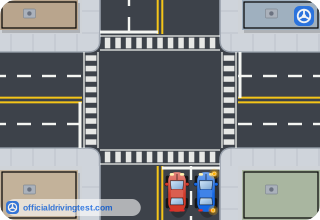
- Only vehicles behind you
- Pedestrians and bicyclists
- Only pedestrians in marked crosswalks
- Only vehicles in the lane to your left
Show answer
Correct answer: Pedestrians and bicyclists
The manual tells you to always check for pedestrians and bicyclists before turning, and to yield the right-of-way if necessary.
Source: Tennessee Comprehensive Driver License Manual (March 2025 printing), page 58 · Open this page in the manual (Manual page 58)
-
Which way must you travel around a roundabout?
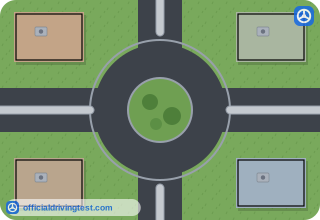
- To the left, counter-clockwise
- To the right, clockwise
- To the left, clockwise
- To the right, counter-clockwise
Show answer
Correct answer: To the right, counter-clockwise
You always travel around a roundabout to the right, in a counter-clockwise direction.
Source: Tennessee Comprehensive Driver License Manual (March 2025 printing), page 59 · Open this page in the manual (Manual page 59)
-
When you reach a roundabout, whom must you yield to?
- Vehicles already within the circulating traffic
- Vehicles waiting to enter behind you in line
- Only pedestrians who are waiting in the crosswalk
- Only vehicles that are about to exit the circle
Show answer
Correct answer: Vehicles already within the circulating traffic
You yield to vehicles already in the circulating traffic, like at a yield-sign intersection, and enter when there is a gap.
Source: Tennessee Comprehensive Driver License Manual (March 2025 printing), page 59 · Open this page in the manual (Manual page 59)
-
Once you are inside a roundabout, when should you stop?
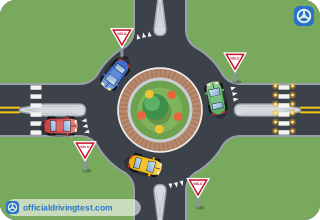
- Whenever another driver is waiting to enter behind you
- At every cross street that you pass inside the circle
- Only when directed by signs, signals or a traffic officer
- When you miss the street you wanted to turn onto
Show answer
Correct answer: Only when directed by signs, signals or a traffic officer
Once inside a roundabout, you do not stop unless signs, signals or a traffic officer direct you to.
Source: Tennessee Comprehensive Driver License Manual (March 2025 printing), page 59 · Open this page in the manual (Manual page 59)
-
At what speeds are roundabouts usually posted?
- 5 to 10 m.p.h.
- 15 to 25 m.p.h.
- 30 to 40 m.p.h.
- 45 to 55 m.p.h.
Show answer
Correct answer: 15 to 25 m.p.h.
Within a roundabout you proceed slowly; speeds are usually posted at 15 to 25 m.p.h.
Source: Tennessee Comprehensive Driver License Manual (March 2025 printing), page 59 · Open this page in the manual (Manual page 59)
-
What should you not do in a multi-lane roundabout?
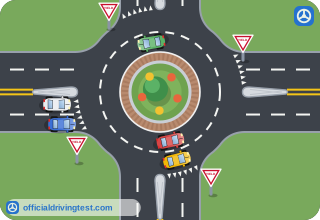
- Use your right turn signal
- Yield to vehicles already inside
- Stay in your lane
- Overtake or pass any vehicles
Show answer
Correct answer: Overtake or pass any vehicles
The manual says that in a multi-lane roundabout you do not overtake or pass vehicles, because it is a low-speed device.
Source: Tennessee Comprehensive Driver License Manual (March 2025 printing), page 59 · Open this page in the manual (Manual page 59)
-
As you leave a roundabout, what must you watch for and yield to if necessary?
- Vehicles entering the circle from behind you
- Bicycles parked on the central island
- Pedestrians in or approaching the crosswalk
- Traffic officers standing in the circle
Show answer
Correct answer: Pedestrians in or approaching the crosswalk
On the street you are exiting, watch for pedestrians in or approaching the crosswalk and yield the right-of-way if necessary.
Source: Tennessee Comprehensive Driver License Manual (March 2025 printing), page 59 · Open this page in the manual (Manual page 59)
-
You want to make a U-turn. How far in each direction must you be able to see traffic?
- At least 100 feet
- At least 500 feet
- At least 200 feet
- At least 300 feet
Show answer
Correct answer: At least 500 feet
You may not make a U-turn where you cannot see traffic coming from both directions for at least 500 feet each way.
Source: Tennessee Comprehensive Driver License Manual (March 2025 printing), page 59 · Open this page in the manual (Manual page 59)
-
What does the manual say about U-turns at an intersection where a traffic light or police officer controls the traffic flow?
- You may make one if no cars are coming
- You may make one after a full stop
- You may make one only at night
- You may not make one there
Show answer
Correct answer: You may not make one there
You may not make a U-turn at an intersection where a traffic light or police officer is controlling the traffic flow.
Source: Tennessee Comprehensive Driver License Manual (March 2025 printing), page 59 · Open this page in the manual (Manual page 59)
-
What does the manual say about U-turns between intersections in a city?
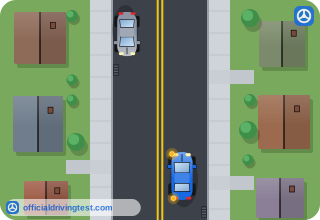
- You may not make one; drive around the block
- You may make one if you signal first
- You may make one if the street is empty
- You may make one at any driveway
Show answer
Correct answer: You may not make one; drive around the block
U-turns between intersections in a city are not allowed; the safest thing is to drive around the block.
Source: Tennessee Comprehensive Driver License Manual (March 2025 printing), page 59 · Open this page in the manual (Manual page 59)
-
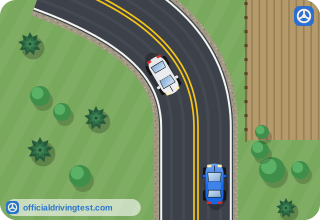
May you make a U-turn at or near a curve or the crest of a hill?
- Yes, if you signal and slow down first
- Yes, but only in full daylight hours
- Not if you cannot see 500 feet each way
- Yes, if no vehicle is behind you at all
Show answer
Correct answer: Not if you cannot see 500 feet each way
You may not make a U-turn at or near a curve or hill crest when you cannot see 500 feet or more in each direction.
Source: Tennessee Comprehensive Driver License Manual (March 2025 printing), page 59 · Open this page in the manual (Manual page 59)
-
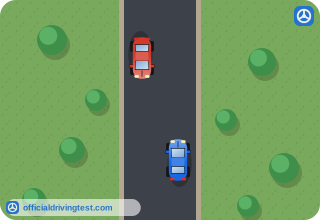
On a road with no center line markings where vehicles come from both directions, how much of the road must you give drivers going the opposite way?
- At least one-third
- A quarter of the road
- At least half
- Only enough for one vehicle
Show answer
Correct answer: At least half
Drivers must give others going in the opposite direction at least half the road on a road with no center line markings.
Source: Tennessee Comprehensive Driver License Manual (March 2025 printing), page 59 · Open this page in the manual (Manual page 59)
-
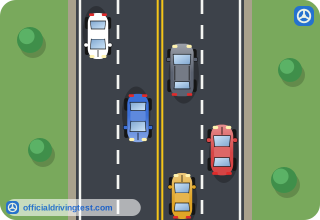
On a road with four or more lanes and two-way traffic, which lanes should you drive in, except when passing or turning left?
- The left lanes
- The center lane
- Whichever lane is open
- The right lanes
Show answer
Correct answer: The right lanes
On roads with four or more lanes and two-way traffic, you drive in the right lanes except to pass other vehicles or turn left.
Source: Tennessee Comprehensive Driver License Manual (March 2025 printing), page 59 · Open this page in the manual (Manual page 59)
-
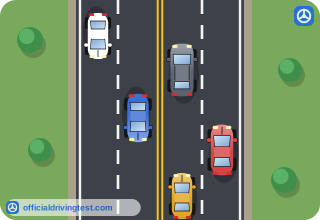
On a four-lane highway, which lane should you drive in unless you are passing or turning left?
- The extreme right lane
- The lane next to the yellow lines
- Either lane on your side
- The left lane on your side
Show answer
Correct answer: The extreme right lane
You drive in the extreme right lane except when passing another vehicle or making a left turn.
Source: Tennessee Comprehensive Driver License Manual (March 2025 printing), page 60 · Open this page in the manual (Manual page 60)
-
When may you drive within, across or over a median strip or barrier on a divided highway?
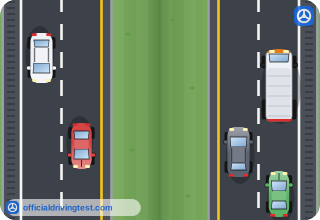
- Whenever you signal first and no other traffic is near
- Any time the median has no barrier or raised curb on it
- Only at an authorized crossover or intersection, or when directed
- When you need to make a quick turnaround on the highway
Show answer
Correct answer: Only at an authorized crossover or intersection, or when directed
Crossing a median is allowed only at an authorized crossover or intersection, or when you are officially directed to do so.
Source: Tennessee Comprehensive Driver License Manual (March 2025 printing), page 60 · Open this page in the manual (Manual page 60)
-
On a divided four-lane highway, how should you treat a crossover when you use it for a left turn?
- Like a merge lane, speeding up to cross both lanes quickly
- Like a cross street, keeping to the right side of the paved area
- Like a parking lot, using any open space you can find
- Like a median, staying on the left side of the crossover
Show answer
Correct answer: Like a cross street, keeping to the right side of the paved area
You treat the crossover opening like a cross street and keep to the right side of the crossover paved area.
Source: Tennessee Comprehensive Driver License Manual (March 2025 printing), page 60 · Open this page in the manual (Manual page 60)
-
A vehicle is already waiting in a crossover for traffic to clear. What should you do?
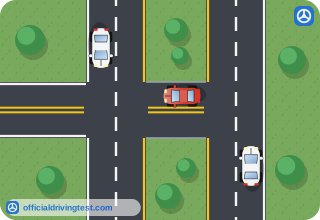
- Pull into the left side of the crossover beside it
- Pull in behind it so your car is inside the crossover
- Move to the right shoulder and wait with hazard lights
- Stay stopped in the leftmost lane with your turn signal on
Show answer
Correct answer: Stay stopped in the leftmost lane with your turn signal on
You remain stopped in the left most lane of the four-lane highway with your turn signal on until the waiting vehicle has cleared.
Source: Tennessee Comprehensive Driver License Manual (March 2025 printing), page 60 · Open this page in the manual (Manual page 60)
-
Why should you not “swing” into the left side of a crossover or “bunch up” behind a waiting car?
- It puts you on the wrong side and risks a head-on crash
- It blocks the view of other drivers behind you
- It wears out your brakes while you wait
- It is a lane violation on a divided highway
Show answer
Correct answer: It puts you on the wrong side and risks a head-on crash
Swinging into the crossover's left side puts your car on the wrong side of the road, risking a head-on collision with a driver turning left from the opposite direction.
Source: Tennessee Comprehensive Driver License Manual (March 2025 printing), page 60 · Open this page in the manual (Manual page 60)
-
You realize you are driving the wrong way on a street. What should you do immediately?
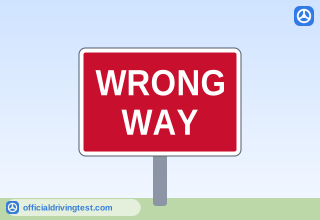
- Turn off the street or get into the proper lane
- Stop where you are and wait for the road to clear
- Back up the way that you came in
- Speed up to get out of the lane faster
Show answer
Correct answer: Turn off the street or get into the proper lane
You must turn off the one-way street or get into the proper lane of a two-way street immediately.
Source: Tennessee Comprehensive Driver License Manual (March 2025 printing), page 60 · Open this page in the manual (Manual page 60)
-
What are shared center turn lanes reserved for?
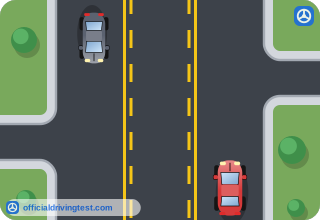
- Vehicles passing slower traffic on the road
- Vehicles making left turns in either direction
- Buses and carpools during rush hour
- Vehicles making right turns only
Show answer
Correct answer: Vehicles making left turns in either direction
These center lanes are reserved for vehicles making left turns in either direction from or into the roadway.
Source: Tennessee Comprehensive Driver License Manual (March 2025 printing), page 60 · Open this page in the manual (Manual page 60)
-
What is the farthest you may travel in a shared center turn lane?
- 100 feet
- 500 feet
- 1,000 feet
- 300 feet
Show answer
Correct answer: 300 feet
Shared center turn lanes cannot be used for travel farther than 300 feet.
Source: Tennessee Comprehensive Driver License Manual (March 2025 printing), page 60 · Open this page in the manual (Manual page 60)
-
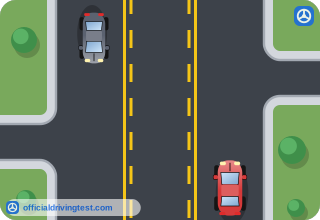
May a shared center turn lane be used for passing?
- No, it cannot be used for passing
- Yes, if no one is coming toward you
- Yes, but only at night
- Yes, if you signal first
Show answer
Correct answer: No, it cannot be used for passing
Shared center turn lanes cannot be used for passing.
Source: Tennessee Comprehensive Driver License Manual (March 2025 printing), page 60 · Open this page in the manual (Manual page 60)
-
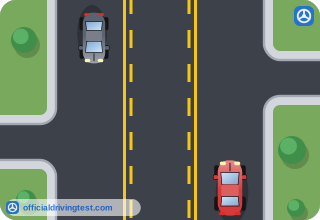
Should you travel in the center turn lane to reach a left-turn lane at an intersection?
- Yes, it is the quickest way
- No, do not travel in it to reach one
- Yes, if no one is coming
- Yes, at speeds under 25 m.p.h.
Show answer
Correct answer: No, do not travel in it to reach one
The manual says not to travel in the center turn lane to access a left turn lane at an intersection.
Source: Tennessee Comprehensive Driver License Manual (March 2025 printing), page 60 · Open this page in the manual (Manual page 60)
-
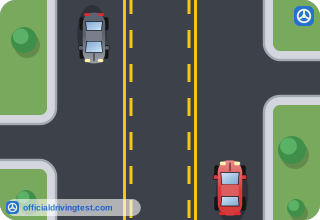
You turn from a side street or driveway into a shared center turn lane. What may you do?
- Stay in it until you reach the next intersection
- Pass slower vehicles in it
- Travel in it as far as you like
- Stop and wait for traffic to clear before merging right
Show answer
Correct answer: Stop and wait for traffic to clear before merging right
You may turn into the shared center turn lane, stop, and wait for traffic to clear before merging into the lane immediately to the right.
Source: Tennessee Comprehensive Driver License Manual (March 2025 printing), page 60 · Open this page in the manual (Manual page 60)
-
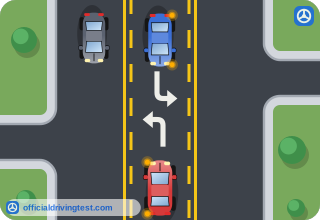
If vehicles enter a shared center turn lane from opposite directions, who has the right-of-way?
- The first vehicle to enter the lane
- The vehicle traveling faster
- The vehicle on the larger road
- The vehicle on the other driver's right
Show answer
Correct answer: The first vehicle to enter the lane
When vehicles enter the turn lane from opposite directions, the first vehicle to enter has the right-of-way.
Source: Tennessee Comprehensive Driver License Manual (March 2025 printing), page 60 · Open this page in the manual (Manual page 60)
-
What is a reversible lane?
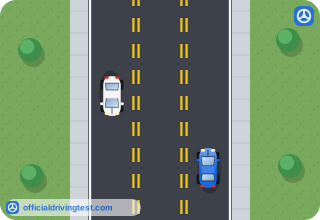
- A lane that allows left turns in both directions only
- A lane used one way at some times and the other way at others
- A lane reserved for buses during rush hour
- A lane that may be used only for passing
Show answer
Correct answer: A lane used one way at some times and the other way at others
Reversible lanes are designed to carry traffic in one direction at certain times and in the opposite direction at other times.
Source: Tennessee Comprehensive Driver License Manual (March 2025 printing), page 61 · Open this page in the manual (Manual page 61)
-
What risk do you face if you cut back to your lane too soon after passing?
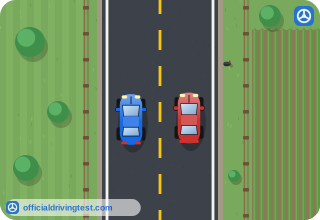
- Being rear-ended by a vehicle behind you
- Sideswiping the vehicle you are passing
- Running off the pavement on the right
- Stalling at the next intersection
Show answer
Correct answer: Sideswiping the vehicle you are passing
Cutting back too soon risks sideswiping the vehicle you are passing.
Source: Tennessee Comprehensive Driver License Manual (March 2025 printing), page 61 · Open this page in the manual (Manual page 61)
-
What risk do you face if you do not cut back to your lane soon enough after passing?
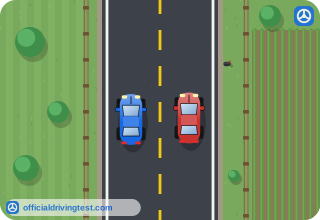
- Sideswiping the passed vehicle
- Being rear-ended by a vehicle behind you
- Running off the pavement on the right
- A head-on collision
Show answer
Correct answer: A head-on collision
Not cutting back soon enough risks a head-on collision.
Source: Tennessee Comprehensive Driver License Manual (March 2025 printing), page 61 · Open this page in the manual (Manual page 61)
-
As a rule, what should you do if you see any sign of an oncoming vehicle when deciding whether to pass?
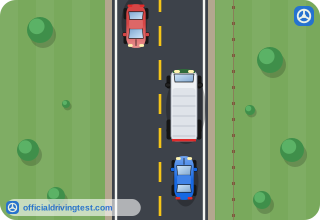
- Treat it as too close to risk a pass
- Pass if you can finish quickly
- Pass only if the other driver slows
- Pass only if you flash your headlights
Show answer
Correct answer: Treat it as too close to risk a pass
Any sign of an oncoming vehicle means it is too close for you to risk a pass.
Source: Tennessee Comprehensive Driver License Manual (March 2025 printing), page 62 · Open this page in the manual (Manual page 62)
-
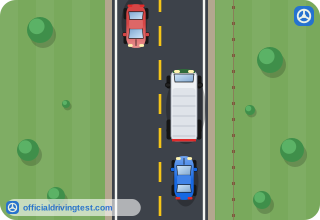
When in doubt about passing, what should you do?
- Speed up and pass quickly
- Pass on the shoulder
- Stay in your lane
- Flash your lights and pass
Show answer
Correct answer: Stay in your lane
When you are not sure a pass is safe, you stay in your lane.
Source: Tennessee Comprehensive Driver License Manual (March 2025 printing), page 62 · Open this page in the manual (Manual page 62)
-
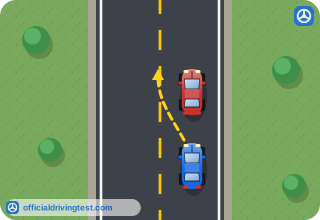
Why should you stay well behind the vehicle you want to pass?
- To keep its exhaust out of your car
- To get a better view of the road ahead
- To warn the driver you will pass
- To let your engine speed up first
Show answer
Correct answer: To get a better view of the road ahead
Staying well back gives you a better view of the road ahead, so you can check for a no-passing zone and oncoming vehicles.
Source: Tennessee Comprehensive Driver License Manual (March 2025 printing), page 62 · Open this page in the manual (Manual page 62)
-
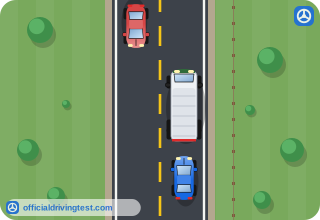
On a two-lane road, which side of a same-direction vehicle should you pass on?
- The right
- Either side
- The shoulder
- The left
Show answer
Correct answer: The left
When overtaking a vehicle going your way on a two-lane road, you should pass only to its left.
Source: Tennessee Comprehensive Driver License Manual (March 2025 printing), page 62 · Open this page in the manual (Manual page 62)
-
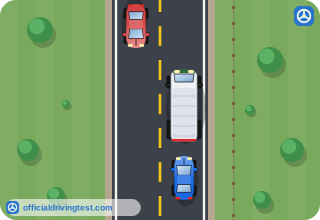
You feel you must swing out across the center line for a look before passing. What does the manual say this means?
- The driver ahead is driving faster than the speed limit allows
- Your mirrors are not adjusted well enough to show the lane
- You are following too closely or cannot see far enough to pass safely
- You should give the driver ahead a longer warning signal
Show answer
Correct answer: You are following too closely or cannot see far enough to pass safely
Needing to swing out for a look means you are following too closely or attempting a pass where your sight distance is too limited.
Source: Tennessee Comprehensive Driver License Manual (March 2025 printing), page 62 · Open this page in the manual (Manual page 62)
-
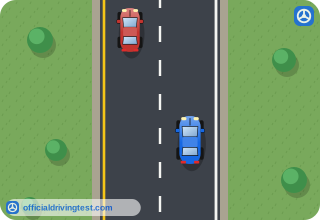
Why should you check your blind spot before moving left to pass?
- Pedestrians may be crossing the road ahead
- A vehicle may be starting to pass around you
- A parked car may be on your right
- Oncoming traffic may be turning left
Show answer
Correct answer: A vehicle may be starting to pass around you
Another vehicle may already be starting a pass around yours, and it can sit in your blind spot.
Source: Tennessee Comprehensive Driver License Manual (March 2025 printing), page 62 · Open this page in the manual (Manual page 62)
-
When may you return to the right lane after passing?
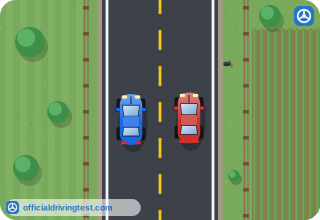
- As soon as your front bumper is past the other vehicle
- As soon as the other driver slows down to let you in
- Right after you flash your headlights at the other driver
- Once you can see the whole passed vehicle in your rearview mirror
Show answer
Correct answer: Once you can see the whole passed vehicle in your rearview mirror
You return when you can see the entire vehicle you passed in your rearview mirror; you then signal right and move over.
Source: Tennessee Comprehensive Driver License Manual (March 2025 printing), page 62 · Open this page in the manual (Manual page 62)
-
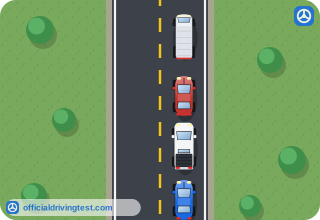
Is it illegal in Tennessee to pass more than one vehicle at a time?
- Yes, it is illegal on two-lane roads
- Yes, it is illegal except on interstates
- No, but as a general rule it is not safe
- No, and it is always safe on straight roads
Show answer
Correct answer: No, but as a general rule it is not safe
The manual says it is not safe as a general rule to pass several vehicles at once, though it is not illegal in Tennessee.
Source: Tennessee Comprehensive Driver License Manual (March 2025 printing), page 62 · Open this page in the manual (Manual page 62)
-
If you consider passing several vehicles, you should be back in the right lane before coming within how far of no-passing markings or oncoming vehicles?
- 50 feet
- 100 feet
- 200 feet
- 300 feet
Show answer
Correct answer: 100 feet
The manual recommends completing the pass and returning to the right lane before coming within 100 feet of no-passing markings or oncoming vehicles.
Source: Tennessee Comprehensive Driver License Manual (March 2025 printing), page 62 · Open this page in the manual (Manual page 62)
-
The manual recommends not even considering passing several vehicles unless you are on what kind of road?
- A winding road with a slight hill ahead of you
- A road where a curve hides the oncoming lane
- A road with a solid yellow line in your lane
- A straight, level road with excellent visibility ahead
Show answer
Correct answer: A straight, level road with excellent visibility ahead
One condition is a straight, level roadway where your vision of oncoming traffic is excellent.
Source: Tennessee Comprehensive Driver License Manual (March 2025 printing), page 62 · Open this page in the manual (Manual page 62)
-
Why should you take extra precautions when passing in inclement weather and at twilight?
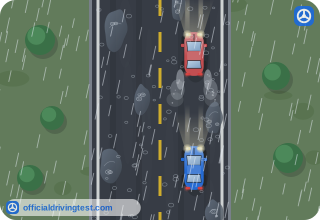
- Some oncoming vehicles may not be easily visible
- Headlights are not allowed in such conditions
- Passing is illegal in those conditions
- Other drivers cannot see your signals
Show answer
Correct answer: Some oncoming vehicles may not be easily visible
In bad weather and twilight, oncoming vehicles may be hard to see, especially if they are not using their headlights as required.
Source: Tennessee Comprehensive Driver License Manual (March 2025 printing), page 62 · Open this page in the manual (Manual page 62)
-
Why is passing at night harder if you do not know the road?
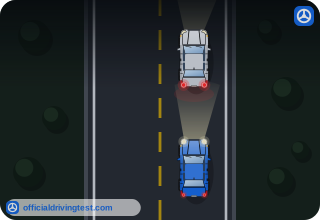
- Center lines are not painted at night
- Oncoming vehicles always use high beams
- It is harder to see where the passing zone ends
- Your headlights reflect off the road signs
Show answer
Correct answer: It is harder to see where the passing zone ends
At night it is more difficult to see where the passing zone ends, and a hill or curve ahead could prove deadly.
Source: Tennessee Comprehensive Driver License Manual (March 2025 printing), page 62 · Open this page in the manual (Manual page 62)
-
May you pass another vehicle on the right by driving off the pavement of the roadway?
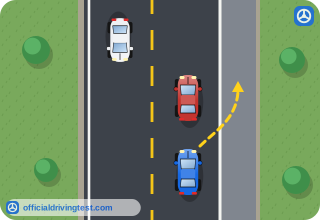
- Yes, if the shoulder is wide
- No, never
- Yes, if the other vehicle is slow
- Yes, if the other driver signals
Show answer
Correct answer: No, never
Passing on the right is never permitted by driving off the pavement of the roadway.
Source: Tennessee Comprehensive Driver License Manual (March 2025 printing), page 62 · Open this page in the manual (Manual page 62)
-
Under which condition may you pass another vehicle on the right?
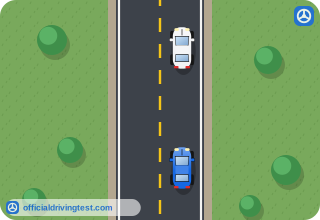
- The vehicle ahead is driving below the speed limit
- A solid yellow line is in the oncoming lane
- The vehicle ahead is a truck or a bus
- The vehicle ahead has signaled a left turn
Show answer
Correct answer: The vehicle ahead has signaled a left turn
You may pass on the right when the vehicle overtaken has signaled, or is about to make, a left turn.
Source: Tennessee Comprehensive Driver License Manual (March 2025 printing), page 62 · Open this page in the manual (Manual page 62)
-
What should you never do to a driver who has signaled a left turn?
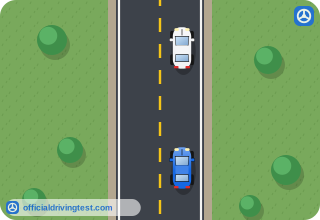
- Pass on the left of that driver
- Pass on the right of that driver
- Stop behind that driver
- Signal a turn yourself
Show answer
Correct answer: Pass on the left of that driver
The manual says never to pass on the left of a driver who has signaled a left turn.
Source: Tennessee Comprehensive Driver License Manual (March 2025 printing), page 62 · Open this page in the manual (Manual page 62)
-
On which kind of road may you pass on the right if the pavement is free from obstruction and wide enough for two or more lanes?
- A two-way road with one lane each way
- A road with parked vehicles on the right
- A one-way street restricted to one direction
- A road that is under construction
Show answer
Correct answer: A one-way street restricted to one direction
Passing on the right is allowed on a one-way street that is free from obstruction and paved for two or more lanes of moving vehicles.
Source: Tennessee Comprehensive Driver License Manual (March 2025 printing), page 62 · Open this page in the manual (Manual page 62)
-
May you pass on the right using a bike lane or a parking lane?
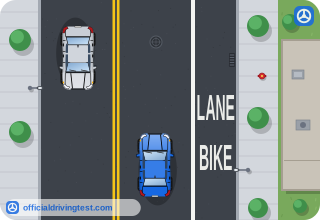
- Yes, if no cyclists are present
- No, not at any location
- Yes, on streets under 25 m.p.h.
- Yes, if you signal first
Show answer
Correct answer: No, not at any location
The manual says not to pass on the right using a bike lane or parking lane at any location.
Source: Tennessee Comprehensive Driver License Manual (March 2025 printing), page 62 · Open this page in the manual (Manual page 62)
-
Where does the manual say not to pass on the right using the emergency lane?
- On any road without a paved shoulder
- Only on the interstate highway or its ramps
- Within one mile of a school zone
- Within sight of a traffic light or stop sign
Show answer
Correct answer: Within sight of a traffic light or stop sign
You do not pass on the right in the emergency lane within sight of a traffic light or stop sign, as at intersections with stopped vehicles.
Source: Tennessee Comprehensive Driver License Manual (March 2025 printing), page 62 · Open this page in the manual (Manual page 62)
-
A driver passes on the right and crashes into a car ahead that starts a right turn when the light changes. Who is “at fault”?
- The person passing on the right
- The driver who was turning right
- Neither driver
- Both drivers equally
Show answer
Correct answer: The person passing on the right
The person passing on the right is at fault because the vehicle turning right was properly traveling within the marked lane of traffic.
Source: Tennessee Comprehensive Driver License Manual (March 2025 printing), page 62 · Open this page in the manual (Manual page 62)
-
What does the manual say about backing into an intersection from a driveway?
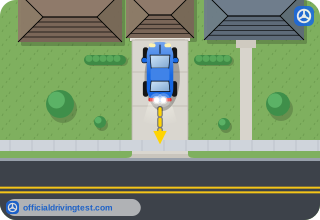
- It is allowed if no traffic is in sight
- It is allowed during daylight hours only
- It is illegal
- It is allowed if you use your hazard flashers
Show answer
Correct answer: It is illegal
Backing into an intersection from a driveway is illegal.
Source: Tennessee Comprehensive Driver License Manual (March 2025 printing), page 64 · Open this page in the manual (Manual page 64)
-
When backing out of a parking space, when should you look both directions?
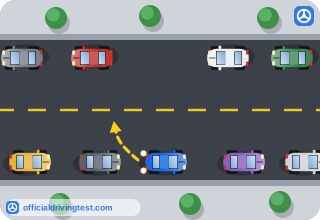
- Before and during the backing maneuver
- Only before you shift into reverse
- Only after you have cleared the parked cars
- Only if you see a pedestrian nearby
Show answer
Correct answer: Before and during the backing maneuver
Look both ways before and during the move out of the space and be ready to stop quickly if a hazard appears.
Source: Tennessee Comprehensive Driver License Manual (March 2025 printing), page 64 · Open this page in the manual (Manual page 64)
-
What must a driver do when coming out of any type of parking space, including parallel spaces?
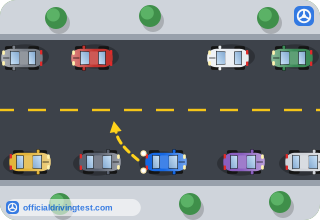
- Sound the horn and then proceed
- Back out quickly to clear the space
- Look, signal and yield the right-of-way
- Look and signal, since traffic must yield
Show answer
Correct answer: Look, signal and yield the right-of-way
A driver leaving any parking space must look, signal and yield the right-of-way.
Source: Tennessee Comprehensive Driver License Manual (March 2025 printing), page 65 · Open this page in the manual (Manual page 65)
-
What should you be aware of at certain locations before you turn?
- Signs prohibiting right or left turns
- Signs posting a lower speed limit
- Signs showing the name of the street
- Signs marking a bus stop
Show answer
Correct answer: Signs prohibiting right or left turns
Do not turn unless the turn is permitted and can be made safely; some locations prohibit right or left turns.
Source: Tennessee Comprehensive Driver License Manual (March 2025 printing), page 56 · Open this page in the manual (Manual page 56)
-
You are not in the proper lane for the turn you want to make. What should you do?
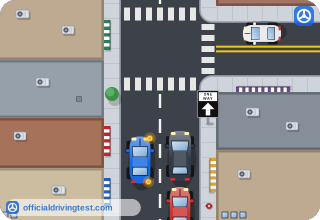
- Turn from the lane you are in and correct your position later
- Cut across the other lanes to make the turn at this intersection
- Drive to the next intersection and turn from the proper lane there
- Stop where you are and wait until the proper lane clears out
Show answer
Correct answer: Drive to the next intersection and turn from the proper lane there
Turning from the wrong lane is unsafe; go to the next intersection and circle back if necessary.
Source: Tennessee Comprehensive Driver License Manual (March 2025 printing), page 56 · Open this page in the manual (Manual page 56)
-
What does the manual say will leave you in the wrong lane after a turn?
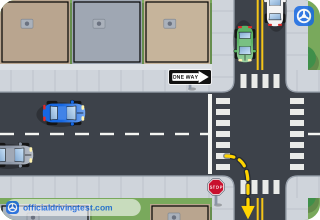
- Turning too slowly or with your signal on
- Turning from the closest lane in your direction
- Slowing down before you begin the turn itself
- Turning too wide or too late, or straddling lanes
Show answer
Correct answer: Turning too wide or too late, or straddling lanes
Turning too wide or too late, straddling lanes or turning into the wrong side of the street leaves you in the wrong lane.
Source: Tennessee Comprehensive Driver License Manual (March 2025 printing), page 56 · Open this page in the manual (Manual page 56)
-
In an intersection with multiple turn lanes, what should you always follow?
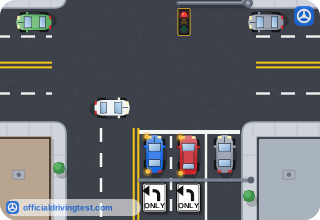
- The yellow lines
- The white lines
- The car ahead of you
- The curb
Show answer
Correct answer: The white lines
The manual says to always follow the white lines in intersections using multiple turn lanes.
Source: Tennessee Comprehensive Driver License Manual (March 2025 printing), page 56 · Open this page in the manual (Manual page 56)
-
While waiting for oncoming traffic to pass before turning left, what should you do with your wheels?
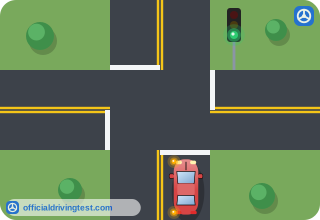
- Turn them toward the direction of the turn
- Turn them away from the direction of the turn
- Keep them straight until you begin the turn
- Keep them turned and the brake off
Show answer
Correct answer: Keep them straight until you begin the turn
If you are hit from behind with wheels turned, you could be pushed into oncoming traffic.
Source: Tennessee Comprehensive Driver License Manual (March 2025 printing), page 56 · Open this page in the manual (Manual page 56)
-
The traffic light is about to change and traffic ahead may keep you from completing your turn. What should you do?
- Enter the intersection and wait inside it to finish the turn
- Stay behind the stop line or crosswalk until you can finish the turn
- Enter quickly and try to complete the turn before the light changes
- Stop in the crosswalk until traffic ahead has cleared out
Show answer
Correct answer: Stay behind the stop line or crosswalk until you can finish the turn
Do not enter the intersection if you might not finish the turn before the light changes and block traffic.
Source: Tennessee Comprehensive Driver License Manual (March 2025 printing), page 56 · Open this page in the manual (Manual page 56)
-
Two drivers meet at an intersection and both want to turn left. How do they turn?
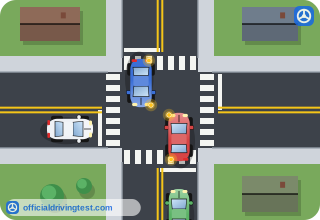
- Each turns to the right of the other
- The driver on the right goes first, then the other
- Both stop until one of them signals to go ahead
- Each turns to the left of the other
Show answer
Correct answer: Each turns to the left of the other
The manual says that when both drivers turn left, each turns to the left of the other.
Source: Tennessee Comprehensive Driver License Manual (March 2025 printing), page 56 · Open this page in the manual (Manual page 56)
-
When you merge onto an interstate from an entrance ramp, who must yield the right-of-way?
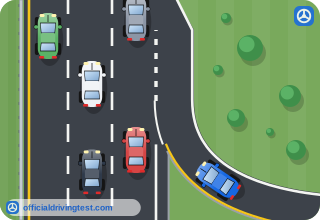
- The drivers already on the interstate
- You, the driver entering the interstate
- Whichever driver is going faster
- The driver in the larger vehicle
Show answer
Correct answer: You, the driver entering the interstate
Drivers on the interstate should make room when they can, but yielding the right-of-way is the entering driver's responsibility.
Source: Tennessee Comprehensive Driver License Manual (March 2025 printing), page 68 · Open this page in the manual (Manual page 68)
-
At a weaving interchange, what must you and the driver moving right toward the exit ramp do?
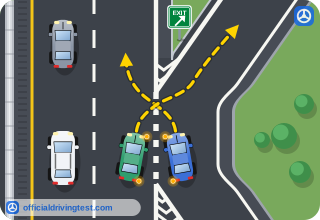
- Both yield and share it in an equal "give and take" way
- Let the entering driver go first in every case
- Let the exiting driver go first in every case
- Speed up so the merge is finished quickly
Show answer
Correct answer: Both yield and share it in an equal "give and take" way
Entering and exiting drivers use the same lane at a weaving interchange, so both must yield and share it in an equal give-and-take manner.
Source: Tennessee Comprehensive Driver License Manual (March 2025 printing), page 70 · Open this page in the manual (Manual page 70)
-
At an intersection, which way should you look first before driving through?
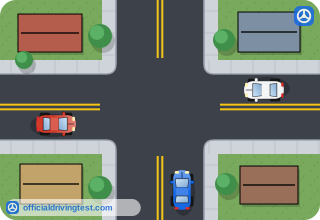
- To the right, because those cars will be closer to you
- Straight ahead, then behind you
- To the left, because those cars will be closer to you
- Behind you, then to the right
Show answer
Correct answer: To the left, because those cars will be closer to you
The manual says look left first, then right, then take one more quick look left before you go through.
Source: Tennessee Comprehensive Driver License Manual (March 2025 printing), page 93 · Open this page in the manual (Manual page 93)
-
What minimum gap does the manual say is needed whenever you change lanes, enter a roadway or your lane merges with another lane?
- A one-second gap
- A two-second gap
- A four-second gap
- An eight-second gap
Show answer
Correct answer: A four-second gap
The manual says a minimum four-second gap is needed when changing lanes, entering a roadway or merging.
Source: Tennessee Comprehensive Driver License Manual (March 2025 printing), page 94 · Open this page in the manual (Manual page 94)
-
What should you do if you need to cross several lanes?
- Cut across all of them at once
- Take them one at a time
- Cross them as fast as you can
- Cross them only from the right shoulder
Show answer
Correct answer: Take them one at a time
The manual says to take lanes one at a time and never cut across several lanes, which can tie up traffic or cause a crash.
Source: Tennessee Comprehensive Driver License Manual (March 2025 printing), page 94 · Open this page in the manual (Manual page 94)
-
What does the manual say about crossing traffic at an intersection?
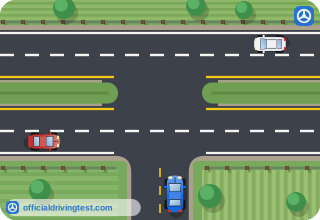
- You may stop with part of your vehicle in the traffic lane
- You may enter if the first lane looks clear
- You may enter and wait in the middle for a gap
- You need a gap large enough to get all the way across the road
Show answer
Correct answer: You need a gap large enough to get all the way across the road
Make sure you can complete the crossing before entering, and do not block the intersection or leave part of your vehicle in a traffic lane.
Source: Tennessee Comprehensive Driver License Manual (March 2025 printing), page 94 · Open this page in the manual (Manual page 94)
-
What should you make sure of before you enter an intersection to cross or enter the roadway?
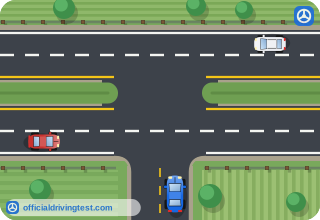
- That you can safely complete the maneuver
- That another driver will stop for you
- That the intersection has a stop line
- That your vehicle is in the right lane
Show answer
Correct answer: That you can safely complete the maneuver
The manual says not to block intersections, and to enter only when you are sure you can finish the crossing.
Source: Tennessee Comprehensive Driver License Manual (March 2025 printing), page 94 · Open this page in the manual (Manual page 94)
-
You are turning left and a bicyclist is entering the intersection from the opposite direction. What should you do?
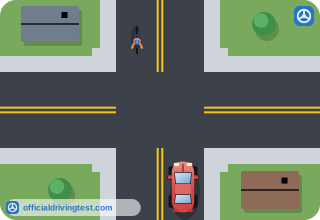
- Turn quickly before the bicyclist reaches you
- Wait for the bicyclist to pass before making the turn
- Sound your horn and turn ahead of the bicyclist
- Turn if the bicyclist is more than a car length away
Show answer
Correct answer: Wait for the bicyclist to pass before making the turn
The driver should wait for the oncoming bicyclist to pass before turning left.
Source: Tennessee Comprehensive Driver License Manual (March 2025 printing), page 105 · Open this page in the manual (Manual page 105)
-
Your vehicle is sharing the left turn lane with a bicyclist. What should you do?
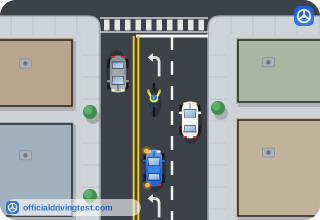
- Move up alongside the bicyclist so you turn together
- Turn first, ahead of the bicyclist, using your signal
- Pass the bicyclist inside the turn lane and turn
- Stay behind the bicyclist until the turn is completed
Show answer
Correct answer: Stay behind the bicyclist until the turn is completed
When sharing a left turn lane with a bicyclist, a driver stays behind the rider until the rider has finished the turn.
Source: Tennessee Comprehensive Driver License Manual (March 2025 printing), page 105 · Open this page in the manual (Manual page 105)
-
You are turning right and a bicyclist is approaching on the right. What should you do?
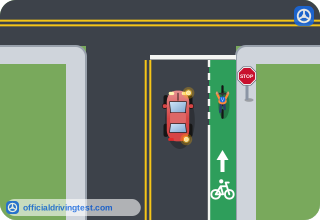
- Let the bicyclist go through the intersection first
- Turn ahead of the bicyclist, using your turn signal
- Speed up and turn before the bicyclist arrives
- Honk your horn and turn at once
Show answer
Correct answer: Let the bicyclist go through the intersection first
The driver lets the bicyclist through the intersection first, and always signals turns.
Source: Tennessee Comprehensive Driver License Manual (March 2025 printing), page 105 · Open this page in the manual (Manual page 105)
-
When preparing for a right turn where a bicyclist is riding beside you, what should you do?
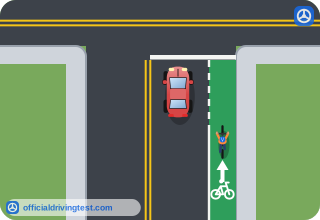
- Slow down well ahead and stop in the right-hand lane
- Pass the bicyclist and turn across the path at once
- Merge with the bicycle traffic; do not turn across its path
- Stay well out of the bicycle traffic until you turn
Show answer
Correct answer: Merge with the bicycle traffic; do not turn across its path
The driver merges with bicycle traffic first so the turn does not cut across the bicyclist’s path.
Source: Tennessee Comprehensive Driver License Manual (March 2025 printing), page 105 · Open this page in the manual (Manual page 105)
-
What should you do before a left turn to share the road safely with motorcycles?
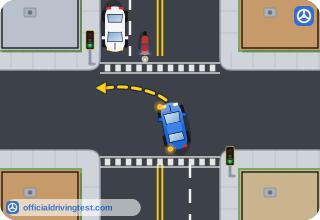
- Always signal your intention and watch for oncoming motorcycles
- Signal only when you can see another vehicle behind you
- Turn at once, because motorcycles can stop quickly
- Watch only for oncoming cars and trucks
Show answer
Correct answer: Always signal your intention and watch for oncoming motorcycles
The manual says to signal every turn and watch for oncoming motorcycles when turning left.
Source: Tennessee Comprehensive Driver License Manual (March 2025 printing), page 107 · Open this page in the manual (Manual page 107)
-
At an intersection with a motorcycle, when should you move into its path of travel?
- As soon as the rider slows down
- Only after the rider’s intentions are absolutely clear
- As soon as the rider signals a turn
- Right after the rider enters the intersection
Show answer
Correct answer: Only after the rider’s intentions are absolutely clear
Most collisions and injuries happen at intersections, so drivers should wait until it is certain whether the rider is turning or going straight.
Source: Tennessee Comprehensive Driver License Manual (March 2025 printing), page 107 · Open this page in the manual (Manual page 107)