Tennessee: Right-of-way, turning and passing — Right Turns, Roundabouts and U-Turns Practice Test
Questions in this part include: “What else are roundabouts, traffic circles and rotaries known as?” · “At what speeds are roundabouts usually posted?”
Independent educational site · not affiliated with any government agency or DMV
Ready? Test yourself
- Instant feedback with an explanation
- Every answer cites its source in the manual
- Your best score is saved on this device
- Keyboard: press 1 to 4 to answer and Enter for the next question
Questions are original and based on the official manual "Tennessee Comprehensive Driver License Manual" (March 2025 printing), Tennessee Department of Safety and Homeland Security.
All 17 questions in this practice test
Take the test above first, then use this list to study. Tap “Show answer” to see the correct answer and explanation.
Show the questions and answersHide the questions
-
In the United States, which way do drivers turn when going around a traffic circle or roundabout?
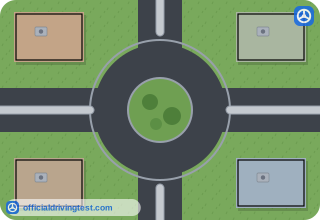
- To the right
- To the left
- Whichever way is shorter
- Toward the center island first
Show answer
Correct answer: To the right
Right-hand traffic is the rule, so drivers keep to the right side of the road and turn right around circles, roundabouts and town squares.
Source: Tennessee Comprehensive Driver License Manual (March 2025 printing), page 45 · Open this page in the manual (Manual page 45)
-
What else are roundabouts, traffic circles and rotaries known as?
- “Cross junctions”
- “Town squares”
- “Loop ramps”
- “Merge areas”
Show answer
Correct answer: “Town squares”
The manual says roundabouts, traffic circles and rotaries are also known as town squares.
Source: Tennessee Comprehensive Driver License Manual (March 2025 printing), page 53 · Open this page in the manual (Manual page 53)
-
Why should you avoid swinging wide to the left before a right turn?
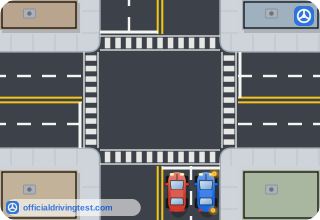
- Your tires may leave the pavement and scuff the curb
- Your vehicle will use more fuel than a tight turn
- You will block other drivers' view of the signal
- Others may think you are turning left or changing lanes
Show answer
Correct answer: Others may think you are turning left or changing lanes
A wide swing can make the driver behind think you are changing lanes or turning left, and that driver may try to pass you on the right.
Source: Tennessee Comprehensive Driver License Manual (March 2025 printing), page 58 · Open this page in the manual (Manual page 58)
-
After you complete a right turn, which lane should you move into?
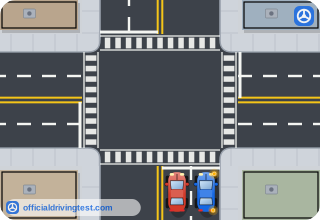
- The center lane
- The lane closest to the center line
- The travel lane closest to the right curb
- Whichever lane has the fewest cars
Show answer
Correct answer: The travel lane closest to the right curb
You move around the corner and into the travel lane closest to the right curb.
Source: Tennessee Comprehensive Driver License Manual (March 2025 printing), page 58 · Open this page in the manual (Manual page 58)
-
What is one reason roundabouts are used?
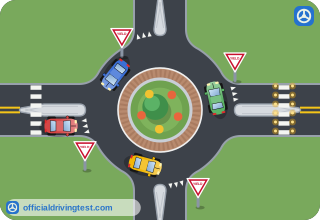
- To increase the speed of traffic
- To let drivers stop and wait inside the circle
- To slow speeds and reduce accidents
- To give trucks more room to stop
Show answer
Correct answer: To slow speeds and reduce accidents
Roundabouts are usually used to slow speeds, reduce accidents and discourage use of neighborhood streets as commuting thoroughfares.
Source: Tennessee Comprehensive Driver License Manual (March 2025 printing), page 58 · Open this page in the manual (Manual page 58)
-
Which way must you travel around a roundabout?
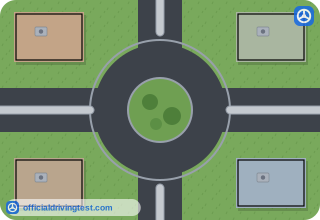
- To the left, counter-clockwise
- To the right, clockwise
- To the left, clockwise
- To the right, counter-clockwise
Show answer
Correct answer: To the right, counter-clockwise
You always travel around a roundabout to the right, in a counter-clockwise direction.
Source: Tennessee Comprehensive Driver License Manual (March 2025 printing), page 59 · Open this page in the manual (Manual page 59)
-
When you reach a roundabout, whom must you yield to?
- Vehicles already within the circulating traffic
- Vehicles waiting to enter behind you in line
- Only pedestrians who are waiting in the crosswalk
- Only vehicles that are about to exit the circle
Show answer
Correct answer: Vehicles already within the circulating traffic
You yield to vehicles already in the circulating traffic, like at a yield-sign intersection, and enter when there is a gap.
Source: Tennessee Comprehensive Driver License Manual (March 2025 printing), page 59 · Open this page in the manual (Manual page 59)
-
Once you are inside a roundabout, when should you stop?
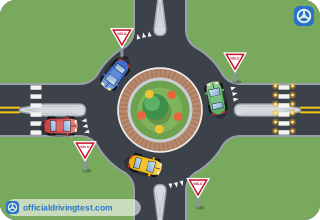
- Whenever another driver is waiting to enter behind you
- At every cross street that you pass inside the circle
- Only when directed by signs, signals or a traffic officer
- When you miss the street you wanted to turn onto
Show answer
Correct answer: Only when directed by signs, signals or a traffic officer
Once inside a roundabout, you do not stop unless signs, signals or a traffic officer direct you to.
Source: Tennessee Comprehensive Driver License Manual (March 2025 printing), page 59 · Open this page in the manual (Manual page 59)
-
At what speeds are roundabouts usually posted?
- 5 to 10 m.p.h.
- 15 to 25 m.p.h.
- 30 to 40 m.p.h.
- 45 to 55 m.p.h.
Show answer
Correct answer: 15 to 25 m.p.h.
Within a roundabout you proceed slowly; speeds are usually posted at 15 to 25 m.p.h.
Source: Tennessee Comprehensive Driver License Manual (March 2025 printing), page 59 · Open this page in the manual (Manual page 59)
-
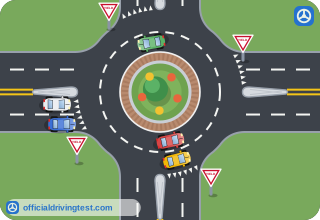
What should you not do in a multi-lane roundabout?
- Use your right turn signal
- Yield to vehicles already inside
- Stay in your lane
- Overtake or pass any vehicles
Show answer
Correct answer: Overtake or pass any vehicles
The manual says that in a multi-lane roundabout you do not overtake or pass vehicles, because it is a low-speed device.
Source: Tennessee Comprehensive Driver License Manual (March 2025 printing), page 59 · Open this page in the manual (Manual page 59)
-
As you leave a roundabout, what must you watch for and yield to if necessary?
- Vehicles entering the circle from behind you
- Bicycles parked on the central island
- Pedestrians in or approaching the crosswalk
- Traffic officers standing in the circle
Show answer
Correct answer: Pedestrians in or approaching the crosswalk
On the street you are exiting, watch for pedestrians in or approaching the crosswalk and yield the right-of-way if necessary.
Source: Tennessee Comprehensive Driver License Manual (March 2025 printing), page 59 · Open this page in the manual (Manual page 59)
-
You want to make a U-turn. How far in each direction must you be able to see traffic?
- At least 100 feet
- At least 500 feet
- At least 200 feet
- At least 300 feet
Show answer
Correct answer: At least 500 feet
You may not make a U-turn where you cannot see traffic coming from both directions for at least 500 feet each way.
Source: Tennessee Comprehensive Driver License Manual (March 2025 printing), page 59 · Open this page in the manual (Manual page 59)
-
What does the manual say about U-turns at an intersection where a traffic light or police officer controls the traffic flow?
- You may make one if no cars are coming
- You may make one after a full stop
- You may make one only at night
- You may not make one there
Show answer
Correct answer: You may not make one there
You may not make a U-turn at an intersection where a traffic light or police officer is controlling the traffic flow.
Source: Tennessee Comprehensive Driver License Manual (March 2025 printing), page 59 · Open this page in the manual (Manual page 59)
-
What does the manual say about U-turns between intersections in a city?
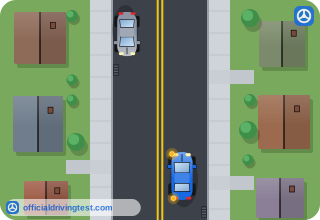
- You may not make one; drive around the block
- You may make one if you signal first
- You may make one if the street is empty
- You may make one at any driveway
Show answer
Correct answer: You may not make one; drive around the block
U-turns between intersections in a city are not allowed; the safest thing is to drive around the block.
Source: Tennessee Comprehensive Driver License Manual (March 2025 printing), page 59 · Open this page in the manual (Manual page 59)
-
May you make a U-turn at or near a curve or the crest of a hill?
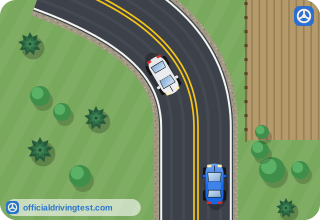
- Yes, if you signal and slow down first
- Yes, but only in full daylight hours
- Not if you cannot see 500 feet each way
- Yes, if no vehicle is behind you at all
Show answer
Correct answer: Not if you cannot see 500 feet each way
You may not make a U-turn at or near a curve or hill crest when you cannot see 500 feet or more in each direction.
Source: Tennessee Comprehensive Driver License Manual (March 2025 printing), page 59 · Open this page in the manual (Manual page 59)
-
You are turning right and a bicyclist is approaching on the right. What should you do?
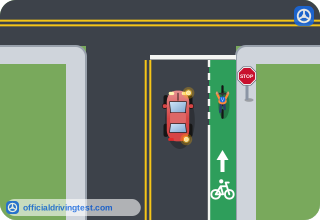
- Let the bicyclist go through the intersection first
- Turn ahead of the bicyclist, using your turn signal
- Speed up and turn before the bicyclist arrives
- Honk your horn and turn at once
Show answer
Correct answer: Let the bicyclist go through the intersection first
The driver lets the bicyclist through the intersection first, and always signals turns.
Source: Tennessee Comprehensive Driver License Manual (March 2025 printing), page 105 · Open this page in the manual (Manual page 105)
-
When preparing for a right turn where a bicyclist is riding beside you, what should you do?
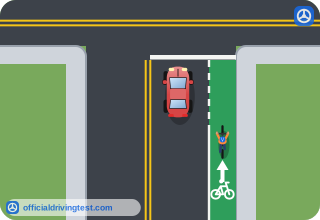
- Slow down well ahead and stop in the right-hand lane
- Pass the bicyclist and turn across the path at once
- Merge with the bicycle traffic; do not turn across its path
- Stay well out of the bicycle traffic until you turn
Show answer
Correct answer: Merge with the bicycle traffic; do not turn across its path
The driver merges with bicycle traffic first so the turn does not cut across the bicyclist’s path.
Source: Tennessee Comprehensive Driver License Manual (March 2025 printing), page 105 · Open this page in the manual (Manual page 105)