Tennessee: Pedestrians — Part 2 Practice Test
Questions in this part include: “Which of these identifies a hearing impaired pedestrian that you must yield to anywhere on the roadway?” · “Which pedestrians are the most frequent victims in auto-pedestrian collisions?”
Independent educational site · not affiliated with any government agency or DMV
Ready? Test yourself
- Instant feedback with an explanation
- Every answer cites its source in the manual
- Your best score is saved on this device
- Keyboard: press 1 to 4 to answer and Enter for the next question
Questions are original and based on the official manual "Tennessee Comprehensive Driver License Manual" (March 2025 printing), Tennessee Department of Safety and Homeland Security.
All 16 questions in this practice test
Take the test above first, then use this list to study. Tap “Show answer” to see the correct answer and explanation.
Show the questions and answersHide the questions
-
A blind pedestrian with a white cane or a guide dog is crossing the roadway, even away from a crosswalk. How far away must you stop?
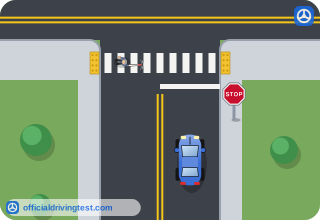
- At least 5 feet
- At least 15 feet
- At least 10 feet
- At least 25 feet
Show answer
Correct answer: At least 10 feet
The manual says to stop at least 10 feet away until the person is off the roadway.
Source: Tennessee Comprehensive Driver License Manual (March 2025 printing), page 53 · Open this page in the manual (Manual page 53)
-
Why should you not use your horn near a blind pedestrian who is crossing?
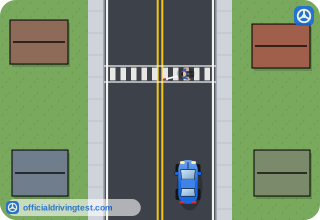
- It could startle the pedestrian
- It might be mistaken for an emergency vehicle
- It could distract other drivers
- It does not carry far enough to be useful
Show answer
Correct answer: It could startle the pedestrian
The manual says not to use your horn because it could startle the blind pedestrian.
Source: Tennessee Comprehensive Driver License Manual (March 2025 printing), page 53 · Open this page in the manual (Manual page 53)
-
Which of these identifies a hearing impaired pedestrian that you must yield to anywhere on the roadway?
- A dog on a bright yellow leash
- A dog wearing a green vest
- A dog wearing a red harness
- A dog on a blaze orange leash
Show answer
Correct answer: A dog on a blaze orange leash
The manual names a hearing impaired person with a dog on a blaze orange leash.
Source: Tennessee Comprehensive Driver License Manual (March 2025 printing), page 53 · Open this page in the manual (Manual page 53)
-
Where does the manual say you should slow down because children are likely to be present?
- Near schools, playgrounds and residential areas
- Only in marked school zones
- Only on roads with a posted limit above 35 miles per hour
- Only in downtown business districts
Show answer
Correct answer: Near schools, playgrounds and residential areas
You must drive with extreme caution when children are present and slow down near schools, playgrounds and residential areas.
Source: Tennessee Comprehensive Driver License Manual (March 2025 printing), page 53 · Open this page in the manual (Manual page 53)
-
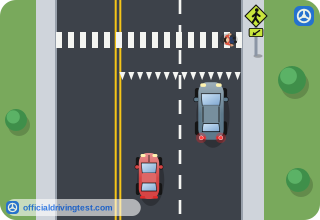
A car ahead of you has stopped for pedestrians in a marked or unmarked crosswalk. What does the manual say about passing it?
- You may pass it if you slow down first
- You may pass it if the crosswalk is unmarked
- Do not pass it
- You may pass it if no one is on your side
Show answer
Correct answer: Do not pass it
Passing a car stopped for pedestrians is not allowed and is a frequent cause of pedestrian deaths.
Source: Tennessee Comprehensive Driver License Manual (March 2025 printing), page 63 · Open this page in the manual (Manual page 63)
-
On a multi-lane road, about how far before a crosswalk should you stop so you do not block other drivers' view of the crossing pedestrians?
- About 30 feet
- About 10 feet
- About 20 feet
- About 50 feet
Show answer
Correct answer: About 30 feet
Stopping about 30 feet back keeps drivers in other lanes able to see the pedestrians crossing.
Source: Tennessee Comprehensive Driver License Manual (March 2025 printing), page 63 · Open this page in the manual (Manual page 63)
-
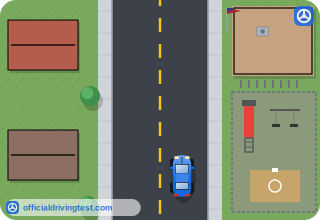
Why should you be alert near schools, playgrounds and residential streets?
- Speed limits there are never posted
- Drivers there must stop at every driveway
- Children may be crossing, running or riding into the street without looking
- Parked cars are not allowed on those streets at any time of day
Show answer
Correct answer: Children may be crossing, running or riding into the street without looking
These areas often have children present who may run or ride into the street without looking.
Source: Tennessee Comprehensive Driver License Manual (March 2025 printing), page 102 · Open this page in the manual (Manual page 102)
-
Which pedestrians are the most frequent victims in auto-pedestrian collisions?
- Joggers and runners who use the shoulder of the road
- Pedestrians who walk in groups of two or more
- Young, elderly, disabled and intoxicated pedestrians
- Adults who carry a flashlight at night
Show answer
Correct answer: Young, elderly, disabled and intoxicated pedestrians
The manual says drivers should be especially alert for young, elderly, disabled and intoxicated pedestrians, who are hit most often.
Source: Tennessee Comprehensive Driver License Manual (March 2025 printing), page 103 · Open this page in the manual (Manual page 103)
-
Where is there a crosswalk, even if no painted lines mark the crossing?
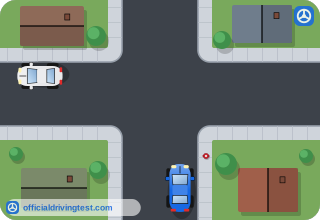
- Only at intersections that have traffic lights
- At every intersection
- Only where a school zone sign is posted
- Only at intersections with a stop sign
Show answer
Correct answer: At every intersection
Every intersection has a crosswalk, whether or not paint marks it.
Source: Tennessee Comprehensive Driver License Manual (March 2025 printing), page 103 · Open this page in the manual (Manual page 103)
-
In general, how do pedestrians stand on right-of-way at intersections?
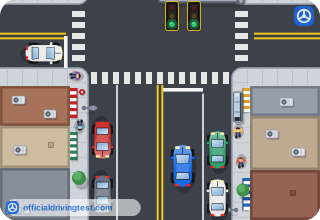
- They have it only at intersections with a marked crosswalk
- They never have it unless a police officer directs traffic
- They have it only at intersections with a traffic light
- They generally have the right-of-way at all intersections
Show answer
Correct answer: They generally have the right-of-way at all intersections
The manual states that pedestrians generally have the right-of-way at all intersections.
Source: Tennessee Comprehensive Driver License Manual (March 2025 printing), page 103 · Open this page in the manual (Manual page 103)
-
Regardless of the rules of the road or right-of-way, what does the law specifically require of a driver where pedestrians are concerned?
- Sound the horn before passing any pedestrian on the road
- Stop only for pedestrians who are inside a marked crosswalk
- Slow down only when a pedestrian is facing the vehicle
- Exercise great care and extreme caution to avoid striking pedestrians
Show answer
Correct answer: Exercise great care and extreme caution to avoid striking pedestrians
Even when a driver has the right-of-way, the law requires great care and extreme caution to avoid striking pedestrians.
Source: Tennessee Comprehensive Driver License Manual (March 2025 printing), page 103 · Open this page in the manual (Manual page 103)
-
You are stopped at a red light. What should you do about the crosswalk?
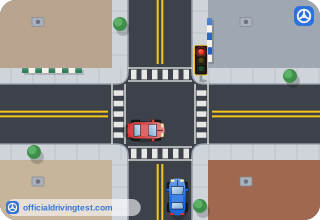
- Stop with your front wheels over it to see the cross traffic
- Not block it and not stop with any part of your vehicle over it
- Stop in it if no pedestrians are waiting at the curb
- Stop partly over it if you plan to turn when it turns green
Show answer
Correct answer: Not block it and not stop with any part of your vehicle over it
Blocking the crosswalk, or stopping with part of the vehicle over it, forces pedestrians around the vehicle and into danger.
Source: Tennessee Comprehensive Driver License Manual (March 2025 printing), page 103 · Open this page in the manual (Manual page 103)
-
When must a driver slow down or stop to yield to a pedestrian in a crosswalk?
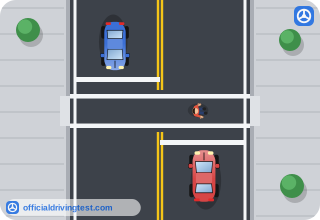
- Only when the pedestrian has already crossed the center line of the road toward your side of it
- Only when the pedestrian is on the half of the road farthest from your vehicle and stays in the crosswalk
- When the pedestrian is on your half of the roadway or coming so close from the other half as to be in danger
- Only when the pedestrian is on the opposite half of the road and has raised a hand to stop you
Show answer
Correct answer: When the pedestrian is on your half of the roadway or coming so close from the other half as to be in danger
A driver must yield to a pedestrian in the crosswalk who is on the driver’s half of the roadway, or who is coming from the other half so closely as to be in danger.
Source: Tennessee Comprehensive Driver License Manual (March 2025 printing), page 103 · Open this page in the manual (Manual page 103)
-
You are making a right turn. Which pedestrians should you be especially watchful for?
- Pedestrians on the left side of your vehicle only
- Only pedestrians who are directly behind your vehicle
- Pedestrians to the right of your vehicle
- Only pedestrians who are waiting at a bus stop
Show answer
Correct answer: Pedestrians to the right of your vehicle
The manual says to be alert to pedestrians on the right of the vehicle, especially when turning right.
Source: Tennessee Comprehensive Driver License Manual (March 2025 printing), page 103 · Open this page in the manual (Manual page 103)
-
A pedestrian steps off the curb into the roadway on your half of the road. When must you yield?
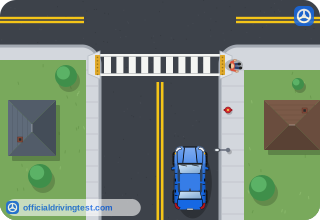
- Immediately, as soon as the pedestrian steps off the curb
- After the pedestrian has walked past the middle of the road
- After you have honked your horn to warn the pedestrian
- After the pedestrian has been in the roadway for a few seconds
Show answer
Correct answer: Immediately, as soon as the pedestrian steps off the curb
A driver must yield immediately when a pedestrian steps off the curb onto the driver’s half of the road or so close to it that the pedestrian is in danger.
Source: Tennessee Comprehensive Driver License Manual (March 2025 printing), page 103 · Open this page in the manual (Manual page 103)
-
What must a driver always do for a blind pedestrian carrying a white, metallic, red tipped white cane or using a guide dog?
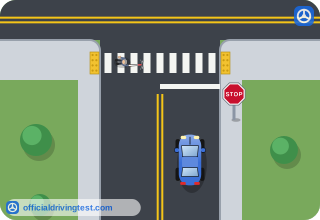
- Sound the horn so the pedestrian knows the car is near
- Pass quickly on the left so the pedestrian can cross
- Stop only if the pedestrian raises the cane
- Always yield to the pedestrian
Show answer
Correct answer: Always yield to the pedestrian
The manual says to always yield to blind pedestrians who carry a white cane or use a guide dog.
Source: Tennessee Comprehensive Driver License Manual (March 2025 printing), page 103 · Open this page in the manual (Manual page 103)