Tennessee: Emergency vehicles and work zones — Part 2 Practice Test
Questions in this part include: “Flaggers at most work sites use paddles with which words?” · “What is the fine range under Tennessee law for violating the speed limit posted in active work zones?”
Independent educational site · not affiliated with any government agency or DMV
Ready? Test yourself
- Instant feedback with an explanation
- Every answer cites its source in the manual
- Your best score is saved on this device
- Keyboard: press 1 to 4 to answer and Enter for the next question
Questions are original and based on the official manual "Tennessee Comprehensive Driver License Manual" (March 2025 printing), Tennessee Department of Safety and Homeland Security.
All 17 questions in this practice test
Take the test above first, then use this list to study. Tap “Show answer” to see the correct answer and explanation.
Show the questions and answersHide the questions
-
Flaggers at most work sites use paddles with which words?
- STOP on one side and GO on the other
- SLOW on one side and YIELD on the other
- STOP on one side and SLOW on the other
- WAIT on one side and GO on the other
Show answer
Correct answer: STOP on one side and SLOW on the other
At most work sites, flaggers use paddles that say STOP on one side and SLOW on the other.
Source: Tennessee Comprehensive Driver License Manual (March 2025 printing), page 39 · Open this page in the manual (Manual page 39)
-
When do highway flaggers use red flags?
- Only during the night
- In emergency situations
- Only in heavy rain or fog
- Only on interstates
Show answer
Correct answer: In emergency situations
Flaggers usually use STOP/SLOW paddles, but red flags are used in emergency situations.
Source: Tennessee Comprehensive Driver License Manual (March 2025 printing), page 39 · Open this page in the manual (Manual page 39)
-
How do a flagger’s basic hand movements for stop and proceed differ when using a flag instead of a paddle?
- Flags are used only to stop traffic
- Paddles are used only to slow traffic
- Flag signals mean the opposite of paddles
- They are the same for both
Show answer
Correct answer: They are the same for both
The basic hand movements for stop and proceed are the same whether the flagger uses a flag or a paddle.
Source: Tennessee Comprehensive Driver License Manual (March 2025 printing), page 39 · Open this page in the manual (Manual page 39)
-
Besides fluorescent orange, what color clothing may flaggers and other workers directing traffic wear in work zones?
- Fluorescent yellow-green
- Fluorescent pink (coral)
- Bright solid red
- Reflective navy blue
Show answer
Correct answer: Fluorescent yellow-green
Flaggers and other workers directing traffic may wear fluorescent yellow-green clothing, vests and hard hats in addition to fluorescent orange.
Source: Tennessee Comprehensive Driver License Manual (March 2025 printing), page 39 · Open this page in the manual (Manual page 39)
-
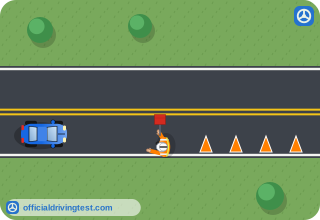
A flagger faces you, holds a red flag straight out across your lane and raises the other hand with the palm toward you. What does this signal mean?
- Proceed
- Slow down
- Stop
- Pull over
Show answer
Correct answer: Stop
A flag held straight out across the lane with the free hand raised, palm toward traffic, is the flagger signal to stop traffic.
Source: Tennessee Comprehensive Driver License Manual (March 2025 printing), page 39 · Open this page in the manual (Manual page 39)
-
A flagger stands sideways to you, holds the red flag down out of the way and waves the free arm over the head. What does this signal mean?
- Stop traffic
- Traffic may proceed
- Alert and slow traffic
- Pull onto the shoulder
Show answer
Correct answer: Traffic may proceed
With the flag lowered and the free arm waving traffic on, the flagger is signaling traffic to proceed.
Source: Tennessee Comprehensive Driver License Manual (March 2025 printing), page 39 · Open this page in the manual (Manual page 39)
-
A flagger faces you with the arm held out and moves a red flag up and down. What does this signal mean?
- Stop
- Proceed
- Turn around
- Alert and slow down
Show answer
Correct answer: Alert and slow down
Moving the extended flag up and down is the flagger signal to alert traffic and slow it down.
Source: Tennessee Comprehensive Driver License Manual (March 2025 printing), page 39 · Open this page in the manual (Manual page 39)
-
What is the fine range under Tennessee law for violating the speed limit posted in active work zones?
- A minimum of $50 up to a maximum of $250
- A minimum of $500 up to a maximum of $1,000
- A minimum of $250 up to a maximum of $500
- A minimum of $100 up to a maximum of $750
Show answer
Correct answer: A minimum of $250 up to a maximum of $500
Tennessee law sets a minimum fine of $250 and a maximum of $500 for violating the speed limit posted in active work zones.
Source: Tennessee Comprehensive Driver License Manual (March 2025 printing), page 47 · Open this page in the manual (Manual page 47)
-
Which color is used for the signs and other traffic control devices that make highway work zones easy to recognize?
- Orange (or yellow-green)
- Blue with white stripes
- Green and purple
- Red and brown
Show answer
Correct answer: Orange (or yellow-green)
Orange (or yellow-green) signs and orange devices, flashing lights on equipment and workers in highly visible clothing mark a work zone.
Source: Tennessee Comprehensive Driver License Manual (March 2025 printing), page 47 · Open this page in the manual (Manual page 47)
-
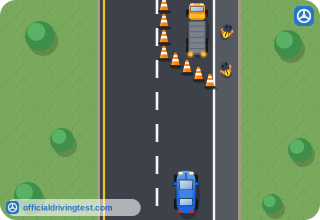
Which of these is counted as work being done in a highway work zone?
- Only road paving and resurfacing
- Only bridge painting and cleaning
- Tree trimming and utility work
- Only snow removal and salting
Show answer
Correct answer: Tree trimming and utility work
A highway work zone covers construction, maintenance or utility work on the road, shoulders or related items, including utility work, tree trimming and survey activities.
Source: Tennessee Comprehensive Driver License Manual (March 2025 printing), page 47 · Open this page in the manual (Manual page 47)
-
How do police vehicles attempting to stop a driver signal?
- Flashing blue or blue and red lights, and/or an audible signal
- Steady green lights together with a hand signal from the officer
- Flashing amber lights and a horn sounded by the police car
- Flashing white lights and a steady red light on the roof
Show answer
Correct answer: Flashing blue or blue and red lights, and/or an audible signal
Police use flashing blue or flashing blue and red lights and/or an audible signal to stop drivers.
Source: Tennessee Comprehensive Driver License Manual (March 2025 printing), page 52 · Open this page in the manual (Manual page 52)
-
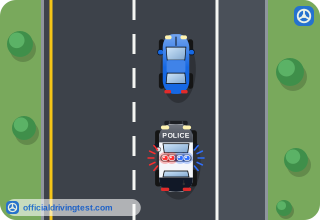
When police signal you to stop, where should you stop and park?
- In the lane you are in, with your hazard lights on
- In the middle of the intersection so you can be seen
- On the left side of the road so the officer can approach safely
- Near the right-hand edge or curb, clear of any intersection
Show answer
Correct answer: Near the right-hand edge or curb, clear of any intersection
The manual says to drive as close as safely practical to the right-hand edge or curb, clear of any intersection, then stop and park.
Source: Tennessee Comprehensive Driver License Manual (March 2025 printing), page 52 · Open this page in the manual (Manual page 52)
-
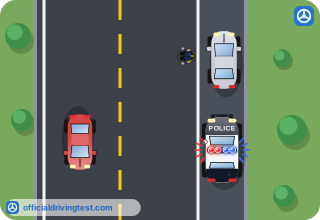
During a stop by a police officer, where should the driver keep his or her hands?
- On the dashboard
- On the steering wheel
- Out of the window
- On top of the head
Show answer
Correct answer: On the steering wheel
Drivers should keep their hands on the steering wheel and passengers should keep theirs in plain view.
Source: Tennessee Comprehensive Driver License Manual (March 2025 printing), page 52 · Open this page in the manual (Manual page 52)
-
What does the manual say drivers should tell an officer during a traffic stop?
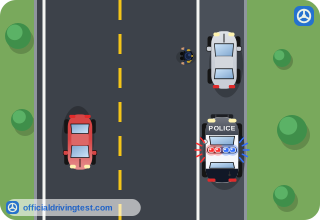
- How long they have held their driver license and where it was issued
- Where they are headed and why they are in a hurry
- If they have a handgun permit and if they are armed
- Whether they plan to dispute the ticket in court
Show answer
Correct answer: If they have a handgun permit and if they are armed
Drivers should advise officers if they have a handgun permit and if they are armed.
Source: Tennessee Comprehensive Driver License Manual (March 2025 printing), page 52 · Open this page in the manual (Manual page 52)
-
During a traffic stop, what should you do about your vehicle doors and where you sit?
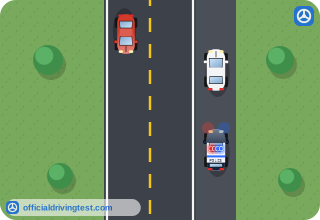
- Keep all doors closed and stay in the vehicle unless asked to get out
- Get out and meet the officer at the rear of your vehicle right away
- Open the door so the officer can see inside the vehicle at once
- Get out and wait on the shoulder until the officer arrives
Show answer
Correct answer: Keep all doors closed and stay in the vehicle unless asked to get out
The manual says to keep doors closed and remain in the vehicle unless the officer asks you to get out.
Source: Tennessee Comprehensive Driver License Manual (March 2025 printing), page 52 · Open this page in the manual (Manual page 52)
-
A police stop is made after dark. What should you do before the officer approaches?
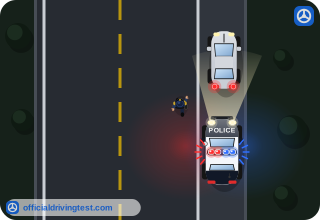
- Turn on the high beams
- Turn off every light on the vehicle
- Roll up the window and lock the doors
- Turn on the vehicle’s interior light
Show answer
Correct answer: Turn on the vehicle’s interior light
Turning on the interior light after dark lets the officer see inside the vehicle as he or she approaches.
Source: Tennessee Comprehensive Driver License Manual (March 2025 printing), page 52 · Open this page in the manual (Manual page 52)
-
You disagree with enforcement action an officer takes against you. What does the manual say to do?
- Explain your side at the roadside until the officer agrees with you
- Refuse to sign anything until a supervisor comes to the scene
- Do not argue at the scene, because traffic charges are decided in court
- Ask the officer to cancel the charge by showing your clean driving record
Show answer
Correct answer: Do not argue at the scene, because traffic charges are decided in court
Arguing with the officer at the scene is not the place to settle it; traffic violations and crimes are decided in court.
Source: Tennessee Comprehensive Driver License Manual (March 2025 printing), page 52 · Open this page in the manual (Manual page 52)