Tennessee: Emergency vehicles and work zones
Yielding to emergency vehicles, the Move Over Law, police stops, flaggers, and work zone speed limits and fines. Split into 4 shorter tests so you're not stuck in one long quiz.
Independent educational site · not affiliated with any government agency or DMV
Choose a part
Emergency vehicles and work zones — Part 1
Questions in this part include: “What does the Tennessee Highway Patrol's Project CAR do?”
StartEmergency vehicles and work zones — Part 2
Questions in this part include: “Flaggers at most work sites use paddles with which words?”
StartEmergency vehicles and work zones — Part 3
Questions in this part include: “Which of these makes you yield the right-of-way to a police vehicle, fire engine or ambulance?”
StartEmergency vehicles and work zones — Part 4
Questions in this part include: “A "STATE LAW" sign reads "MOVE OVER FOR STOPPED EMERGENCY VEHICLES." What maximum fine does the sign list?”
StartAll 69 Emergency vehicles and work zones questions with answers
Choose a part above to take a practice test, or study every question and answer here.
Show the questions and answersHide the questions
-
What does the manual say about speed limits in work zones?
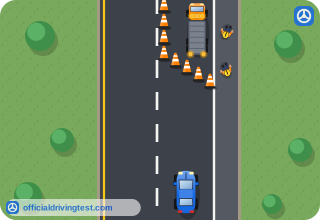
- They are always the same as on the road before the zone
- They apply only when workers can be seen
- They are usually reduced, so drive within the posted limits
- They are raised at night
Show answer
Correct answer: They are usually reduced, so drive within the posted limits
The tip is to slow down and drive within the posted limits, which are usually reduced in work zones.
Source: Tennessee Comprehensive Driver License Manual (March 2025 printing), page 18 · Open this page in the manual (Manual page 18)
-
What does the Tennessee Highway Patrol's Project CAR do?
- Gives free driver education classes to teenage drivers
- Inspects vehicles entering work zones
- Rewards drivers who obey work zone limits
- Puts troopers in work zones to target traffic-law violators
Show answer
Correct answer: Puts troopers in work zones to target traffic-law violators
Project CAR (Construction Accident Reduction) puts troopers in work zones to target violators when workers are present.
Source: Tennessee Comprehensive Driver License Manual (March 2025 printing), page 18 · Open this page in the manual (Manual page 18)
-
According to the manual, what causes most work zone accidents?
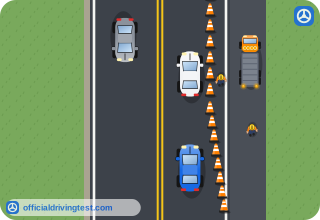
- Head-on collisions
- Rear-end collisions
- Collisions with animals
- Collisions with backing trucks
Show answer
Correct answer: Rear-end collisions
The tip to not tailgate is given because most work zone accidents are caused by rear-end collisions.
Source: Tennessee Comprehensive Driver License Manual (March 2025 printing), page 18 · Open this page in the manual (Manual page 18)
-
What can happen to a driver who waits and merges at the last chance in a work zone?
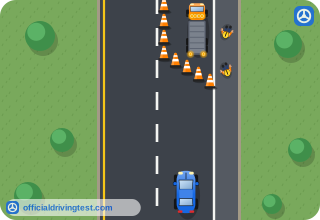
- The driver gets the right of way over other cars
- Nothing, because late merging keeps traffic moving
- The driver can be ticketed and cause an accident
- The driver loses the license for 90 days
Show answer
Correct answer: The driver can be ticketed and cause an accident
The tip says to merge early because a last chance merger can be ticketed and cause an accident.
Source: Tennessee Comprehensive Driver License Manual (March 2025 printing), page 18 · Open this page in the manual (Manual page 18)
-
What should a driver do about lane changes when a flagger is in a work zone?
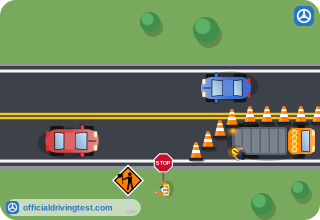
- Follow flagger signals; change lanes only when told to
- Change lanes freely to get around slow-moving traffic
- Ignore the flagger when no workers are close
- Move to the left lane before the flagger
Show answer
Correct answer: Follow flagger signals; change lanes only when told to
The tip is to follow flaggers' signals and not change lanes in the zone unless instructed.
Source: Tennessee Comprehensive Driver License Manual (March 2025 printing), page 18 · Open this page in the manual (Manual page 18)
-
What should a driver turn on before entering a work zone to be more visible to workers and other motorists?
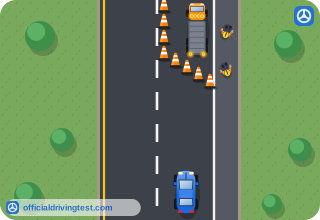
- The vehicle's headlights
- The hazard flashers
- Only the parking lights
- The horn
Show answer
Correct answer: The vehicle's headlights
Headlights make the vehicle more visible to workers and other motorists.
Source: Tennessee Comprehensive Driver License Manual (March 2025 printing), page 18 · Open this page in the manual (Manual page 18)
-
Why does the manual say to expect the unexpected in work zones?
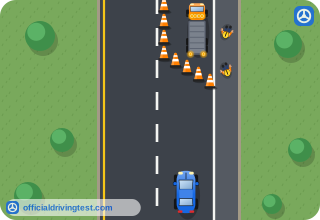
- Work zones are always closed at night
- Work zones never have flaggers
- Work zones change constantly
- Speed limits are removed in work zones
Show answer
Correct answer: Work zones change constantly
Conditions in a work zone change constantly, so drivers should stay ready.
Source: Tennessee Comprehensive Driver License Manual (March 2025 printing), page 18 · Open this page in the manual (Manual page 18)
-
What do temporary traffic control zones allow at an incident on the road?
- Drivers to pass slower cars on the shoulder
- Drivers to park near the scene to help
- Traffic to flow safely through the incident
- Traffic to go faster to clear the area
Show answer
Correct answer: Traffic to flow safely through the incident
Temporary traffic control zones let traffic move safely through incidents while reasonably protecting motorists, responders, vehicles and equipment.
Source: Tennessee Comprehensive Driver License Manual (March 2025 printing), page 36 · Open this page in the manual (Manual page 36)
-
What do orange work area signs warn you about?
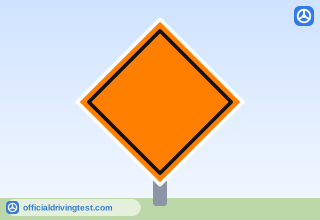
- A school zone a short way ahead
- People working on or near the roadway
- A railroad crossing just ahead
- A recreation area at the next exit
Show answer
Correct answer: People working on or near the roadway
Construction, maintenance and emergency operations signs warn that people are working on or near the road.
Source: Tennessee Comprehensive Driver License Manual (March 2025 printing), page 39 · Open this page in the manual (Manual page 39)
-
In a work area, a person with a sign or flag is directing traffic. What must you do?
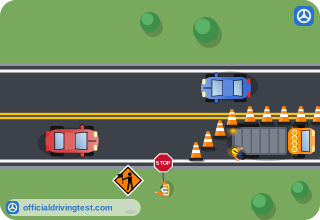
- Follow the posted signs instead
- Obey only if police are present
- Treat the signals as advice only
- Obey that person’s directions
Show answer
Correct answer: Obey that person’s directions
In work areas a person with a sign or flag may control traffic, and drivers must obey that person.
Source: Tennessee Comprehensive Driver License Manual (March 2025 printing), page 39 · Open this page in the manual (Manual page 39)
-
Electronic message or arrow signs on some roads give advance warning of what?
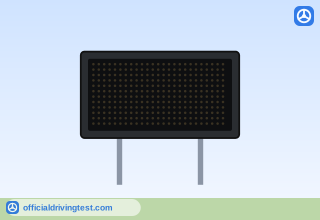
- Gas stations, food and lodging at the next exit
- Speed cameras and police checkpoints ahead
- Construction, road closures or weather hazards
- Sports and concert events in the nearby area
Show answer
Correct answer: Construction, road closures or weather hazards
These mobile signs warn ahead of construction zones, special traffic directions, road closures and sometimes weather hazards.
Source: Tennessee Comprehensive Driver License Manual (March 2025 printing), page 39 · Open this page in the manual (Manual page 39)
-
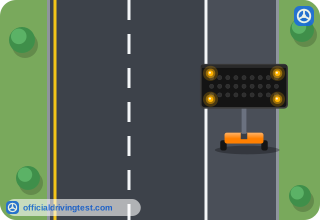
What do flashing arrow panels alert approaching drivers to?
- Speed cameras
- Lane closures
- School crossings
- Railroad crossings
Show answer
Correct answer: Lane closures
Flashing arrow panels warn drivers that a lane is closed ahead.
Source: Tennessee Comprehensive Driver License Manual (March 2025 printing), page 39 · Open this page in the manual (Manual page 39)
-
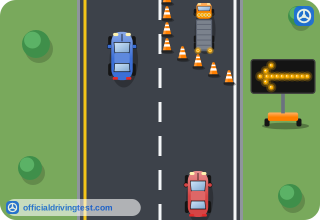
When must you begin to merge into the open lane at a flashing arrow panel?
- Right when you reach the sign
- Just after you pass the sign
- At the last cone before the closure
- Well in advance of the sign
Show answer
Correct answer: Well in advance of the sign
You must start merging into the remaining open lane well before you reach the arrow panel.
Source: Tennessee Comprehensive Driver License Manual (March 2025 printing), page 39 · Open this page in the manual (Manual page 39)
-
What are barricades, vertical panels, concrete barriers, drums and cones most commonly used for?
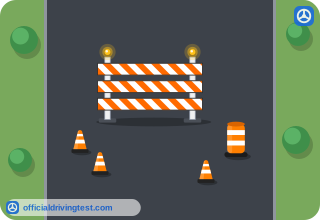
- Guiding drivers safely through work zones
- Marking where trucks must stop and wait
- Closing roads during school hours only
- Showing where drivers may park for free
Show answer
Correct answer: Guiding drivers safely through work zones
These channeling devices are the most common tools for guiding drivers safely through work zones.
Source: Tennessee Comprehensive Driver License Manual (March 2025 printing), page 39 · Open this page in the manual (Manual page 39)
-
When driving near barricades, drums and cones in a work zone, what should you do?
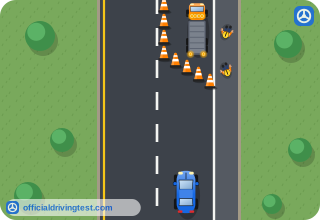
- Move onto the shoulder to give the workers more room
- Speed up so you get through the work zone quickly
- Keep in the middle of your lane and obey the speed limit
- Drive close to the devices so others can pass you
Show answer
Correct answer: Keep in the middle of your lane and obey the speed limit
Near channeling devices, keep your vehicle in the middle of the lane and obey the posted speed limit.
Source: Tennessee Comprehensive Driver License Manual (March 2025 printing), page 39 · Open this page in the manual (Manual page 39)
-
As you leave a work zone, what should you do?
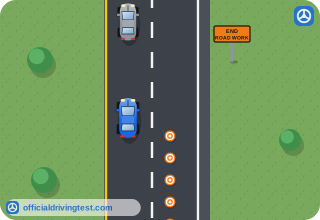
- Change lanes at once to pass slow traffic
- Stay in your lane and maintain your speed
- Speed up right away to make up for lost time
- Slow down until all the traffic has cleared
Show answer
Correct answer: Stay in your lane and maintain your speed
When leaving a work zone, stay in your lane and keep your speed steady.
Source: Tennessee Comprehensive Driver License Manual (March 2025 printing), page 39 · Open this page in the manual (Manual page 39)
-
When leaving a work zone marked with channeling devices, when may you change lanes?
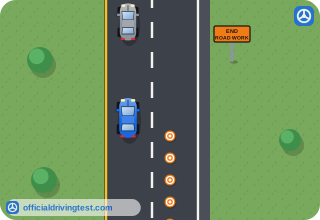
- As soon as you pass the last worker you see
- As soon as the lane next to you is empty
- As soon as the reduced speed limit ends
- Once you are completely clear of the work zone
Show answer
Correct answer: Once you are completely clear of the work zone
Do not change lanes until you are completely clear of the work zone.
Source: Tennessee Comprehensive Driver License Manual (March 2025 printing), page 39 · Open this page in the manual (Manual page 39)
-
During traffic-related emergencies, what do law enforcement officers wear so drivers can see them?
- Fluorescent yellow-green vests and rain coats
- Fluorescent pink vests and rain coats
- Dark blue reflective vests and rain jackets
- White reflective vests and hard helmets
Show answer
Correct answer: Fluorescent yellow-green vests and rain coats
Officers wear fluorescent yellow-green vests and rain coats at traffic emergencies so they can be seen, even in low light and poor weather.
Source: Tennessee Comprehensive Driver License Manual (March 2025 printing), page 39 · Open this page in the manual (Manual page 39)
-
Flaggers at most work sites use paddles with which words?
- STOP on one side and GO on the other
- SLOW on one side and YIELD on the other
- STOP on one side and SLOW on the other
- WAIT on one side and GO on the other
Show answer
Correct answer: STOP on one side and SLOW on the other
At most work sites, flaggers use paddles that say STOP on one side and SLOW on the other.
Source: Tennessee Comprehensive Driver License Manual (March 2025 printing), page 39 · Open this page in the manual (Manual page 39)
-
When do highway flaggers use red flags?
- Only during the night
- In emergency situations
- Only in heavy rain or fog
- Only on interstates
Show answer
Correct answer: In emergency situations
Flaggers usually use STOP/SLOW paddles, but red flags are used in emergency situations.
Source: Tennessee Comprehensive Driver License Manual (March 2025 printing), page 39 · Open this page in the manual (Manual page 39)
-
How do a flagger’s basic hand movements for stop and proceed differ when using a flag instead of a paddle?
- Flags are used only to stop traffic
- Paddles are used only to slow traffic
- Flag signals mean the opposite of paddles
- They are the same for both
Show answer
Correct answer: They are the same for both
The basic hand movements for stop and proceed are the same whether the flagger uses a flag or a paddle.
Source: Tennessee Comprehensive Driver License Manual (March 2025 printing), page 39 · Open this page in the manual (Manual page 39)
-
Besides fluorescent orange, what color clothing may flaggers and other workers directing traffic wear in work zones?
- Fluorescent yellow-green
- Fluorescent pink (coral)
- Bright solid red
- Reflective navy blue
Show answer
Correct answer: Fluorescent yellow-green
Flaggers and other workers directing traffic may wear fluorescent yellow-green clothing, vests and hard hats in addition to fluorescent orange.
Source: Tennessee Comprehensive Driver License Manual (March 2025 printing), page 39 · Open this page in the manual (Manual page 39)
-
A flagger faces you, holds a red flag straight out across your lane and raises the other hand with the palm toward you. What does this signal mean?
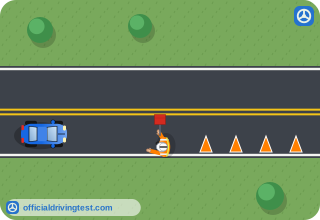
- Proceed
- Slow down
- Stop
- Pull over
Show answer
Correct answer: Stop
A flag held straight out across the lane with the free hand raised, palm toward traffic, is the flagger signal to stop traffic.
Source: Tennessee Comprehensive Driver License Manual (March 2025 printing), page 39 · Open this page in the manual (Manual page 39)
-
A flagger stands sideways to you, holds the red flag down out of the way and waves the free arm over the head. What does this signal mean?
- Stop traffic
- Traffic may proceed
- Alert and slow traffic
- Pull onto the shoulder
Show answer
Correct answer: Traffic may proceed
With the flag lowered and the free arm waving traffic on, the flagger is signaling traffic to proceed.
Source: Tennessee Comprehensive Driver License Manual (March 2025 printing), page 39 · Open this page in the manual (Manual page 39)
-
A flagger faces you with the arm held out and moves a red flag up and down. What does this signal mean?
- Stop
- Proceed
- Turn around
- Alert and slow down
Show answer
Correct answer: Alert and slow down
Moving the extended flag up and down is the flagger signal to alert traffic and slow it down.
Source: Tennessee Comprehensive Driver License Manual (March 2025 printing), page 39 · Open this page in the manual (Manual page 39)
-
What is the fine range under Tennessee law for violating the speed limit posted in active work zones?
- A minimum of $50 up to a maximum of $250
- A minimum of $500 up to a maximum of $1,000
- A minimum of $250 up to a maximum of $500
- A minimum of $100 up to a maximum of $750
Show answer
Correct answer: A minimum of $250 up to a maximum of $500
Tennessee law sets a minimum fine of $250 and a maximum of $500 for violating the speed limit posted in active work zones.
Source: Tennessee Comprehensive Driver License Manual (March 2025 printing), page 47 · Open this page in the manual (Manual page 47)
-
Which color is used for the signs and other traffic control devices that make highway work zones easy to recognize?
- Orange (or yellow-green)
- Blue with white stripes
- Green and purple
- Red and brown
Show answer
Correct answer: Orange (or yellow-green)
Orange (or yellow-green) signs and orange devices, flashing lights on equipment and workers in highly visible clothing mark a work zone.
Source: Tennessee Comprehensive Driver License Manual (March 2025 printing), page 47 · Open this page in the manual (Manual page 47)
-
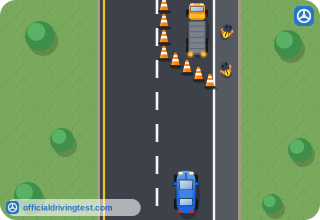
Which of these is counted as work being done in a highway work zone?
- Only road paving and resurfacing
- Only bridge painting and cleaning
- Tree trimming and utility work
- Only snow removal and salting
Show answer
Correct answer: Tree trimming and utility work
A highway work zone covers construction, maintenance or utility work on the road, shoulders or related items, including utility work, tree trimming and survey activities.
Source: Tennessee Comprehensive Driver License Manual (March 2025 printing), page 47 · Open this page in the manual (Manual page 47)
-
How do police vehicles attempting to stop a driver signal?
- Flashing blue or blue and red lights, and/or an audible signal
- Steady green lights together with a hand signal from the officer
- Flashing amber lights and a horn sounded by the police car
- Flashing white lights and a steady red light on the roof
Show answer
Correct answer: Flashing blue or blue and red lights, and/or an audible signal
Police use flashing blue or flashing blue and red lights and/or an audible signal to stop drivers.
Source: Tennessee Comprehensive Driver License Manual (March 2025 printing), page 52 · Open this page in the manual (Manual page 52)
-
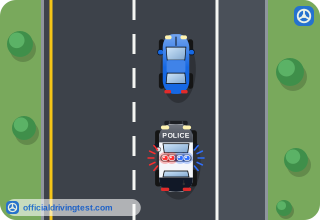
When police signal you to stop, where should you stop and park?
- In the lane you are in, with your hazard lights on
- In the middle of the intersection so you can be seen
- On the left side of the road so the officer can approach safely
- Near the right-hand edge or curb, clear of any intersection
Show answer
Correct answer: Near the right-hand edge or curb, clear of any intersection
The manual says to drive as close as safely practical to the right-hand edge or curb, clear of any intersection, then stop and park.
Source: Tennessee Comprehensive Driver License Manual (March 2025 printing), page 52 · Open this page in the manual (Manual page 52)
-
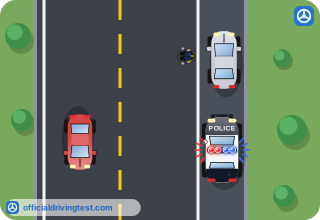
During a stop by a police officer, where should the driver keep his or her hands?
- On the dashboard
- On the steering wheel
- Out of the window
- On top of the head
Show answer
Correct answer: On the steering wheel
Drivers should keep their hands on the steering wheel and passengers should keep theirs in plain view.
Source: Tennessee Comprehensive Driver License Manual (March 2025 printing), page 52 · Open this page in the manual (Manual page 52)
-
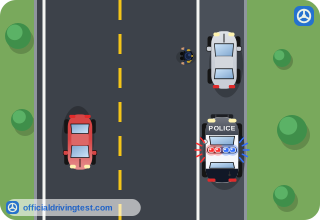
What does the manual say drivers should tell an officer during a traffic stop?
- How long they have held their driver license and where it was issued
- Where they are headed and why they are in a hurry
- If they have a handgun permit and if they are armed
- Whether they plan to dispute the ticket in court
Show answer
Correct answer: If they have a handgun permit and if they are armed
Drivers should advise officers if they have a handgun permit and if they are armed.
Source: Tennessee Comprehensive Driver License Manual (March 2025 printing), page 52 · Open this page in the manual (Manual page 52)
-
During a traffic stop, what should you do about your vehicle doors and where you sit?
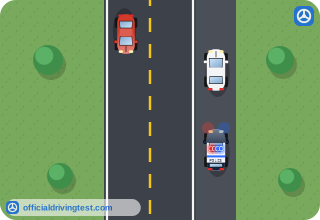
- Keep all doors closed and stay in the vehicle unless asked to get out
- Get out and meet the officer at the rear of your vehicle right away
- Open the door so the officer can see inside the vehicle at once
- Get out and wait on the shoulder until the officer arrives
Show answer
Correct answer: Keep all doors closed and stay in the vehicle unless asked to get out
The manual says to keep doors closed and remain in the vehicle unless the officer asks you to get out.
Source: Tennessee Comprehensive Driver License Manual (March 2025 printing), page 52 · Open this page in the manual (Manual page 52)
-
A police stop is made after dark. What should you do before the officer approaches?
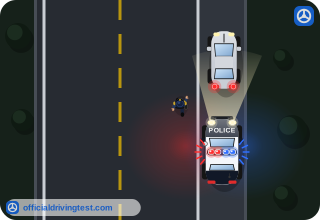
- Turn on the high beams
- Turn off every light on the vehicle
- Roll up the window and lock the doors
- Turn on the vehicle’s interior light
Show answer
Correct answer: Turn on the vehicle’s interior light
Turning on the interior light after dark lets the officer see inside the vehicle as he or she approaches.
Source: Tennessee Comprehensive Driver License Manual (March 2025 printing), page 52 · Open this page in the manual (Manual page 52)
-
You disagree with enforcement action an officer takes against you. What does the manual say to do?
- Explain your side at the roadside until the officer agrees with you
- Refuse to sign anything until a supervisor comes to the scene
- Do not argue at the scene, because traffic charges are decided in court
- Ask the officer to cancel the charge by showing your clean driving record
Show answer
Correct answer: Do not argue at the scene, because traffic charges are decided in court
Arguing with the officer at the scene is not the place to settle it; traffic violations and crimes are decided in court.
Source: Tennessee Comprehensive Driver License Manual (March 2025 printing), page 52 · Open this page in the manual (Manual page 52)
-
Someone in an unmarked police car signals you to pull over and stop. What may you do?
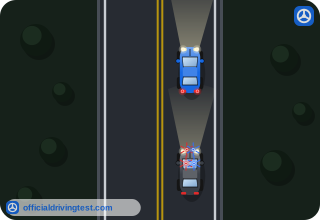
- Speed up to get away until you reach the next highway exit ramp
- Drive slowly to the nearest area with other people, such as a parking lot
- Ignore the signal unless the car has a marked door and a light bar
- Stop at once in whatever lane you are in, even on the interstate
Show answer
Correct answer: Drive slowly to the nearest area with other people, such as a parking lot
The manual allows you to drive slowly a short distance to a place with other people around, such as the next business parking lot or exit.
Source: Tennessee Comprehensive Driver License Manual (March 2025 printing), page 52 · Open this page in the manual (Manual page 52)
-
When approaching a fire station, what should you do if an emergency vehicle is backing into the driveway entrance?
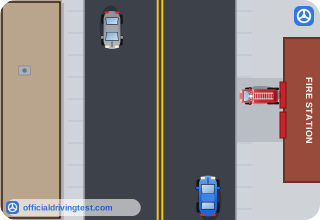
- Pass it quickly before it backs into the driveway and blocks the road
- Sound your horn to warn the crew that you are approaching
- Keep going and let the vehicle wait for a gap in traffic
- Yield to it, whether it is about to back in or already backing in
Show answer
Correct answer: Yield to it, whether it is about to back in or already backing in
The manual says to yield to an emergency vehicle about to back into, or already backing into, the station driveway.
Source: Tennessee Comprehensive Driver License Manual (March 2025 printing), page 53 · Open this page in the manual (Manual page 53)
-
Which of these makes you yield the right-of-way to a police vehicle, fire engine or ambulance?
- A siren only, and never a flashing light alone
- A siren, an air horn or a red or blue flashing light
- Only a flashing white light shown on the roof
- A steady red light shown on the vehicle roof alone
Show answer
Correct answer: A siren, an air horn or a red or blue flashing light
You yield to an emergency vehicle that uses a siren, an air horn or a red or blue flashing light.
Source: Tennessee Comprehensive Driver License Manual (March 2025 printing), page 54 · Open this page in the manual (Manual page 54)
-
Which of these is against the law for an unauthorized private vehicle?
- Blue flashing emergency lights, or blue and red together
- Red brake lights that come on when the driver brakes
- White reverse lights that come on when backing up
- White or amber steady-burning lights shining to the front
Show answer
Correct answer: Blue flashing emergency lights, or blue and red together
Unauthorized private vehicles may not have blue flashing emergency lights, or blue and red combined, installed, maintained or shown.
Source: Tennessee Comprehensive Driver License Manual (March 2025 printing), page 54 · Open this page in the manual (Manual page 54)
-
A fire truck is responding to a fire alarm. Which of these is against the law?
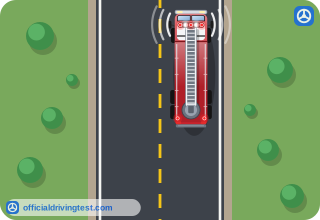
- Yielding the right-of-way to it
- Pulling to the right-hand edge of the road
- Stopping until it has passed
- Following the fire truck
Show answer
Correct answer: Following the fire truck
It is against the law to follow a fire truck or other emergency vehicle responding to an alarm or emergency.
Source: Tennessee Comprehensive Driver License Manual (March 2025 printing), page 54 · Open this page in the manual (Manual page 54)
-
Where is it illegal to take your vehicle once an emergency vehicle has stopped to deal with an emergency?
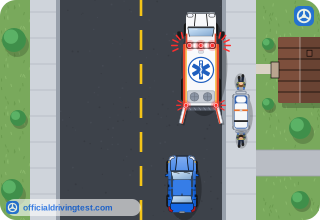
- Within 100 feet of where the emergency vehicle has stopped
- Within the block where the emergency vehicle has stopped
- Anywhere that you can still see the emergency vehicle
- Within the nearest intersection on either side of it
Show answer
Correct answer: Within the block where the emergency vehicle has stopped
The manual makes it illegal to take your vehicle within the block where an emergency vehicle has stopped.
Source: Tennessee Comprehensive Driver License Manual (March 2025 printing), page 54 · Open this page in the manual (Manual page 54)
-
You pass the site of a fire and an unprotected fire department hose is lying on the road. When may you drive over it?
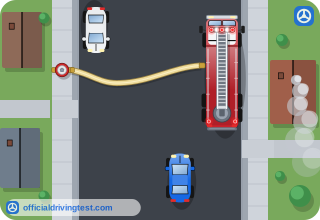
- If you drive over it slowly and carefully in low gear
- If there is no other route that you can take around the site
- If a bystander at the scene waves you across the hose
- Only if the fire department official in command says it is okay
Show answer
Correct answer: Only if the fire department official in command says it is okay
Do not drive over an unprotected fire department hose unless the official in command says it is okay.
Source: Tennessee Comprehensive Driver License Manual (March 2025 printing), page 54 · Open this page in the manual (Manual page 54)
-
What does Tennessee law require when an emergency vehicle is approaching?
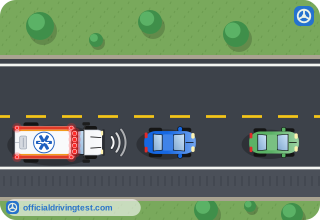
- Yield and pull to the right-hand edge or curb, parallel to it, and stop
- Speed up and pass the emergency vehicle on the right side of the road
- Stop where you are in your own lane and turn on your hazard flashers
- Move to the left edge of the road, slow down, and keep going
Show answer
Correct answer: Yield and pull to the right-hand edge or curb, parallel to it, and stop
All traffic meeting or being overtaken must yield and drive to the right edge or curb and stop.
Source: Tennessee Comprehensive Driver License Manual (March 2025 printing), page 54 · Open this page in the manual (Manual page 54)
-
You have pulled over for an emergency vehicle. How long must you remain in that stopped position?
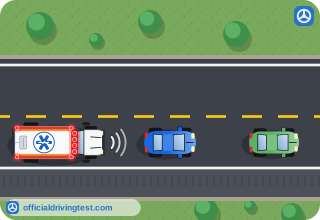
- Until you can no longer hear the siren or see any flashing lights
- For at least one full minute after the vehicle has gone by you
- Until the vehicle has passed or a police officer directs you to move
- Until the next car in line behind you has begun to move on
Show answer
Correct answer: Until the vehicle has passed or a police officer directs you to move
You stay stopped until the emergency vehicle has passed or an officer tells you to move, and you still proceed with caution.
Source: Tennessee Comprehensive Driver License Manual (March 2025 printing), page 54 · Open this page in the manual (Manual page 54)
-
You are in an intersection when an emergency vehicle approaches. What should you do?
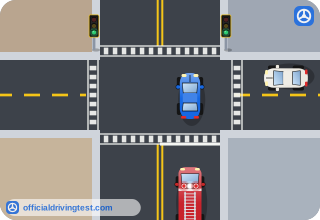
- Stop right where you are inside the intersection
- Pull over immediately to the nearest curb or edge of road
- Back up out of the intersection to clear the way
- Drive on through the intersection before pulling over
Show answer
Correct answer: Drive on through the intersection before pulling over
Pulling over inside the intersection could block the emergency vehicle’s path, so you drive through first.
Source: Tennessee Comprehensive Driver License Manual (March 2025 printing), page 54 · Open this page in the manual (Manual page 54)
-
When pulling over for an emergency vehicle, why should you not pull to the right if it would block a side road or driveway?
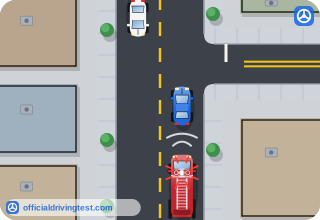
- The emergency vehicle may need to turn into that road or driveway
- The vehicles behind you will not see that you have stopped
- Your vehicle would be hidden from other drivers on the side road
- The emergency vehicle will need the right shoulder in order to pass
Show answer
Correct answer: The emergency vehicle may need to turn into that road or driveway
The emergency vehicle may need to turn into that road or driveway to reach the incident.
Source: Tennessee Comprehensive Driver License Manual (March 2025 printing), page 54 · Open this page in the manual (Manual page 54)
-
You are stopped at a red light when an emergency vehicle approaches, and the light turns green before it has passed. What should you do?
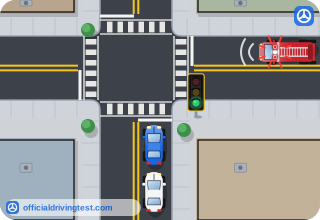
- Proceed on green, since the green light gives you priority
- Stay where you are until it has passed or turned onto another street
- Proceed only if the emergency vehicle is more than a block away
- Move forward slowly into the intersection and then stop there
Show answer
Correct answer: Stay where you are until it has passed or turned onto another street
Do NOT proceed on green; wait until the emergency vehicle has passed or turned onto another street.
Source: Tennessee Comprehensive Driver License Manual (March 2025 printing), page 54 · Open this page in the manual (Manual page 54)
-
Why does the manual advise turning down the radio volume when yielding to emergency vehicles?
- So you can hear your own engine and tires and notice a problem
- So that other drivers can hear your horn if you have to sound it
- So you can hear directions given over the emergency vehicle’s loudspeaker
- So that you stay calm and relaxed while you wait for it to pass by
Show answer
Correct answer: So you can hear directions given over the emergency vehicle’s loudspeaker
Directions from the emergency vehicle’s loudspeaker may need an immediate reaction.
Source: Tennessee Comprehensive Driver License Manual (March 2025 printing), page 54 · Open this page in the manual (Manual page 54)
-
Which of these is listed as a stationary vehicle you are likely to see using flashing lights along the roadside?
- A taxi picking up a passenger
- A delivery van making a drop-off
- A farm tractor working beside the road
- A recovery vehicle such as a tow truck
Show answer
Correct answer: A recovery vehicle such as a tow truck
The manual lists utility, emergency, highway maintenance and recovery vehicles such as tow trucks.
Source: Tennessee Comprehensive Driver License Manual (March 2025 printing), page 55 · Open this page in the manual (Manual page 55)
-
If you change lanes for an emergency vehicle stopped on the right shoulder under the Move Over Law, which lane do you move into?
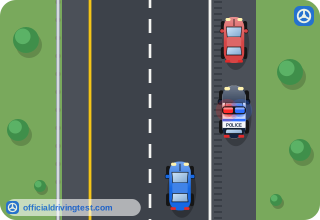
- The right-most lane, beside the stopped vehicle
- The left lane, freeing the right-most lane as a barrier
- The left shoulder, to leave every lane open
- The HOV lane, even if you are driving alone
Show answer
Correct answer: The left lane, freeing the right-most lane as a barrier
With the emergency vehicle on the right shoulder, you merge into the left lane so the right-most lane stays empty as a safety barrier.
Source: Tennessee Comprehensive Driver License Manual (March 2025 printing), page 72 · Open this page in the manual (Manual page 72)
-
If you change lanes for an emergency vehicle stopped on the left shoulder under the Move Over Law, which lane do you move into?
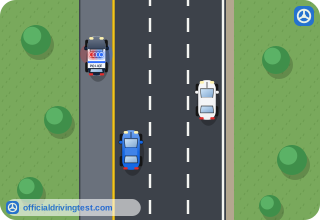
- The left-most lane, beside the stopped vehicle
- The right shoulder, to leave every lane open
- The right lane, freeing the left-most lane as a barrier
- The HOV lane, even if you are driving alone
Show answer
Correct answer: The right lane, freeing the left-most lane as a barrier
The move-over requirement applies on either side of the road; with the vehicle on the left shoulder, you merge into the right lane so the left-most lane stays empty as a barrier.
Source: Tennessee Comprehensive Driver License Manual (March 2025 printing), page 72 · Open this page in the manual (Manual page 72)
-
When does the Move Over Law apply to an emergency, utility service or maintenance vehicle?
- Only when it is moving with its siren on
- Only when an officer is standing beside it
- At any time, even when parked with no lights on
- When it is stationary and using its flashing lights
Show answer
Correct answer: When it is stationary and using its flashing lights
The law covers these vehicles when they are stationary and using their flashing lights.
Source: Tennessee Comprehensive Driver License Manual (March 2025 printing), page 72 · Open this page in the manual (Manual page 72)
-
A "STATE LAW" sign reads "MOVE OVER FOR STOPPED EMERGENCY VEHICLES." What maximum fine does the sign list?
- $50
- $500
- $100
- $1,000
Show answer
Correct answer: $500
The Move Over Law sign printed with the law reads "STATE LAW – MOVE OVER FOR STOPPED EMERGENCY VEHICLES – $500 MAXIMUM FINE."
Source: Tennessee Comprehensive Driver License Manual (March 2025 printing), page 72 · Open this page in the manual (Manual page 72)
-
What is a work zone, according to the manual?
- Only a lane closure where flaggers work
- Only construction work done on a highway
- Any road work that may impede traffic
- Only an area with reduced speed signs
Show answer
Correct answer: Any road work that may impede traffic
A work zone can be any road work that may impede traffic, including moving work zones.
Source: Tennessee Comprehensive Driver License Manual (March 2025 printing), page 112 · Open this page in the manual (Manual page 112)
-
Besides orange, what bright color do work-zone workers normally wear to be highly visible?
- Bright red
- Bright yellow-green
- Plain white
- Dark blue
Show answer
Correct answer: Bright yellow-green
Workers normally wear bright yellow-green shirts, vests or hardhats to be highly visible.
Source: Tennessee Comprehensive Driver License Manual (March 2025 printing), page 112 · Open this page in the manual (Manual page 112)
-
What colors do temporary signs in work zones use?
- A white background with red letters or symbols
- A yellow background with green letters or symbols
- A black background with orange letters or symbols
- An orange background with black letters or symbols
Show answer
Correct answer: An orange background with black letters or symbols
All temporary signs in work zones have an orange background and black letters or symbols.
Source: Tennessee Comprehensive Driver License Manual (March 2025 printing), page 112 · Open this page in the manual (Manual page 112)
-
On a divided highway, where will temporary work zone signs be found?
- Only on the right side of the road shoulder
- Only in the median of the road ahead
- On both the left and right sides of the road
- Only on overhead structures
Show answer
Correct answer: On both the left and right sides of the road
On a divided highway these signs appear on both sides; on other roads they are on the right side.
Source: Tennessee Comprehensive Driver License Manual (March 2025 printing), page 112 · Open this page in the manual (Manual page 112)
-
What should you do if there are no reduced speed limit signs posted in a work zone?
- Obey the normal posted speed limit
- Drive as fast as other traffic
- Drive 10 miles per hour below the limit
- Stop and wait for a flagger
Show answer
Correct answer: Obey the normal posted speed limit
Without posted reductions, drivers should follow the normal posted speed limit.
Source: Tennessee Comprehensive Driver License Manual (March 2025 printing), page 112 · Open this page in the manual (Manual page 112)
-
What is the maximum fine under Tennessee law for a speed violation in a work zone where the speed is reduced and workers are present?
- $100
- $250
- $1,000
- $500
Show answer
Correct answer: $500
Tennessee law sets a fine of up to a maximum of $500 for such violations.
Source: Tennessee Comprehensive Driver License Manual (March 2025 printing), page 112 · Open this page in the manual (Manual page 112)
-
How many feet per second does a car traveling 60 M.P.H. travel?
- 44 feet
- 88 feet
- 60 feet
- 120 feet
Show answer
Correct answer: 88 feet
The manual gives 88 feet per second at 60 M.P.H., which shows how quickly you reach a work zone.
Source: Tennessee Comprehensive Driver License Manual (March 2025 printing), page 112 · Open this page in the manual (Manual page 112)
-
What does the manual advise about merging when approaching a work zone?
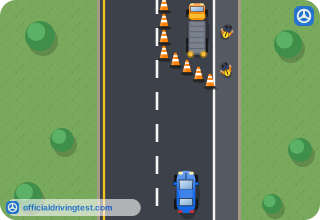
- Stay in the closing lane until the last moment
- Move to the appropriate lane at first notice of it
- Merge only after passing the work zone signs
- Wait for a flagger before changing any lane
Show answer
Correct answer: Move to the appropriate lane at first notice of it
Merging early helps keep traffic flowing and posted speeds steady.
Source: Tennessee Comprehensive Driver License Manual (March 2025 printing), page 112 · Open this page in the manual (Manual page 112)
-
What should you not do while driving through a work zone, because you need to hear what is going on?
- Use your turn signals
- Turn on your headlights
- Check your mirrors
- Wear earphones
Show answer
Correct answer: Wear earphones
The manual says to keep your ears open and not wear earphones while driving.
Source: Tennessee Comprehensive Driver License Manual (March 2025 printing), page 112 · Open this page in the manual (Manual page 112)
-
When should you turn on your headlights near a work zone?
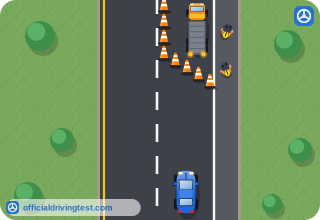
- Before you enter the zone
- Only after dark
- Only when workers are visible
- Only after you pass the first sign
Show answer
Correct answer: Before you enter the zone
Headlights make you more visible to workers and other motorists, so turn them on before entering.
Source: Tennessee Comprehensive Driver License Manual (March 2025 printing), page 112 · Open this page in the manual (Manual page 112)
-
In a work zone, when may you change lanes?
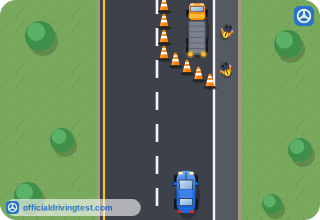
- Whenever the next lane is clear
- Whenever traffic slows down
- Only when instructed to do so
- Only to pass slow vehicles
Show answer
Correct answer: Only when instructed to do so
Follow flagger signals and sign instructions, and do not change lanes within the zone unless told to.
Source: Tennessee Comprehensive Driver License Manual (March 2025 printing), page 112 · Open this page in the manual (Manual page 112)
-
How should you drive through a work zone at night?
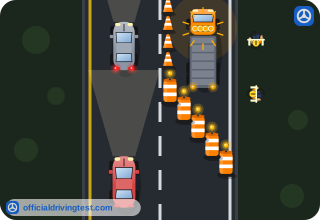
- At normal speed when no workers are present
- With your high beams on at all times
- Only in the left lane of the roadway
- With extreme caution, workers present or not
Show answer
Correct answer: With extreme caution, workers present or not
Night driving in a work zone calls for extreme caution even when nobody is working.
Source: Tennessee Comprehensive Driver License Manual (March 2025 printing), page 113 · Open this page in the manual (Manual page 113)
-
Where should you adjust your lane position in a work zone, when possible?
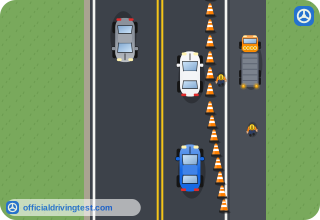
- Toward the workers so you can watch them
- Away from the side workers and equipment
- Onto the shoulder beside the equipment
- Over the center line to give them room
Show answer
Correct answer: Away from the side workers and equipment
Moving away from side workers and equipment gives them more room.
Source: Tennessee Comprehensive Driver License Manual (March 2025 printing), page 113 · Open this page in the manual (Manual page 113)
-
Some work zones, like line painting, road patching and mowing, are mobile. Until which sign should you keep observing the posted signs?
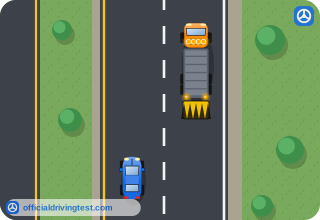
- "End Road Work"
- "Road Work Ahead"
- "Reduced Speed Ahead"
- "Flagger Ahead"
Show answer
Correct answer: "End Road Work"
Because mobile workers may be out of sight, follow the posted signs until you see the End Road Work sign.
Source: Tennessee Comprehensive Driver License Manual (March 2025 printing), page 113 · Open this page in the manual (Manual page 113)
-
What does the manual suggest you do to avoid work zones altogether?
- Use alternate routes when you can
- Drive during rush hour
- Drive on the shoulder
- Drive faster through the area
Show answer
Correct answer: Use alternate routes when you can
Using alternate routes, when possible, lets you avoid road work zones.
Source: Tennessee Comprehensive Driver License Manual (March 2025 printing), page 113 · Open this page in the manual (Manual page 113)
-
What should you do about delays in work zones?
- Ignore them and drive faster to make up time
- Wait until the work is finished to travel
- Expect them, plan for them and leave early
- Drive in the closed lane to avoid them
Show answer
Correct answer: Expect them, plan for them and leave early
Planning for delays and leaving early helps you arrive on time without rushing.
Source: Tennessee Comprehensive Driver License Manual (March 2025 printing), page 113 · Open this page in the manual (Manual page 113)