Pavement markings in South Dakota
The South Dakota Driver License Manual shows or names everything on this page: 12 in all, on pages 36–37, 39–40.
Independent educational site · not affiliated with any government agency or DMV
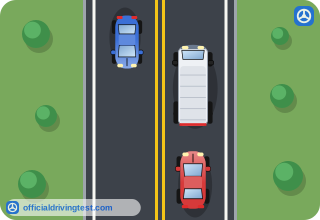
Double Yellow Line (No Passing, Both Directions)
Two-direction roadway – indicated by a double yellow line - passing prohibited in both directions. Section: "Pavement markings are lines, arrows, words, or symbols painted on the roadway to give you directions or warnings."
Manual page 36
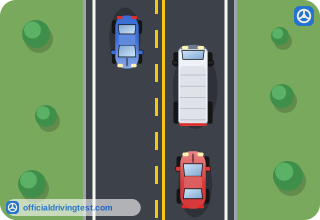
Solid and Dashed Yellow Lines (Passing Permitted from the Dashed Side)
Two-direction roadway – passing permitted when dashed yellow line is on your side. Section: "Pavement markings are lines, arrows, words, or symbols painted on the roadway to give you directions or warnings."
Manual page 36
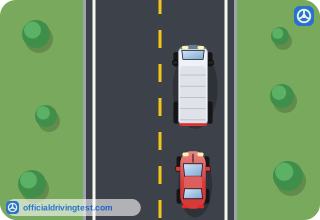
Dashed Yellow Line (Passing Permitted)
Two-direction roadway with dashed yellow line– passing permitted. Section: "Pavement markings are lines, arrows, words, or symbols painted on the roadway to give you directions or warnings."
Manual page 36
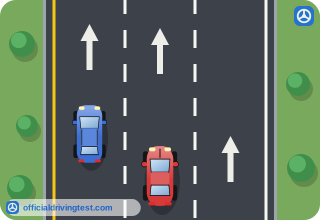
One-Direction Roadway with Dashed White Line
One-direction roadway with white dashed line – passing permitted. Section: "Pavement markings are lines, arrows, words, or symbols painted on the roadway to give you directions or warnings."
Manual page 36
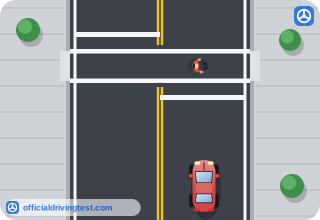
Marked Crosswalk (Two Lines)
Crosswalks define the area where pedestrians may cross the roadway. When required to stop because of a sign or signal, you must stop behind the stop line, crosswalk, stop sign, or traffic signal. You must yield to pedestrians entering or in a crosswalk. Section: "The following are some of the most common types of crosswalk markings."
Manual page 37
Stop Line
p37: "When required to stop because of a sign or signal, you must stop behind the stop line, crosswalk, stop sign, or traffic signal. ... If there is a stop line before the crosswalk, the stop line must be obeyed first." p63: "Many intersections are marked with stop lines to show where you must come to a complete stop. These stop lines help to set you farther back at an intersection to give larger vehicles more turning space. Always stop behind stop lines."
Manual page 37
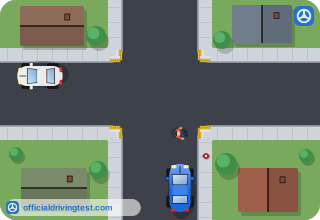
UNMARKED CROSSWALK
Not all crosswalks are marked. Be alert for pedestrians when crossing intersections. If crosswalks are not apparent, then you must stop before entering the intersection. Section: "Crosswalks define the area where pedestrians may cross the roadway. When required to stop because of a sign or signal, you must stop behind the stop line, crosswalk, stop sign, or traffic signal. You must yield to pedestrians entering or in a crosswalk."
Manual page 37
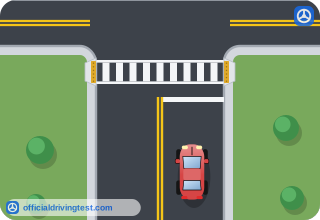
Crosswalk (Longitudinal Bars)
Crosswalks define the area where pedestrians may cross the roadway. When required to stop because of a sign or signal, you must stop behind the stop line, crosswalk, stop sign, or traffic signal. You must yield to pedestrians entering or in a crosswalk. p39/p40 diagram: "Approaching vehicles must yield to pedestrians in the crosswalk and to traffic in the roundabout."
Manual page 37
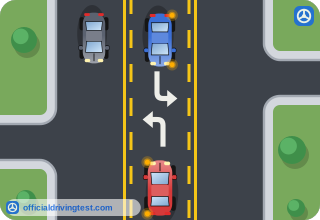
Shared Center Lane
Shared center lanes are reserved for making left turns (or U-turns when they are permitted) by vehicles traveling in either direction. On the pavement, left-turn arrows for traffic in one direction alternate with left-turn arrows for traffic coming from the other direction. These lanes are marked on each side by solid yellow and dashed yellow lines. Be sure you enter the lane only if it is safe to do so.
Manual page 37
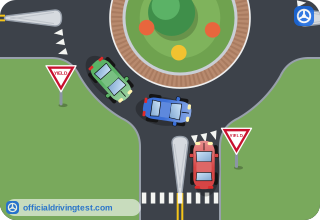
Yield Line Markings (Roundabout)
Diagram text: "Approaching vehicles must yield to pedestrians in the crosswalk and to traffic in the roundabout."
Manual page 39
Raised Splitter Island (Roundabout)
The manual does not state it
Manual page 39
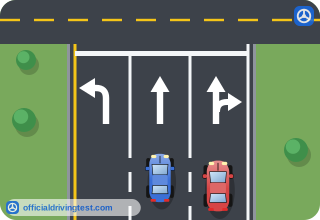
Lane-Use Arrows
p36: "They are used to divide lanes, tell you when you may pass other vehicles or change lanes, tell you which lanes to use for turns, define pedestrian walkways, and show where you must stop for signs or traffic signals." p40: "Black and white signs on the side of the road and white arrows on the road will show the correct lane to use. In general, if you want to make a left turn, you should be in the left lane or other lanes that are signed and marked as left turn lanes. If you want to make a right turn, you should be in the right lane or other lanes that are signed and marked as right turn lanes. If you want to go straight, observe the signs and arrows to see which lane is correct."
Manual page 40