South Carolina: Emergency vehicles, police stops and work zones — Part 3 Practice Test
Questions in this part include: “What should you not make toward an officer during a traffic stop?” · “What is a work zone?”
Independent educational site · not affiliated with any government agency or DMV
Ready? Test yourself
- Instant feedback with an explanation
- Every answer cites its source in the manual
- Your best score is saved on this device
- Keyboard: press 1 to 4 to answer and Enter for the next question
Questions are original and based on the official manual "South Carolina Driver's Manual" (2026 (posted April 2026)), South Carolina Department of Motor Vehicles.
All 17 questions in this practice test
Take the test above first, then use this list to study. Tap “Show answer” to see the correct answer and explanation.
Show the questions and answersHide the questions
-
If an officer believes a crime has been committed, when can the officer search your vehicle without a court-issued warrant?
- Never, a warrant is always required
- As long as the officer has probable cause
- Only if you give written permission
- Only during daylight hours
Show answer
Correct answer: As long as the officer has probable cause
The manual says an officer with probable cause may search the vehicle without a court-issued warrant.
Source: South Carolina Driver's Manual (2026 (posted April 2026)), page 10-14 · Open this page in the manual (Manual page 10-14)
-
What should you not make toward an officer during a traffic stop?
- Polite requests for clarification
- Respectful questions about the ticket
- Statements about where your documents are
- Threatening motions or statements
Show answer
Correct answer: Threatening motions or statements
The manual says never to make threatening motions or statements to an officer.
Source: South Carolina Driver's Manual (2026 (posted April 2026)), page 10-14 · Open this page in the manual (Manual page 10-14)
-
If an officer arrests someone who is with you, what should you never do?
- Attempt to interfere with the arrest
- Keep your emotions under control
- Keep your hands where they can be seen
- Politely ask for clarification
Show answer
Correct answer: Attempt to interfere with the arrest
You must never try to interfere with the arrest of others who are with you.
Source: South Carolina Driver's Manual (2026 (posted April 2026)), page 10-14 · Open this page in the manual (Manual page 10-14)
-
How do the consequences of running from law enforcement compare with an initial traffic citation?
- They are about the same
- They are less severe
- They are more severe
- They apply only if you cause a collision
Show answer
Correct answer: They are more severe
The manual says the consequences of running from law enforcement are more severe than any initial traffic citation.
Source: South Carolina Driver's Manual (2026 (posted April 2026)), page 10-14 · Open this page in the manual (Manual page 10-14)
-
What do move-over laws require drivers to do when approaching emergency vehicles?
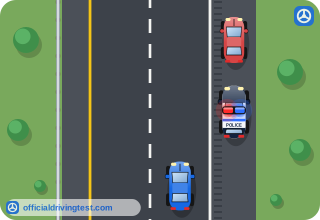
- Slow down and change lanes
- Stop and wait for the vehicle to leave
- Speed up and pass quickly
- Stop on the shoulder with hazard flashers on
Show answer
Correct answer: Slow down and change lanes
Move-over laws require drivers to slow down and change lanes when they approach emergency vehicles.
Source: South Carolina Driver's Manual (2026 (posted April 2026)), page 10-14 · Open this page in the manual (Manual page 10-14)
-
Which of these workers does the manual list as being struck while performing duties on the road?
- School bus drivers
- Mail carriers
- Tow truck operators
- Taxi drivers
Show answer
Correct answer: Tow truck operators
The manual names law enforcement officers, emergency medical services, fire department personnel and tow truck operators.
Source: South Carolina Driver's Manual (2026 (posted April 2026)), page 10-14 · Open this page in the manual (Manual page 10-14)
-
What should you do when you approach a stopped authorized emergency vehicle?
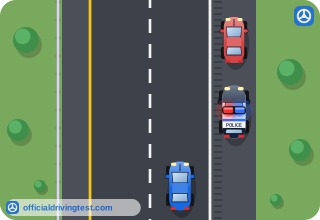
- Maintain your speed and stay in your lane
- Slow down and change to a lane away from it, if safe
- Stop behind it and wait until it drives away
- Speed up to get past it before traffic closes in
Show answer
Correct answer: Slow down and change to a lane away from it, if safe
You should slow down and yield the right-of-way by changing to a lane away from the emergency vehicle when that is safe.
Source: South Carolina Driver's Manual (2026 (posted April 2026)), page 10-15 · Open this page in the manual (Manual page 10-15)
-
If you cannot safely change lanes when approaching a stopped authorized emergency vehicle, what should you do?
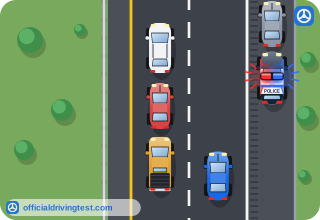
- Stop in your lane until the vehicle leaves
- Change lanes anyway to obey the law
- Speed up to get past it quickly
- Slow down and proceed with caution at a safe speed
Show answer
Correct answer: Slow down and proceed with caution at a safe speed
If a lane change is unsafe, slow down and continue with caution at a speed safe for traffic conditions.
Source: South Carolina Driver's Manual (2026 (posted April 2026)), page 10-15 · Open this page in the manual (Manual page 10-15)
-
What is a work zone?
- A road closed to every kind of vehicle
- Any road with a reduced speed limit
- A parking area for road crews
- An area where roadwork takes place
Show answer
Correct answer: An area where roadwork takes place
A work zone is an area where roadwork takes place and may involve a lane closure, a detour, and moving equipment.
Source: South Carolina Driver's Manual (2026 (posted April 2026)), page 11-3 · Open this page in the manual (Manual page 11-3)
-
When should you reduce your speed in a work zone?
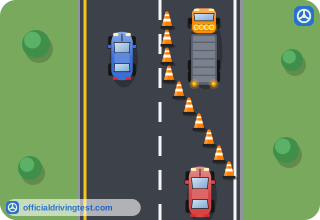
- Only when workers are present
- Always, even if there are no workers
- Only when the work zone has a lane closure
- Only when driving at night
Show answer
Correct answer: Always, even if there are no workers
You should always slow down in a work zone, even with no workers in sight.
Source: South Carolina Driver's Manual (2026 (posted April 2026)), page 11-3 · Open this page in the manual (Manual page 11-3)
-
Why can a work zone be hazardous even when no workers are present?
- Its traffic signals are turned off
- The speed limit is always raised there
- It may have narrower lanes and rough pavement
- Lane markings are not allowed there
Show answer
Correct answer: It may have narrower lanes and rough pavement
Narrower lanes and rough pavement can create hazardous conditions in a work zone.
Source: South Carolina Driver's Manual (2026 (posted April 2026)), page 11-3 · Open this page in the manual (Manual page 11-3)
-
Which of these should you do when driving through a work zone?
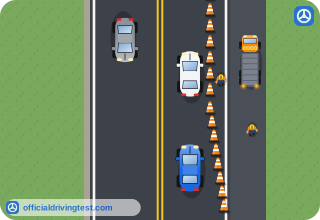
- Increase your following distance and be prepared to stop
- Keep up your speed so you do not delay other traffic
- Move up close behind the car ahead to save space
- Pass slower vehicles before the lanes narrow
Show answer
Correct answer: Increase your following distance and be prepared to stop
In a work zone you should slow down, leave more following distance, watch the traffic around you, and be ready to stop.
Source: South Carolina Driver's Manual (2026 (posted April 2026)), page 11-4 · Open this page in the manual (Manual page 11-4)
-
How should you drive through a work zone at night?
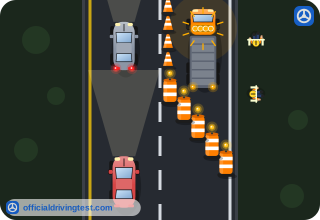
- Normally, unless workers are visible near the road
- With extra caution only when workers are present
- With extreme caution, workers present or not
- Faster, because there is less traffic at night
Show answer
Correct answer: With extreme caution, workers present or not
Night work zones call for extreme caution whether or not workers are there.
Source: South Carolina Driver's Manual (2026 (posted April 2026)), page 11-4 · Open this page in the manual (Manual page 11-4)
-
Why should you adjust your lane position in a work zone?
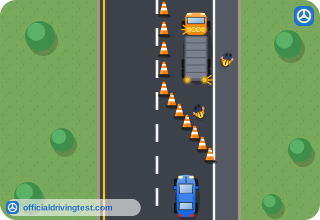
- To stay as close to the cones as you can
- To give workers and equipment space
- To get ahead of slower construction vehicles
- To line up for a faster lane early
Show answer
Correct answer: To give workers and equipment space
Adjusting your lane position leaves room for workers and construction vehicles.
Source: South Carolina Driver's Manual (2026 (posted April 2026)), page 11-4 · Open this page in the manual (Manual page 11-4)
-
Until when should you observe the posted work zone signs?
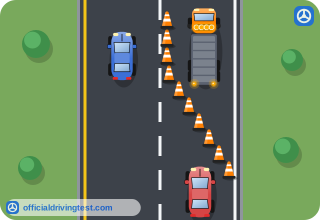
- Until you pass the last orange cone
- Until you can no longer see any workers
- Until the road surface becomes smooth
- Until you see the End Road Work sign
Show answer
Correct answer: Until you see the End Road Work sign
Keep following the posted work zone signs until you reach the sign reading End Road Work.
Source: South Carolina Driver's Manual (2026 (posted April 2026)), page 11-4 · Open this page in the manual (Manual page 11-4)
-
What should you do about possible delays in a work zone?
- Drive faster outside the zone to make up the time
- Count on a detour to avoid any delay
- Wait to leave until work crews have finished
- Expect delays, plan for them, and leave earlier
Show answer
Correct answer: Expect delays, plan for them, and leave earlier
The manual says to expect delays, plan for them, and leave earlier to reach your destination.
Source: South Carolina Driver's Manual (2026 (posted April 2026)), page 11-4 · Open this page in the manual (Manual page 11-4)
-
When possible, what should you do about work zones?
- Drive through them at night when traffic is lighter
- Use alternate routes and avoid them
- Enter them early to get ahead of slower traffic
- Treat them like any other road
Show answer
Correct answer: Use alternate routes and avoid them
When possible, you should use alternate routes and stay out of work zones.
Source: South Carolina Driver's Manual (2026 (posted April 2026)), page 11-4 · Open this page in the manual (Manual page 11-4)