South Carolina: Emergency vehicles, police stops and work zones — Part 2 Practice Test
Questions in this part include: “What should concealed weapons permit (CWP) holders do during a traffic stop?” · “How is your acceptance of a traffic ticket treated?”
Independent educational site · not affiliated with any government agency or DMV
Ready? Test yourself
- Instant feedback with an explanation
- Every answer cites its source in the manual
- Your best score is saved on this device
- Keyboard: press 1 to 4 to answer and Enter for the next question
Questions are original and based on the official manual "South Carolina Driver's Manual" (2026 (posted April 2026)), South Carolina Department of Motor Vehicles.
All 18 questions in this practice test
Take the test above first, then use this list to study. Tap “Show answer” to see the correct answer and explanation.
Show the questions and answersHide the questions
-
During a traffic stop, what should you and your passengers do about seatbelts?
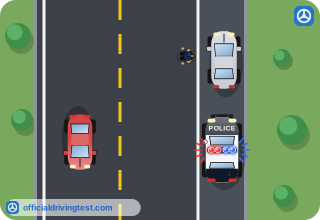
- Unfasten them so the officer can see you
- Take them off so you can step out quickly
- Unfasten them only after the officer arrives
- Keep them fastened
Show answer
Correct answer: Keep them fastened
Everyone should keep his or her seatbelt fastened and stay in the vehicle during the stop.
Source: South Carolina Driver's Manual (2026 (posted April 2026)), page 10-12 · Open this page in the manual (Manual page 10-12)
-
During a traffic stop, who should avoid using cell phones and mobile devices?
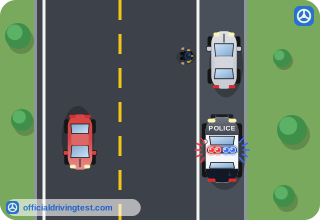
- Only the driver
- You and all of your passengers
- Only passengers in the back seat
- Only passengers under 18
Show answer
Correct answer: You and all of your passengers
Neither the driver nor any passenger should use a phone or mobile device during the stop.
Source: South Carolina Driver's Manual (2026 (posted April 2026)), page 10-12 · Open this page in the manual (Manual page 10-12)
-
While waiting for the officer during a traffic stop, what should you not do?
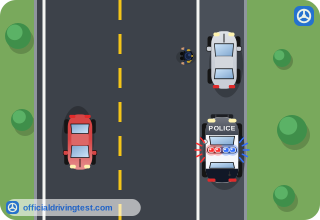
- Keep your hands on the steering wheel
- Search for your license or vehicle documents
- Give the officer your full attention
- Ask your passengers to remain calm
Show answer
Correct answer: Search for your license or vehicle documents
Do not make sudden movements or look for your license or documents; wait for the officer's instructions.
Source: South Carolina Driver's Manual (2026 (posted April 2026)), page 10-12 · Open this page in the manual (Manual page 10-12)
-
If you have a weapon in the vehicle during a traffic stop, what should you do?
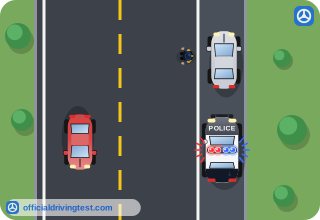
- Stay silent unless the officer asks about it
- Place it on the dashboard in plain view
- Wait until the officer asks to search the vehicle
- Inform the officer of all weapons upon first contact
Show answer
Correct answer: Inform the officer of all weapons upon first contact
You should tell the officer about every weapon in the vehicle when contact begins.
Source: South Carolina Driver's Manual (2026 (posted April 2026)), page 10-12 · Open this page in the manual (Manual page 10-12)
-
What should concealed weapons permit (CWP) holders do during a traffic stop?
- Follow CWP procedures
- Exit the vehicle with the permit in hand
- Place the weapon on the seat beside them
- Say nothing about the permit unless asked
Show answer
Correct answer: Follow CWP procedures
The manual says CWP holders should follow CWP procedures.
Source: South Carolina Driver's Manual (2026 (posted April 2026)), page 10-12 · Open this page in the manual (Manual page 10-12)
-
At night, what should you do as soon as you stop for an officer?
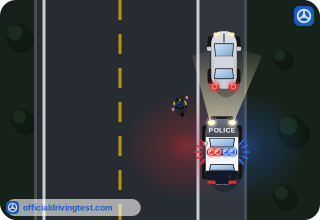
- Turn on your high beams
- Switch off all of your lights
- Turn on your interior lights
- Get out and face the officer's spotlight
Show answer
Correct answer: Turn on your interior lights
Interior lights help the officer see inside your vehicle when a spotlight is used at night.
Source: South Carolina Driver's Manual (2026 (posted April 2026)), page 10-13 · Open this page in the manual (Manual page 10-13)
-
Why should you roll down your window during a traffic stop?
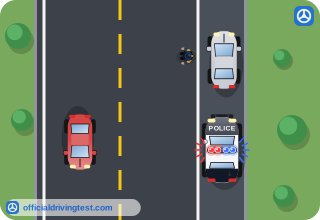
- So that you and the officer can communicate
- So the officer can reach inside the vehicle
- So you can hand over your keys
- So the officer can check every passenger's identification
Show answer
Correct answer: So that you and the officer can communicate
Rolling the window down lets you and the officer talk to each other.
Source: South Carolina Driver's Manual (2026 (posted April 2026)), page 10-13 · Open this page in the manual (Manual page 10-13)
-
What should you do if the officer who stops you is driving an unmarked vehicle or is not in uniform?
- Refuse to roll down your window
- Stay in the car and say nothing
- Ask to see the officer's credentials
- Step out to inspect the vehicle
Show answer
Correct answer: Ask to see the officer's credentials
When an officer is in an unmarked vehicle or out of uniform, you may ask to see his or her credentials.
Source: South Carolina Driver's Manual (2026 (posted April 2026)), page 10-13 · Open this page in the manual (Manual page 10-13)
-
Which documents may an officer ask to see during a traffic stop?
- Driver's license, birth certificate, and vehicle title
- Driver's license, proof of insurance, and vehicle registration
- Proof of insurance, Social Security card, and passport
- Vehicle registration, vehicle title, and inspection report
Show answer
Correct answer: Driver's license, proof of insurance, and vehicle registration
The manual lists the driver's license, proof of insurance and vehicle registration.
Source: South Carolina Driver's Manual (2026 (posted April 2026)), page 10-13 · Open this page in the manual (Manual page 10-13)
-
If the documents an officer asks for are out of your reach, what should you do?
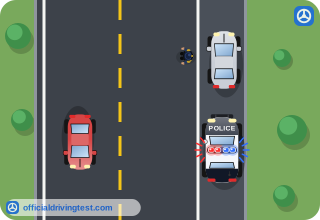
- Reach for them quickly to avoid delay
- Ask a passenger to search for them while you talk
- Step out and look for them in the trunk
- Tell the officer where they are and ask to reach for them
Show answer
Correct answer: Tell the officer where they are and ask to reach for them
Tell the officer where the documents are and ask if you may reach for them; do not make sudden movements or search for them.
Source: South Carolina Driver's Manual (2026 (posted April 2026)), page 10-13 · Open this page in the manual (Manual page 10-13)
-
If an officer asks you to exit the vehicle, what should you do?
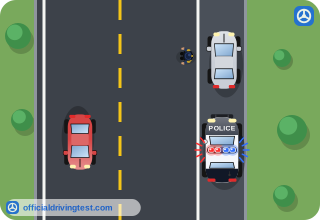
- Stand in the traffic lane so the officer can see you
- Put your hands in your pockets while you wait
- Lean on your car door with your back to traffic
- Stay safely away from traffic, hands in plain view
Show answer
Correct answer: Stay safely away from traffic, hands in plain view
When asked to step out, move safely away from traffic and keep your hands where they can be seen.
Source: South Carolina Driver's Manual (2026 (posted April 2026)), page 10-13 · Open this page in the manual (Manual page 10-13)
-
If you disagree with an officer's decision to issue a traffic ticket, what should you avoid?
- Asking the officer to clarify the action being taken
- Prolonging the contact by arguing with the officer
- Asking questions politely
- Asking where the ticket's information can be found
Show answer
Correct answer: Prolonging the contact by arguing with the officer
Arguing only drags out the stop; you can state your case in court instead.
Source: South Carolina Driver's Manual (2026 (posted April 2026)), page 10-13 · Open this page in the manual (Manual page 10-13)
-
If you wish to contest a traffic ticket, where will you have the opportunity to explain your point?
- At the roadside, to the officer
- At the SCDMV
- In court
- By mail, to the officer's supervisor
Show answer
Correct answer: In court
A driver who wants to contest a ticket can explain his or her point in court.
Source: South Carolina Driver's Manual (2026 (posted April 2026)), page 10-13 · Open this page in the manual (Manual page 10-13)
-
How is your acceptance of a traffic ticket treated?
- It is not considered an admission of guilt
- It is considered an admission of guilt
- It cancels your right to contest the ticket
- It counts as payment of the fine
Show answer
Correct answer: It is not considered an admission of guilt
Accepting a ticket document is not an admission of guilt.
Source: South Carolina Driver's Manual (2026 (posted April 2026)), page 10-13 · Open this page in the manual (Manual page 10-13)
-
What does the manual say about signing a traffic ticket in SC?
- A driver must sign it within 24 hours
- A driver must sign it only for a speeding ticket
- It is not a requirement that a driver sign it
- A driver must sign it in front of a witness
Show answer
Correct answer: It is not a requirement that a driver sign it
In SC a driver does not have to sign a traffic ticket, though other states may arrest a driver who refuses.
Source: South Carolina Driver's Manual (2026 (posted April 2026)), page 10-13 · Open this page in the manual (Manual page 10-13)
-
If you believe an officer acted inappropriately, what should you do?
- Report it to the officer's agency in a timely manner
- Argue with the officer about it right at the scene
- Say nothing about it to anyone
- Mention it only if you are given a court date
Show answer
Correct answer: Report it to the officer's agency in a timely manner
A complaint about an officer should be made to that officer's agency promptly.
Source: South Carolina Driver's Manual (2026 (posted April 2026)), page 10-14 · Open this page in the manual (Manual page 10-14)
-
Where can you find the name of the officer and the law enforcement agency?
- On your vehicle registration
- On the back of your driver's license
- On the SCDMV website
- On the ticket, or ask the officer
Show answer
Correct answer: On the ticket, or ask the officer
The ticket carries the officer's name and agency, and you may also ask the officer.
Source: South Carolina Driver's Manual (2026 (posted April 2026)), page 10-14 · Open this page in the manual (Manual page 10-14)
-
According to the manual, what is the purpose of a warning or ticket for a traffic violation?
- To raise money for law enforcement agencies
- To deter illegal and/or unsafe behavior
- To punish drivers who disagree with the officer
- To record the driver's name for the SCDMV
Show answer
Correct answer: To deter illegal and/or unsafe behavior
A warning or ticket is meant to discourage illegal or unsafe driving.
Source: South Carolina Driver's Manual (2026 (posted April 2026)), page 10-14 · Open this page in the manual (Manual page 10-14)