Pennsylvania: Signals & vehicle controls Practice Test
Signaling, headlights, horns, and what to do if your vehicle breaks down.
Independent educational site · not affiliated with any government agency or DMV
Ready? Test yourself
Answer to start, or tap Start below:
Before driving, the manual says you should check all fluid levels. Which of the following is one of the fluids it names?
- Instant feedback with an explanation
- Every answer cites its source in the manual
- Your best score is saved on this device
- Keyboard: press 1 to 4 to answer and Enter for the next question
Questions are original and based on the official manual "Pennsylvania Driver's Manual" (Pub 95), Pennsylvania Department of Transportation (PennDOT), Bureau of Driver Licensing.
All 31 questions in this practice test
Take the test above first, then use this list to study. Tap “Show answer” to see the correct answer and explanation.
Show the questions and answersHide the questions
-
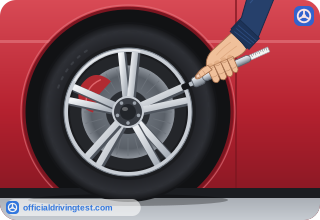
According to the manual, tires should be checked for pressure while they are 'cold' — meaning before driving, or at least how long after you've driven?
- Three hours
- One hour
- Two hours
- Six hours
Show answer
Correct answer: Three hours
Check tires 'cold' — before you've driven, or at least three hours after you've driven — for an accurate pressure reading.
Source: Pennsylvania Driver's Manual (Pub 95), page 31 · Open this page in the manual (Manual page 31)
-
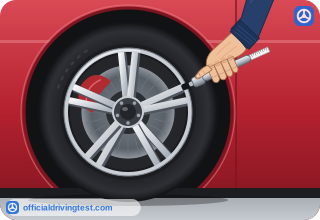
Where can you find your vehicle's recommended tire pressure (psi)?
- Printed on the tire's sidewall
- In the owner's manual or driver's door jamb
- On the vehicle's title or registration card
- In the vehicle's fuse box
Show answer
Correct answer: In the owner's manual or driver's door jamb
The recommended psi is located in the vehicle owner's manual or on the driver's side door jamb of the vehicle.
Source: Pennsylvania Driver's Manual (Pub 95), page 31 · Open this page in the manual (Manual page 31)
-
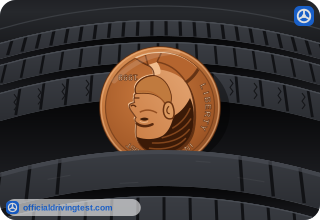
In the manual's 'penny test' for checking tire tread, you insert a penny into a tread groove with Abraham Lincoln's head pointing down. What does it mean if any part of Lincoln's head is covered by the tread?
- The tire is overinflated
- The tire must be replaced immediately
- You are driving with a safe amount of tread
- The tire is out of balance
Show answer
Correct answer: You are driving with a safe amount of tread
If any part of Lincoln's head is covered by the tread, you're driving with a safe amount of tread; if your tread gets below that, your car's ability to grip the road in adverse conditions is greatly reduced.
Source: Pennsylvania Driver's Manual (Pub 95), page 31 · Open this page in the manual (Manual page 31)
-
Before driving, the manual says you should check all fluid levels. Which of the following is one of the fluids it names?
- Windshield washer fluid
- Brake fluid
- Transmission fluid
- Power steering fluid
Show answer
Correct answer: Windshield washer fluid
The manual names engine oil, windshield washer fluid and fuel as levels to check and fill as needed.
Source: Pennsylvania Driver's Manual (Pub 95), page 31 · Open this page in the manual (Manual page 31)
-
Why does the manual say you must adjust the driver's seat before driving?
- So passengers have more legroom
- So you can reach the pedals and see out the windshield
- So the seat belt sits looser across your body
- So the head restraint can be removed
Show answer
Correct answer: So you can reach the pedals and see out the windshield
You must be able to easily reach the pedals and other controls and have a clear view out the windshield.
Source: Pennsylvania Driver's Manual (Pub 95), page 31 · Open this page in the manual (Manual page 31)
-
How should the rearview mirror be set, according to the manual?
- So you can see only the sky
- So you can see traffic directly behind you
- So you can see the back seat
- So you can see your own eyes clearly
Show answer
Correct answer: So you can see traffic directly behind you
The rearview mirror should be set so you can see the traffic directly behind your vehicle.
Source: Pennsylvania Driver's Manual (Pub 95), page 31 · Open this page in the manual (Manual page 31)
-
How should a side mirror be adjusted, according to the manual?
- So you can see the entire rear seat behind you
- It points straight down at the road
- So you barely see your vehicle's side when you lean
- It shows only oncoming traffic
Show answer
Correct answer: So you barely see your vehicle's side when you lean
Side mirrors should be set so when you lean left or right you can just barely see the side of your vehicle.
Source: Pennsylvania Driver's Manual (Pub 95), page 31 · Open this page in the manual (Manual page 31)
-
According to the manual, when is it legal to have tags, permits or placards attached to your rearview mirror?
- At any time, as long as they are small
- Only during daylight hours
- Only on divided highways
- Only while the vehicle is parked
Show answer
Correct answer: Only while the vehicle is parked
Tags, permits and placards may only be attached to the rearview mirror when the vehicle is parked; hanging objects while moving is against the law.
Source: Pennsylvania Driver's Manual (Pub 95), page 31 · Open this page in the manual (Manual page 31)
-
What does the manual say about placing objects on your front windshield?
- It is against the law if it blocks a driver's view
- It is allowed if the object is transparent
- It is allowed only on the passenger side
- It is allowed as long as the vehicle is not moving
Show answer
Correct answer: It is against the law if it blocks a driver's view
It is against the law to place anything on the front windshield that blocks a driver's view of the roadway.
Source: Pennsylvania Driver's Manual (Pub 95), page 31 · Open this page in the manual (Manual page 31)
-
According to the manual, how should you adjust your head restraint?
- So the top of the head restraint is level with your chin
- So it touches the back of your neck
- So its top is at least as high as the top of your ears
- Head restraints do not need adjustment
Show answer
Correct answer: So its top is at least as high as the top of your ears
Adjust your head restraint so the top of the head restraint is at least as high as the top of your ears, to help prevent or reduce neck injuries.
Source: Pennsylvania Driver's Manual (Pub 95), page 32 · Open this page in the manual (Manual page 32)
-
According to the manual, what should you avoid wearing while driving at night?
- Prescription eyeglasses or contact lenses
- A seat belt
- Gloves
- Sunglasses or tinted contact lenses
Show answer
Correct answer: Sunglasses or tinted contact lenses
If you normally wear corrective lenses, always wear them while driving, but do not wear sunglasses or tinted contact lenses at night.
Source: Pennsylvania Driver's Manual (Pub 95), page 32 · Open this page in the manual (Manual page 32)
-
Besides reducing the risk of being thrown from the vehicle in a crash, why does the manual say you should lock your vehicle's doors while driving?
- It improves fuel economy
- It reduces the risk of being carjacked
- It is required only on highways
- It prevents the horn from working
Show answer
Correct answer: It reduces the risk of being carjacked
Locking your doors also reduces the likelihood of being carjacked or otherwise victimized when you stop at an intersection or pull into a parking lot.
Source: Pennsylvania Driver's Manual (Pub 95), page 32 · Open this page in the manual (Manual page 32)
-
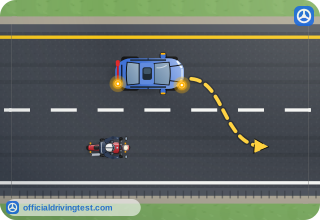
According to the manual, how should you check the blind spot areas to the left-rear and right-rear of your vehicle?
- Rely on your side mirrors alone
- Rely on a passenger's judgment
- Always check them by turning your head before changing lanes
- They do not need to be checked if you have mirrors
Show answer
Correct answer: Always check them by turning your head before changing lanes
The left-rear and right-rear areas are blind spots — always check them by turning your head before changing lanes.
Source: Pennsylvania Driver's Manual (Pub 95), page 37 · Open this page in the manual (Manual page 37)
-
According to the manual, how does it define a 'blind spot'?
- The area directly in front of the vehicle
- Only the area visible in the rearview mirror
- The area covered by the vehicle's headlights at night
- Any place a driver cannot see without moving their head
Show answer
Correct answer: Any place a driver cannot see without moving their head
A blind spot is any place around a vehicle a driver cannot see without moving their head.
Source: Pennsylvania Driver's Manual (Pub 95), page 37 · Open this page in the manual (Manual page 37)
-
According to the manual, why should you avoid driving on either side and slightly to the rear of another vehicle for a long time?
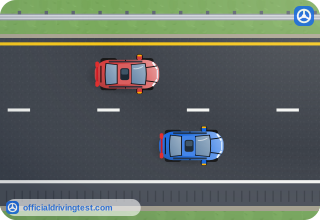
- Both positions are blind spots for the other driver
- It wastes fuel
- It is illegal in Pennsylvania
- It increases your own vehicle's blind spot only
Show answer
Correct answer: Both positions are blind spots for the other driver
Both positions — either side and slightly to the rear of another vehicle — are blind spots for the other driver; speed up or drop back to move out of it.
Source: Pennsylvania Driver's Manual (Pub 95), page 37 · Open this page in the manual (Manual page 37)
-
According to the manual, when checking for traffic before changing lanes, how long should you take your eyes off the road ahead?
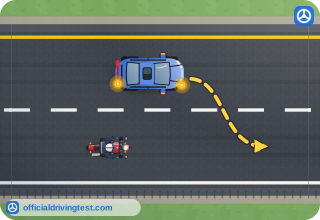
- Not more than one second
- Up to three seconds
- Up to five seconds
- As long as needed to be sure
Show answer
Correct answer: Not more than one second
Check mirrors and blind spots quickly — do not take your eyes off of the road ahead for more than a second.
Source: Pennsylvania Driver's Manual (Pub 95), page 38 · Open this page in the manual (Manual page 38)
-
According to the manual, on roads with three or more lanes, what should you do before making a lane change?
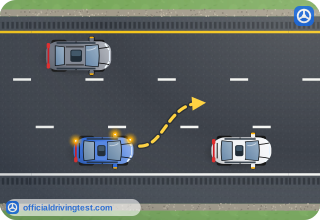
- Check only the lane you are entering
- Check all lanes, as another driver may want the same spot
- Check only your rearview mirror
- No additional checking is needed beyond signaling
Show answer
Correct answer: Check all lanes, as another driver may want the same spot
On roads with three (3) or more lanes, check all lanes before you make a lane change — someone in another lane may also be planning to move into the same spot.
Source: Pennsylvania Driver's Manual (Pub 95), page 38 · Open this page in the manual (Manual page 38)
-
How often does the manual recommend cleaning your headlights?
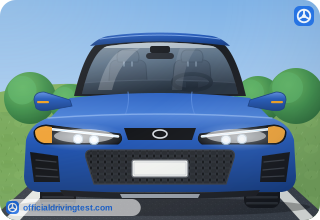
- Once a month
- Once a year
- Only when they stop working
- At least once a week
Show answer
Correct answer: At least once a week
Clean your headlights at least once a week; dirty headlights may give only half of the light they should.
Source: Pennsylvania Driver's Manual (Pub 95), page 40 · Open this page in the manual (Manual page 40)
-
Pennsylvania law requires you to use your headlights when you cannot see pedestrians or vehicles ahead for a distance of how many feet?
- 1,000 feet
- 500 feet
- 750 feet
- 1,500 feet
Show answer
Correct answer: 1,000 feet
State law requires headlight use when you cannot see pedestrians or vehicles on the highway for a distance of 1,000 feet ahead.
Source: Pennsylvania Driver's Manual (Pub 95), page 40 · Open this page in the manual (Manual page 40)
-
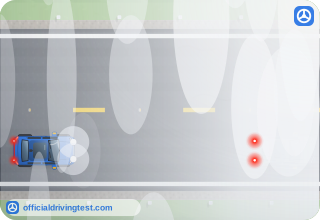
In bad weather (rain, snow, sleet, hail, fog, smoke or smog), which headlight setting should you use?
- High beams, to see farther
- Low beams only
- Parking lights only
- Fog lights with high beams
Show answer
Correct answer: Low beams only
In bad weather, use only low beams — high beams actually reduce visibility under these conditions.
Source: Pennsylvania Driver's Manual (Pub 95), page 40 · Open this page in the manual (Manual page 40)
-
Which of the following is NOT enough by itself to meet Pennsylvania's law on being seen in low light?
- Low beam headlights
- Fog lights combined with low beams
- Daytime running lights alone
- Headlights turned on between sunset and sunrise
Show answer
Correct answer: Daytime running lights alone
Daytime running lights are not enough — your tail lights must be illuminated as well.
Source: Pennsylvania Driver's Manual (Pub 95), page 40 · Open this page in the manual (Manual page 40)
-
What is the starting fine under Pennsylvania law for failing to use headlights when required, before added costs?
- $10
- $50
- $100
- $25
Show answer
Correct answer: $25
State law calls for fines beginning at $25, with the total penalty approaching $100 once other costs are added.
Source: Pennsylvania Driver's Manual (Pub 95), page 40 · Open this page in the manual (Manual page 40)
-
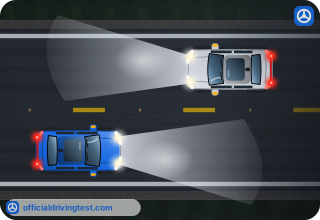
Pennsylvania law requires you to use low beam headlights when you are within how many feet of an oncoming vehicle?
- 500 feet
- 200 feet
- 300 feet
- 1,000 feet
Show answer
Correct answer: 500 feet
Pennsylvania law requires you to use low beams whenever you are within 500 feet of an oncoming vehicle.
Source: Pennsylvania Driver's Manual (Pub 95), page 40 · Open this page in the manual (Manual page 40)
-
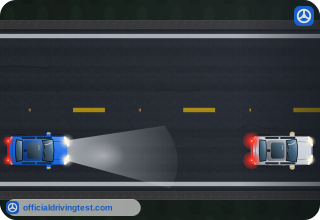
Pennsylvania law requires you to switch to low beams when following another vehicle within how many feet?
- 100 feet
- 300 feet
- 200 feet
- 500 feet
Show answer
Correct answer: 300 feet
You must use low beams when you are following a vehicle within 300 feet.
Source: Pennsylvania Driver's Manual (Pub 95), page 40 · Open this page in the manual (Manual page 40)
-
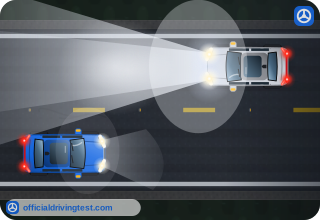
If an oncoming driver's high beams are blinding you and they do not dim their lights, what should you do?
- Flash your high beams repeatedly until they respond
- Stop your vehicle in your lane
- Look toward the right side of the road
- Close your eyes briefly
Show answer
Correct answer: Look toward the right side of the road
If the other driver does not dim their lights, look toward the right side of the road so you are not blinded and can stay on course.
Source: Pennsylvania Driver's Manual (Pub 95), page 40 · Open this page in the manual (Manual page 40)
-
If you must brake where other drivers may not expect it, what does the manual suggest?
- Come to a complete stop immediately
- Sound your horn continuously
- Quickly tap the brakes three or four times
- Turn on your headlights
Show answer
Correct answer: Quickly tap the brakes three or four times
If you are going to brake where other drivers may not expect it, quickly tap your brake pedal three or four times.
Source: Pennsylvania Driver's Manual (Pub 95), page 44 · Open this page in the manual (Manual page 44)
-
Under Pennsylvania law, if you are driving less than 35 mph, how far before turning must you signal?
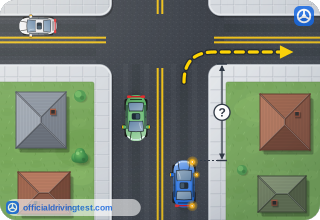
- At least 100 feet
- At least 50 feet
- At least 200 feet
- At least 300 feet
Show answer
Correct answer: At least 100 feet
You must always use your turn signals at least 100 feet before turning, if you are driving less than 35 mph.
Source: Pennsylvania Driver's Manual (Pub 95), page 44 · Open this page in the manual (Manual page 44)
-
Under Pennsylvania law, if you are driving 35 mph or more, how far before turning must you signal?
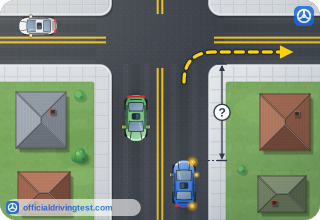
- At least 100 feet
- At least 300 feet
- At least 200 feet
- At least 500 feet
Show answer
Correct answer: At least 300 feet
If you are driving 35 mph or more, you must signal at least 300 feet before turning.
Source: Pennsylvania Driver's Manual (Pub 95), page 44 · Open this page in the manual (Manual page 44)
-
If glare from a following vehicle's headlights reflecting in your rearview mirror is uncomfortable, what can you do?
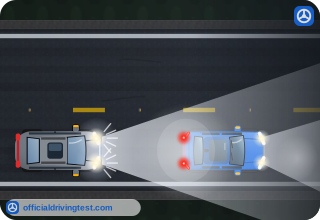
- Turn off your headlights
- Pull over and stop
- Speed up to increase your distance
- Switch the mirror to its night setting
Show answer
Correct answer: Switch the mirror to its night setting
You can switch the inside rearview mirror from its daytime to nighttime setting to reduce glare.
Source: Pennsylvania Driver's Manual (Pub 95), page 40 · Open this page in the manual (Manual page 40)
-
If a vehicle with its high beams on is coming toward you, what should you do first?
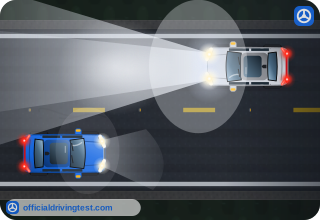
- Flash your high beams quickly a few times
- Immediately look away from the road
- Turn on your hazard lights
- Pull off onto the shoulder
Show answer
Correct answer: Flash your high beams quickly a few times
If a vehicle using high beams comes toward you, flash your high beams quickly a few times.
Source: Pennsylvania Driver's Manual (Pub 95), page 40 · Open this page in the manual (Manual page 40)
-
According to the manual, when should you use your horn while driving?
- Whenever you pass another vehicle
- Only when it is required by a posted sign
- When a driver or pedestrian may not see you
- Only in designated horn zones
Show answer
Correct answer: When a driver or pedestrian may not see you
Use your horn when you think another driver or a pedestrian does not see you — for example, if a child is beginning to run into the street.
Source: Pennsylvania Driver's Manual (Pub 95), page 44 · Open this page in the manual (Manual page 44)