Pennsylvania: Seat belts & child safety
Pennsylvania's seat belt and child restraint laws. Split into 2 shorter tests so you're not stuck in one long quiz.
Independent educational site · not affiliated with any government agency or DMV
Choose a part
Seat belts & child safety — Part 1
Questions in this part include: “According to the manual, where should you never store loose items such as backpacks or tools?”
Seat belts & child safety — Part 2
Questions in this part include: “The manual compares the force of a 30 mph crash on an unbelted body to which of the following?”
Questions are original and based on the official manual "Pennsylvania Driver's Manual" (Pub 95), Pennsylvania Department of Transportation (PennDOT), Bureau of Driver Licensing.
All 35 Seat belts & child safety questions with answers
Choose a part above to take a practice test, or study every question and answer here.
Show the questions and answersHide the questions
1Part 118 questions
-
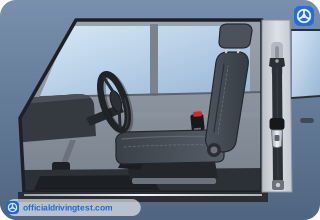
According to the manual, how should you fasten your seat belt on every trip?
- Only the lap belt is required
- Only the shoulder belt is required
- Fasten both the lap and shoulder belts
- Only the driver needs a seat belt
Show answer
Correct answer: Fasten both the lap and shoulder belts
The manual instructs drivers to fasten both their lap and shoulder belts on every trip.
Source: Pennsylvania Driver's Manual (Pub 95), page 31 · Open this page in the manual (Manual page 31)
-
According to Pennsylvania crash statistics cited in the manual for 2017, which age group of drivers had the highest number of unbuckled injuries and fatalities and the lowest seat belt use?
- Ages 25 to 34
- Ages 35 to 54
- Ages 55 and older
- Ages 16 to 24
Show answer
Correct answer: Ages 16 to 24
Drivers ages 16 to 24 had the highest number of unbuckled injuries and fatalities of any age group and the lowest seat belt use.
Source: Pennsylvania Driver's Manual (Pub 95), page 31 · Open this page in the manual (Manual page 31)
-
According to the manual, where should you never store loose items such as backpacks or tools?
- On the rear window deck
- In the trunk
- Secured by a seat belt
- In the glove compartment
Show answer
Correct answer: On the rear window deck
Never store items on the rear window deck; instead put heavier objects in the trunk or secure them with seat belts, since loose items become projectiles in a crash.
Source: Pennsylvania Driver's Manual (Pub 95), page 31 · Open this page in the manual (Manual page 31)
-
According to the manual, being thrown from a vehicle in a crash increases your chances of death by about how much?
- 75 percent
- 25 percent
- 50 percent
- 60 percent
Show answer
Correct answer: 75 percent
Being thrown from a vehicle increases your chances of death by 75 percent; locking doors and wearing your seat belt helps prevent this.
Source: Pennsylvania Driver's Manual (Pub 95), page 32 · Open this page in the manual (Manual page 32)
-
What is the maximum speed for an open-bed pickup or flatbed truck if any person is occupying the bed?
- 55 mph
- 45 mph
- 25 mph
- 35 mph
Show answer
Correct answer: 35 mph
An open-bed pickup truck or open flatbed truck may not be driven at a speed of more than 35 mph if any person is occupying the bed.
Source: Pennsylvania Driver's Manual (Pub 95), page 59 · Open this page in the manual (Manual page 59)
-
May an open-bed truck be driven with a child under 18 occupying the bed of the truck?
- Yes, but only under 35 mph
- Yes, at any speed on any road
- No, except in a few specific cases
- Yes, but only on quiet rural roads
Show answer
Correct answer: No, except in a few specific cases
Such a truck may not be driven when a child under 18 years of age is occupying the bed of the truck, except for a few specific exceptions.
Source: Pennsylvania Driver's Manual (Pub 95), page 59 · Open this page in the manual (Manual page 59)
-
Which of the following is listed as an exception allowing a farmer's child to occupy the bed of a truck?
- Being transported between parts of a farm to do farm work
- Being driven along on a family vacation out of state
- Being driven to school or to a school event
- Being driven along on a shopping trip into town
Show answer
Correct answer: Being transported between parts of a farm to do farm work
One exception is a child of a farmer being transported between parts of a farm or farms owned or operated by the farmer, to perform work on the farm.
Source: Pennsylvania Driver's Manual (Pub 95), page 59 · Open this page in the manual (Manual page 59)
-
Which of the following is listed as an exception allowing a child employed for farm labor to occupy the bed of a truck?
- Being transported on any errand for the employer
- Being transported to a sporting goods store in town
- Being transported between parts of the employer's farms
- Being transported to a friend's house
Show answer
Correct answer: Being transported between parts of the employer's farms
A child employed to perform farm labor may occupy the bed of a truck while being transported between parts of a farm or farms owned or operated by the child's employer.
Source: Pennsylvania Driver's Manual (Pub 95), page 60 · Open this page in the manual (Manual page 60)
-
A child possessing a valid hunting license may occupy the bed of a truck under which circumstance?
- Being transported to a friend's house
- Being transported between a hunting camp and site in hunting season
- At any time, regardless of purpose
- Being transported to a sporting goods store during hunting season
Show answer
Correct answer: Being transported between a hunting camp and site in hunting season
A child with a valid hunting license may occupy the bed of a truck while being transported between a hunting camp and a hunting site, or between hunting sites, during hunting season.
Source: Pennsylvania Driver's Manual (Pub 95), page 60 · Open this page in the manual (Manual page 60)
-
When may a child who is a participant in an officially sanctioned parade occupy the bed of a truck?
- Only if the truck is decorated for the parade
- Only during the course of the parade itself
- At any time during the parade season
- Only if a parent is also in the bed
Show answer
Correct answer: Only during the course of the parade itself
A child participating in an officially sanctioned parade may occupy the truck bed only during the course of the parade.
Source: Pennsylvania Driver's Manual (Pub 95), page 60 · Open this page in the manual (Manual page 60)
-
Under Section 4581 of the Vehicle Code, who is required to wear a seat belt in a car, light truck, or motor home?
- Only the driver
- All drivers and front seat passengers
- Only passengers under age 18
- Only passengers in the back seat
Show answer
Correct answer: All drivers and front seat passengers
Pennsylvania law requires all drivers and front seat passengers in cars, light trucks, and motor homes to wear seat belts.
Source: Pennsylvania Driver's Manual (Pub 95), page 89 · Open this page in the manual (Manual page 89)
-
If you are transporting a passenger who is 8 years old or older but under 18, what does Pennsylvania law require?
- They must wear a seat belt only if riding in the front seat
- They are exempt from the seat belt law
- They must wear a seat belt no matter where they ride
- They must wear a seat belt only on highways
Show answer
Correct answer: They must wear a seat belt no matter where they ride
Passengers age 8 or older but under 18 must wear seat belts no matter where they are riding in the vehicle.
Source: Pennsylvania Driver's Manual (Pub 95), page 89 · Open this page in the manual (Manual page 89)
-
If you are a driver under the age of 18, what does Pennsylvania law say about the number of passengers you may carry?
- It is limited to two passengers regardless of seat belts
- There is no limit as long as everyone is over age 12
- It may not exceed four passengers
- It may not exceed the number of seat belts in the vehicle
Show answer
Correct answer: It may not exceed the number of seat belts in the vehicle
For a driver under 18, the number of passengers may not exceed the number of seat belts in the vehicle.
Source: Pennsylvania Driver's Manual (Pub 95), page 89 · Open this page in the manual (Manual page 89)
-
According to the manual, about how much more likely are you to be killed in a crash if you are thrown from your vehicle rather than staying inside it?
- About 25 times more likely
- About 5 times more likely
- About 10 times more likely
- About 2 times more likely
Show answer
Correct answer: About 25 times more likely
Your chances of being killed are almost 25 times greater if you are thrown from your vehicle.
Source: Pennsylvania Driver's Manual (Pub 95), page 89 · Open this page in the manual (Manual page 89)
-
The forces in a collision can be strong enough to throw an unbelted occupant how far?
- Up to 300 feet, about 30 vehicle lengths
- Up to 150 feet, about 15 vehicle lengths
- Up to 50 feet, about 5 vehicle lengths
- Up to 500 feet
Show answer
Correct answer: Up to 150 feet, about 15 vehicle lengths
The manual states the forces in a collision can fling an occupant as much as 150 feet, about 15 vehicle lengths.
Source: Pennsylvania Driver's Manual (Pub 95), page 89 · Open this page in the manual (Manual page 89)
-
According to the manual, how many of every five people killed by being thrown clear of a vehicle would have survived if they had stayed inside?
- One
- Two
- Four
- Three
Show answer
Correct answer: Four
Four out of every five people killed by being thrown clear would have lived if they had stayed inside the vehicle.
Source: Pennsylvania Driver's Manual (Pub 95), page 89 · Open this page in the manual (Manual page 89)
-
About how much time does your body have to stop after a vehicle crashes, which is why only a seat belt (not your arms and legs) can slow you down safely?
- 1 full second
- 5 seconds
- 1/10th of a second
- 1/50th of a second
Show answer
Correct answer: 1/50th of a second
You have only 1/50th of a second to stop your body after the vehicle crashes; arms and legs cannot react that quickly, but seat belts do.
Source: Pennsylvania Driver's Manual (Pub 95), page 89 · Open this page in the manual (Manual page 89)
-
According to the manual, an unbelted driver or passenger can be killed on impact even when the vehicle is traveling as slowly as what speed?
- 12 mph
- 25 mph
- 40 mph
- 5 mph
Show answer
Correct answer: 12 mph
A driver or passenger who is not buckled up can be killed on impact even when the vehicle is traveling as slowly as 12 mph.
Source: Pennsylvania Driver's Manual (Pub 95), page 89 · Open this page in the manual (Manual page 89)
2Part 217 questions
-
The manual compares the force of a 30 mph crash on an unbelted body to which of the following?
- Being struck by a bicycle
- Falling from the top of a three-story building
- Falling off a curb
- Jumping from a moving vehicle at walking speed
Show answer
Correct answer: Falling from the top of a three-story building
The manual states that at 30 mph, hitting the vehicle's interior is like hitting the ground from the top of a three-story building.
Source: Pennsylvania Driver's Manual (Pub 95), page 89 · Open this page in the manual (Manual page 89)
-
Under Pennsylvania's Child Passenger Protection Act 229, how must children under age 4 be restrained in a vehicle?
- In any seat belt, front or back
- In a booster seat only in the back seat
- In a federally-approved child safety seat, front or back
- In the driver's lap if no other seat is available
Show answer
Correct answer: In a federally-approved child safety seat, front or back
Children under age 4 must be buckled into a federally-approved child safety seat secured to the vehicle by the seat belt or LATCH system, no matter where they ride.
Source: Pennsylvania Driver's Manual (Pub 95), page 90 · Open this page in the manual (Manual page 90)
-
Under Act 229, how must children ages 4 and older but under age 8 be restrained?
- In a rear-facing car seat in the back seat
- In a lap and shoulder belt with no booster seat
- In a booster seat with only a lap belt
- In a booster seat used with lap and shoulder belts
Show answer
Correct answer: In a booster seat used with lap and shoulder belts
Children ages 4 and older but under 8 must be buckled into a federally-approved booster seat secured by the seat belt system and used with lap and shoulder belts.
Source: Pennsylvania Driver's Manual (Pub 95), page 90 · Open this page in the manual (Manual page 90)
-
Under the Child Passenger Protection Act, who is responsible for securing children into an approved restraint system and ensuring occupants under 18 are buckled up?
- The vehicle owner only
- The driver
- The front-seat passenger
- The registered owner's insurance company
Show answer
Correct answer: The driver
Drivers are responsible for securing children into an approved child passenger restraint system and ensuring children under 18 are buckled up.
Source: Pennsylvania Driver's Manual (Pub 95), page 90 · Open this page in the manual (Manual page 90)
-
What can happen to a person convicted of violating Pennsylvania's Child Restraint Law?
- A warning only, with no fine
- Their vehicle registration is automatically suspended
- They may be fined and are responsible for all court costs
- Only points are added, with no fine
Show answer
Correct answer: They may be fined and are responsible for all court costs
Violators may be fined and will be responsible for all court costs.
Source: Pennsylvania Driver's Manual (Pub 95), page 90 · Open this page in the manual (Manual page 90)
-
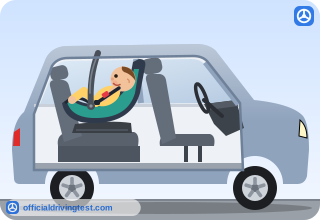
According to the manual, until when must a child younger than age 2 be secured in a rear-facing car seat?
- Until the child turns 2, regardless of height or weight
- Until the child weighs more than 40 pounds, at any height
- Until the child can sit up unassisted
- Until the child outgrows the seat maker's weight and height limits
Show answer
Correct answer: Until the child outgrows the seat maker's weight and height limits
Children younger than age 2 must be secured in a rear-facing car seat until they outgrow the maximum weight and height limits designated by the car seat manufacturer.
Source: Pennsylvania Driver's Manual (Pub 95), page 90 · Open this page in the manual (Manual page 90)
-
Why should you never install a rear-facing child safety seat in a front seat that has an air bag?
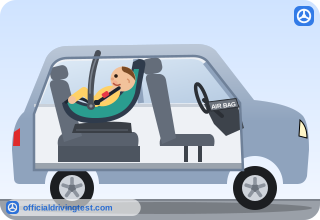
- The air bag would hit the seat and injure the infant's head
- The seat belt will not fit properly in the front seat
- Rear-facing seats are too wide for most front seats
- It is only a recommendation, not a safety concern
Show answer
Correct answer: The air bag would hit the seat and injure the infant's head
In a crash, the air bag will hit the back of the child seat with tremendous force, transmitted to the infant's head and causing severe injury or death.
Source: Pennsylvania Driver's Manual (Pub 95), page 90 · Open this page in the manual (Manual page 90)
-
About how many children under age 5 are involved in vehicle crashes in Pennsylvania each year, according to the manual?
- About 700
- About 7,000
- About 1,500
- About 20,000
Show answer
Correct answer: About 7,000
The manual states approximately 7,000 children under five years of age are involved in crashes in Pennsylvania each year.
Source: Pennsylvania Driver's Manual (Pub 95), page 90 · Open this page in the manual (Manual page 90)
-
According to the manual, if the outside temperature is in the low 80s Fahrenheit, how quickly can the inside of a vehicle reach deadly temperatures, even with a window cracked two inches?
- About 60 minutes
- About 30 minutes
- In only 10 minutes
- Nearly 3 hours
Show answer
Correct answer: In only 10 minutes
Even with a window rolled down two inches, at low-80s outside temperatures the inside of a vehicle can reach deadly levels in only 10 minutes.
Source: Pennsylvania Driver's Manual (Pub 95), page 90 · Open this page in the manual (Manual page 90)
-
What does the manual say about leaving a child or pet alone in a vehicle?
- It is fine for a few minutes if the engine is off
- It is only dangerous in summer months
- It is safe if the vehicle is parked in shade
- It should never be done, even with windows partly open
Show answer
Correct answer: It should never be done, even with windows partly open
The manual advises to never leave a child or pet alone in a car, even if the windows are partially open.
Source: Pennsylvania Driver's Manual (Pub 95), page 90 · Open this page in the manual (Manual page 90)
-
What tip does the manual give to help prevent accidentally leaving a child in a vehicle?
- Place your purse or cell phone in the back seat
- Always park facing north
- Leave a window fully open
- Set a timer on your phone for exactly one hour
Show answer
Correct answer: Place your purse or cell phone in the back seat
The manual suggests placing your purse, briefcase, cell phone, or something you'll need in the back seat so you are sure to see a child left in the vehicle.
Source: Pennsylvania Driver's Manual (Pub 95), page 90 · Open this page in the manual (Manual page 90)
-
What visual reminder does the manual suggest keeping in an empty child car seat, then moving to the front seat once the child is buckled in?
- A brightly colored blanket
- A large teddy bear or other stuffed animal
- A handwritten note taped to the dashboard
- A pair of the child's shoes
Show answer
Correct answer: A large teddy bear or other stuffed animal
The manual suggests keeping a large teddy bear or other stuffed animal in the car seat when empty, moving it to the front seat as a reminder once the child is placed in the seat.
Source: Pennsylvania Driver's Manual (Pub 95), page 90 · Open this page in the manual (Manual page 90)
-
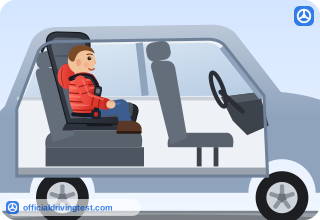
Why does the manual warn against dressing a child in a thick winter coat before buckling them into a car seat?
- Winter coats are flammable
- The coat makes it harder to see the child in a mirror
- It can compress in a crash, leaving slack in the harness
- It voids the car seat's warranty
Show answer
Correct answer: It can compress in a crash, leaving slack in the harness
Thick winter coats can compress enough in a crash to create significant slack in the harness, reducing the seat's protection.
Source: Pennsylvania Driver's Manual (Pub 95), page 90 · Open this page in the manual (Manual page 90)
-
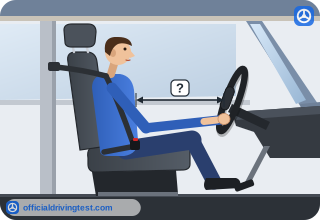
For air bag safety, how far away from the steering wheel should a driver try to sit?
- At least 5 inches
- At least 2 feet
- As close as possible for better control
- At least 10 inches
Show answer
Correct answer: At least 10 inches
To be safe in case the air bag deploys, the manual recommends being at least 10 inches away from the steering wheel.
Source: Pennsylvania Driver's Manual (Pub 95), page 91 · Open this page in the manual (Manual page 91)
-
For air bag safety, where should a driver hold the steering wheel?
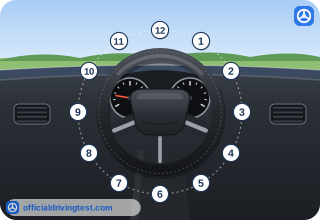
- At the 9 and 3 o'clock, or 8 and 4 o'clock positions
- At the 12 and 6 o'clock positions
- At the top center of the wheel with both hands together
- Wherever is most comfortable
Show answer
Correct answer: At the 9 and 3 o'clock, or 8 and 4 o'clock positions
Holding the wheel at 9 and 3 or 8 and 4 o'clock helps keep your wrists and arms from being injured if the air bag deploys.
Source: Pennsylvania Driver's Manual (Pub 95), page 91 · Open this page in the manual (Manual page 91)
-
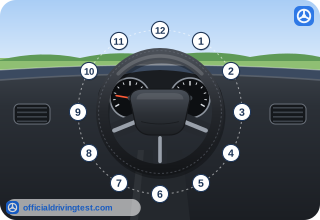
According to the manual, where should you keep your thumbs while holding the steering wheel, to avoid injury if the air bag deploys?
- Wrapped tightly around the inside of the wheel
- On the top or outside rim of the wheel
- Resting on the horn button
- Interlocked in the center of the wheel
Show answer
Correct answer: On the top or outside rim of the wheel
Keep your thumbs on the top or outside rim of the wheel, instead of gripping the inside of the wheel.
Source: Pennsylvania Driver's Manual (Pub 95), page 91 · Open this page in the manual (Manual page 91)
-
The manual recommends that children of what age and under ride in the rear seat of a vehicle?
- Age 8 and under
- Age 10 and under
- Age 16 and under
- Age 12 and under
Show answer
Correct answer: Age 12 and under
It is recommended that all children ages 12 and under ride in the rear seat, since most collisions are frontal and children may fidget near the air bag compartment up front.
Source: Pennsylvania Driver's Manual (Pub 95), page 91 · Open this page in the manual (Manual page 91)