Oregon: Signals and vehicle controls
Turn signals and hand-and-arm signals, headlights, backing, blind spots, mirrors and changing lanes. Split into 3 shorter tests so you're not stuck in one long quiz.
Independent educational site · not affiliated with any government agency or DMV
Choose a part
Signals and vehicle controls — Part 1
Questions in this part include: “Which trailer may carry passengers, according to the manual?”
StartSignals and vehicle controls — Part 2
Questions in this part include: “Hand-and-arm signals should only be used in daylight and when you can clearly see people and vehicles at what distance?”
StartSignals and vehicle controls — Part 3
Questions in this part include: “What must be true of auxiliary lights, such as fog lights, when you are required to dim your headlights?”
StartAll 49 Signals and vehicle controls questions with answers
Choose a part above to take a practice test, or study every question and answer here.
Show the questions and answersHide the questions
-
What is a mistake that drivers often make when backing up?
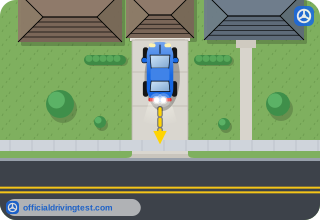
- Looking out through the rear window
- Failing to look both ways behind them
- Backing up slowly
- Glancing to either side for pedestrians
Show answer
Correct answer: Failing to look both ways behind them
The manual names failing to look both ways behind you as a common backing mistake, because mirrors do not give a full view.
Source: Oregon Driver Manual (2026-2027), page 29 · Open this page in the manual (Manual page 29)
-
To see as much as possible when backing up, what should you do?
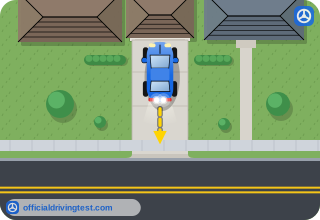
- Use only your mirrors, since they give you a full view of the area behind you
- Turn your body to the left and look out through the driver’s side window
- Keep your head facing forward and watch the rearview mirror to see behind
- Turn your body and head to the right and look through the rear window
Show answer
Correct answer: Turn your body and head to the right and look through the rear window
Mirrors do not give a full view, so turn your body and head to the right and look out through the rear window.
Source: Oregon Driver Manual (2026-2027), page 29 · Open this page in the manual (Manual page 29)
-
After checking for pedestrians and approaching traffic by glancing to either side, how should you back up?
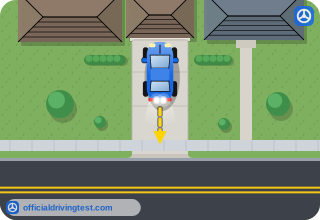
- Slowly
- At a moderate speed
- As fast as the lane allows
- In short, quick bursts
Show answer
Correct answer: Slowly
The manual says to glance to either side, then back up slowly.
Source: Oregon Driver Manual (2026-2027), page 29 · Open this page in the manual (Manual page 29)
-
What is a driver’s “blind spot”?
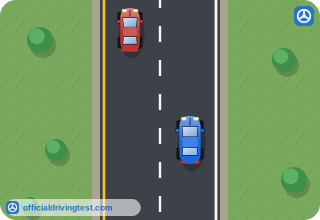
- The area around your vehicle you cannot see from the driver’s seat, even with mirrors
- The area directly behind your vehicle that is visible in your rearview mirror
- The area in front of your vehicle that your headlights do not light up at night
- The part of the road ahead of your vehicle that is hidden by a hill or a curve
Show answer
Correct answer: The area around your vehicle you cannot see from the driver’s seat, even with mirrors
A blind spot is the area around your vehicle that you cannot see from the driver’s seat even with the use of mirrors.
Source: Oregon Driver Manual (2026-2027), page 30 · Open this page in the manual (Manual page 30)
-
What should you do about other drivers’ blind spots?
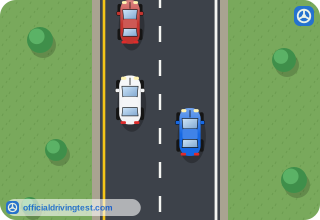
- Stay in another driver’s blind spot so your vehicle is hard to hit
- Sound your horn when you are in another driver’s blind spot
- Avoid driving in another driver’s blind spot, if possible
- Drive in another driver’s blind spot only on multilane streets
Show answer
Correct answer: Avoid driving in another driver’s blind spot, if possible
The manual says to avoid driving in another driver’s blind spot, if possible.
Source: Oregon Driver Manual (2026-2027), page 30 · Open this page in the manual (Manual page 30)
-
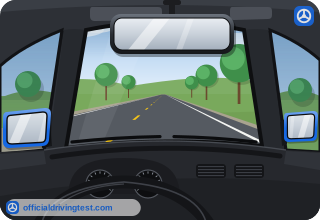
Before you change lanes, what should you check your side and rearview mirrors for?
- Pedestrians waiting at the next corner
- Traffic approaching you from behind
- Road signs on the left side of the road
- Brake lights on the vehicles ahead
Show answer
Correct answer: Traffic approaching you from behind
Before changing lanes, check your mirrors for traffic approaching you from behind.
Source: Oregon Driver Manual (2026-2027), page 30 · Open this page in the manual (Manual page 30)
-
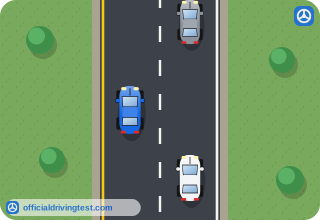
What should you do before you change lanes so that other drivers know your plan?
- Flash your headlights
- Tap the brake pedal twice
- Sound your horn
- Use your turn signal
Show answer
Correct answer: Use your turn signal
Using your turn signal lets other drivers know you plan to change lanes.
Source: Oregon Driver Manual (2026-2027), page 30 · Open this page in the manual (Manual page 30)
-
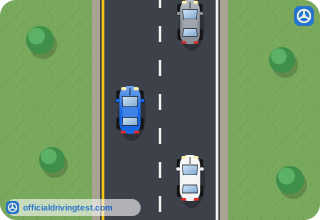
Before moving right to change lanes, over which shoulder should you glance?
- Your left shoulder
- Your right shoulder
- Either shoulder, as you prefer
- Neither, since mirrors show the whole area
Show answer
Correct answer: Your right shoulder
Glance over your right shoulder if you are moving right and over your left shoulder if you are moving left.
Source: Oregon Driver Manual (2026-2027), page 30 · Open this page in the manual (Manual page 30)
-
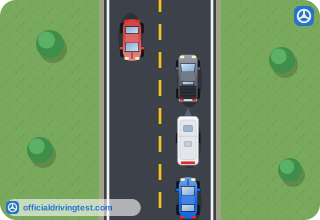
How do large vehicles and vehicles towing a trailer differ from other passenger vehicles?
- They accelerate more quickly but need much more room to stop
- They need less room to turn but take longer to speed up
- They can stop sooner than other vehicles because of their weight
- They take longer to accelerate and stop, and need more room to turn
Show answer
Correct answer: They take longer to accelerate and stop, and need more room to turn
Large vehicles or vehicles towing a trailer are longer, higher and wider, take longer to accelerate and stop, and require more room to turn.
Source: Oregon Driver Manual (2026-2027), page 35 · Open this page in the manual (Manual page 35)
-
When you tow a trailer and traffic is stacking up behind you, what should you do?
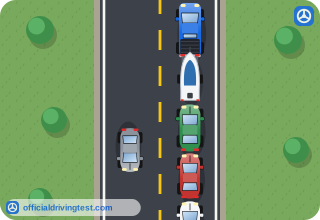
- Pull off at the first safe turnout to let the traffic pass
- Speed up so that you stay ahead of the traffic behind you
- Move to the left lane so the traffic can pass you on the right
- Slow down gradually until you reach the next exit ramp
Show answer
Correct answer: Pull off at the first safe turnout to let the traffic pass
The manual says to pull off at the first safe turnout to let the traffic pass.
Source: Oregon Driver Manual (2026-2027), page 35 · Open this page in the manual (Manual page 35)
-
When you drive a motor home or tow a trailer on a road with two or more lanes in the same direction, which lane should you use?
- The left lane
- The center lane
- The right lane
- Any lane you choose
Show answer
Correct answer: The right lane
The manual says to use the right lane on roads with two or more lanes going in the same direction.
Source: Oregon Driver Manual (2026-2027), page 35 · Open this page in the manual (Manual page 35)
-
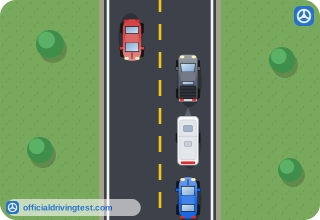
When you drive a pickup with a camper, a motor home, or tow a trailer, what should you often check?
- Only the traffic that is ahead of you
- Your speed and the traffic behind you
- Only your fuel level and warning lights
- The tire pressure of the vehicle in front of you
Show answer
Correct answer: Your speed and the traffic behind you
The manual says to often check your speed and the traffic behind you.
Source: Oregon Driver Manual (2026-2027), page 35 · Open this page in the manual (Manual page 35)
-
Which trailer may carry passengers, according to the manual?
- A boat trailer towed behind a passenger car
- A general utility trailer fitted with seats
- A trailer towed with a fifth-wheel device
- A camping trailer pulled by a passenger car
Show answer
Correct answer: A trailer towed with a fifth-wheel device
It is against the law to allow passengers to ride in any type of trailer except a commercial bus trailer, an independently-steered trailer, or a trailer towed with a fifth-wheel device.
Source: Oregon Driver Manual (2026-2027), page 36 · Open this page in the manual (Manual page 36)
-
What window and door material must a fifth-wheel trailer have in order to carry passengers?
- Tinted glass of any type
- Safety glazing materials
- Wire-reinforced screens
- Ordinary window glass
Show answer
Correct answer: Safety glazing materials
To carry passengers, a fifth-wheel trailer must have safety glazing materials in windows and doors with windows.
Source: Oregon Driver Manual (2026-2027), page 36 · Open this page in the manual (Manual page 36)
-
To carry passengers, a fifth-wheel trailer must have a way for the passengers to do what?
- Open the trailer hitch from the inside of the trailer
- Control the brakes of the trailer from the inside
- Steer the trailer from the inside while it is towed
- Get the driver’s attention with a signal or sound
Show answer
Correct answer: Get the driver’s attention with a signal or sound
A fifth-wheel trailer carrying passengers must have a way for them to get the driver’s attention by a visual signal or sound.
Source: Oregon Driver Manual (2026-2027), page 36 · Open this page in the manual (Manual page 36)
-
What kind of exit must a fifth-wheel trailer have to carry passengers?
- An unobstructed exit that opens from inside and outside
- An exit that opens only from the outside of the trailer
- An exit that opens only from the inside of the trailer
- An exit at the rear of the trailer that is kept locked
Show answer
Correct answer: An unobstructed exit that opens from inside and outside
An unobstructed exit that opens from both inside and outside is required.
Source: Oregon Driver Manual (2026-2027), page 36 · Open this page in the manual (Manual page 36)
-
What is the maximum number of boats, general utility trailers, or other vehicles you may tow behind a passenger or recreational vehicle under Oregon law?
- One
- Two
- Three
- As many as the hitch can carry
Show answer
Correct answer: One
Oregon law allows you to tow a maximum of one boat, general utility trailer, or other vehicle, and you cannot tow a second trailer or vehicle.
Source: Oregon Driver Manual (2026-2027), page 36 · Open this page in the manual (Manual page 36)
-
Which of these is a move you must signal before making?
- Pulling away from a curb
- Driving straight through a green light
- Staying in your lane on a straight road
- Continuing straight through an intersection
Show answer
Correct answer: Pulling away from a curb
You must signal before you turn, change lanes, exit a roundabout, or pull away from a curb.
Source: Oregon Driver Manual (2026-2027), page 38 · Open this page in the manual (Manual page 38)
-
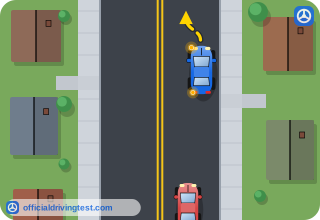
Before you turn, change lanes, or pull away from a curb, what should you check?
- Only the traffic coming from behind you
- Only the lane you are moving into
- Traffic ahead, behind and to the side
- Only the traffic directly ahead of you
Show answer
Correct answer: Traffic ahead, behind and to the side
Before making such a move, be sure you can do so safely by checking traffic ahead, behind and to the side.
Source: Oregon Driver Manual (2026-2027), page 38 · Open this page in the manual (Manual page 38)
-
When your vehicle is moving in traffic, how far before a turn or lane change should you start using your turn signal?
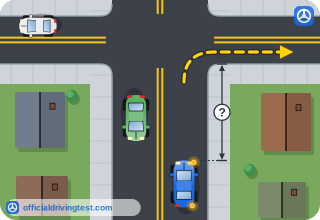
- At least 50 feet
- At least 100 feet
- At least 200 feet
- At least 500 feet
Show answer
Correct answer: At least 100 feet
The manual says to use your turn signal at least 100 feet before the turn or lane change.
Source: Oregon Driver Manual (2026-2027), page 38 · Open this page in the manual (Manual page 38)
-
You are parked at a curb and about to reenter traffic. How long should you use your signal?
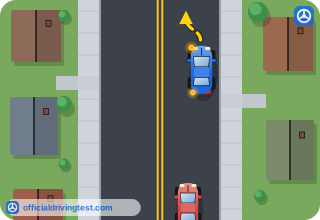
- Only until your vehicle begins to move forward
- For at least 500 feet after you enter the lane
- No signal is needed when you start from a curb at all
- Long enough to alert traffic you are moving in
Show answer
Correct answer: Long enough to alert traffic you are moving in
When parked at a curb and about to reenter traffic, use a signal long enough to alert traffic that you are moving into the lane.
Source: Oregon Driver Manual (2026-2027), page 38 · Open this page in the manual (Manual page 38)
-
Hand-and-arm signals should only be used in daylight and when you can clearly see people and vehicles at what distance?
- 100 feet
- 500 feet
- 2,000 feet
- 1,000 feet
Show answer
Correct answer: 1,000 feet
Hand-and-arm signals are for daylight and when you can clearly see people and vehicles at a distance of 1,000 feet.
Source: Oregon Driver Manual (2026-2027), page 38 · Open this page in the manual (Manual page 38)
-
At night or when visibility is poor, which signals must you use?
- Hand-and-arm signals
- Turn signal lights
- Either turn signal lights or hand-and-arm signals
- The horn and the brake lights
Show answer
Correct answer: Turn signal lights
You must use turn signal lights at night or when visibility is poor.
Source: Oregon Driver Manual (2026-2027), page 38 · Open this page in the manual (Manual page 38)
-
When should hand-and-arm signals not be used?
- Any time you are driving in daylight
- Any time you are slowing down
- Any time you are driving a wide or long vehicle
- Any time you are driving a compact passenger car
Show answer
Correct answer: Any time you are driving a wide or long vehicle
Hand-and-arm signals should not be used any time you are driving a wide or long vehicle.
Source: Oregon Driver Manual (2026-2027), page 38 · Open this page in the manual (Manual page 38)
-
A driver's left arm extends straight out of the driver's window, level with the shoulder. What does this hand-and-arm signal mean?
- Left turn
- Right turn
- Stop or decrease speed
- Pull over to the curb
Show answer
Correct answer: Left turn
In the manual's hand-and-arm signals picture, the left arm held straight out means a left turn.
Source: Oregon Driver Manual (2026-2027), page 38 · Open this page in the manual (Manual page 38)
-
A driver's left arm is held out of the window and bent upward, with the hand pointing to the sky. What does this hand-and-arm signal mean?
- Left turn
- Right turn
- Stop or decrease speed
- Passing is permitted
Show answer
Correct answer: Right turn
In the manual's hand-and-arm signals picture, the arm bent upward means a right turn.
Source: Oregon Driver Manual (2026-2027), page 38 · Open this page in the manual (Manual page 38)
-
A driver's left arm extends out of the window and angles downward, with the hand toward the ground. What does this hand-and-arm signal mean?
- Left turn
- Right turn
- Speed up and merge into traffic
- Stop or decrease speed
Show answer
Correct answer: Stop or decrease speed
In the manual's hand-and-arm signals picture, the arm angled downward means stop or decrease speed.
Source: Oregon Driver Manual (2026-2027), page 38 · Open this page in the manual (Manual page 38)
-
Why should you not rely solely on the turn signal of another driver?
- The driver may signal one way but turn the other way
- Drivers are only required to signal on multi-lane roads
- Turn signals cannot be seen well in bright daylight
- Most drivers signal only when a police officer is nearby
Show answer
Correct answer: The driver may signal one way but turn the other way
The manual warns that a driver may signal to turn right and instead turn left, or may turn without signaling.
Source: Oregon Driver Manual (2026-2027), page 38 · Open this page in the manual (Manual page 38)
-
Which of these tells other drivers that you are slowing or stopping?
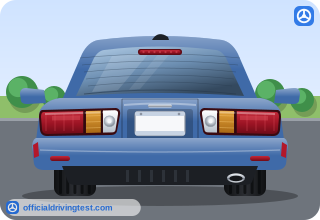
- Your parking lights
- Your brake lights
- Your fog lights
- Your high beams
Show answer
Correct answer: Your brake lights
The manual lists using your brake lights to indicate you are slowing or stopping.
Source: Oregon Driver Manual (2026-2027), page 74 · Open this page in the manual (Manual page 74)
-
According to the manual, collisions often occur when what happens?
- A driver signals early before changing direction or lanes
- Both drivers are traveling at exactly the posted speed limit
- A driver stays in the same lane for a long period of time
- A driver does not see another vehicle or does something unexpected
Show answer
Correct answer: A driver does not see another vehicle or does something unexpected
The manual says collisions often occur when one driver does not see another vehicle or a driver does something unexpected.
Source: Oregon Driver Manual (2026-2027), page 74 · Open this page in the manual (Manual page 74)
-
During what hours must headlights be turned on?
- From one hour after sunset to one hour before sunrise
- Only when it is completely dark
- Only when it is raining
- From sunset to sunrise
Show answer
Correct answer: From sunset to sunrise
Headlights must be turned on from sunset to sunrise.
Source: Oregon Driver Manual (2026-2027), page 76 · Open this page in the manual (Manual page 76)
-
Lights must be on whenever conditions make it difficult to see people or vehicles how far ahead?
- 1,000 feet
- 200 feet
- 600 feet
- 2,000 feet
Show answer
Correct answer: 1,000 feet
Lights must be on at any time conditions make it difficult to see people or vehicles 1,000 feet ahead.
Source: Oregon Driver Manual (2026-2027), page 76 · Open this page in the manual (Manual page 76)
-
If you are using high beams, within what distance of an oncoming vehicle must you dim your lights?
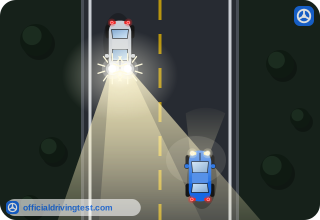
- 200 feet
- 300 feet
- 500 feet
- 1,000 feet
Show answer
Correct answer: 500 feet
You must dim your lights when an oncoming vehicle is within 500 feet.
Source: Oregon Driver Manual (2026-2027), page 76 · Open this page in the manual (Manual page 76)
-
Within what distance of a vehicle you are following should you dim your lights?
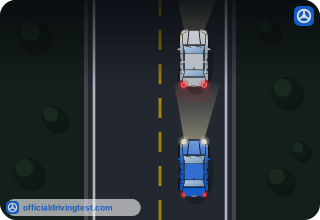
- 150 feet
- 350 feet
- 500 feet
- 700 feet
Show answer
Correct answer: 350 feet
The manual says to dim your lights when following another vehicle within 350 feet.
Source: Oregon Driver Manual (2026-2027), page 76 · Open this page in the manual (Manual page 76)
-
What must be true of auxiliary lights, such as fog lights, when you are required to dim your headlights?
- They may stay on if they are yellow
- They must be on
- They may stay on if you drive slowly
- They must be off
Show answer
Correct answer: They must be off
When you are required to dim your headlights, other auxiliary lights such as fog lights must be off because they make it difficult for oncoming drivers to see.
Source: Oregon Driver Manual (2026-2027), page 76 · Open this page in the manual (Manual page 76)
-
Which is illegal when driving at night or in bad weather?
- Driving with only the parking lights on
- Driving with low beam headlights on in the rain
- Driving with the windshield wipers on in the rain
- Driving with your dome light turned off
Show answer
Correct answer: Driving with only the parking lights on
It is illegal to drive at night or in bad weather with only the parking lights on.
Source: Oregon Driver Manual (2026-2027), page 76 · Open this page in the manual (Manual page 76)
-
What must a vehicle stopped or parked on a road or shoulder have on in limited visibility conditions?
- Its high beams
- Its fog lights only
- Its parking lights
- Its turn signals
Show answer
Correct answer: Its parking lights
A vehicle stopped or parked on a road or shoulder must have parking lights on in limited visibility conditions.
Source: Oregon Driver Manual (2026-2027), page 76 · Open this page in the manual (Manual page 76)
-
What should you do often when driving at night?
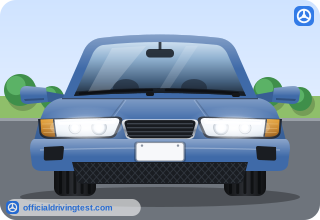
- Check that your headlights, taillights, and turn signals work and are clean
- Switch between high and low beams every mile you drive at night
- Look straight into oncoming headlights so your eyes adjust
- Replace the bulbs in your headlights before each trip made at night
Show answer
Correct answer: Check that your headlights, taillights, and turn signals work and are clean
The manual advises checking headlights, taillights, and turn signal lights often to make sure they work and the lenses are clean.
Source: Oregon Driver Manual (2026-2027), page 77 · Open this page in the manual (Manual page 77)
-
Which headlight setting should you use when driving into fog, dust, or smoke?
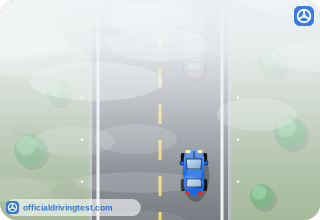
- High beam
- Parking lights only
- Fog lights with high beam
- Low beam
Show answer
Correct answer: Low beam
The manual says to use low beams in low visibility because light from high beams reflects back and causes glare.
Source: Oregon Driver Manual (2026-2027), page 77 · Open this page in the manual (Manual page 77)
-
When your windshield wipers are on, which lights should you turn on to increase your visibility to other motorists?
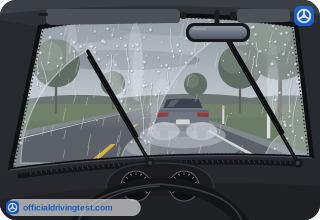
- Your hazard lights
- Your high beams
- Your headlights
- Your fog lights
Show answer
Correct answer: Your headlights
The manual says to turn on your headlights when your windshield wipers are on.
Source: Oregon Driver Manual (2026-2027), page 77 · Open this page in the manual (Manual page 77)
-
What may signs on some roads require you to do?
- Drive with your hazard lights turned on
- Stay below 25 mph at all times on that road
- Carry a spare set of headlight bulbs
- Carry or use chains or traction tires
Show answer
Correct answer: Carry or use chains or traction tires
The manual says you may see signs that require you to carry or use chains or traction tires.
Source: Oregon Driver Manual (2026-2027), page 79 · Open this page in the manual (Manual page 79)
-
Which of these is included in the manual’s meaning of “chains”?
- Cable chains
- Studded tires
- Retractable studded tires
- Tires with a mountain/snowflake emblem
Show answer
Correct answer: Cable chains
The manual says “chains” include link chains, cable chains or any other device specifically designed to increase traction on snow and ice.
Source: Oregon Driver Manual (2026-2027), page 79 · Open this page in the manual (Manual page 79)
-
Which of these is a “traction tire” under the manual’s definition?
- A link chain
- A cable chain
- A studded tire
- A device that attaches to the outside of the tire
Show answer
Correct answer: A studded tire
The manual says traction tires are studded tires, retractable studded tires, or other tires that meet the tire industry definition as suitable for severe snow.
Source: Oregon Driver Manual (2026-2027), page 79 · Open this page in the manual (Manual page 79)
-
Which emblem on the tire sidewall shows that a tire is designated by the tire industry as suitable for severe snow conditions?
- A sun and raindrop emblem
- A mountain/snowflake emblem
- A chain-link emblem
- A star-in-a-circle emblem
Show answer
Correct answer: A mountain/snowflake emblem
Tires designated by the tire industry display a mountain/snowflake emblem on the tire sidewall.
Source: Oregon Driver Manual (2026-2027), page 79 · Open this page in the manual (Manual page 79)
-
When are studded tires generally allowed in Oregon?
- Only from October 1 through April 30
- Only from December 1 through February 28
- All year round
- Only from November 1 through March 31
Show answer
Correct answer: Only from November 1 through March 31
Studded tires are generally allowed only from November 1 through March 31 in Oregon.
Source: Oregon Driver Manual (2026-2027), page 79 · Open this page in the manual (Manual page 79)
-
Why are drivers encouraged to use chains or other traction tires instead of studded tires?
- Because of the damage studded tires cause
- Because studded tires are illegal
- Because studded tires wear out in one season
- Because chains are required by law everywhere
Show answer
Correct answer: Because of the damage studded tires cause
Because of the damage caused by studded tires, drivers are encouraged to use alternates such as chains or other traction tires.
Source: Oregon Driver Manual (2026-2027), page 79 · Open this page in the manual (Manual page 79)
-
What does the manual say to avoid in order to save fuel?
- Unnecessary idling
- Steady speeds
- Combining errands
- Proper maintenance
Show answer
Correct answer: Unnecessary idling
Avoiding unnecessary idling is a listed fuel saving technique.
Source: Oregon Driver Manual (2026-2027), page 86 · Open this page in the manual (Manual page 86)
-
Which technique helps you save fuel?
- Make a separate trip for each errand
- Combine errands into a single trip
- Drive at higher speeds on short trips
- Leave the engine running while you shop
Show answer
Correct answer: Combine errands into a single trip
Combining errands into a single trip is a listed fuel saving technique.
Source: Oregon Driver Manual (2026-2027), page 86 · Open this page in the manual (Manual page 86)
-
Which of these helps improve gas mileage?
- Driving at the highest legal speed
- Starting quickly from every stop
- Idling to keep the engine warm
- Properly maintaining your vehicle
Show answer
Correct answer: Properly maintaining your vehicle
Properly maintaining your vehicle is a listed fuel saving technique.
Source: Oregon Driver Manual (2026-2027), page 86 · Open this page in the manual (Manual page 86)