Oregon: Signals and vehicle controls — Part 3 Practice Test
Questions in this part include: “What must be true of auxiliary lights, such as fog lights, when you are required to dim your headlights?” · “Which of these is a “traction tire” under the manual’s definition?”
Independent educational site · not affiliated with any government agency or DMV
Ready? Test yourself
- Instant feedback with an explanation
- Every answer cites its source in the manual
- Your best score is saved on this device
Questions are original and based on the official manual "Oregon Driver Manual" (2026-2027), Oregon Driver and Motor Vehicle Services (DMV).
All 16 questions in this practice test
Take the test above first, then use this list to study. Tap “Show answer” to see the correct answer and explanation.
Show the questions and answersHide the questions
-
Within what distance of a vehicle you are following should you dim your lights?
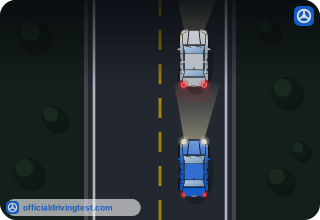
- 150 feet
- 350 feet
- 500 feet
- 700 feet
Show answer
Correct answer: 350 feet
The manual says to dim your lights when following another vehicle within 350 feet.
Source: Oregon Driver Manual (2026-2027), page 76 · Open this page in the manual (Manual page 76)
-
What must be true of auxiliary lights, such as fog lights, when you are required to dim your headlights?
- They may stay on if they are yellow
- They must be on
- They may stay on if you drive slowly
- They must be off
Show answer
Correct answer: They must be off
When you are required to dim your headlights, other auxiliary lights such as fog lights must be off because they make it difficult for oncoming drivers to see.
Source: Oregon Driver Manual (2026-2027), page 76 · Open this page in the manual (Manual page 76)
-
Which is illegal when driving at night or in bad weather?
- Driving with only the parking lights on
- Driving with low beam headlights on in the rain
- Driving with the windshield wipers on in the rain
- Driving with your dome light turned off
Show answer
Correct answer: Driving with only the parking lights on
It is illegal to drive at night or in bad weather with only the parking lights on.
Source: Oregon Driver Manual (2026-2027), page 76 · Open this page in the manual (Manual page 76)
-
What must a vehicle stopped or parked on a road or shoulder have on in limited visibility conditions?
- Its high beams
- Its fog lights only
- Its parking lights
- Its turn signals
Show answer
Correct answer: Its parking lights
A vehicle stopped or parked on a road or shoulder must have parking lights on in limited visibility conditions.
Source: Oregon Driver Manual (2026-2027), page 76 · Open this page in the manual (Manual page 76)
-
What should you do often when driving at night?
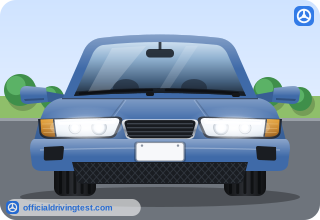
- Check that your headlights, taillights, and turn signals work and are clean
- Switch between high and low beams every mile you drive at night
- Look straight into oncoming headlights so your eyes adjust
- Replace the bulbs in your headlights before each trip made at night
Show answer
Correct answer: Check that your headlights, taillights, and turn signals work and are clean
The manual advises checking headlights, taillights, and turn signal lights often to make sure they work and the lenses are clean.
Source: Oregon Driver Manual (2026-2027), page 77 · Open this page in the manual (Manual page 77)
-
Which headlight setting should you use when driving into fog, dust, or smoke?
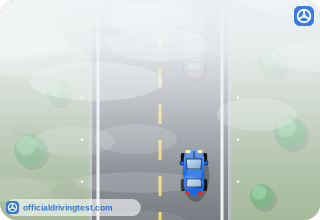
- High beam
- Parking lights only
- Fog lights with high beam
- Low beam
Show answer
Correct answer: Low beam
The manual says to use low beams in low visibility because light from high beams reflects back and causes glare.
Source: Oregon Driver Manual (2026-2027), page 77 · Open this page in the manual (Manual page 77)
-
When your windshield wipers are on, which lights should you turn on to increase your visibility to other motorists?
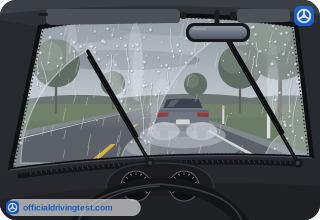
- Your hazard lights
- Your high beams
- Your headlights
- Your fog lights
Show answer
Correct answer: Your headlights
The manual says to turn on your headlights when your windshield wipers are on.
Source: Oregon Driver Manual (2026-2027), page 77 · Open this page in the manual (Manual page 77)
-
What may signs on some roads require you to do?
- Drive with your hazard lights turned on
- Stay below 25 mph at all times on that road
- Carry a spare set of headlight bulbs
- Carry or use chains or traction tires
Show answer
Correct answer: Carry or use chains or traction tires
The manual says you may see signs that require you to carry or use chains or traction tires.
Source: Oregon Driver Manual (2026-2027), page 79 · Open this page in the manual (Manual page 79)
-
Which of these is included in the manual’s meaning of “chains”?
- Cable chains
- Studded tires
- Retractable studded tires
- Tires with a mountain/snowflake emblem
Show answer
Correct answer: Cable chains
The manual says “chains” include link chains, cable chains or any other device specifically designed to increase traction on snow and ice.
Source: Oregon Driver Manual (2026-2027), page 79 · Open this page in the manual (Manual page 79)
-
Which of these is a “traction tire” under the manual’s definition?
- A link chain
- A cable chain
- A studded tire
- A device that attaches to the outside of the tire
Show answer
Correct answer: A studded tire
The manual says traction tires are studded tires, retractable studded tires, or other tires that meet the tire industry definition as suitable for severe snow.
Source: Oregon Driver Manual (2026-2027), page 79 · Open this page in the manual (Manual page 79)
-
Which emblem on the tire sidewall shows that a tire is designated by the tire industry as suitable for severe snow conditions?
- A sun and raindrop emblem
- A mountain/snowflake emblem
- A chain-link emblem
- A star-in-a-circle emblem
Show answer
Correct answer: A mountain/snowflake emblem
Tires designated by the tire industry display a mountain/snowflake emblem on the tire sidewall.
Source: Oregon Driver Manual (2026-2027), page 79 · Open this page in the manual (Manual page 79)
-
When are studded tires generally allowed in Oregon?
- Only from October 1 through April 30
- Only from December 1 through February 28
- All year round
- Only from November 1 through March 31
Show answer
Correct answer: Only from November 1 through March 31
Studded tires are generally allowed only from November 1 through March 31 in Oregon.
Source: Oregon Driver Manual (2026-2027), page 79 · Open this page in the manual (Manual page 79)
-
Why are drivers encouraged to use chains or other traction tires instead of studded tires?
- Because of the damage studded tires cause
- Because studded tires are illegal
- Because studded tires wear out in one season
- Because chains are required by law everywhere
Show answer
Correct answer: Because of the damage studded tires cause
Because of the damage caused by studded tires, drivers are encouraged to use alternates such as chains or other traction tires.
Source: Oregon Driver Manual (2026-2027), page 79 · Open this page in the manual (Manual page 79)
-
What does the manual say to avoid in order to save fuel?
- Unnecessary idling
- Steady speeds
- Combining errands
- Proper maintenance
Show answer
Correct answer: Unnecessary idling
Avoiding unnecessary idling is a listed fuel saving technique.
Source: Oregon Driver Manual (2026-2027), page 86 · Open this page in the manual (Manual page 86)
-
Which technique helps you save fuel?
- Make a separate trip for each errand
- Combine errands into a single trip
- Drive at higher speeds on short trips
- Leave the engine running while you shop
Show answer
Correct answer: Combine errands into a single trip
Combining errands into a single trip is a listed fuel saving technique.
Source: Oregon Driver Manual (2026-2027), page 86 · Open this page in the manual (Manual page 86)
-
Which of these helps improve gas mileage?
- Driving at the highest legal speed
- Starting quickly from every stop
- Idling to keep the engine warm
- Properly maintaining your vehicle
Show answer
Correct answer: Properly maintaining your vehicle
Properly maintaining your vehicle is a listed fuel saving technique.
Source: Oregon Driver Manual (2026-2027), page 86 · Open this page in the manual (Manual page 86)