Oregon: Signals and vehicle controls — Part 2 Practice Test
Questions in this part include: “Hand-and-arm signals should only be used in daylight and when you can clearly see people and vehicles at what distance?” · “Why should you not rely solely on the turn signal of another driver?”
Independent educational site · not affiliated with any government agency or DMV
Ready? Test yourself
- Instant feedback with an explanation
- Every answer cites its source in the manual
- Your best score is saved on this device
Questions are original and based on the official manual "Oregon Driver Manual" (2026-2027), Oregon Driver and Motor Vehicle Services (DMV).
All 16 questions in this practice test
Take the test above first, then use this list to study. Tap “Show answer” to see the correct answer and explanation.
Show the questions and answersHide the questions
-
Which of these is a move you must signal before making?
- Pulling away from a curb
- Driving straight through a green light
- Staying in your lane on a straight road
- Continuing straight through an intersection
Show answer
Correct answer: Pulling away from a curb
You must signal before you turn, change lanes, exit a roundabout, or pull away from a curb.
Source: Oregon Driver Manual (2026-2027), page 38 · Open this page in the manual (Manual page 38)
-
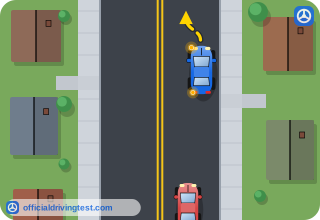
Before you turn, change lanes, or pull away from a curb, what should you check?
- Only the traffic coming from behind you
- Only the lane you are moving into
- Traffic ahead, behind and to the side
- Only the traffic directly ahead of you
Show answer
Correct answer: Traffic ahead, behind and to the side
Before making such a move, be sure you can do so safely by checking traffic ahead, behind and to the side.
Source: Oregon Driver Manual (2026-2027), page 38 · Open this page in the manual (Manual page 38)
-
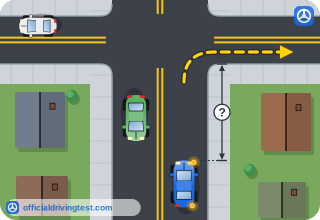
When your vehicle is moving in traffic, how far before a turn or lane change should you start using your turn signal?
- At least 50 feet
- At least 100 feet
- At least 200 feet
- At least 500 feet
Show answer
Correct answer: At least 100 feet
The manual says to use your turn signal at least 100 feet before the turn or lane change.
Source: Oregon Driver Manual (2026-2027), page 38 · Open this page in the manual (Manual page 38)
-
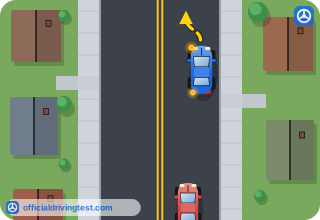
You are parked at a curb and about to reenter traffic. How long should you use your signal?
- Only until your vehicle begins to move forward
- For at least 500 feet after you enter the lane
- No signal is needed when you start from a curb at all
- Long enough to alert traffic you are moving in
Show answer
Correct answer: Long enough to alert traffic you are moving in
When parked at a curb and about to reenter traffic, use a signal long enough to alert traffic that you are moving into the lane.
Source: Oregon Driver Manual (2026-2027), page 38 · Open this page in the manual (Manual page 38)
-
Hand-and-arm signals should only be used in daylight and when you can clearly see people and vehicles at what distance?
- 100 feet
- 500 feet
- 2,000 feet
- 1,000 feet
Show answer
Correct answer: 1,000 feet
Hand-and-arm signals are for daylight and when you can clearly see people and vehicles at a distance of 1,000 feet.
Source: Oregon Driver Manual (2026-2027), page 38 · Open this page in the manual (Manual page 38)
-
At night or when visibility is poor, which signals must you use?
- Hand-and-arm signals
- Turn signal lights
- Either turn signal lights or hand-and-arm signals
- The horn and the brake lights
Show answer
Correct answer: Turn signal lights
You must use turn signal lights at night or when visibility is poor.
Source: Oregon Driver Manual (2026-2027), page 38 · Open this page in the manual (Manual page 38)
-
When should hand-and-arm signals not be used?
- Any time you are driving in daylight
- Any time you are slowing down
- Any time you are driving a wide or long vehicle
- Any time you are driving a compact passenger car
Show answer
Correct answer: Any time you are driving a wide or long vehicle
Hand-and-arm signals should not be used any time you are driving a wide or long vehicle.
Source: Oregon Driver Manual (2026-2027), page 38 · Open this page in the manual (Manual page 38)
-
A driver's left arm extends straight out of the driver's window, level with the shoulder. What does this hand-and-arm signal mean?
- Left turn
- Right turn
- Stop or decrease speed
- Pull over to the curb
Show answer
Correct answer: Left turn
In the manual's hand-and-arm signals picture, the left arm held straight out means a left turn.
Source: Oregon Driver Manual (2026-2027), page 38 · Open this page in the manual (Manual page 38)
-
A driver's left arm is held out of the window and bent upward, with the hand pointing to the sky. What does this hand-and-arm signal mean?
- Left turn
- Right turn
- Stop or decrease speed
- Passing is permitted
Show answer
Correct answer: Right turn
In the manual's hand-and-arm signals picture, the arm bent upward means a right turn.
Source: Oregon Driver Manual (2026-2027), page 38 · Open this page in the manual (Manual page 38)
-
A driver's left arm extends out of the window and angles downward, with the hand toward the ground. What does this hand-and-arm signal mean?
- Left turn
- Right turn
- Speed up and merge into traffic
- Stop or decrease speed
Show answer
Correct answer: Stop or decrease speed
In the manual's hand-and-arm signals picture, the arm angled downward means stop or decrease speed.
Source: Oregon Driver Manual (2026-2027), page 38 · Open this page in the manual (Manual page 38)
-
Why should you not rely solely on the turn signal of another driver?
- The driver may signal one way but turn the other way
- Drivers are only required to signal on multi-lane roads
- Turn signals cannot be seen well in bright daylight
- Most drivers signal only when a police officer is nearby
Show answer
Correct answer: The driver may signal one way but turn the other way
The manual warns that a driver may signal to turn right and instead turn left, or may turn without signaling.
Source: Oregon Driver Manual (2026-2027), page 38 · Open this page in the manual (Manual page 38)
-
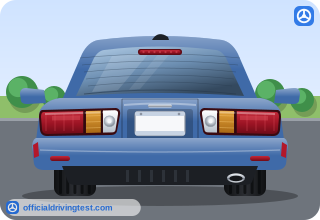
Which of these tells other drivers that you are slowing or stopping?
- Your parking lights
- Your brake lights
- Your fog lights
- Your high beams
Show answer
Correct answer: Your brake lights
The manual lists using your brake lights to indicate you are slowing or stopping.
Source: Oregon Driver Manual (2026-2027), page 74 · Open this page in the manual (Manual page 74)
-
According to the manual, collisions often occur when what happens?
- A driver signals early before changing direction or lanes
- Both drivers are traveling at exactly the posted speed limit
- A driver stays in the same lane for a long period of time
- A driver does not see another vehicle or does something unexpected
Show answer
Correct answer: A driver does not see another vehicle or does something unexpected
The manual says collisions often occur when one driver does not see another vehicle or a driver does something unexpected.
Source: Oregon Driver Manual (2026-2027), page 74 · Open this page in the manual (Manual page 74)
-
During what hours must headlights be turned on?
- From one hour after sunset to one hour before sunrise
- Only when it is completely dark
- Only when it is raining
- From sunset to sunrise
Show answer
Correct answer: From sunset to sunrise
Headlights must be turned on from sunset to sunrise.
Source: Oregon Driver Manual (2026-2027), page 76 · Open this page in the manual (Manual page 76)
-
Lights must be on whenever conditions make it difficult to see people or vehicles how far ahead?
- 1,000 feet
- 200 feet
- 600 feet
- 2,000 feet
Show answer
Correct answer: 1,000 feet
Lights must be on at any time conditions make it difficult to see people or vehicles 1,000 feet ahead.
Source: Oregon Driver Manual (2026-2027), page 76 · Open this page in the manual (Manual page 76)
-
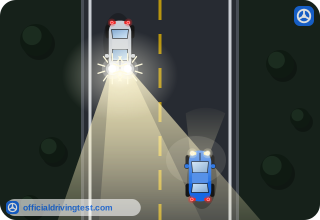
If you are using high beams, within what distance of an oncoming vehicle must you dim your lights?
- 200 feet
- 300 feet
- 500 feet
- 1,000 feet
Show answer
Correct answer: 500 feet
You must dim your lights when an oncoming vehicle is within 500 feet.
Source: Oregon Driver Manual (2026-2027), page 76 · Open this page in the manual (Manual page 76)