Oregon: Signals and vehicle controls — Part 1 Practice Test
Questions in this part include: “Which trailer may carry passengers, according to the manual?” · “To carry passengers, a fifth-wheel trailer must have a way for the passengers to do what?”
Independent educational site · not affiliated with any government agency or DMV
Ready? Test yourself
- Instant feedback with an explanation
- Every answer cites its source in the manual
- Your best score is saved on this device
Questions are original and based on the official manual "Oregon Driver Manual" (2026-2027), Oregon Driver and Motor Vehicle Services (DMV).
All 17 questions in this practice test
Take the test above first, then use this list to study. Tap “Show answer” to see the correct answer and explanation.
Show the questions and answersHide the questions
-
What is a mistake that drivers often make when backing up?
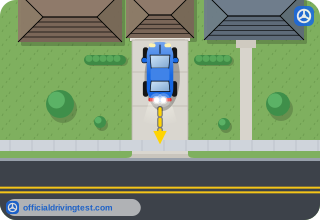
- Looking out through the rear window
- Failing to look both ways behind them
- Backing up slowly
- Glancing to either side for pedestrians
Show answer
Correct answer: Failing to look both ways behind them
The manual names failing to look both ways behind you as a common backing mistake, because mirrors do not give a full view.
Source: Oregon Driver Manual (2026-2027), page 29 · Open this page in the manual (Manual page 29)
-
To see as much as possible when backing up, what should you do?
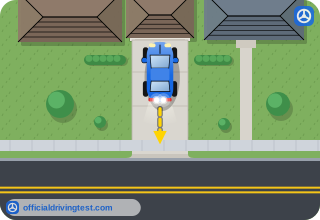
- Use only your mirrors, since they give you a full view of the area behind you
- Turn your body to the left and look out through the driver’s side window
- Keep your head facing forward and watch the rearview mirror to see behind
- Turn your body and head to the right and look through the rear window
Show answer
Correct answer: Turn your body and head to the right and look through the rear window
Mirrors do not give a full view, so turn your body and head to the right and look out through the rear window.
Source: Oregon Driver Manual (2026-2027), page 29 · Open this page in the manual (Manual page 29)
-
After checking for pedestrians and approaching traffic by glancing to either side, how should you back up?
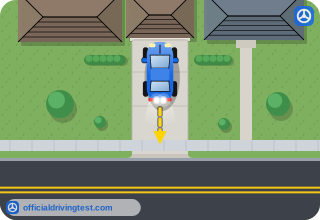
- Slowly
- At a moderate speed
- As fast as the lane allows
- In short, quick bursts
Show answer
Correct answer: Slowly
The manual says to glance to either side, then back up slowly.
Source: Oregon Driver Manual (2026-2027), page 29 · Open this page in the manual (Manual page 29)
-
What is a driver’s “blind spot”?
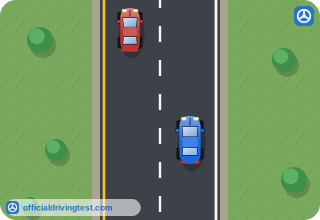
- The area around your vehicle you cannot see from the driver’s seat, even with mirrors
- The area directly behind your vehicle that is visible in your rearview mirror
- The area in front of your vehicle that your headlights do not light up at night
- The part of the road ahead of your vehicle that is hidden by a hill or a curve
Show answer
Correct answer: The area around your vehicle you cannot see from the driver’s seat, even with mirrors
A blind spot is the area around your vehicle that you cannot see from the driver’s seat even with the use of mirrors.
Source: Oregon Driver Manual (2026-2027), page 30 · Open this page in the manual (Manual page 30)
-
What should you do about other drivers’ blind spots?
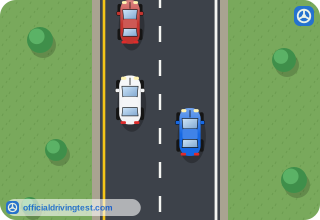
- Stay in another driver’s blind spot so your vehicle is hard to hit
- Sound your horn when you are in another driver’s blind spot
- Avoid driving in another driver’s blind spot, if possible
- Drive in another driver’s blind spot only on multilane streets
Show answer
Correct answer: Avoid driving in another driver’s blind spot, if possible
The manual says to avoid driving in another driver’s blind spot, if possible.
Source: Oregon Driver Manual (2026-2027), page 30 · Open this page in the manual (Manual page 30)
-
Before you change lanes, what should you check your side and rearview mirrors for?
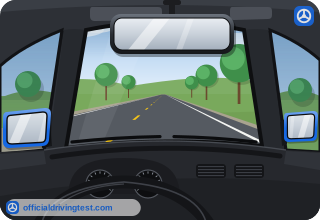
- Pedestrians waiting at the next corner
- Traffic approaching you from behind
- Road signs on the left side of the road
- Brake lights on the vehicles ahead
Show answer
Correct answer: Traffic approaching you from behind
Before changing lanes, check your mirrors for traffic approaching you from behind.
Source: Oregon Driver Manual (2026-2027), page 30 · Open this page in the manual (Manual page 30)
-
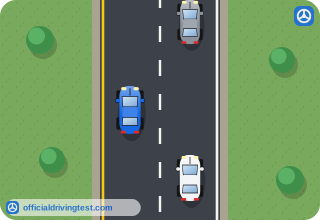
What should you do before you change lanes so that other drivers know your plan?
- Flash your headlights
- Tap the brake pedal twice
- Sound your horn
- Use your turn signal
Show answer
Correct answer: Use your turn signal
Using your turn signal lets other drivers know you plan to change lanes.
Source: Oregon Driver Manual (2026-2027), page 30 · Open this page in the manual (Manual page 30)
-
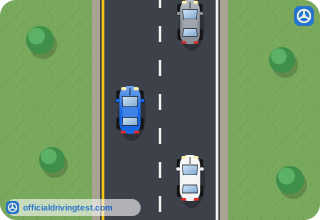
Before moving right to change lanes, over which shoulder should you glance?
- Your left shoulder
- Your right shoulder
- Either shoulder, as you prefer
- Neither, since mirrors show the whole area
Show answer
Correct answer: Your right shoulder
Glance over your right shoulder if you are moving right and over your left shoulder if you are moving left.
Source: Oregon Driver Manual (2026-2027), page 30 · Open this page in the manual (Manual page 30)
-
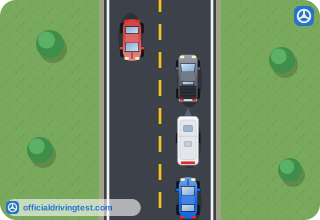
How do large vehicles and vehicles towing a trailer differ from other passenger vehicles?
- They accelerate more quickly but need much more room to stop
- They need less room to turn but take longer to speed up
- They can stop sooner than other vehicles because of their weight
- They take longer to accelerate and stop, and need more room to turn
Show answer
Correct answer: They take longer to accelerate and stop, and need more room to turn
Large vehicles or vehicles towing a trailer are longer, higher and wider, take longer to accelerate and stop, and require more room to turn.
Source: Oregon Driver Manual (2026-2027), page 35 · Open this page in the manual (Manual page 35)
-
When you tow a trailer and traffic is stacking up behind you, what should you do?
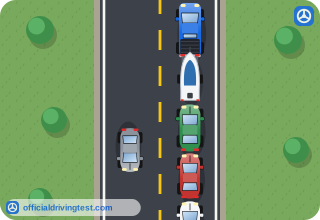
- Pull off at the first safe turnout to let the traffic pass
- Speed up so that you stay ahead of the traffic behind you
- Move to the left lane so the traffic can pass you on the right
- Slow down gradually until you reach the next exit ramp
Show answer
Correct answer: Pull off at the first safe turnout to let the traffic pass
The manual says to pull off at the first safe turnout to let the traffic pass.
Source: Oregon Driver Manual (2026-2027), page 35 · Open this page in the manual (Manual page 35)
-
When you drive a motor home or tow a trailer on a road with two or more lanes in the same direction, which lane should you use?
- The left lane
- The center lane
- The right lane
- Any lane you choose
Show answer
Correct answer: The right lane
The manual says to use the right lane on roads with two or more lanes going in the same direction.
Source: Oregon Driver Manual (2026-2027), page 35 · Open this page in the manual (Manual page 35)
-
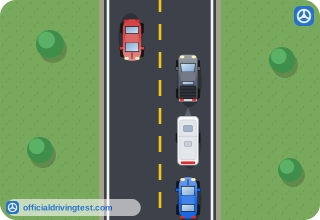
When you drive a pickup with a camper, a motor home, or tow a trailer, what should you often check?
- Only the traffic that is ahead of you
- Your speed and the traffic behind you
- Only your fuel level and warning lights
- The tire pressure of the vehicle in front of you
Show answer
Correct answer: Your speed and the traffic behind you
The manual says to often check your speed and the traffic behind you.
Source: Oregon Driver Manual (2026-2027), page 35 · Open this page in the manual (Manual page 35)
-
Which trailer may carry passengers, according to the manual?
- A boat trailer towed behind a passenger car
- A general utility trailer fitted with seats
- A trailer towed with a fifth-wheel device
- A camping trailer pulled by a passenger car
Show answer
Correct answer: A trailer towed with a fifth-wheel device
It is against the law to allow passengers to ride in any type of trailer except a commercial bus trailer, an independently-steered trailer, or a trailer towed with a fifth-wheel device.
Source: Oregon Driver Manual (2026-2027), page 36 · Open this page in the manual (Manual page 36)
-
What window and door material must a fifth-wheel trailer have in order to carry passengers?
- Tinted glass of any type
- Safety glazing materials
- Wire-reinforced screens
- Ordinary window glass
Show answer
Correct answer: Safety glazing materials
To carry passengers, a fifth-wheel trailer must have safety glazing materials in windows and doors with windows.
Source: Oregon Driver Manual (2026-2027), page 36 · Open this page in the manual (Manual page 36)
-
To carry passengers, a fifth-wheel trailer must have a way for the passengers to do what?
- Open the trailer hitch from the inside of the trailer
- Control the brakes of the trailer from the inside
- Steer the trailer from the inside while it is towed
- Get the driver’s attention with a signal or sound
Show answer
Correct answer: Get the driver’s attention with a signal or sound
A fifth-wheel trailer carrying passengers must have a way for them to get the driver’s attention by a visual signal or sound.
Source: Oregon Driver Manual (2026-2027), page 36 · Open this page in the manual (Manual page 36)
-
What kind of exit must a fifth-wheel trailer have to carry passengers?
- An unobstructed exit that opens from inside and outside
- An exit that opens only from the outside of the trailer
- An exit that opens only from the inside of the trailer
- An exit at the rear of the trailer that is kept locked
Show answer
Correct answer: An unobstructed exit that opens from inside and outside
An unobstructed exit that opens from both inside and outside is required.
Source: Oregon Driver Manual (2026-2027), page 36 · Open this page in the manual (Manual page 36)
-
What is the maximum number of boats, general utility trailers, or other vehicles you may tow behind a passenger or recreational vehicle under Oregon law?
- One
- Two
- Three
- As many as the hitch can carry
Show answer
Correct answer: One
Oregon law allows you to tow a maximum of one boat, general utility trailer, or other vehicle, and you cannot tow a second trailer or vehicle.
Source: Oregon Driver Manual (2026-2027), page 36 · Open this page in the manual (Manual page 36)