Oklahoma: Speed and following distance — Part 4 Practice Test
Questions in this part include: “What is a "cushion of safety" when you are driving?” · “What is one way the manual says to set your following distance by car lengths?”
Independent educational site · not affiliated with any government agency or DMV
Ready? Test yourself
- Instant feedback with an explanation
- Every answer cites its source in the manual
- Your best score is saved on this device
- Keyboard: press 1 to 4 to answer and Enter for the next question
Questions are original and based on the official manual "Oklahoma Driver Manual" (2025 (updated November 24, 2025)), Service Oklahoma.
All 17 questions in this practice test
Take the test above first, then use this list to study. Tap “Show answer” to see the correct answer and explanation.
Show the questions and answersHide the questions
-
Why should you never drive into water crossing the roadway?
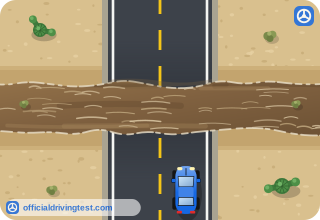
- Water can wash the paint and the protective wax off your vehicle
- Wet brakes can never dry out again and will stop working for good
- You can't judge the depth of the water or the force and pull of the flow
- The road under the water is always too slippery for any tires
Show answer
Correct answer: You can't judge the depth of the water or the force and pull of the flow
You cannot tell how deep the water is or how strong the current is.
Source: Oklahoma Driver Manual (2025 (updated November 24, 2025)), page 44 · Open this page in the manual (Manual page 44)
-
What is a "cushion of safety" when you are driving?
- Having open space in front, behind and on the sides of your vehicle
- Driving 10 mph below the posted limit whenever there is traffic
- Keeping open space only on the side next to other cars on the road
- Staying in the right-hand lane of the road at all times of day
Show answer
Correct answer: Having open space in front, behind and on the sides of your vehicle
A cushion of safety is open space around your vehicle on all sides.
Source: Oklahoma Driver Manual (2025 (updated November 24, 2025)), page 44 · Open this page in the manual (Manual page 44)
-
How far behind the next vehicle should you stay?
- Close enough that other drivers cannot cut in front of you
- Exactly two car lengths behind the vehicle at any speed
- Only one car length behind the vehicle at any speed
- Far enough that you can stop safely if it should stop suddenly
Show answer
Correct answer: Far enough that you can stop safely if it should stop suddenly
Stay far enough back to stop safely if the vehicle ahead stops suddenly.
Source: Oklahoma Driver Manual (2025 (updated November 24, 2025)), page 44 · Open this page in the manual (Manual page 44)
-
What is one way the manual says to set your following distance by car lengths?
- Allow one car length for every 5 miles per hour of speed
- Allow one car length for every 10 miles per hour of speed
- Allow two car lengths for every 10 miles per hour of speed
- Allow one car length for every 20 miles per hour of speed
Show answer
Correct answer: Allow one car length for every 10 miles per hour of speed
The manual says to allow one car length for every 10 mph of speed.
Source: Oklahoma Driver Manual (2025 (updated November 24, 2025)), page 44 · Open this page in the manual (Manual page 44)
-
When cars bunch up and travel in a pack, what is much safer?
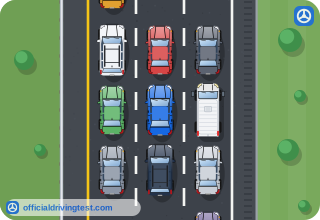
- Avoiding the pack and keeping your cushion of safety
- Staying in the middle of the pack to be protected
- Closing the gap so that no other car can cut in
- Speeding up to pass the whole pack all at once
Show answer
Correct answer: Avoiding the pack and keeping your cushion of safety
It is much safer to stay out of the pack and keep your cushion of safety.
Source: Oklahoma Driver Manual (2025 (updated November 24, 2025)), page 44 · Open this page in the manual (Manual page 44)
-
In a caravan or motorcade outside of a business or residential area, how much space should you leave between each vehicle?
- At least 50 feet
- At least 100 feet
- At least 200 feet
- At least 400 feet
Show answer
Correct answer: At least 200 feet
The manual says to leave at least 200 feet so other cars or trucks can enter the line safely.
Source: Oklahoma Driver Manual (2025 (updated November 24, 2025)), page 44 · Open this page in the manual (Manual page 44)
-
Why do trucks usually take longer to stop than cars?
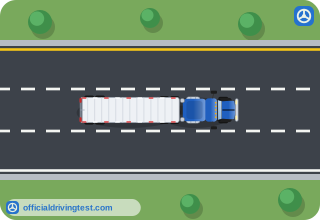
- Because they have no brakes on the front wheels
- Because of their size
- Because they always travel faster than cars
- Because they are allowed to follow closely
Show answer
Correct answer: Because of their size
Trucks take longer to stop than cars because of their size.
Source: Oklahoma Driver Manual (2025 (updated November 24, 2025)), page 44 · Open this page in the manual (Manual page 44)
-
Under what conditions may a truck be able to stop more quickly than a car?
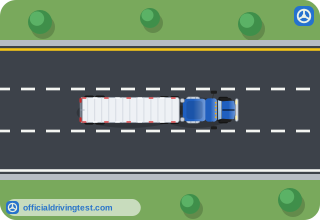
- At lower speeds or on dry pavement
- When it is carrying a heavy load on ice
- When it is going downhill at night
- At higher speeds or on wet pavement
Show answer
Correct answer: At higher speeds or on wet pavement
The manual says trucks may have better traction at higher speeds or on wet pavement and stop more quickly than a car.
Source: Oklahoma Driver Manual (2025 (updated November 24, 2025)), page 44 · Open this page in the manual (Manual page 44)
-
How far ahead should you watch for brake lights when following another car?
- Only the car directly ahead of you
- Two cars down the line
- Four or five cars down the line
- Ten cars down the line
Show answer
Correct answer: Four or five cars down the line
Watching four or five cars ahead increases your response time.
Source: Oklahoma Driver Manual (2025 (updated November 24, 2025)), page 45 · Open this page in the manual (Manual page 45)
-
What should you do as soon as you see brake lights go on ahead?
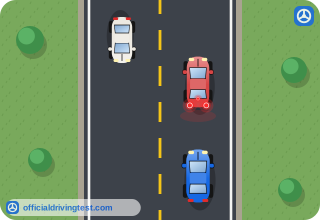
- Shift your foot to the brake pedal
- Move into the next lane right away
- Flash your headlights at the car
- Sound your horn to warn them
Show answer
Correct answer: Shift your foot to the brake pedal
Moving your foot to the brake pedal right away lets you stop if needed.
Source: Oklahoma Driver Manual (2025 (updated November 24, 2025)), page 45 · Open this page in the manual (Manual page 45)
-
What is a sure sign of danger when following another vehicle?
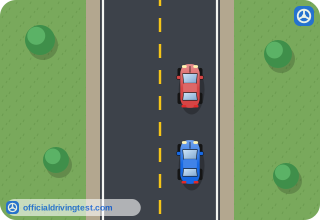
- Growing distance between your car and the one ahead
- A vehicle passing you in the next lane
- Brake lights on a car in the opposite lane
- Shrinking distance between your car and the one ahead
Show answer
Correct answer: Shrinking distance between your car and the one ahead
The manual calls a shrinking distance between your car and the one ahead a sure sign of danger.
Source: Oklahoma Driver Manual (2025 (updated November 24, 2025)), page 45 · Open this page in the manual (Manual page 45)
-
How can you tell whether a car in the distance ahead is moving or stopped?
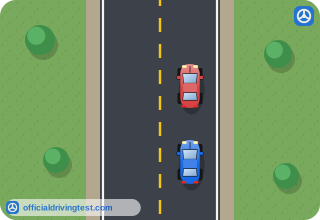
- Watch its brake lights only
- Compare it to a fixed object
- Sound your horn to see if it moves
- Move onto the shoulder to look
Show answer
Correct answer: Compare it to a fixed object
The manual says to compare the car in question to a fixed object.
Source: Oklahoma Driver Manual (2025 (updated November 24, 2025)), page 45 · Open this page in the manual (Manual page 45)
-
Why should you look for problems that might develop for the driver ahead of you?
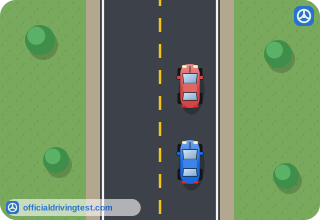
- So you have more time to react
- So you can pass that driver sooner
- So you can follow more closely
- So you can avoid using your brakes
Show answer
Correct answer: So you have more time to react
Spotting problems ahead gives you more time to react.
Source: Oklahoma Driver Manual (2025 (updated November 24, 2025)), page 45 · Open this page in the manual (Manual page 45)
-
The car ahead of you signals for a left turn. What should you do?
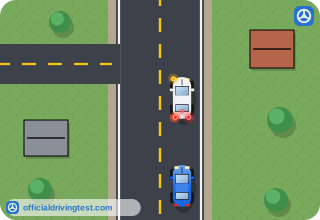
- Flash your headlights to hurry it
- Sound your horn so it turns sooner
- Slow down and prepare to stop
- Stay close behind it
Show answer
Correct answer: Slow down and prepare to stop
The manual says to slow down and prepare to stop, so you avoid being hit from behind.
Source: Oklahoma Driver Manual (2025 (updated November 24, 2025)), page 45 · Open this page in the manual (Manual page 45)
-
If someone is following you too closely, what should you do if braking will not cause a collision?
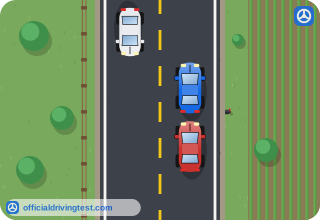
- Brake hard to teach the driver a lesson
- Flash your brake lights
- Speed up to pull away
- Turn on your hazard lights and stop
Show answer
Correct answer: Flash your brake lights
You may flash your brake lights if braking will not cause a collision, to warn the driver behind.
Source: Oklahoma Driver Manual (2025 (updated November 24, 2025)), page 45 · Open this page in the manual (Manual page 45)
-
Which tactic does the manual list for dealing with a tailgater?
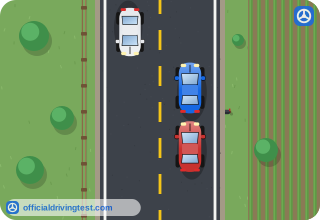
- Speed up to put distance between you and the driver
- Move to the center of the road to block the driver
- Brake suddenly so the driver learns to back off
- Slow down and encourage the driver behind you to pass
Show answer
Correct answer: Slow down and encourage the driver behind you to pass
The manual says to slow down and encourage the driver behind you to pass.
Source: Oklahoma Driver Manual (2025 (updated November 24, 2025)), page 45 · Open this page in the manual (Manual page 45)
-
If tactics fail with a tailgater, where is it best to stop and let the driver pass?
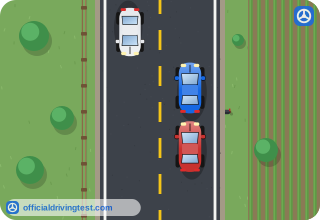
- On a quiet, empty side road where no other cars are around
- On the shoulder of a dark road far from other traffic
- In an area where there are other people, such as a convenience store
- In the left lane of the road
Show answer
Correct answer: In an area where there are other people, such as a convenience store
Pull over where other people are present, keep your doors locked, and at night use a well-lighted area.
Source: Oklahoma Driver Manual (2025 (updated November 24, 2025)), page 45 · Open this page in the manual (Manual page 45)