Oklahoma: Speed and following distance
Oklahoma’s basic speed rule and speed limits, stopping distances, braking on ice and in rain, and keeping a safe following distance. Split into 4 shorter tests so you're not stuck in one long quiz.
Independent educational site · not affiliated with any government agency or DMV
Choose a part
Speed and following distance — Part 1
Questions in this part include: “What does the Basic Speed Rule mean?”
StartSpeed and following distance — Part 2
Questions in this part include: “What does the manual say about speed limits that cities and towns set?”
StartSpeed and following distance — Part 3
Questions in this part include: “Using the estimated emergency stopping distances in the manual, what is the estimated braking distance at 50 mph?”
StartSpeed and following distance — Part 4
Questions in this part include: “What is a "cushion of safety" when you are driving?”
StartAll 68 Speed and following distance questions with answers
Choose a part above to take a practice test, or study every question and answer here.
Show the questions and answersHide the questions
-
What does the Basic Speed Rule mean?
- The speed you may drive is limited by the current conditions
- You may always drive at the posted speed limit if it is under 65 mph
- You must drive at an exact speed set for each type of road
- The speed you may drive is set by the fastest car near you
Show answer
Correct answer: The speed you may drive is limited by the current conditions
The rule sets no exact limit. The speed you may drive depends on the conditions at that moment.
Source: Oklahoma Driver Manual (2025 (updated November 24, 2025)), page 40 · Open this page in the manual (Manual page 40)
-
The posted speed limit is 65 mph and you are driving at night on a two-lane state highway in very foggy conditions. What does the Basic Speed Rule say about driving 65 mph?
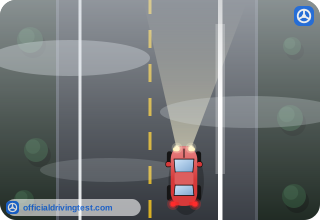
- It is acceptable because it is not above the posted limit
- It is too slow for those conditions
- It is too fast for those conditions
- It is required, so you do not block other vehicles
Show answer
Correct answer: It is too fast for those conditions
Fog, rain or darkness can make even the posted limit too fast, so you must slow down for the conditions.
Source: Oklahoma Driver Manual (2025 (updated November 24, 2025)), page 40 · Open this page in the manual (Manual page 40)
-
Under the Basic Speed Rule, your speed must be "careful and prudent." What does that mean?
- Driving exactly at the posted limit
- Using skill and good judgment
- Driving a little under the speed of other cars
- Driving as fast as the road allows
Show answer
Correct answer: Using skill and good judgment
Careful and prudent means choosing your speed with skill and good judgment.
Source: Oklahoma Driver Manual (2025 (updated November 24, 2025)), page 40 · Open this page in the manual (Manual page 40)
-
Under the Basic Speed Rule, your speed must be "reasonable and proper" for the conditions. How is this described?
- Always at or above the posted limit
- Always below the posted limit
- Always matching the car ahead of you
- Not too fast and not too slow
Show answer
Correct answer: Not too fast and not too slow
Reasonable and proper speed is neither too fast nor too slow for the conditions.
Source: Oklahoma Driver Manual (2025 (updated November 24, 2025)), page 40 · Open this page in the manual (Manual page 40)
-
Which of these conditions does the Basic Speed Rule say your speed must be reasonable for?
- The model year of your vehicle and the price you originally paid for it
- The kind of fuel your vehicle uses and its total mileage so far
- Whether pedestrians are present, especially children in school zones
- The brand of tires on your vehicle and when they were bought
Show answer
Correct answer: Whether pedestrians are present, especially children in school zones
The conditions include the amount and speed of traffic, pedestrians (especially children in school zones), the road, visibility, weather and your own ability.
Source: Oklahoma Driver Manual (2025 (updated November 24, 2025)), page 40 · Open this page in the manual (Manual page 40)
-
In the Basic Speed Rule, what does the condition "visibility" mean?
- How far ahead you can see clearly
- How brightly your headlights shine
- How clean your windshield is
- How far the car ahead is from you
Show answer
Correct answer: How far ahead you can see clearly
Visibility is how far ahead you can see clearly.
Source: Oklahoma Driver Manual (2025 (updated November 24, 2025)), page 40 · Open this page in the manual (Manual page 40)
-
What does the Basic Speed Rule say about driving too slowly?
- Slow driving is never a problem as long as you stay below the posted speed limit
- Slow driving is allowed in any lane of any road if your headlights are on
- Slow driving is only a problem on freeways and turnpikes with high limits
- You must not drive so slowly that you block or hinder vehicles moving at normal speeds
Show answer
Correct answer: You must not drive so slowly that you block or hinder vehicles moving at normal speeds
Driving so slowly that you block, hinder or interfere with vehicles moving at normal speeds violates the rule.
Source: Oklahoma Driver Manual (2025 (updated November 24, 2025)), page 40 · Open this page in the manual (Manual page 40)
-
The law says no person shall drive at a speed greater than will permit him to stop within what distance?
- The next intersection
- The assured clear distance ahead
- The length of one city block
- Two car lengths
Show answer
Correct answer: The assured clear distance ahead
The law requires a speed that lets you stop within the assured clear distance ahead.
Source: Oklahoma Driver Manual (2025 (updated November 24, 2025)), page 40 · Open this page in the manual (Manual page 40)
-
You are driving within the posted speed limit in downtown traffic and cannot stop in time when the car ahead stops suddenly. What are you doing?
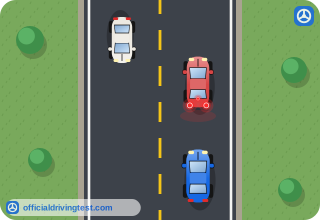
- Breaking the Basic Speed Rule or following too closely
- Nothing wrong, because you stayed within the posted limit
- Breaking the minimum speed law
- Driving too slowly for the conditions
Show answer
Correct answer: Breaking the Basic Speed Rule or following too closely
Being within the posted limit does not excuse failing to stop; it means your speed was unsafe for conditions or you followed too closely.
Source: Oklahoma Driver Manual (2025 (updated November 24, 2025)), page 40 · Open this page in the manual (Manual page 40)
-
Outside school and construction zones, what is the most you may be fined on a speeding conviction?
- $250.00
- $500.00
- $654.00
- $1,000.00
Show answer
Correct answer: $654.00
The manual states a speeding conviction may bring a fine of up to $654.00.
Source: Oklahoma Driver Manual (2025 (updated November 24, 2025)), page 40 · Open this page in the manual (Manual page 40)
-
Upon conviction of speeding, how long a jail sentence may you receive?
- 10 days
- 30 days
- 6 months
- 1 year
Show answer
Correct answer: 30 days
A speeding conviction may carry up to 30 days in jail.
Source: Oklahoma Driver Manual (2025 (updated November 24, 2025)), page 40 · Open this page in the manual (Manual page 40)
-
What happens to speeding fines in school and construction zones when workers or equipment are present?
- They are cut in half
- They stay the same
- They triple
- They double
Show answer
Correct answer: They double
Speeding fines double in school and construction zones when workers or equipment are present.
Source: Oklahoma Driver Manual (2025 (updated November 24, 2025)), page 40 · Open this page in the manual (Manual page 40)
-
Unless otherwise posted, what speed may you drive on controlled access highways under state law and normal conditions?
- 60 mph
- 65 mph
- 75 mph
- 70 mph
Show answer
Correct answer: 75 mph
The state speed limits list 75 mph for controlled access highways unless a different limit is posted.
Source: Oklahoma Driver Manual (2025 (updated November 24, 2025)), page 41 · Open this page in the manual (Manual page 41)
-
Unless otherwise posted, what is the state speed limit on undivided state highways?
- 65 mph
- 45 mph
- 55 mph
- 70 mph
Show answer
Correct answer: 65 mph
The state speed limits set 65 mph for undivided state highways unless otherwise posted.
Source: Oklahoma Driver Manual (2025 (updated November 24, 2025)), page 41 · Open this page in the manual (Manual page 41)
-
Unless otherwise posted, what is the state speed limit on county roads?
- 40 mph
- 45 mph
- 65 mph
- 55 mph
Show answer
Correct answer: 55 mph
The state speed limits set 55 mph for county roads unless otherwise posted.
Source: Oklahoma Driver Manual (2025 (updated November 24, 2025)), page 41 · Open this page in the manual (Manual page 41)
-
Unless otherwise posted, what is the state speed limit on highways within state parks or wildlife refuges?
- 15 mph
- 35 mph
- 25 mph
- 45 mph
Show answer
Correct answer: 35 mph
The state speed limits set 35 mph for highways in state parks and wildlife refuges.
Source: Oklahoma Driver Manual (2025 (updated November 24, 2025)), page 41 · Open this page in the manual (Manual page 41)
-
Unless otherwise posted, what is the state speed limit in a properly marked school zone on a highway outside of a municipality?
- 25 mph
- 15 mph
- 20 mph
- 35 mph
Show answer
Correct answer: 25 mph
The state speed limits set 25 mph for properly marked school zones on highways outside a municipality.
Source: Oklahoma Driver Manual (2025 (updated November 24, 2025)), page 41 · Open this page in the manual (Manual page 41)
-
What does the manual say about speed limits that cities and towns set?
- Only counties can change the speed limits set by the state
- Cities and towns must always use the state speed limits
- Under state law, cities and towns can set their own speed limits
- Cities and towns may set limits only inside school zones
Show answer
Correct answer: Under state law, cities and towns can set their own speed limits
State law lets cities and towns set their own limits, so you must watch for posted signs.
Source: Oklahoma Driver Manual (2025 (updated November 24, 2025)), page 41 · Open this page in the manual (Manual page 41)
-
Where does the manual tell you to watch carefully for speed limit signs because city and town limits change according to the zones?
- Only in school zones
- In business, residential and school zones
- Only on highways outside of cities
- Only where construction crews are working
Show answer
Correct answer: In business, residential and school zones
Limits change by zone, so you must watch for and obey signs in business, residential and school zones.
Source: Oklahoma Driver Manual (2025 (updated November 24, 2025)), page 41 · Open this page in the manual (Manual page 41)
-
Why is night driving especially dangerous on poorly lit highways and country roads?
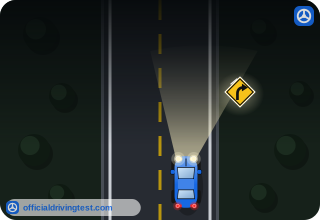
- Other drivers are required to drive slower at night
- Headlights make the road surface slippery
- The distance that you can see clearly is greatly reduced
- Road signs are not allowed to be reflective
Show answer
Correct answer: The distance that you can see clearly is greatly reduced
At night you can see far less clearly, so hazards appear later.
Source: Oklahoma Driver Manual (2025 (updated November 24, 2025)), page 41 · Open this page in the manual (Manual page 41)
-
Which of these is hard to see when driving at night?
- People walking or riding bikes dressed in dark clothing
- Vehicles that have their headlights turned on low beam
- Road signs with reflective lettering and bright colors
- People wearing bright orange safety vests at the roadside
Show answer
Correct answer: People walking or riding bikes dressed in dark clothing
Dark-colored animals, dark objects on the road and people in dark clothing are hard to see at night.
Source: Oklahoma Driver Manual (2025 (updated November 24, 2025)), page 41 · Open this page in the manual (Manual page 41)
-
What does "overdriving your lights" at night mean you cannot do?
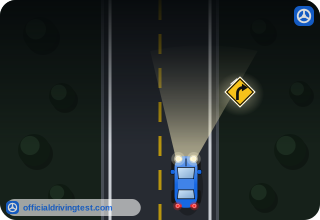
- Turn on your high beams in time
- Keep up with the flow of traffic
- See the lane lines clearly
- Stop within the distance you can see
Show answer
Correct answer: Stop within the distance you can see
If you drive too fast for your lights, you cannot stop within the distance they let you see.
Source: Oklahoma Driver Manual (2025 (updated November 24, 2025)), page 41 · Open this page in the manual (Manual page 41)
-
When adjusting your speed at night, which two things should you consider?
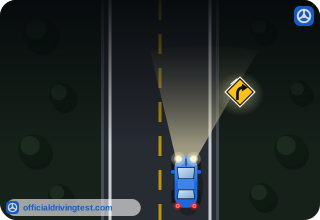
- How old your tires are and how much fuel you have in the tank
- How powerful your lights are and how responsive your brakes are
- How wide the road is and how many lanes it has in each direction
- How heavy your car is and how long your trip will take today
Show answer
Correct answer: How powerful your lights are and how responsive your brakes are
The manual says to consider the power of your lights and the responsiveness of your brakes.
Source: Oklahoma Driver Manual (2025 (updated November 24, 2025)), page 41 · Open this page in the manual (Manual page 41)
-
What does the manual say about wearing sunglasses or colored glasses when driving at night or on dark days?
- Don't wear them
- Wear them only to cut glare from oncoming headlights
- Wear them only on poorly lit country roads
- Wear them to help your eyes adjust faster
Show answer
Correct answer: Don't wear them
The manual says not to wear sunglasses or colored glasses at night or on dark days.
Source: Oklahoma Driver Manual (2025 (updated November 24, 2025)), page 41 · Open this page in the manual (Manual page 41)
-
How do colored lenses affect your eyes when you drive at night?
- They cause your eyes to adjust faster to the glare of oncoming headlights
- They completely remove the glare from street lights and billboards
- They cause your eyes to adjust even more slowly and can reduce your vision
- They make dark objects and animals on the road easier to see
Show answer
Correct answer: They cause your eyes to adjust even more slowly and can reduce your vision
Colored lenses slow the eyes down even more in adjusting to changes in light and can reduce vision.
Source: Oklahoma Driver Manual (2025 (updated November 24, 2025)), page 41 · Open this page in the manual (Manual page 41)
-
Which of these can interfere with your night driving vision because your eyes take longer to adjust?
- Reflective paint on the lane lines and on the road signs ahead
- Glare from oncoming headlights and billboard and advertising lights
- The warning lights and gauges on your own dashboard at night
- Your own headlights when they are set on the low beam position
Show answer
Correct answer: Glare from oncoming headlights and billboard and advertising lights
Glare from oncoming headlights, billboards and advertising lights and sometimes street lights makes your eyes slower to adjust.
Source: Oklahoma Driver Manual (2025 (updated November 24, 2025)), page 41 · Open this page in the manual (Manual page 41)
-
Which of these does your stopping distance depend on?
- The weight of your vehicle
- The color of your vehicle
- The type of fuel your vehicle uses
- The number of lanes on the road
Show answer
Correct answer: The weight of your vehicle
Stopping distance depends on your reaction time, weather and road conditions, the weight of your vehicle and the condition of your brakes.
Source: Oklahoma Driver Manual (2025 (updated November 24, 2025)), page 42 · Open this page in the manual (Manual page 42)
-
What are the three steps in stopping your vehicle?
- Perception, signaling and braking
- Observation, steering and braking
- Perception, reaction and braking
- Reaction, signaling and parking
Show answer
Correct answer: Perception, reaction and braking
Stopping takes three steps: perception, reaction and braking.
Source: Oklahoma Driver Manual (2025 (updated November 24, 2025)), page 42 · Open this page in the manual (Manual page 42)
-
About how long does the perception step of stopping take?
- About 1 second
- About .5 seconds
- About 1.5 seconds
- About 2 seconds
Show answer
Correct answer: About .5 seconds
The manual gives perception, when you see or hear danger, as about .5 seconds.
Source: Oklahoma Driver Manual (2025 (updated November 24, 2025)), page 42 · Open this page in the manual (Manual page 42)
-
About how long does the reaction step of stopping take?
- About .25 seconds
- About 1 second
- About 2 seconds
- About .66 seconds
Show answer
Correct answer: About .66 seconds
The manual gives reaction, when your brain tells your foot to brake, as about .66 seconds.
Source: Oklahoma Driver Manual (2025 (updated November 24, 2025)), page 42 · Open this page in the manual (Manual page 42)
-
In the stopping process, which step is when your brain tells your foot to brake?
- Perception
- Braking
- Reaction
- Skidding
Show answer
Correct answer: Reaction
Reaction is the step in which the brain tells the foot to brake; perception is seeing or hearing the danger.
Source: Oklahoma Driver Manual (2025 (updated November 24, 2025)), page 42 · Open this page in the manual (Manual page 42)
-
How long does the braking step of stopping take?
- It depends on speed
- About 1 second at any speed
- About 1.5 seconds at any speed
- About 2 seconds at any speed
Show answer
Correct answer: It depends on speed
The braking time depends on speed, while perception and reaction are about .5 and .66 seconds.
Source: Oklahoma Driver Manual (2025 (updated November 24, 2025)), page 42 · Open this page in the manual (Manual page 42)
-
Using the estimated emergency stopping distances in the manual, how many feet does the driver travel during reaction time at 30 mph?
- 44 feet
- 88 feet
- 110 feet
- 66 feet
Show answer
Correct answer: 66 feet
The estimated driver reaction distance is 66 feet at 30 mph.
Source: Oklahoma Driver Manual (2025 (updated November 24, 2025)), page 42 · Open this page in the manual (Manual page 42)
-
Using the estimated emergency stopping distances in the manual, how many feet does the driver travel during reaction time at 70 mph?
- 110 feet
- 154 feet
- 132 feet
- 176 feet
Show answer
Correct answer: 154 feet
The estimated driver reaction distance is 154 feet at 70 mph.
Source: Oklahoma Driver Manual (2025 (updated November 24, 2025)), page 42 · Open this page in the manual (Manual page 42)
-
Using the estimated emergency stopping distances in the manual, what is the estimated braking distance at 50 mph?
- 83 - 167 feet
- 53 - 107 feet
- 120 - 240 feet
- 163 - 327 feet
Show answer
Correct answer: 83 - 167 feet
The estimated braking distance is 83 to 167 feet at 50 mph.
Source: Oklahoma Driver Manual (2025 (updated November 24, 2025)), page 42 · Open this page in the manual (Manual page 42)
-
Using the estimated emergency stopping distances in the manual, what is the estimated total stopping distance at 60 mph?
- 193 - 277 feet
- 317 - 481 feet
- 252 - 372 feet
- 389 - 603 feet
Show answer
Correct answer: 252 - 372 feet
The estimated total stopping distance is 252 to 372 feet at 60 mph.
Source: Oklahoma Driver Manual (2025 (updated November 24, 2025)), page 42 · Open this page in the manual (Manual page 42)
-
Which of these is a time when you should always increase your following distance?
- On a dry road in clear weather
- On slick roads or in fog
- When traffic is light in daylight
- When driving under 20 mph
Show answer
Correct answer: On slick roads or in fog
The manual says to always increase your distance on slick roads, behind large vehicles and motorcycles, at night and in fog or bad weather.
Source: Oklahoma Driver Manual (2025 (updated November 24, 2025)), page 42 · Open this page in the manual (Manual page 42)
-
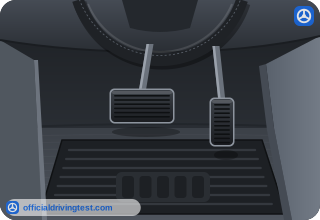
How should you apply your brakes?
- Quickly and firmly
- In short, hard bursts
- Only with the parking brake
- Slowly and evenly
Show answer
Correct answer: Slowly and evenly
The manual says to apply your brakes slowly and evenly.
Source: Oklahoma Driver Manual (2025 (updated November 24, 2025)), page 43 · Open this page in the manual (Manual page 43)
-
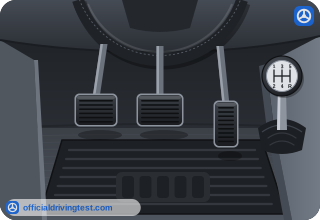
With a standard transmission approaching a stop sign or signal, what should you do first if you want to use your gearshift to slow down?
- Turn on your hazard lights for the car behind you
- Tap the horn twice to warn the car behind you
- Flash your brake lights to signal the car behind you
- Release the clutch and coast to a stop
Show answer
Correct answer: Flash your brake lights to signal the car behind you
You first flash your brake lights to warn the car behind, then shift down to a lower gear.
Source: Oklahoma Driver Manual (2025 (updated November 24, 2025)), page 43 · Open this page in the manual (Manual page 43)
-
What is "black ice"?
- A layer of snow packed into dark wheel ruts
- Ice that forms only on roads that are made of dark asphalt
- A clear icy coating on the road surface that you cannot see
- Frost that forms on the inside of the windshield
Show answer
Correct answer: A clear icy coating on the road surface that you cannot see
Black ice is a clear icy coating on the road that is hard to see, so drivers must be extremely careful.
Source: Oklahoma Driver Manual (2025 (updated November 24, 2025)), page 43 · Open this page in the manual (Manual page 43)
-
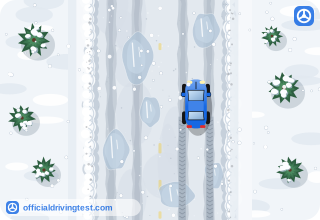
How can you find out how much traction you have on an icy road?
- Accelerate quickly to see whether the wheels spin
- Brake as hard as you can for a moment
- Watch how far the cars ahead slide
- Test your brakes gently after the car is in motion
Show answer
Correct answer: Test your brakes gently after the car is in motion
The manual says to test your brakes gently once the car is moving to learn how much traction you have.
Source: Oklahoma Driver Manual (2025 (updated November 24, 2025)), page 43 · Open this page in the manual (Manual page 43)
-
Which places does the manual name as danger spots to watch for black ice?
- On roads near rivers and lakes
- On bridges and in shady areas
- On freshly paved roads
- At toll booths and rest areas
Show answer
Correct answer: On bridges and in shady areas
Even on seemingly clear roads, danger spots such as bridges and shady areas may have black ice.
Source: Oklahoma Driver Manual (2025 (updated November 24, 2025)), page 43 · Open this page in the manual (Manual page 43)
-
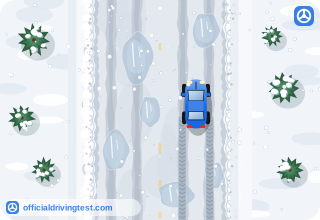
What is the manual's best advice for driving on icy roads?
- Drive in a low gear and keep to the center of the road
- Drive at half the posted speed limit
- Follow a plow or a truck closely
- Don't drive on them, and ask whether the trip is worth the risk
Show answer
Correct answer: Don't drive on them, and ask whether the trip is worth the risk
The best advice is simply not to drive on icy roads; ask yourself if the trip is worth the risk.
Source: Oklahoma Driver Manual (2025 (updated November 24, 2025)), page 43 · Open this page in the manual (Manual page 43)
-
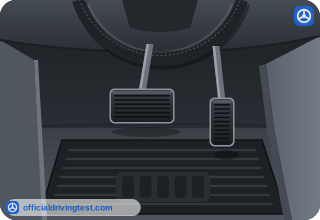
With standard brakes, when does maximum braking come?
- Right after the wheels lock
- As soon as you touch the brake pedal
- Just before the wheels lock and stop rotating
- When the pedal is pressed all the way to the floor
Show answer
Correct answer: Just before the wheels lock and stop rotating
Maximum braking is just before the wheels lock; too much pressure locks them and the vehicle skids.
Source: Oklahoma Driver Manual (2025 (updated November 24, 2025)), page 43 · Open this page in the manual (Manual page 43)
-
If your car has an antilock brake system (ABS), where does the manual tell you to read the instructions on maximum braking?
- In the owner's manual
- On the dashboard warning light
- In a Service Oklahoma notice
- On the back of the brake pedal
Show answer
Correct answer: In the owner's manual
The manual says braking techniques for ABS differ and sends you to the owner's manual for maximum braking instructions.
Source: Oklahoma Driver Manual (2025 (updated November 24, 2025)), page 43 · Open this page in the manual (Manual page 43)
-
When are roads likely to be very slick during rain?
- After several hours of steady rain
- Only during a heavy downpour
- Just after the rain stops
- Just after it begins to rain or drizzle
Show answer
Correct answer: Just after it begins to rain or drizzle
The first few drops loosen built-up grease and dirt and make a slippery film on the road.
Source: Oklahoma Driver Manual (2025 (updated November 24, 2025)), page 44 · Open this page in the manual (Manual page 44)
-
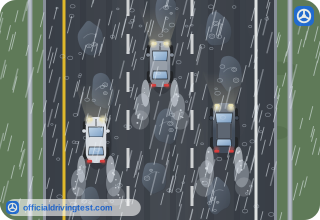
What does hydroplaning mean?
- Your tires grip the wet road harder because of the film of water
- Your tires lose contact with the road surface and ride on a film of water
- Your brakes lock up because water gets into the brake lines of the car
- Your engine stalls because water gets into the engine on a wet road
Show answer
Correct answer: Your tires lose contact with the road surface and ride on a film of water
In hydroplaning, the tires ride on a film of water instead of touching the road.
Source: Oklahoma Driver Manual (2025 (updated November 24, 2025)), page 44 · Open this page in the manual (Manual page 44)
-
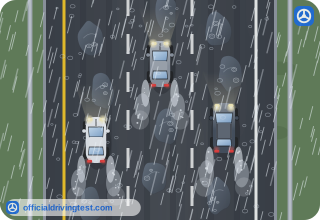
As long as the road surface is wet, what should you do to avoid hydroplaning?
- Slow down
- Brake firmly and often
- Speed up to stay on top of the water
- Shift into neutral
Show answer
Correct answer: Slow down
You should slow down while the road is wet to avoid hydroplaning.
Source: Oklahoma Driver Manual (2025 (updated November 24, 2025)), page 44 · Open this page in the manual (Manual page 44)
-
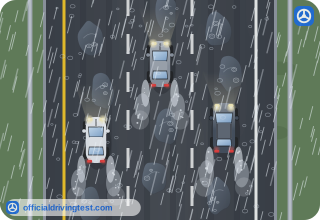
How does hydroplaning affect traction and stopping distance?
- It increases traction and shortens stopping distance
- It reduces traction but shortens stopping distance
- It reduces traction and increases stopping distance
- It has no effect on traction but increases stopping distance
Show answer
Correct answer: It reduces traction and increases stopping distance
Hydroplaning reduces traction and increases stopping distance, and turning becomes more hazardous.
Source: Oklahoma Driver Manual (2025 (updated November 24, 2025)), page 44 · Open this page in the manual (Manual page 44)
-
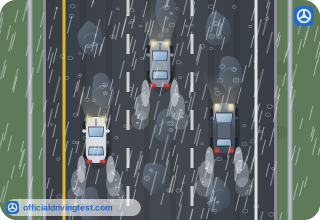
Which tires can hydroplane even at reduced speeds?
- Only snow tires
- Wide tires
- Only studded tires
- Only worn spare tires
Show answer
Correct answer: Wide tires
The manual notes that wide tires can hydroplane even at reduced speeds.
Source: Oklahoma Driver Manual (2025 (updated November 24, 2025)), page 44 · Open this page in the manual (Manual page 44)
-
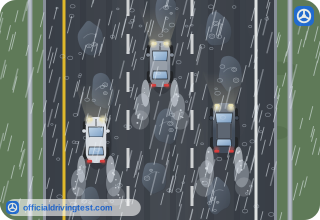
What should you do in a heavy downpour?
- Speed up to get out of the storm
- Keep your speed and turn on your high beams
- Stop in the middle of your lane
- Slow down or pull off the road
Show answer
Correct answer: Slow down or pull off the road
In a heavy downpour the manual says to slow down or pull off the road.
Source: Oklahoma Driver Manual (2025 (updated November 24, 2025)), page 44 · Open this page in the manual (Manual page 44)
-
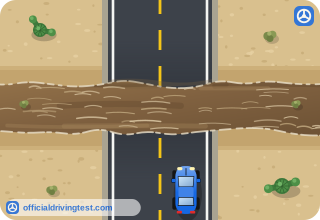
Why should you never drive into water crossing the roadway?
- Water can wash the paint and the protective wax off your vehicle
- Wet brakes can never dry out again and will stop working for good
- You can't judge the depth of the water or the force and pull of the flow
- The road under the water is always too slippery for any tires
Show answer
Correct answer: You can't judge the depth of the water or the force and pull of the flow
You cannot tell how deep the water is or how strong the current is.
Source: Oklahoma Driver Manual (2025 (updated November 24, 2025)), page 44 · Open this page in the manual (Manual page 44)
-
What is a "cushion of safety" when you are driving?
- Having open space in front, behind and on the sides of your vehicle
- Driving 10 mph below the posted limit whenever there is traffic
- Keeping open space only on the side next to other cars on the road
- Staying in the right-hand lane of the road at all times of day
Show answer
Correct answer: Having open space in front, behind and on the sides of your vehicle
A cushion of safety is open space around your vehicle on all sides.
Source: Oklahoma Driver Manual (2025 (updated November 24, 2025)), page 44 · Open this page in the manual (Manual page 44)
-
How far behind the next vehicle should you stay?
- Close enough that other drivers cannot cut in front of you
- Exactly two car lengths behind the vehicle at any speed
- Only one car length behind the vehicle at any speed
- Far enough that you can stop safely if it should stop suddenly
Show answer
Correct answer: Far enough that you can stop safely if it should stop suddenly
Stay far enough back to stop safely if the vehicle ahead stops suddenly.
Source: Oklahoma Driver Manual (2025 (updated November 24, 2025)), page 44 · Open this page in the manual (Manual page 44)
-
What is one way the manual says to set your following distance by car lengths?
- Allow one car length for every 5 miles per hour of speed
- Allow one car length for every 10 miles per hour of speed
- Allow two car lengths for every 10 miles per hour of speed
- Allow one car length for every 20 miles per hour of speed
Show answer
Correct answer: Allow one car length for every 10 miles per hour of speed
The manual says to allow one car length for every 10 mph of speed.
Source: Oklahoma Driver Manual (2025 (updated November 24, 2025)), page 44 · Open this page in the manual (Manual page 44)
-
When cars bunch up and travel in a pack, what is much safer?
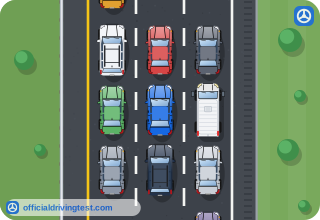
- Avoiding the pack and keeping your cushion of safety
- Staying in the middle of the pack to be protected
- Closing the gap so that no other car can cut in
- Speeding up to pass the whole pack all at once
Show answer
Correct answer: Avoiding the pack and keeping your cushion of safety
It is much safer to stay out of the pack and keep your cushion of safety.
Source: Oklahoma Driver Manual (2025 (updated November 24, 2025)), page 44 · Open this page in the manual (Manual page 44)
-
In a caravan or motorcade outside of a business or residential area, how much space should you leave between each vehicle?
- At least 50 feet
- At least 100 feet
- At least 200 feet
- At least 400 feet
Show answer
Correct answer: At least 200 feet
The manual says to leave at least 200 feet so other cars or trucks can enter the line safely.
Source: Oklahoma Driver Manual (2025 (updated November 24, 2025)), page 44 · Open this page in the manual (Manual page 44)
-
Why do trucks usually take longer to stop than cars?
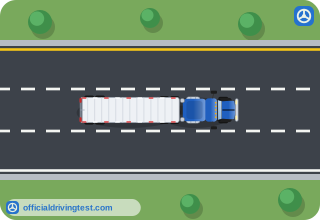
- Because they have no brakes on the front wheels
- Because of their size
- Because they always travel faster than cars
- Because they are allowed to follow closely
Show answer
Correct answer: Because of their size
Trucks take longer to stop than cars because of their size.
Source: Oklahoma Driver Manual (2025 (updated November 24, 2025)), page 44 · Open this page in the manual (Manual page 44)
-
Under what conditions may a truck be able to stop more quickly than a car?
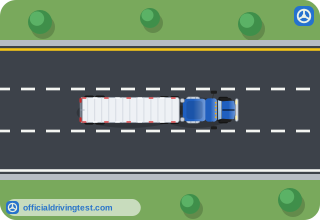
- At lower speeds or on dry pavement
- When it is carrying a heavy load on ice
- When it is going downhill at night
- At higher speeds or on wet pavement
Show answer
Correct answer: At higher speeds or on wet pavement
The manual says trucks may have better traction at higher speeds or on wet pavement and stop more quickly than a car.
Source: Oklahoma Driver Manual (2025 (updated November 24, 2025)), page 44 · Open this page in the manual (Manual page 44)
-
How far ahead should you watch for brake lights when following another car?
- Only the car directly ahead of you
- Two cars down the line
- Four or five cars down the line
- Ten cars down the line
Show answer
Correct answer: Four or five cars down the line
Watching four or five cars ahead increases your response time.
Source: Oklahoma Driver Manual (2025 (updated November 24, 2025)), page 45 · Open this page in the manual (Manual page 45)
-
What should you do as soon as you see brake lights go on ahead?
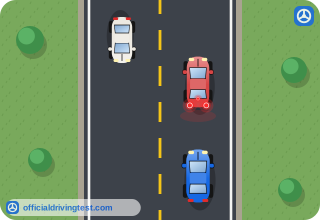
- Shift your foot to the brake pedal
- Move into the next lane right away
- Flash your headlights at the car
- Sound your horn to warn them
Show answer
Correct answer: Shift your foot to the brake pedal
Moving your foot to the brake pedal right away lets you stop if needed.
Source: Oklahoma Driver Manual (2025 (updated November 24, 2025)), page 45 · Open this page in the manual (Manual page 45)
-
What is a sure sign of danger when following another vehicle?
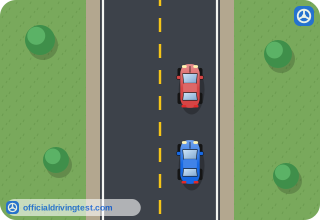
- Growing distance between your car and the one ahead
- A vehicle passing you in the next lane
- Brake lights on a car in the opposite lane
- Shrinking distance between your car and the one ahead
Show answer
Correct answer: Shrinking distance between your car and the one ahead
The manual calls a shrinking distance between your car and the one ahead a sure sign of danger.
Source: Oklahoma Driver Manual (2025 (updated November 24, 2025)), page 45 · Open this page in the manual (Manual page 45)
-
How can you tell whether a car in the distance ahead is moving or stopped?
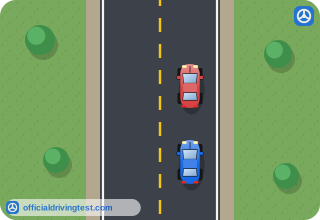
- Watch its brake lights only
- Compare it to a fixed object
- Sound your horn to see if it moves
- Move onto the shoulder to look
Show answer
Correct answer: Compare it to a fixed object
The manual says to compare the car in question to a fixed object.
Source: Oklahoma Driver Manual (2025 (updated November 24, 2025)), page 45 · Open this page in the manual (Manual page 45)
-
Why should you look for problems that might develop for the driver ahead of you?
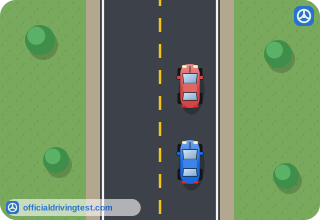
- So you have more time to react
- So you can pass that driver sooner
- So you can follow more closely
- So you can avoid using your brakes
Show answer
Correct answer: So you have more time to react
Spotting problems ahead gives you more time to react.
Source: Oklahoma Driver Manual (2025 (updated November 24, 2025)), page 45 · Open this page in the manual (Manual page 45)
-
The car ahead of you signals for a left turn. What should you do?
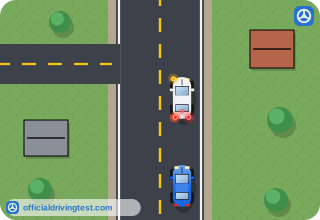
- Flash your headlights to hurry it
- Sound your horn so it turns sooner
- Slow down and prepare to stop
- Stay close behind it
Show answer
Correct answer: Slow down and prepare to stop
The manual says to slow down and prepare to stop, so you avoid being hit from behind.
Source: Oklahoma Driver Manual (2025 (updated November 24, 2025)), page 45 · Open this page in the manual (Manual page 45)
-
If someone is following you too closely, what should you do if braking will not cause a collision?
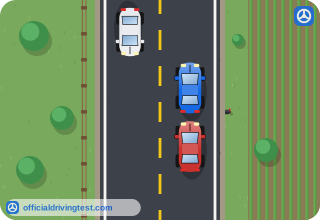
- Brake hard to teach the driver a lesson
- Flash your brake lights
- Speed up to pull away
- Turn on your hazard lights and stop
Show answer
Correct answer: Flash your brake lights
You may flash your brake lights if braking will not cause a collision, to warn the driver behind.
Source: Oklahoma Driver Manual (2025 (updated November 24, 2025)), page 45 · Open this page in the manual (Manual page 45)
-
Which tactic does the manual list for dealing with a tailgater?
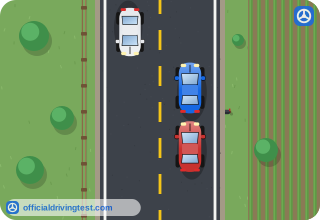
- Speed up to put distance between you and the driver
- Move to the center of the road to block the driver
- Brake suddenly so the driver learns to back off
- Slow down and encourage the driver behind you to pass
Show answer
Correct answer: Slow down and encourage the driver behind you to pass
The manual says to slow down and encourage the driver behind you to pass.
Source: Oklahoma Driver Manual (2025 (updated November 24, 2025)), page 45 · Open this page in the manual (Manual page 45)
-
If tactics fail with a tailgater, where is it best to stop and let the driver pass?
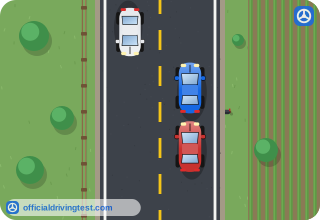
- On a quiet, empty side road where no other cars are around
- On the shoulder of a dark road far from other traffic
- In an area where there are other people, such as a convenience store
- In the left lane of the road
Show answer
Correct answer: In an area where there are other people, such as a convenience store
Pull over where other people are present, keep your doors locked, and at night use a well-lighted area.
Source: Oklahoma Driver Manual (2025 (updated November 24, 2025)), page 45 · Open this page in the manual (Manual page 45)