Oklahoma: Speed and following distance — Part 3 Practice Test
Questions in this part include: “Using the estimated emergency stopping distances in the manual, what is the estimated braking distance at 50 mph?” · “What is "black ice"?”
Independent educational site · not affiliated with any government agency or DMV
Ready? Test yourself
- Instant feedback with an explanation
- Every answer cites its source in the manual
- Your best score is saved on this device
- Keyboard: press 1 to 4 to answer and Enter for the next question
Questions are original and based on the official manual "Oklahoma Driver Manual" (2025 (updated November 24, 2025)), Service Oklahoma.
All 17 questions in this practice test
Take the test above first, then use this list to study. Tap “Show answer” to see the correct answer and explanation.
Show the questions and answersHide the questions
-
Using the estimated emergency stopping distances in the manual, what is the estimated braking distance at 50 mph?
- 83 - 167 feet
- 53 - 107 feet
- 120 - 240 feet
- 163 - 327 feet
Show answer
Correct answer: 83 - 167 feet
The estimated braking distance is 83 to 167 feet at 50 mph.
Source: Oklahoma Driver Manual (2025 (updated November 24, 2025)), page 42 · Open this page in the manual (Manual page 42)
-
Using the estimated emergency stopping distances in the manual, what is the estimated total stopping distance at 60 mph?
- 193 - 277 feet
- 317 - 481 feet
- 252 - 372 feet
- 389 - 603 feet
Show answer
Correct answer: 252 - 372 feet
The estimated total stopping distance is 252 to 372 feet at 60 mph.
Source: Oklahoma Driver Manual (2025 (updated November 24, 2025)), page 42 · Open this page in the manual (Manual page 42)
-
Which of these is a time when you should always increase your following distance?
- On a dry road in clear weather
- On slick roads or in fog
- When traffic is light in daylight
- When driving under 20 mph
Show answer
Correct answer: On slick roads or in fog
The manual says to always increase your distance on slick roads, behind large vehicles and motorcycles, at night and in fog or bad weather.
Source: Oklahoma Driver Manual (2025 (updated November 24, 2025)), page 42 · Open this page in the manual (Manual page 42)
-
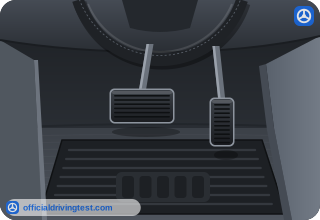
How should you apply your brakes?
- Quickly and firmly
- In short, hard bursts
- Only with the parking brake
- Slowly and evenly
Show answer
Correct answer: Slowly and evenly
The manual says to apply your brakes slowly and evenly.
Source: Oklahoma Driver Manual (2025 (updated November 24, 2025)), page 43 · Open this page in the manual (Manual page 43)
-
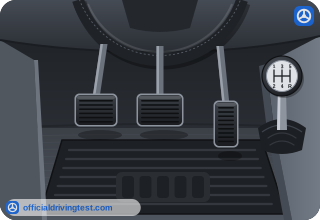
With a standard transmission approaching a stop sign or signal, what should you do first if you want to use your gearshift to slow down?
- Turn on your hazard lights for the car behind you
- Tap the horn twice to warn the car behind you
- Flash your brake lights to signal the car behind you
- Release the clutch and coast to a stop
Show answer
Correct answer: Flash your brake lights to signal the car behind you
You first flash your brake lights to warn the car behind, then shift down to a lower gear.
Source: Oklahoma Driver Manual (2025 (updated November 24, 2025)), page 43 · Open this page in the manual (Manual page 43)
-
What is "black ice"?
- A layer of snow packed into dark wheel ruts
- Ice that forms only on roads that are made of dark asphalt
- A clear icy coating on the road surface that you cannot see
- Frost that forms on the inside of the windshield
Show answer
Correct answer: A clear icy coating on the road surface that you cannot see
Black ice is a clear icy coating on the road that is hard to see, so drivers must be extremely careful.
Source: Oklahoma Driver Manual (2025 (updated November 24, 2025)), page 43 · Open this page in the manual (Manual page 43)
-
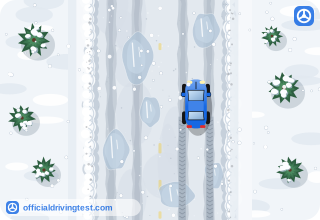
How can you find out how much traction you have on an icy road?
- Accelerate quickly to see whether the wheels spin
- Brake as hard as you can for a moment
- Watch how far the cars ahead slide
- Test your brakes gently after the car is in motion
Show answer
Correct answer: Test your brakes gently after the car is in motion
The manual says to test your brakes gently once the car is moving to learn how much traction you have.
Source: Oklahoma Driver Manual (2025 (updated November 24, 2025)), page 43 · Open this page in the manual (Manual page 43)
-
Which places does the manual name as danger spots to watch for black ice?
- On roads near rivers and lakes
- On bridges and in shady areas
- On freshly paved roads
- At toll booths and rest areas
Show answer
Correct answer: On bridges and in shady areas
Even on seemingly clear roads, danger spots such as bridges and shady areas may have black ice.
Source: Oklahoma Driver Manual (2025 (updated November 24, 2025)), page 43 · Open this page in the manual (Manual page 43)
-
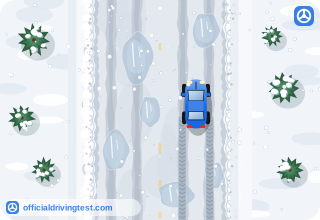
What is the manual's best advice for driving on icy roads?
- Drive in a low gear and keep to the center of the road
- Drive at half the posted speed limit
- Follow a plow or a truck closely
- Don't drive on them, and ask whether the trip is worth the risk
Show answer
Correct answer: Don't drive on them, and ask whether the trip is worth the risk
The best advice is simply not to drive on icy roads; ask yourself if the trip is worth the risk.
Source: Oklahoma Driver Manual (2025 (updated November 24, 2025)), page 43 · Open this page in the manual (Manual page 43)
-
With standard brakes, when does maximum braking come?
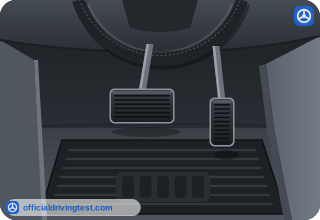
- Right after the wheels lock
- As soon as you touch the brake pedal
- Just before the wheels lock and stop rotating
- When the pedal is pressed all the way to the floor
Show answer
Correct answer: Just before the wheels lock and stop rotating
Maximum braking is just before the wheels lock; too much pressure locks them and the vehicle skids.
Source: Oklahoma Driver Manual (2025 (updated November 24, 2025)), page 43 · Open this page in the manual (Manual page 43)
-
If your car has an antilock brake system (ABS), where does the manual tell you to read the instructions on maximum braking?
- In the owner's manual
- On the dashboard warning light
- In a Service Oklahoma notice
- On the back of the brake pedal
Show answer
Correct answer: In the owner's manual
The manual says braking techniques for ABS differ and sends you to the owner's manual for maximum braking instructions.
Source: Oklahoma Driver Manual (2025 (updated November 24, 2025)), page 43 · Open this page in the manual (Manual page 43)
-
When are roads likely to be very slick during rain?
- After several hours of steady rain
- Only during a heavy downpour
- Just after the rain stops
- Just after it begins to rain or drizzle
Show answer
Correct answer: Just after it begins to rain or drizzle
The first few drops loosen built-up grease and dirt and make a slippery film on the road.
Source: Oklahoma Driver Manual (2025 (updated November 24, 2025)), page 44 · Open this page in the manual (Manual page 44)
-
What does hydroplaning mean?
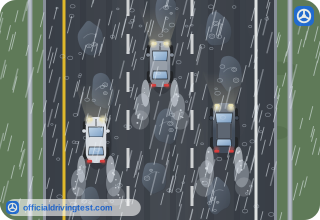
- Your tires grip the wet road harder because of the film of water
- Your tires lose contact with the road surface and ride on a film of water
- Your brakes lock up because water gets into the brake lines of the car
- Your engine stalls because water gets into the engine on a wet road
Show answer
Correct answer: Your tires lose contact with the road surface and ride on a film of water
In hydroplaning, the tires ride on a film of water instead of touching the road.
Source: Oklahoma Driver Manual (2025 (updated November 24, 2025)), page 44 · Open this page in the manual (Manual page 44)
-
As long as the road surface is wet, what should you do to avoid hydroplaning?
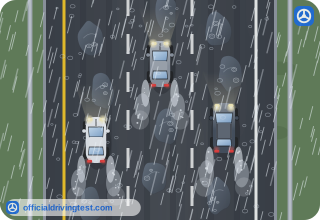
- Slow down
- Brake firmly and often
- Speed up to stay on top of the water
- Shift into neutral
Show answer
Correct answer: Slow down
You should slow down while the road is wet to avoid hydroplaning.
Source: Oklahoma Driver Manual (2025 (updated November 24, 2025)), page 44 · Open this page in the manual (Manual page 44)
-
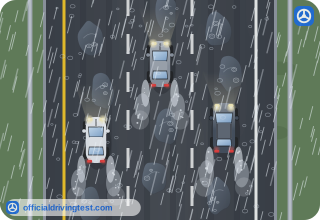
How does hydroplaning affect traction and stopping distance?
- It increases traction and shortens stopping distance
- It reduces traction but shortens stopping distance
- It reduces traction and increases stopping distance
- It has no effect on traction but increases stopping distance
Show answer
Correct answer: It reduces traction and increases stopping distance
Hydroplaning reduces traction and increases stopping distance, and turning becomes more hazardous.
Source: Oklahoma Driver Manual (2025 (updated November 24, 2025)), page 44 · Open this page in the manual (Manual page 44)
-
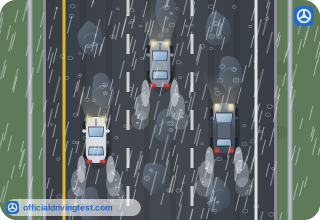
Which tires can hydroplane even at reduced speeds?
- Only snow tires
- Wide tires
- Only studded tires
- Only worn spare tires
Show answer
Correct answer: Wide tires
The manual notes that wide tires can hydroplane even at reduced speeds.
Source: Oklahoma Driver Manual (2025 (updated November 24, 2025)), page 44 · Open this page in the manual (Manual page 44)
-
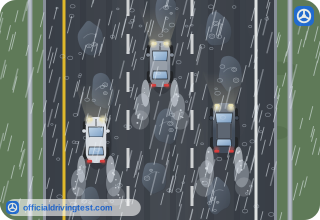
What should you do in a heavy downpour?
- Speed up to get out of the storm
- Keep your speed and turn on your high beams
- Stop in the middle of your lane
- Slow down or pull off the road
Show answer
Correct answer: Slow down or pull off the road
In a heavy downpour the manual says to slow down or pull off the road.
Source: Oklahoma Driver Manual (2025 (updated November 24, 2025)), page 44 · Open this page in the manual (Manual page 44)