North Dakota: Sharing the road — Part 2 Practice Test
Questions in this part include: “Which of these is described as a particularly dangerous situation around trucks?” · “Do motorcyclists have the same rights and responsibilities on public roadways as other drivers?”
Independent educational site · not affiliated with any government agency or DMV
Ready? Test yourself
- Instant feedback with an explanation
- Every answer cites its source in the manual
- Your best score is saved on this device
- Keyboard: press 1 to 4 to answer and Enter for the next question
Questions are original and based on the official manual "North Dakota Noncommercial Driver License Manual" (2025-2027), North Dakota Department of Transportation (NDDOT).
All 20 questions in this practice test
Take the test above first, then use this list to study. Tap “Show answer” to see the correct answer and explanation.
Show the questions and answersHide the questions
-
What does cutting into the open space in front of a truck remove?
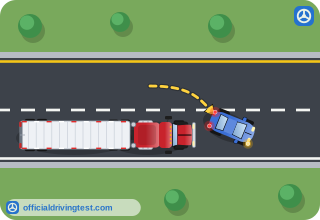
- The truck’s right of way
- The truck’s no-zone on the left side
- The truck driver’s cushion of safety
- The truck driver’s need to use mirrors
Show answer
Correct answer: The truck driver’s cushion of safety
The manual says cutting into the open space in front of a truck removes the truck driver’s cushion of safety.
Source: North Dakota Noncommercial Driver License Manual (2025-2027), page 32 · Open this page in the manual (Manual page 32)
-
Which of these is described as a particularly dangerous situation around trucks?
- Exiting the highway behind a truck
- Trying to beat a truck to a single-lane construction zone
- Passing a tractor-trailer completely on the left side
- Slowing down to leave extra space behind a truck
Show answer
Correct answer: Trying to beat a truck to a single-lane construction zone
The manual calls trying to beat a truck to a single-lane construction zone a particularly dangerous situation.
Source: North Dakota Noncommercial Driver License Manual (2025-2027), page 32 · Open this page in the manual (Manual page 32)
-
You need to reach your exit or turn and a truck is next to you. What does the manual advise?
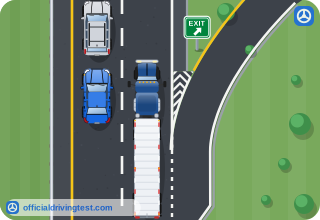
- Slow down and exit behind the truck
- Speed up and cut in front of the truck to make the exit
- Move into the truck’s blind spot and wait for an opening
- Sound your horn so the truck lets you in front
Show answer
Correct answer: Slow down and exit behind the truck
The manual says to take a moment to slow down and exit behind a truck rather than cut it off.
Source: North Dakota Noncommercial Driver License Manual (2025-2027), page 32 · Open this page in the manual (Manual page 32)
-
How should you pass a tractor-trailer?
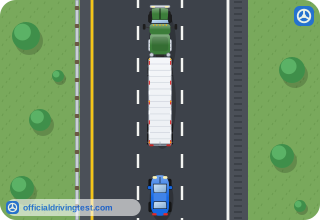
- Pass it on the right side to stay out of its mirrors
- Pass it slowly, staying beside the cab for a while
- Pass it completely, and always on the left side
- Pass it on whichever side has the most room
Show answer
Correct answer: Pass it completely, and always on the left side
The manual says to always pass a tractor-trailer completely and always on the left side, without lingering alongside.
Source: North Dakota Noncommercial Driver License Manual (2025-2027), page 32 · Open this page in the manual (Manual page 32)
-
If you linger beside a vehicle when passing, what does your position make impossible for a trucker?
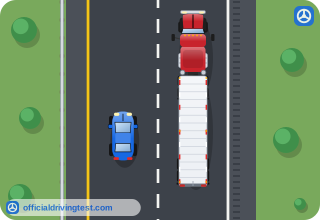
- Seeing the traffic signs along the road ahead
- Taking evasive action if an obstacle appears
- Using the truck’s turn signals and mirrors
- Changing to a different route toward the exit
Show answer
Correct answer: Taking evasive action if an obstacle appears
The manual says that if you linger when passing, the trucker cannot take evasive action if an obstacle appears ahead.
Source: North Dakota Noncommercial Driver License Manual (2025-2027), page 32 · Open this page in the manual (Manual page 32)
-
Why is tailgating a truck or car dangerous?
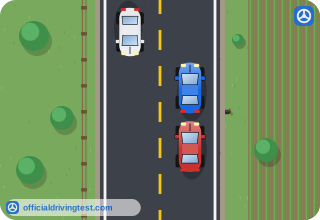
- The vehicle ahead is likely to speed up
- The vehicle ahead cannot use its brake lights
- You cannot see the lane markings behind it
- You take away your own cushion of safety
Show answer
Correct answer: You take away your own cushion of safety
The manual says tailgating removes your own cushion of safety if the vehicle in front stops short.
Source: North Dakota Noncommercial Driver License Manual (2025-2027), page 32 · Open this page in the manual (Manual page 32)
-
Because of its large size, how does a tractor-trailer often appear to be traveling?
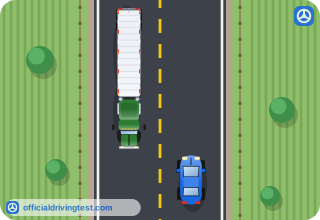
- At a faster speed than it really is
- At a slower speed than it really is
- At exactly its true speed
- At a speed that matches the cars around it
Show answer
Correct answer: At a slower speed than it really is
The manual warns that a tractor-trailer often appears to be going slower than it actually is, so never underestimate its size and speed.
Source: North Dakota Noncommercial Driver License Manual (2025-2027), page 32 · Open this page in the manual (Manual page 32)
-
Do motorcyclists have the same rights and responsibilities on public roadways as other drivers?
- No, they have rights but fewer responsibilities
- No, they must yield to every car
- Yes, they have the same rights and responsibilities
- No, they may use only the shoulder
Show answer
Correct answer: Yes, they have the same rights and responsibilities
The manual states that motorcyclists have the same rights and responsibilities on public roadways as other drivers.
Source: North Dakota Noncommercial Driver License Manual (2025-2027), page 32 · Open this page in the manual (Manual page 32)
-
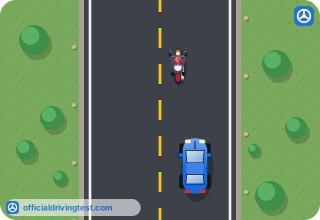
What does the manual say about the traffic lane when you share the road with a motorcycle?
- Share the lane if there seems to be enough room for both
- Share the lane only on multi-lane highways in daylight
- Share the lane when the motorcycle moves to the edge
- Give the motorcyclist a full lane width; do not share the lane
Show answer
Correct answer: Give the motorcyclist a full lane width; do not share the lane
Even if there seems to be enough room for both, the motorcycle needs the room to maneuver safely, so do not share the lane.
Source: North Dakota Noncommercial Driver License Manual (2025-2027), page 32 · Open this page in the manual (Manual page 32)
-
Why can it be more difficult to judge the speed and distance of an approaching motorcycle?
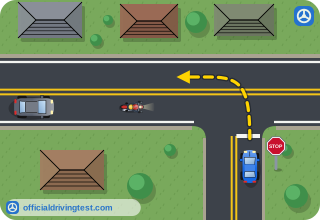
- They have a much smaller profile than other vehicles
- Motorcycles always travel faster than other vehicles
- Motorcycles use much brighter headlights than cars
- Motorcycles never use turn signals or brake lights
Show answer
Correct answer: They have a much smaller profile than other vehicles
A motorcycle’s much smaller profile makes it harder to see and harder to judge its speed and distance.
Source: North Dakota Noncommercial Driver License Manual (2025-2027), page 32 · Open this page in the manual (Manual page 32)
-
Why should you always signal your intentions before changing lanes or merging with traffic when motorcyclists are around?
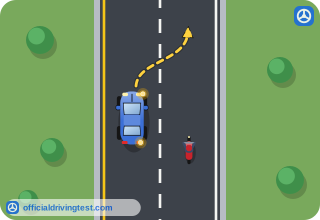
- It gives the motorcyclist the right of way
- It lets the motorcyclist pass you on the right
- It lets the rider anticipate traffic flow
- It lets the motorcyclist ride in your blind spot
Show answer
Correct answer: It lets the rider anticipate traffic flow
Signaling lets the motorcyclist anticipate traffic flow and find a safe lane position.
Source: North Dakota Noncommercial Driver License Manual (2025-2027), page 33 · Open this page in the manual (Manual page 33)
-
When should you make a visual check for motorcycles by checking mirrors and blind spots?
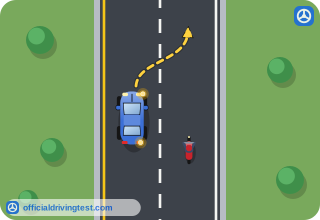
- Only when you see a motorcycle right ahead of you
- Before entering or leaving a lane and at intersections
- Only when driving on multi-lane highways in traffic
- Only when driving at night or in bad weather
Show answer
Correct answer: Before entering or leaving a lane and at intersections
Motorcyclists are often hidden in a blind spot, so check mirrors and blind spots before entering or leaving a lane and at intersections.
Source: North Dakota Noncommercial Driver License Manual (2025-2027), page 33 · Open this page in the manual (Manual page 33)
-
You see a motorcycle with a flashing turn signal. What should you do?
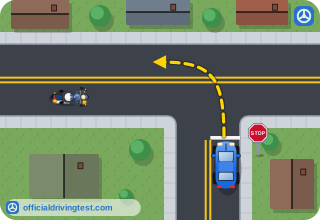
- Wait to be sure it is going to turn
- Assume it will turn and proceed at once
- Sound your horn to warn the rider
- Pass the motorcycle on the same side it signals
Show answer
Correct answer: Wait to be sure it is going to turn
Motorcycle signals usually are not self cancelling and riders sometimes forget to turn them off, so wait to be sure the motorcycle will turn.
Source: North Dakota Noncommercial Driver License Manual (2025-2027), page 33 · Open this page in the manual (Manual page 33)
-
Which road condition is named as one that can make a motorcyclist suddenly change speed or position within a lane?
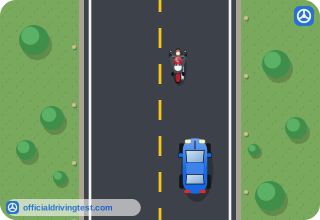
- A wide, smooth shoulder
- Dry, newly painted lane lines
- Gravel
- A clear view of the road ahead
Show answer
Correct answer: Gravel
The manual lists potholes, gravel, wet or slippery surfaces, pavement seams, railroad crossings and grooved pavement as hazards that can make motorcyclists change speed or position.
Source: North Dakota Noncommercial Driver License Manual (2025-2027), page 33 · Open this page in the manual (Manual page 33)
-
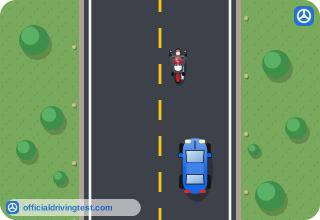
Why should you allow more following distance when following a motorcycle?
- Because motorcycles always stop slower than cars
- So the motorcyclist has time to maneuver or stop
- Because motorcycles cannot use their brakes
- So the motorcyclist can pass you more easily
Show answer
Correct answer: So the motorcyclist has time to maneuver or stop
The manual says the extra following distance gives the motorcyclist enough time to maneuver or stop in an emergency.
Source: North Dakota Noncommercial Driver License Manual (2025-2027), page 33 · Open this page in the manual (Manual page 33)
-
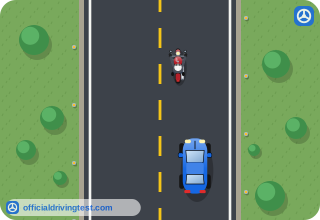
In dry conditions, how does a motorcycle’s stopping ability compare with a car’s?
- Motorcycles need a longer distance to stop than a car
- Motorcycles stop in exactly the same distance as a car
- Motorcycles cannot stop in less than 400 feet
- Motorcycles can stop more quickly than a car
Show answer
Correct answer: Motorcycles can stop more quickly than a car
The manual says that in dry conditions motorcycles can stop more quickly than a car.
Source: North Dakota Noncommercial Driver License Manual (2025-2027), page 33 · Open this page in the manual (Manual page 33)
-
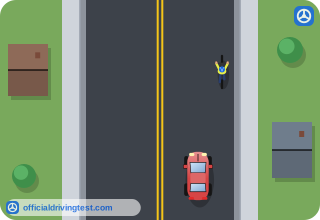
What should you do when you encounter bicyclists?
- Sound your horn to warn them
- Reduce speed
- Keep your speed and move to the center lane
- Drive close beside them to guide them
Show answer
Correct answer: Reduce speed
The manual says to reduce speed when encountering bicyclists, who generally travel at slower speeds than motorists.
Source: North Dakota Noncommercial Driver License Manual (2025-2027), page 33 · Open this page in the manual (Manual page 33)
-
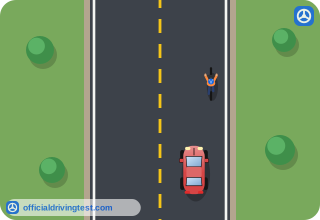
When passing a bicyclist, what minimum passing space is the driver required to leave between the vehicle and the bicycle?
- One foot
- Two feet
- Five feet
- Three feet
Show answer
Correct answer: Three feet
The manual says the driver is required to leave a minimum of three feet of passing space between the vehicle and the bicycle.
Source: North Dakota Noncommercial Driver License Manual (2025-2027), page 33 · Open this page in the manual (Manual page 33)
-
When should you pass a bicyclist?
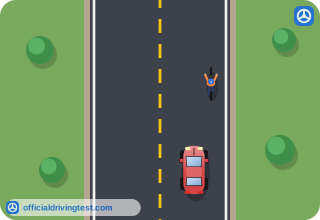
- Only when it is safe, given road and traffic conditions
- Whenever the bicyclist is traveling slowly ahead of you
- Whenever the bicyclist is near the edge of the road
- As soon as you come up behind the bicyclist on the road
Show answer
Correct answer: Only when it is safe, given road and traffic conditions
The manual says to pass a bicyclist only when road and traffic conditions dictate that it is safe.
Source: North Dakota Noncommercial Driver License Manual (2025-2027), page 33 · Open this page in the manual (Manual page 33)
-
What should you do after passing a bicyclist and before moving back to your normal position?
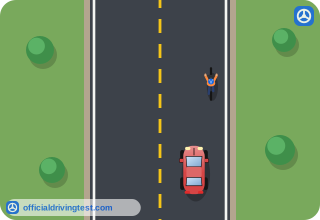
- Sound your horn
- Flash your headlights
- Check over your shoulder
- Brake to slow down
Show answer
Correct answer: Check over your shoulder
The manual says to check over your shoulder after passing a bicyclist and before moving back to your normal position.
Source: North Dakota Noncommercial Driver License Manual (2025-2027), page 33 · Open this page in the manual (Manual page 33)