North Dakota: Sharing the road — Part 1 Practice Test
Questions in this part include: “What is it that plow drivers cannot see?” · “How far may a fully-loaded tractor-trailer take to come to a complete stop on dry pavement?”
Independent educational site · not affiliated with any government agency or DMV
Ready? Test yourself
- Instant feedback with an explanation
- Every answer cites its source in the manual
- Your best score is saved on this device
- Keyboard: press 1 to 4 to answer and Enter for the next question
Questions are original and based on the official manual "North Dakota Noncommercial Driver License Manual" (2025-2027), North Dakota Department of Transportation (NDDOT).
All 20 questions in this practice test
Take the test above first, then use this list to study. Tap “Show answer” to see the correct answer and explanation.
Show the questions and answersHide the questions
-
A school bus is stopped with its red lights flashing. Which drivers must stop?
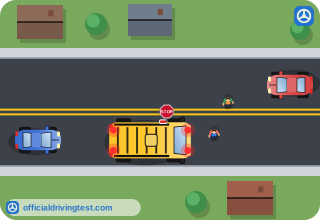
- Only drivers approaching from behind the bus
- Drivers approaching from both directions
- Only drivers approaching from the front of the bus
- Only drivers on a road with no center line
Show answer
Correct answer: Drivers approaching from both directions
When a school bus is stopped and flashing its red lights, drivers approaching from both directions must stop because children are being loaded or unloaded.
Source: North Dakota Noncommercial Driver License Manual (2025-2027), page 20 · Open this page in the manual (Manual page 20)
-
Why must drivers stop when a stopped school bus has its red lights flashing?
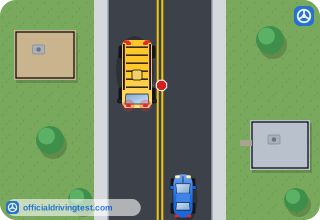
- Children are being loaded or unloaded
- The bus is about to turn around
- The bus has broken down
- The bus driver is changing shifts
Show answer
Correct answer: Children are being loaded or unloaded
Red flashing lights on a stopped school bus mean that children are being loaded or unloaded.
Source: North Dakota Noncommercial Driver License Manual (2025-2027), page 20 · Open this page in the manual (Manual page 20)
-
Which of these allows you to proceed after stopping for a school bus with flashing red lights?
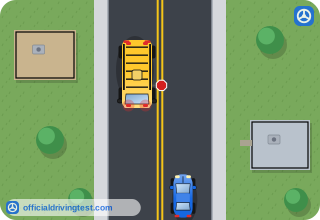
- No children are visible near the bus
- A car behind you passes the bus
- The bus driver signals to let vehicles pass
- Traffic behind you starts to honk
Show answer
Correct answer: The bus driver signals to let vehicles pass
Drivers cannot proceed until the bus begins moving, the bus driver signals to let vehicles pass, or the red lights are no longer flashing.
Source: North Dakota Noncommercial Driver License Manual (2025-2027), page 20 · Open this page in the manual (Manual page 20)
-
What may yellow caution lights on a school bus warn you of?
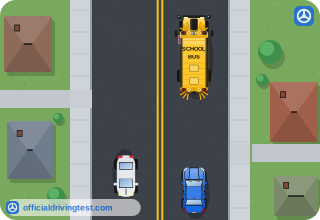
- The school bus is about to turn around at the next corner.
- The school bus is about to stop and its red lights will come on.
- The school bus has finished loading and is about to leave.
- The school bus is allowed to be passed on the right side.
Show answer
Correct answer: The school bus is about to stop and its red lights will come on.
Yellow caution lights on a school bus may warn that the bus is about to stop and that its red flashing lights will soon come on.
Source: North Dakota Noncommercial Driver License Manual (2025-2027), page 20 · Open this page in the manual (Manual page 20)
-
What should you do at dawn and dusk in areas where deer crossing signs are posted?
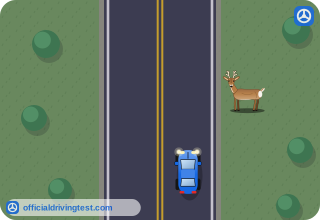
- Pay close attention for deer and drive at slower speeds
- Use your high beams at all times in those areas
- Drive faster to pass through the area quickly
- Sound your horn continuously while driving there
Show answer
Correct answer: Pay close attention for deer and drive at slower speeds
The manual says to pay close attention at dawn and dusk for animals, especially deer, and to drive at slower speeds where deer crossing signs are posted.
Source: North Dakota Noncommercial Driver License Manual (2025-2027), page 25 · Open this page in the manual (Manual page 25)
-
The manual says to stay well back from snowplows because sometimes they have to do what?

- Swerve into the oncoming lane
- Speed up to clear a drift
- Turn off their warning lights
- Stop and back up
Show answer
Correct answer: Stop and back up
The manual says to stay well back from snowplows because sometimes they have to stop and back up.
Source: North Dakota Noncommercial Driver License Manual (2025-2027), page 28 · Open this page in the manual (Manual page 28)
-
What is it that plow drivers cannot see?
- Directly behind themselves
- Directly ahead of the blade
- Both sides of the plow at once
- The road surface under the blade
Show answer
Correct answer: Directly behind themselves
The manual says plow drivers can't see directly behind themselves, which is one reason to stay well back.
Source: North Dakota Noncommercial Driver License Manual (2025-2027), page 28 · Open this page in the manual (Manual page 28)
-
Besides snow, what do plows also throw?

- Road flares
- Antifreeze
- Sanding material
- Warning cones
Show answer
Correct answer: Sanding material
The manual notes that plows also throw sanding material, so you should not crowd the plow.
Source: North Dakota Noncommercial Driver License Manual (2025-2027), page 28 · Open this page in the manual (Manual page 28)
-
On a multi-lane roadway, where could a snowplow be?
- Only in the right-hand lane
- In either lane or on the shoulder
- Only in the lane next to the median
- Only on the shoulder
Show answer
Correct answer: In either lane or on the shoulder
The manual says to know where the plow is on multi-lane roadways, because it could be in either lane or on the shoulder.
Source: North Dakota Noncommercial Driver License Manual (2025-2027), page 28 · Open this page in the manual (Manual page 28)
-
Why must you be extremely cautious when passing a snowplow?

- Its blade extends well into the neighboring lane as it passes you
- Its driver may not slow down for other traffic that is approaching
- It has the right-of-way over all other traffic on the road
- It can be moved sideways by drifts and hard snow-pack
Show answer
Correct answer: It can be moved sideways by drifts and hard snow-pack
The manual says a snowplow can be moved sideways by drifts and hard snow-pack, so be extremely cautious when passing one.
Source: North Dakota Noncommercial Driver License Manual (2025-2027), page 28 · Open this page in the manual (Manual page 28)
-
Where does the manual say to watch for plow trucks that may be turning around?
- At every railroad crossing along the route
- At school bus stops
- On “authorized vehicle only” cross-overs
- At the end of every city block
Show answer
Correct answer: On “authorized vehicle only” cross-overs
The manual says to watch for plow trucks on Interstate ramps and turning around on “authorized vehicle only” cross-overs.
Source: North Dakota Noncommercial Driver License Manual (2025-2027), page 28 · Open this page in the manual (Manual page 28)
-
How far may a fully-loaded tractor-trailer take to come to a complete stop on dry pavement?
- About 100 feet
- About 150 feet
- More than 400 feet
- About 250 feet
Show answer
Correct answer: More than 400 feet
A fully-loaded tractor-trailer may take more than 400 feet on dry pavement to stop, more than the length of a football field.
Source: North Dakota Noncommercial Driver License Manual (2025-2027), page 31 · Open this page in the manual (Manual page 31)
-
With any turning vehicle, how do the rear wheels travel compared with the front wheels?
- They follow the same path
- They follow a shorter path
- They follow a longer path
- They follow a path farther to the left
Show answer
Correct answer: They follow a shorter path
The manual says the rear wheels follow a shorter path than the front wheels, and the longer the vehicle, the greater the difference.
Source: North Dakota Noncommercial Driver License Manual (2025-2027), page 31 · Open this page in the manual (Manual page 31)
-
Drivers of tractor-trailers must often swing out to the left as the first step in making which kind of turn?
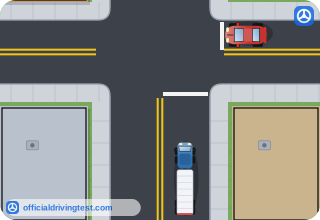
- A left turn
- A U-turn
- A turn into a driveway on the left
- A right turn
Show answer
Correct answer: A right turn
Because the rear wheels follow a shorter path, tractor-trailer drivers must often swing out to the left first when making a right turn.
Source: North Dakota Noncommercial Driver License Manual (2025-2027), page 31 · Open this page in the manual (Manual page 31)
-
What should you do when following a tractor-trailer before you try to pass it?
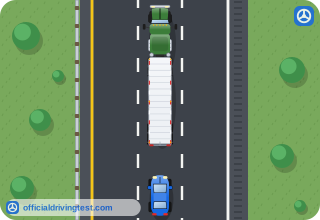
- Sound your horn twice
- Observe its turn signals
- Flash your headlights at the driver
- Move close behind its rear bumper
Show answer
Correct answer: Observe its turn signals
The manual says to observe a tractor-trailer’s turn signals before trying to pass.
Source: North Dakota Noncommercial Driver License Manual (2025-2027), page 31 · Open this page in the manual (Manual page 31)
-
A tractor-trailer you are following appears to be starting a left turn. What should you do before passing it on the right?
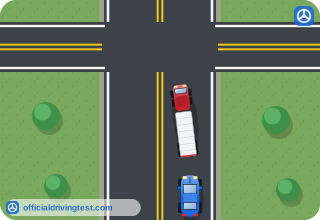
- Pass at once, since the truck is turning away from you
- Speed up and move up alongside its cab to pass
- Stay close behind it and sound your horn at the driver
- Wait a moment to see which way the driver signals
Show answer
Correct answer: Wait a moment to see which way the driver signals
The manual says to wait a moment and check which way the driver is signaling before passing on the right.
Source: North Dakota Noncommercial Driver License Manual (2025-2027), page 31 · Open this page in the manual (Manual page 31)
-
Many drivers falsely assume that a trucker can see the road better because truckers sit twice as high. What does the manual say about a trucker’s blind spots?
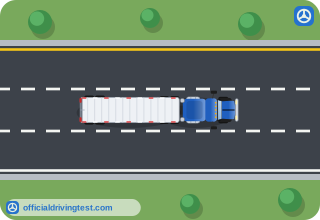
- Truckers still have serious blind spots, called no-zones, into which a car can disappear from view
- Sitting that high means a trucker has no blind spots at all, since the view is better
- The only blind spot is directly behind the trailer, where cars cannot be seen
- Bigger mirrors remove every blind spot a trucker has when changing lanes
Show answer
Correct answer: Truckers still have serious blind spots, called no-zones, into which a car can disappear from view
Truckers have a better forward view and bigger mirrors, but they still have serious blind spots or no-zones where a car can disappear from view.
Source: North Dakota Noncommercial Driver License Manual (2025-2027), page 31 · Open this page in the manual (Manual page 31)
-
What is the rule of thumb for drivers sharing the road with a tractor-trailer?
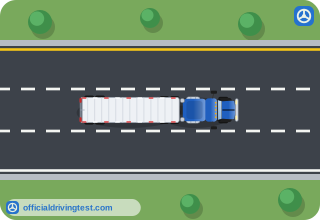
- If you can see the truck’s tail lights, the driver can see you well
- If the truck’s turn signal is off, the driver does not see you at all
- If you can’t see the truck driver in the side mirror, he or she can’t see you
- If you stay in the truck’s lane, the driver can always see you well
Show answer
Correct answer: If you can’t see the truck driver in the side mirror, he or she can’t see you
The manual gives this rule of thumb: if you cannot see the truck driver in the side mirror, the driver cannot see you.
Source: North Dakota Noncommercial Driver License Manual (2025-2027), page 32 · Open this page in the manual (Manual page 32)
-
Why does lingering in a truck’s blind spots on the sides and in the rear increase the chance of a crash?
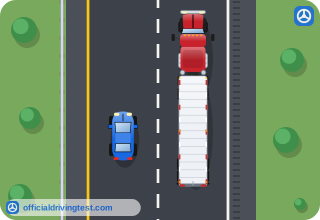
- It makes the truck use more fuel when it is carrying a load
- It makes the truck’s turn signals stop working in a crowd
- It forces the truck to move into the right lane at once
- It hampers the trucker’s ability to take evasive action
Show answer
Correct answer: It hampers the trucker’s ability to take evasive action
Drivers lingering in a truck’s side and rear blind spots hamper the trucker’s ability to take evasive action, and the possibility of a crash increases.
Source: North Dakota Noncommercial Driver License Manual (2025-2027), page 32 · Open this page in the manual (Manual page 32)
-
On multi-lane highways, which lane do tractor-trailers stay in to help the flow of local traffic on and off the highway?
- The center lane
- The far left lane
- The far right lane
- The lane next to the shoulder
Show answer
Correct answer: The center lane
The manual says tractor-trailers stay in the center lane, which also increases the driver’s options if a lane change is needed to avoid a crash.
Source: North Dakota Noncommercial Driver License Manual (2025-2027), page 32 · Open this page in the manual (Manual page 32)