North Carolina: Speed & following distance — Part 2 Practice Test
Questions in this part include: “What is a leading cause of traffic crashes?” · “If you cannot see the inside rear-view mirror of the car ahead, what does the manual say about your position?”
Independent educational site · not affiliated with any government agency or DMV
Ready? Test yourself
- Instant feedback with an explanation
- Every answer cites its source in the manual
- Your best score is saved on this device
Questions are original and based on the official manual "North Carolina Driver Handbook" (Revised May 2025), North Carolina Division of Motor Vehicles (NCDMV).
All 18 questions in this practice test
Take the test above first, then use this list to study. Tap “Show answer” to see the correct answer and explanation.
Show the questions and answersHide the questions
-
As you round a curve, what should you do with your speed?
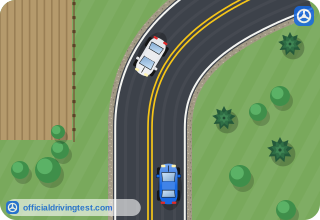
- Gradually decrease it until you are out of the curve
- Keep it exactly the same and avoid touching the pedals
- Hold the brake pedal down lightly the whole way around
- Gradually increase it to maintain traction for good control
Show answer
Correct answer: Gradually increase it to maintain traction for good control
The manual says to gradually increase speed as you round the curve to keep the traction needed for good control.
Source: North Carolina Driver Handbook (Revised May 2025), page 53 · Open this page in the manual (Manual page 53)
-
If you must brake while in a curve, how should you apply the brakes?
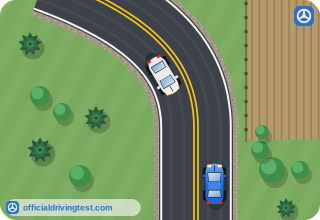
- Firmly and quickly, then release them completely before exiting
- Gradually, until you are sure it is safe to keep continuous pressure
- In short, repeated taps until the vehicle leaves the curve
- Not at all; take your foot off the accelerator and coast through
Show answer
Correct answer: Gradually, until you are sure it is safe to keep continuous pressure
The manual says to apply the brakes gradually until it is safe to keep continuous pressure on the brake pedal.
Source: North Carolina Driver Handbook (Revised May 2025), page 54 · Open this page in the manual (Manual page 54)
-
When should you begin to turn the vehicle for a curve?
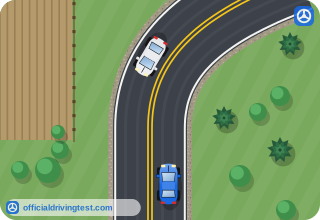
- As soon as the front of your vehicle enters the curve
- Once the vehicle is halfway around the curve
- Just before the point where the road begins to turn
- After the road has started to turn, once you see it
Show answer
Correct answer: Just before the point where the road begins to turn
You begin turning just prior to the point where the road begins to turn.
Source: North Carolina Driver Handbook (Revised May 2025), page 54 · Open this page in the manual (Manual page 54)
-
Where should you drive while rounding a curve?
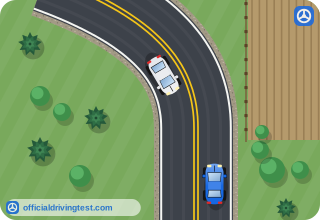
- On your side of the road, as far to the right as you can
- In the center of the road, to keep the curve wide
- On the left side of the road, to cut the curve short
- On whichever side gives you the straightest path
Show answer
Correct answer: On your side of the road, as far to the right as you can
The manual says to stay on your side of the road and drive as far to the right as you can.
Source: North Carolina Driver Handbook (Revised May 2025), page 54 · Open this page in the manual (Manual page 54)
-
On a downhill curve, when should you begin to brake compared with a level roadway?
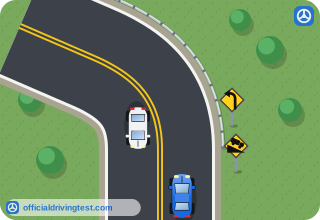
- Later, since gravity slows the vehicle
- At the same point you would on a level road
- Earlier, approaching the curve more slowly
- Only after you enter the curve
Show answer
Correct answer: Earlier, approaching the curve more slowly
Because of the pull of gravity, you should brake earlier and approach a downhill curve more slowly.
Source: North Carolina Driver Handbook (Revised May 2025), page 54 · Open this page in the manual (Manual page 54)
-
What is a leading cause of traffic crashes?
- Following too closely
- Driving too far to the right
- Stopping too early at signals
- Signaling too early before turns
Show answer
Correct answer: Following too closely
The manual states that following too closely is a leading cause of traffic crashes.
Source: North Carolina Driver Handbook (Revised May 2025), page 54 · Open this page in the manual (Manual page 54)
-
On the open road, how much distance should you keep between you and the vehicle ahead?
- Enough so that no vehicle could ever pass between you
- Only one car length, at any speed on the road
- As little as possible, so the space is never used
- Enough so that a passing vehicle can safely move into the space
Show answer
Correct answer: Enough so that a passing vehicle can safely move into the space
On the open road you should leave enough room for a passing vehicle to safely move into and occupy the space.
Source: North Carolina Driver Handbook (Revised May 2025), page 54 · Open this page in the manual (Manual page 54)
-
How much time does the "two-second rule" say to allow between the vehicle ahead passing a given point and your vehicle reaching it?
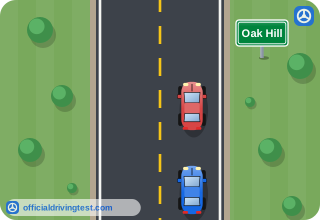
- One second
- Two seconds
- Four seconds
- Six seconds
Show answer
Correct answer: Two seconds
The two-second rule says to allow two seconds between the vehicle ahead passing a point and you reaching it.
Source: North Carolina Driver Handbook (Revised May 2025), page 54 · Open this page in the manual (Manual page 54)
-
When driving in heavy city traffic, how can you avoid a rear-end crash by another vehicle?
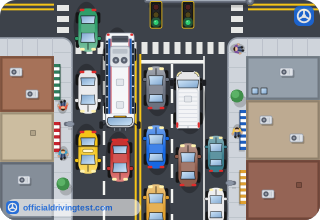
- Stay close behind the vehicle ahead of you
- Check your rear-view mirror often
- Brake sooner than everyone else at every corner
- Keep your eyes fixed only on the road directly ahead
Show answer
Correct answer: Check your rear-view mirror often
The manual says to check your rear-view mirror often and stay aware of dangerous situations behind you.
Source: North Carolina Driver Handbook (Revised May 2025), page 63 · Open this page in the manual (Manual page 63)
-
When driving in cities, what should you leave around your vehicle?
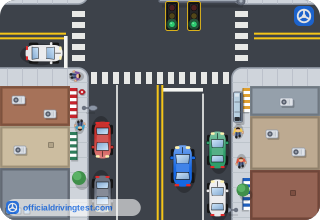
- A gap of exactly one car length
- A clear lane on both sides at all times
- A “margin of safety”
- A gap of one full block
Show answer
Correct answer: A “margin of safety”
The manual says to give yourself plenty of space to make decisions and leave a “margin of safety” around your vehicle.
Source: North Carolina Driver Handbook (Revised May 2025), page 63 · Open this page in the manual (Manual page 63)
-
When driving in cities, how far ahead should you watch the road?
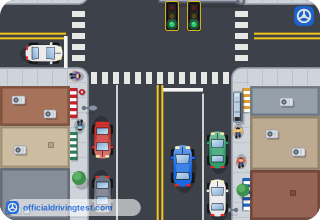
- Far enough to detect possibly dangerous situations earlier
- Only as far as the vehicle directly in front of you
- Only as far as the next traffic signal on the street
- Only far enough to see the taillights of one vehicle
Show answer
Correct answer: Far enough to detect possibly dangerous situations earlier
Watch the road far enough ahead to detect possibly dangerous situations earlier and take proper defensive actions.
Source: North Carolina Driver Handbook (Revised May 2025), page 63 · Open this page in the manual (Manual page 63)
-
If you cannot see the inside rear-view mirror of the car ahead, what does the manual say about your position?
- You are driving too fast for the road
- You are in the safest position to pass
- You are probably in the driver's blind spot
- You are following at the proper distance
Show answer
Correct answer: You are probably in the driver's blind spot
If you cannot see the inside rear-view mirror of the car ahead, you are probably in that driver's blind spot.
Source: North Carolina Driver Handbook (Revised May 2025), page 63 · Open this page in the manual (Manual page 63)
-
When driving in city traffic, what should you never do?
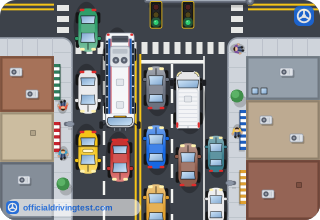
- Signal before changing lanes
- Weave in and out of traffic
- Check your mirrors often
- Plan your lane changes ahead of time
Show answer
Correct answer: Weave in and out of traffic
The manual says never to weave in and out of traffic; stay in one lane if you can and plan lane changes ahead.
Source: North Carolina Driver Handbook (Revised May 2025), page 63 · Open this page in the manual (Manual page 63)
-
What should you watch for near parked vehicles in a city?
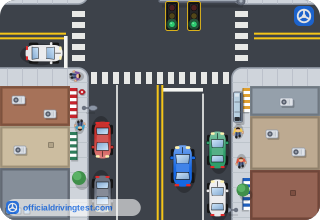
- Only vehicles that are idling with their lights turned on at night
- Drivers who plan to park in the exact space you are passing
- Only pedestrians who are waiting at a marked crosswalk nearby
- Vehicles pulling out and pedestrians darting out from between them
Show answer
Correct answer: Vehicles pulling out and pedestrians darting out from between them
Watch for parked vehicles that might be pulling out and pedestrians who might dart onto the street from between them.
Source: North Carolina Driver Handbook (Revised May 2025), page 63 · Open this page in the manual (Manual page 63)
-
What can parked vehicles block your view of in the city?
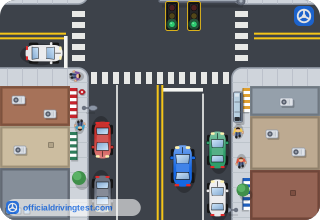
- Traffic signals but not driveways
- Only the road signs on the right side
- Intersecting traffic, driveways and alleys
- Only the lane markings on the road
Show answer
Correct answer: Intersecting traffic, driveways and alleys
Parked vehicles can block your view of intersecting traffic, driveways and alleys.
Source: North Carolina Driver Handbook (Revised May 2025), page 63 · Open this page in the manual (Manual page 63)
-
Which is a reason driving on rural roads is often more dangerous than driving in heavy city traffic?
- Rural roads are always wider and carry more vehicles
- Rural roads have more traffic signals to watch
- Rural roads have more cars parked along the edges
- The lighting is often not as good
Show answer
Correct answer: The lighting is often not as good
Rural driving is often more dangerous because the road may be narrower, the lighting is often not as good and speeds may be higher.
Source: North Carolina Driver Handbook (Revised May 2025), page 63 · Open this page in the manual (Manual page 63)
-
On rural roads, what may be higher, making them more dangerous than heavy city traffic?
- The number of traffic signals
- The travel speeds
- The number of pedestrians
- The amount of traffic
Show answer
Correct answer: The travel speeds
One reason rural driving is often more dangerous than heavy city traffic is that the travel speeds may be higher.
Source: North Carolina Driver Handbook (Revised May 2025), page 63 · Open this page in the manual (Manual page 63)
-
How may a rural road compare to a city street, making it more dangerous?
- The road may have more lanes
- The road may not be as wide
- The road may have more signals
- The road may be better lit
Show answer
Correct answer: The road may not be as wide
One reason rural roads are often more dangerous than heavy city traffic is that the road may not be as wide.
Source: North Carolina Driver Handbook (Revised May 2025), page 63 · Open this page in the manual (Manual page 63)