Pavement markings in North Carolina
The North Carolina Driver Handbook shows or names everything on this page: 11 in all, on pages 46, 83–84, 88.
Independent educational site · not affiliated with any government agency or DMV
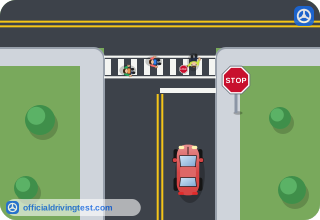
Stop line
When a stop sign, traffic light, flashing light or other traffic-control device requires a vehicle to stop at an intersection, the driver must stop at the appropriately marked stop line. If there is no stop line or marked crosswalk, the driver must stop before entering the intersection where he/she has a view of the intersecting street.
Manual page 83 · Open this page in the manual (Manual page 83)
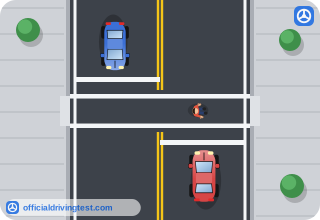
Marked crosswalk
At intersections without traffic signals, pedestrians have the right of way if they are in marked crosswalks or in unmarked crosswalks formed by imaginary lines extending from the sidewalks across the streets;
Manual page 46 · Open this page in the manual (Manual page 46)
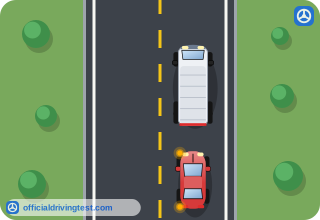
Broken yellow center line
Yellow lines separate travel lanes moving in opposite directions. ... A yellow skipped or broken line is used as the center line on a two-lane, two-way road where passing with care is permitted in both directions.
Manual page 88 · Open this page in the manual (Manual page 88)
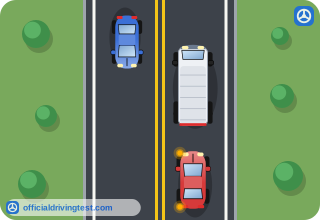
Double solid yellow center line
When continuous, double, solid, yellow lines are the center lines, you cannot cross them to pass in either direction.
Manual page 88 · Open this page in the manual (Manual page 88)
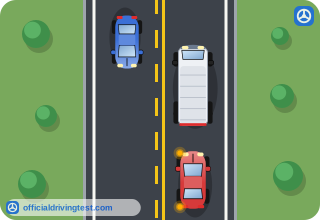
Solid and broken yellow lines
On a two-lane road, passing with care is permitted if the skipped-yellow line is in your lane.
Manual page 84 · Open this page in the manual (Manual page 84)
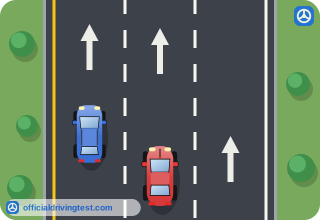
White edge line and lane lines
White lines separate travel lanes moving in the same direction. ... Single, solid, white lines are used as right-edge lines along the roadway and for guiding traffic traveling in the same direction.
Manual page 88 · Open this page in the manual (Manual page 88)
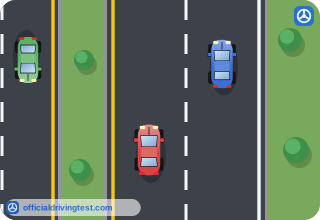
Yellow left-edge line (divided highway)
Single, solid, yellow lines are used as left-edge lines on divided highways. If you see the reverse, you are traveling in the wrong direction.
Manual page 88 · Open this page in the manual (Manual page 88)
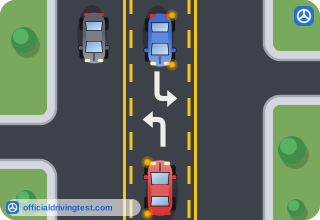
Two-way left-turn lane
On certain multi-lane highways, a special center lane is reserved exclusively for two-way left-turn movements in both directions. The two-way left-turn lane must not be used for passing another vehicle or for the purpose of merging into traffic.
Manual page 88 · Open this page in the manual (Manual page 88)
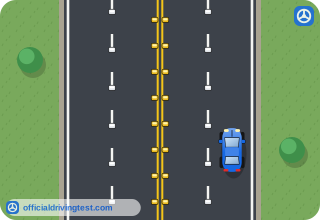
White and yellow raised pavement markers
White and yellow pavement “markers” are reflective devices used in the pavement to improve the visibility of marking lines at night when the road is wet.
Manual page 88 · Open this page in the manual (Manual page 88)
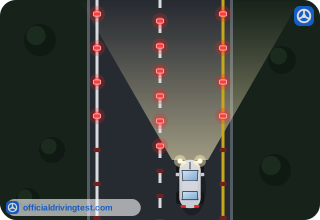
Red reflective pavement markers
Red markers indicate wrong-way movements for motorists.
Manual page 88 · Open this page in the manual (Manual page 88)
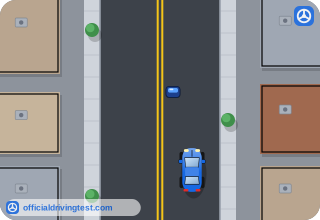
Blue pavement marker (fire hydrant)
In some areas, blue reflective pavement markers on roadways indicate the location of nearby fire hydrants or water supplies for fire-fighting units.
Manual page 88 · Open this page in the manual (Manual page 88)