North Carolina: Pavement markings Practice Test
White and yellow lines, edge lines and what each marking tells you.
Independent educational site · not affiliated with any government agency or DMV
Ready? Test yourself
- Instant feedback with an explanation
- Every answer cites its source in the manual
- Your best score is saved on this device
Questions are original and based on the official manual "North Carolina Driver Handbook" (Revised May 2025), North Carolina Division of Motor Vehicles (NCDMV).
All 13 questions in this practice test
Take the test above first, then use this list to study. Tap “Show answer” to see the correct answer and explanation.
Show the questions and answersHide the questions
-
What do yellow lines separate?
- Travel lanes moving in the same direction
- Travel lanes moving in opposite directions
- Bicycle lanes from travel lanes
- Parking areas from travel lanes
Show answer
Correct answer: Travel lanes moving in opposite directions
Yellow lines separate travel lanes moving in opposite directions.
Source: North Carolina Driver Handbook (Revised May 2025), page 88 · Open this page in the manual (Manual page 88)
-
What do white lines separate?
- Travel lanes moving in opposite directions
- Passing zones from no-passing zones
- Lanes that are reserved for turning
- Travel lanes moving in the same direction
Show answer
Correct answer: Travel lanes moving in the same direction
White lines separate travel lanes moving in the same direction.
Source: North Carolina Driver Handbook (Revised May 2025), page 88 · Open this page in the manual (Manual page 88)
-
What does a yellow skipped (broken) center line on a two-lane, two-way road mean?
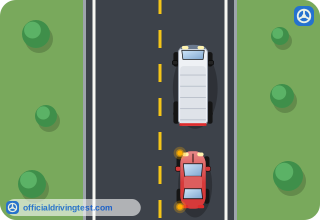
- Passing with care is permitted in both directions
- Passing is prohibited in both directions
- Passing is permitted only in the right lane
- Passing is allowed only during daylight hours
Show answer
Correct answer: Passing with care is permitted in both directions
A skipped yellow center line marks a road where passing with care is permitted in both directions.
Source: North Carolina Driver Handbook (Revised May 2025), page 88 · Open this page in the manual (Manual page 88)
-
What does a continuous double solid yellow center line mean?
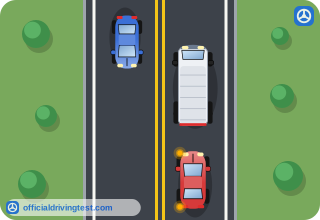
- You may cross it to pass only when the road ahead is clear
- You may pass only on the right side of the road
- You cannot cross it to pass in either direction
- You may cross it to pass slower vehicles only
Show answer
Correct answer: You cannot cross it to pass in either direction
Continuous double solid yellow center lines cannot be crossed to pass in either direction.
Source: North Carolina Driver Handbook (Revised May 2025), page 88 · Open this page in the manual (Manual page 88)
-
When is passing with care permitted on a two-lane road?
- If a solid yellow line is in your lane
- If the skipped-yellow line is in your lane
- If a solid white line is on your right
- Only if no vehicles are ahead of you
Show answer
Correct answer: If the skipped-yellow line is in your lane
On a two-lane road you may pass with care if the skipped-yellow line is in your lane.
Source: North Carolina Driver Handbook (Revised May 2025), page 88 · Open this page in the manual (Manual page 88)
-
How are single, solid, white lines used?
- As left-edge lines on divided highways
- As center lines on two-lane, two-way roads
- To mark a center lane reserved for left turns
- As right-edge lines along the roadway
Show answer
Correct answer: As right-edge lines along the roadway
Single solid white lines are right-edge lines and guide traffic traveling in the same direction.
Source: North Carolina Driver Handbook (Revised May 2025), page 88 · Open this page in the manual (Manual page 88)
-
What are single, solid, yellow lines used as on divided highways?
- Left-edge lines
- Right-edge lines
- Center lines
- Lane-change lines
Show answer
Correct answer: Left-edge lines
Single solid yellow lines are left-edge lines on divided highways.
Source: North Carolina Driver Handbook (Revised May 2025), page 88 · Open this page in the manual (Manual page 88)
-
What does it mean if you see a solid yellow line at the right edge and a solid white line at the left edge of your side of a divided highway?
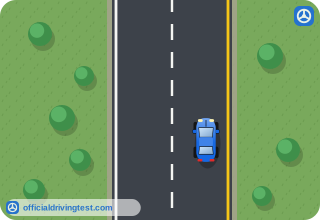
- You are entering a construction or maintenance work zone
- You are in a passing zone on a two-lane road
- You are traveling in the wrong direction
- The road ahead is closed to all traffic
Show answer
Correct answer: You are traveling in the wrong direction
Seeing the reverse of the normal edge-line colors means you are traveling in the wrong direction.
Source: North Carolina Driver Handbook (Revised May 2025), page 88 · Open this page in the manual (Manual page 88)
-
What is a special center lane on certain multi-lane highways reserved exclusively for?
- Passing in both directions
- Left turns in both directions
- Vehicles that are merging into traffic
- Emergency vehicles only
Show answer
Correct answer: Left turns in both directions
A special center lane is reserved exclusively for two-way left-turn movements in both directions.
Source: North Carolina Driver Handbook (Revised May 2025), page 88 · Open this page in the manual (Manual page 88)
-
Which use of a two-way left-turn lane is prohibited?
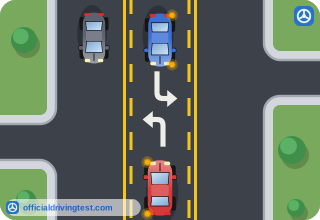
- Making a left turn into a driveway
- Making a left turn from the lane onto a side street
- Making a left turn in either direction of travel
- Passing another vehicle or merging into traffic
Show answer
Correct answer: Passing another vehicle or merging into traffic
The two-way left-turn lane must not be used for passing another vehicle or for merging into traffic.
Source: North Carolina Driver Handbook (Revised May 2025), page 88 · Open this page in the manual (Manual page 88)
-
Why are white and yellow pavement markers used?
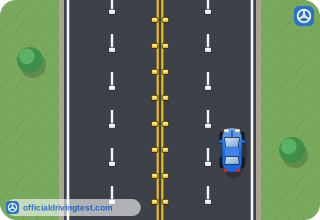
- To improve the visibility of marking lines at night when the road is wet
- To warn drivers that a lane ends when the road is covered by snow
- To show the direction of traffic flow on highways in daylight hours
- To mark the exact location of school zones during the night
Show answer
Correct answer: To improve the visibility of marking lines at night when the road is wet
Reflective pavement markers improve the visibility of marking lines at night when the road is wet.
Source: North Carolina Driver Handbook (Revised May 2025), page 88 · Open this page in the manual (Manual page 88)
-
What do red pavement markers indicate?
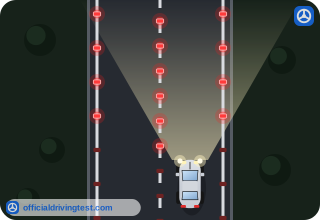
- Nearby fire hydrants
- A lane reserved for buses
- Wrong-way movements
- The start of a no-passing zone
Show answer
Correct answer: Wrong-way movements
Red markers indicate wrong-way movements for motorists.
Source: North Carolina Driver Handbook (Revised May 2025), page 88 · Open this page in the manual (Manual page 88)
-
What do blue reflective pavement markers on roadways indicate in some areas?
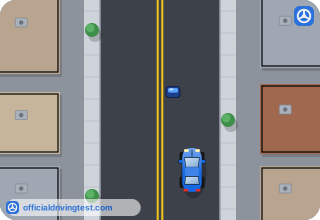
- A parking area reserved for handicap license plate holders
- The location of nearby fire hydrants or water supplies
- A lane reserved for emergency response vehicles only
- Wrong-way movements for motorists
Show answer
Correct answer: The location of nearby fire hydrants or water supplies
Blue reflective markers show the location of nearby fire hydrants or water supplies for fire-fighting units.
Source: North Carolina Driver Handbook (Revised May 2025), page 88 · Open this page in the manual (Manual page 88)