New Jersey: Signals & vehicle controls — Part 3 Practice Test
Questions in this part include: “How should the driver-side outside mirror be adjusted, according to the New Jersey Driver Manual?” · “How tightly should you hold the steering wheel, according to the New Jersey Driver Manual?”
Independent educational site · not affiliated with any government agency or DMV
Ready? Test yourself
- Instant feedback with an explanation
- Every answer cites its source in the manual
- Your best score is saved on this device
Questions are original and based on the official manual "New Jersey Driver Manual" (2026), New Jersey Motor Vehicle Commission (MVC).
All 17 questions in this practice test
Take the test above first, then use this list to study. Tap “Show answer” to see the correct answer and explanation.
Show the questions and answersHide the questions
-
How should the driver-side outside mirror be adjusted, according to the New Jersey Driver Manual?
- So only the sky and the car behind are visible
- So the tip of the front door handle shows in its lower right
- So your car's side fills half of the mirror
- So the rear wheel and tire show in its upper left corner
Show answer
Correct answer: So the tip of the front door handle shows in its lower right
The outside mirror should be adjusted so you can see the tip of the driver-side front door handle in the lower right of the mirror, which shows part of the lanes to the left and rear.
Source: New Jersey Driver Manual (2026), page 50 · Open this page in the manual (Manual page 50)
-
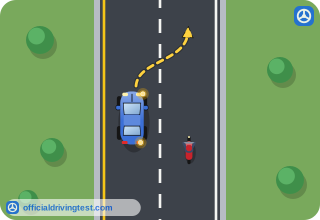
Blind spots are areas behind your vehicle, on both sides, that you cannot see through the mirrors. How does the New Jersey Driver Manual say you can check them?
- By using only the inside rearview mirror
- By sounding the horn before moving
- By turning your head
- By leaning toward the passenger window
Show answer
Correct answer: By turning your head
Blind spots cannot be seen through the mirrors, so the manual says to check them by turning your head.
Source: New Jersey Driver Manual (2026), page 50 · Open this page in the manual (Manual page 50)
-
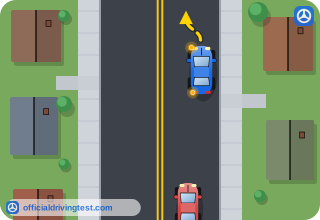
After starting the engine, how should you make sure your path is clear before moving?
- Flash the headlights and move out slowly
- Sound the horn twice and then pull out
- Check the inside and both outside rearview mirrors only
- Turn and look back instead of depending on the mirrors
Show answer
Correct answer: Turn and look back instead of depending on the mirrors
The manual says to make sure your path is clear by turning and looking back, and not to depend on the rearview mirrors.
Source: New Jersey Driver Manual (2026), page 50 · Open this page in the manual (Manual page 50)
-
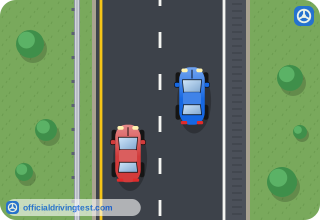
To check your mirrors on the road, you let a vehicle pass you on the left. As it disappears from your inside rearview mirror, what should you be able to see?
- Its rear bumper in the outside rearview mirror
- Nothing, because it is fully in your blind spot
- Its front bumper in the outside rearview mirror
- Its headlights again in the inside mirror
Show answer
Correct answer: Its front bumper in the outside rearview mirror
If the mirrors are set correctly, as the passing vehicle disappears from the inside mirror you should see its front bumper in the outside mirror.
Source: New Jersey Driver Manual (2026), page 50 · Open this page in the manual (Manual page 50)
-
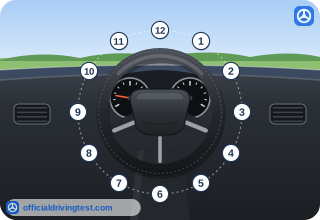
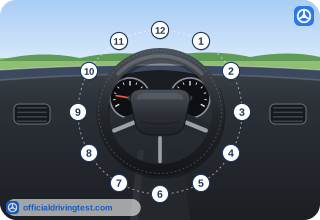
For normal driving, where does the New Jersey Driver Manual say to grip the steering wheel?
- At the 12 o'clock position with one hand
- At the 10 and 2 o'clock positions
- At the 9 and 3 o'clock positions
- At the 6 o'clock position with both hands
Show answer
Correct answer: At the 9 and 3 o'clock positions
For normal driving, grip the outside rim of the wheel at the 9 and 3 o'clock positions, with your thumbs along the face of the wheel.
Source: New Jersey Driver Manual (2026), page 51 · Open this page in the manual (Manual page 51)
-
Which way of holding the steering wheel does the New Jersey Driver Manual say you should never use when turning it?
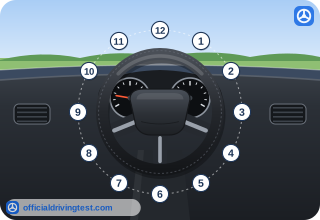
- Gripping it from the inside of the rim, hand facing inward
- Using hand-over-hand steering through a turn
- Holding it firmly with both hands on the rim
- Gripping the outside rim with your thumbs along the wheel's face
Show answer
Correct answer: Gripping it from the inside of the rim, hand facing inward
The manual says a motorist should never turn the wheel while gripping it from the inside of the rim with the hand facing inward.
Source: New Jersey Driver Manual (2026), page 51 · Open this page in the manual (Manual page 51)
-
According to the New Jersey Driver Manual, when may you take a hand off the steering wheel?
- Only when shifting gears or giving hand signals
- Whenever you are driving below 25 mph
- Whenever you adjust the radio or the climate controls
- Whenever you are driving in a straight line
Show answer
Correct answer: Only when shifting gears or giving hand signals
Both hands should always be kept on the wheel, except when shifting gears or giving hand signals.
Source: New Jersey Driver Manual (2026), page 51 · Open this page in the manual (Manual page 51)
-
How tightly should you hold the steering wheel, according to the New Jersey Driver Manual?
- As tightly as possible at all times
- Loosely, so it can move freely
- Firmly, but not too tight
- Tightly at low speed, loosely at high speed
Show answer
Correct answer: Firmly, but not too tight
The wheel should be held firmly but not too tight, and as steady as possible as the vehicle's speed increases.
Source: New Jersey Driver Manual (2026), page 51 · Open this page in the manual (Manual page 51)
-
Where in its lane should a motorist keep the vehicle while driving?
- Straddling one of the lane lines
- In the center of the lane
- Wherever the lane feels widest
- Close to the left lane line
Show answer
Correct answer: In the center of the lane
The manual says the motorist should keep the vehicle in the center of the lane it is traveling in.
Source: New Jersey Driver Manual (2026), page 51 · Open this page in the manual (Manual page 51)
-
On a two-lane road with traffic coming toward you, where does the New Jersey Driver Manual say you should keep your vehicle?
- Keep close to the center line
- Keep to the left to see ahead
- Straddle the center line when clear
- Keep to the right
Show answer
Correct answer: Keep to the right
On a two-lane road with oncoming traffic, the manual says the motorist should keep to the right.
Source: New Jersey Driver Manual (2026), page 51 · Open this page in the manual (Manual page 51)
-
Hand-over-hand steering lets you make steering adjustments of up to how much, while keeping both hands on the wheel?
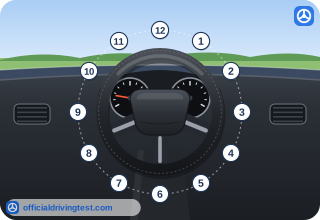
- Up to one full turn of the wheel
- Up to a quarter turn of the wheel
- Up to a half turn of the wheel
- Up to two full turns of the wheel
Show answer
Correct answer: Up to a half turn of the wheel
Hand-over-hand steering permits adjustments ranging from very minor up to a half turn of the wheel while keeping both hands on it.
Source: New Jersey Driver Manual (2026), page 51 · Open this page in the manual (Manual page 51)
-
With hand-over-hand steering, how far may your hands move when moving through a turn?
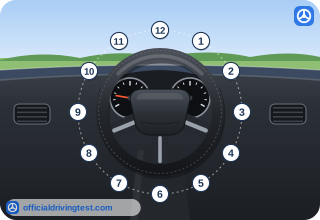
- As much as 90 degrees
- As much as 165 degrees
- As much as 45 degrees
- As much as 360 degrees
Show answer
Correct answer: As much as 165 degrees
The manual says that when moving through a turn, the hands may move as much as 165 degrees.
Source: New Jersey Driver Manual (2026), page 51 · Open this page in the manual (Manual page 51)
-
When steering through a slight curve, what do your hands typically do?
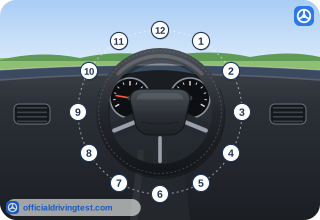
- Let go briefly so the wheel can straighten itself
- Cross over each other using hand-over-hand steering
- Slide together to the 12 o'clock position
- Keep their grip and make only slight finger or wrist moves
Show answer
Correct answer: Keep their grip and make only slight finger or wrist moves
In a slight curve both hands typically keep their original grip, making only slight finger or wrist adjustments to hold the path.
Source: New Jersey Driver Manual (2026), page 51 · Open this page in the manual (Manual page 51)
-
When gripping the steering wheel at the 9 and 3 o'clock positions, where does the New Jersey Driver Manual say to keep your thumbs?
- Along the face of the wheel
- Hooked around the inside of the rim
- Resting on the center horn pad
- Wrapped tightly under the rim
Show answer
Correct answer: Along the face of the wheel
For normal driving, grip the outside rim at the 9 and 3 o'clock positions, keeping your thumbs along the face of the wheel.
Source: New Jersey Driver Manual (2026), page 51 · Open this page in the manual (Manual page 51)
-
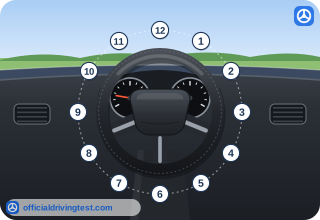
In hand-over-hand steering, after one hand pushes the wheel up toward 12 o'clock, what does the opposite hand do?
- Lets go of the wheel until the turn is finished
- Moves to the inside of the rim, with the palm facing inward
- Crosses over and down to the 9 or 3 o'clock position
- Stays at the bottom of the wheel at 6 o'clock
Show answer
Correct answer: Crosses over and down to the 9 or 3 o'clock position
As one hand pushes the wheel up toward 12 o'clock, the opposite hand crosses over and down to the 9 or 3 o'clock position to provide input or stabilize steering.
Source: New Jersey Driver Manual (2026), page 52 · Open this page in the manual (Manual page 52)
-
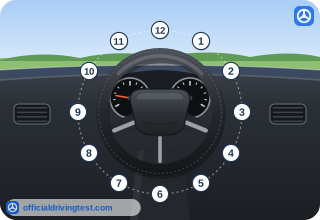
Coming out of a turn, what is 'controlled slipping' of the steering wheel?
- Letting the rear tires slide to finish the turn
- Pumping the brakes as the wheels straighten out
- Releasing the wheel completely so it spins back on its own
- Letting the wheel slip through your fingers to straighten
Show answer
Correct answer: Letting the wheel slip through your fingers to straighten
When coming out of a turn, the wheel can be allowed to slip through the fingers (controlled slipping) to straighten, while both hands stay on the wheel.
Source: New Jersey Driver Manual (2026), page 52 · Open this page in the manual (Manual page 52)
-
Hand-over-hand steering is particularly well suited for which of these?
- Holding a steady course on a straight highway
- Skid recovery
- Backing straight with one hand on top of the wheel
- Steering with one hand on the inside of the rim
Show answer
Correct answer: Skid recovery
The manual says hand-over-hand steering is well suited for precision maneuvers, steering through curves, entering and exiting intersections, and skid recovery.
Source: New Jersey Driver Manual (2026), page 52 · Open this page in the manual (Manual page 52)