New Jersey: Seat belts & child safety — Part 3 Practice Test
Questions in this part include: “Federal safety standards require manufacturers to equip which new vehicles with air bags?” · “Which is a reason a person may qualify for a passenger-side air bag on-off switch?”
Independent educational site · not affiliated with any government agency or DMV
Ready? Test yourself
- Instant feedback with an explanation
- Every answer cites its source in the manual
- Your best score is saved on this device
Questions are original and based on the official manual "New Jersey Driver Manual" (2026), New Jersey Motor Vehicle Commission (MVC).
All 19 questions in this practice test
Take the test above first, then use this list to study. Tap “Show answer” to see the correct answer and explanation.
Show the questions and answersHide the questions
-
What are air bags designed to do?
- Protect mainly in rear-end crashes
- Protect small children riding in the front seat
- Replace seat belts in all types of crashes
- Supplement seat belts in frontal crashes
Show answer
Correct answer: Supplement seat belts in frontal crashes
Air bags are designed to supplement seat belts in frontal crashes, not replace them.
Source: New Jersey Driver Manual (2026), page 43 · Open this page in the manual (Manual page 43)
-
Federal safety standards require manufacturers to equip which new vehicles with air bags?
- Only vehicles that have a full back seat
- Only vehicles sold new in the state of New Jersey
- Only luxury cars and full-size SUVs
- All new passenger cars and light trucks
Show answer
Correct answer: All new passenger cars and light trucks
Federal safety standards require air bags in all new passenger cars and light trucks.
Source: New Jersey Driver Manual (2026), page 43 · Open this page in the manual (Manual page 43)
-
According to NHTSA statistics cited in the New Jersey Driver Manual, how many lives did frontal air bags save from 1987 to 2015?
- 14,869
- 144,869
- 44,869
- 4,869
Show answer
Correct answer: 44,869
NHTSA statistics show that frontal air bags saved 44,869 lives from 1987 to 2015.
Source: New Jersey Driver Manual (2026), page 43 · Open this page in the manual (Manual page 43)
-
How fast can air bags inflate to protect adults in a front-end crash?
- Up to 50 mph
- Up to 200 mph
- Up to 100 mph
- Up to 500 mph
Show answer
Correct answer: Up to 200 mph
Air bags inflate at speeds of up to 200 mph.
Source: New Jersey Driver Manual (2026), page 43 · Open this page in the manual (Manual page 43)
-
According to the New Jersey Driver Manual, an average-sized adult who is correctly belted:
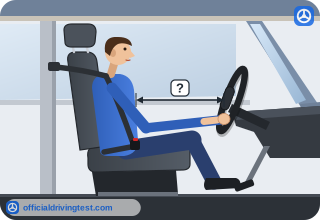
- Is not likely to meet the air bag until it is fully inflated
- Should sit within 5 inches of the steering wheel
- Is usually struck by the air bag while it is still inflating
- Does not need the air bag to be switched on
Show answer
Correct answer: Is not likely to meet the air bag until it is fully inflated
A correctly belted average-sized adult is not likely to encounter the air bag until it is fully inflated.
Source: New Jersey Driver Manual (2026), page 43 · Open this page in the manual (Manual page 43)
-
What danger do air bags pose, according to the New Jersey Driver Manual?
- They keep seat belts from locking properly during a crash
- They could seriously hurt or kill front-seat children
- They can disable the brakes after a crash
- They often go off on their own while the vehicle is parked
Show answer
Correct answer: They could seriously hurt or kill front-seat children
Air bags save many adult lives, but they could seriously injure or kill children sitting in the front seat.
Source: New Jersey Driver Manual (2026), page 43 · Open this page in the manual (Manual page 43)
-
In 1995, NHTSA allowed air bag cutoff switches in which vehicles?
- Pickups, sports cars and cars with no back seat
- Only vehicles built before January 1, 1981
- Only police cars, fire trucks and ambulances in service
- All SUVs, minivans and full-size passenger vans
Show answer
Correct answer: Pickups, sports cars and cars with no back seat
In 1995 NHTSA allowed cutoff switches in pickup trucks, sports cars, and autos with no back seat.
Source: New Jersey Driver Manual (2026), page 43 · Open this page in the manual (Manual page 43)
-
Since January 1998, who may install air bag on-off switches in vehicles once the proper application has been made?
- Only the local police department
- Only the vehicle manufacturer's factory
- Repair shops and dealers
- Only MVC inspection stations
Show answer
Correct answer: Repair shops and dealers
In January 1998 NHTSA allowed repair shops and dealers to install the switches after the appropriate application was made.
Source: New Jersey Driver Manual (2026), page 43 · Open this page in the manual (Manual page 43)
-
Who may qualify for an on-off switch for both the driver and passenger-side air bags?
- Anyone who mostly drives on local roads at low speeds
- Any driver over age 65 who asks the dealer for one
- Drivers who always wear both the lap belt and the shoulder belt
- Some people with medical conditions that make air bags riskier
Show answer
Correct answer: Some people with medical conditions that make air bags riskier
Switches for both air bags are for people with medical conditions when the risks of a deploying air bag exceed the risks of hitting the steering wheel, dashboard or windshield.
Source: New Jersey Driver Manual (2026), page 43 · Open this page in the manual (Manual page 43)
-
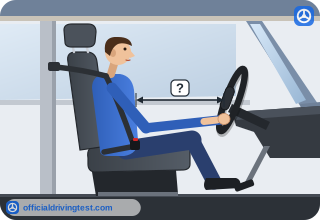
A driver-side air bag on-off switch may be allowed for people who cannot keep at least how much space between the center of the steering wheel and the center of their breastbone?
- 10 inches
- 18 inches
- 6 inches
- 3 inches
Show answer
Correct answer: 10 inches
Driver-side switches are for people who cannot operate the vehicle while keeping at least 10 inches between the center of the steering wheel and the center of the breastbone.
Source: New Jersey Driver Manual (2026), page 44 · Open this page in the manual (Manual page 44)
-
Which is a reason a person may qualify for a passenger-side air bag on-off switch?
- They drive a car with a sunroof or a convertible top
- They prefer that the front passenger sit close to the dashboard
- They must put an infant up front because there is no rear seat
- They usually drive alone and rarely carry any passengers
Show answer
Correct answer: They must put an infant up front because there is no rear seat
Passenger-side switches are for people who must place an infant in the front seat, for example because the vehicle (such as a pickup truck) has no rear seat.
Source: New Jersey Driver Manual (2026), page 44 · Open this page in the manual (Manual page 44)
-
The passenger-side air bag on-off switch category also covers people who must place children of what ages in the front seat (for example, because the vehicle has no rear seat)?
- 13 to 17 years old
- 5 to 15 years old
- 8 to 18 years old
- 1 to 12 years old
Show answer
Correct answer: 1 to 12 years old
It covers people who must place children 1 to 12 years old in the front seat because there is no rear seat, there are more children than rear seats, or a child's medical condition must be monitored.
Source: New Jersey Driver Manual (2026), page 44 · Open this page in the manual (Manual page 44)
-
According to the New Jersey Driver Manual, where are children of any age safest?
- On an adult's lap in the back seat
- Belted properly in the back seat
- In the front seat with the air bag on
- In the front seat with the seat moved all the way forward
Show answer
Correct answer: Belted properly in the back seat
Children of any age are safest belted properly in the back seat, especially in a vehicle with a passenger-side air bag.
Source: New Jersey Driver Manual (2026), page 44 · Open this page in the manual (Manual page 44)
-
In a vehicle with air bags, where should an infant ride?
- In a forward-facing seat in the front seat
- In a rear-facing infant seat in the back seat
- In a booster seat in the back seat
- In a rear-facing infant seat in the front seat
Show answer
Correct answer: In a rear-facing infant seat in the back seat
Always put an infant in a rear-facing infant child safety seat in the back seat of a vehicle with air bags.
Source: New Jersey Driver Manual (2026), page 44 · Open this page in the manual (Manual page 44)
-
According to the New Jersey Driver Manual's air bag safety points, children up to what age should always ride in the back seat?
- 16 years old
- 3 years old
- 6 years old
- 12 years old
Show answer
Correct answer: 12 years old
The manual says always be sure that children 12 years old and younger ride in the back seat.
Source: New Jersey Driver Manual (2026), page 44 · Open this page in the manual (Manual page 44)
-
Which letters on the steering wheel or dashboard show that a vehicle has an air bag?
- SRS or SIR
- GDL or MVC
- TPMS or TCS
- ABS or ESC
Show answer
Correct answer: SRS or SIR
The words air bag or the letters SRS (supplemental restraint system) or SIR (supplemental inflatable restraint) on the steering wheel and dashboard show a vehicle has an air bag.
Source: New Jersey Driver Manual (2026), page 44 · Open this page in the manual (Manual page 44)
-
Besides the steering wheel and dashboard, where might a manufacturer put air bag warning labels?
- On the tire sidewalls and the wheel rims
- On the rear bumper, next to the license plate
- On the sun visors or the open-door frame
- Inside the trunk lid, near the spare tire
Show answer
Correct answer: On the sun visors or the open-door frame
Manufacturers may mark the sun visors or the sides of the open-door frame with warning labels, or put a warning in the owner's manual.
Source: New Jersey Driver Manual (2026), page 44 · Open this page in the manual (Manual page 44)
-
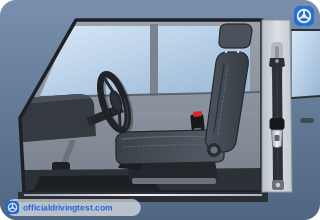
According to the New Jersey starting checklist, how should seat belts and shoulder harnesses be fastened?
- Loosely, with several inches of slack
- With the shoulder harness tucked behind your back
- As tight as they will go, even if uncomfortable
- So that they are firm and comfortable
Show answer
Correct answer: So that they are firm and comfortable
The checklist says seat belts and shoulder harnesses should be fastened so that they are firm and comfortable.
Source: New Jersey Driver Manual (2026), page 49 · Open this page in the manual (Manual page 49)
-
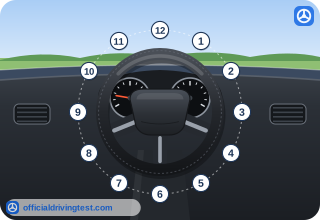
Why does the New Jersey Driver Manual recommend gripping the steering wheel at the 9 and 3 o'clock positions?
- It keeps your arms fully straight and locked
- It lowers the risk of arm injury if the air bag deploys
- It lets you steer safely with one hand at highway speeds
- It lets you grip the inside of the rim more easily
Show answer
Correct answer: It lowers the risk of arm injury if the air bag deploys
Gripping the wheel at 9 and 3 o'clock diminishes the risk of hand, wrist or arm injury if the air bag is deployed.
Source: New Jersey Driver Manual (2026), page 51 · Open this page in the manual (Manual page 51)