New Hampshire: Railroad crossings Practice Test
Crossbucks and advance warning signs, where to stop for a train, crossing several tracks and vehicles that must always stop.
Independent educational site · not affiliated with any government agency or DMV
Ready? Test yourself
- Instant feedback with an explanation
- Every answer cites its source in the manual
- Your best score is saved on this device
- Keyboard: press 1 to 4 to answer and Enter for the next question
Questions are original and based on the official manual "New Hampshire Driver’s Manual" (DSMV 360 (Rev. 11/25)), New Hampshire Division of Motor Vehicles (DMV).
All 10 questions in this practice test
Take the test above first, then use this list to study. Tap “Show answer” to see the correct answer and explanation.
Show the questions and answersHide the questions
-
What does a crossbuck (X) indicate?
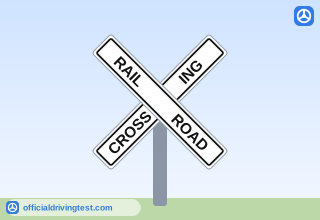
- Where a railroad crossing is
- A school crossing ahead
- A pedestrian crossing ahead
- A crossroad ahead
Show answer
Correct answer: Where a railroad crossing is
The crossbuck (X) indicates where a railroad crossing is.
Source: New Hampshire Driver’s Manual (DSMV 360 (Rev. 11/25)), page 21 · Open this page in the manual (Manual page 21)
-
What do active railroad crossings have to caution drivers?
- Only a painted line across the road
- A flagger at all times
- Signs, lights, or other signals
- Gates that stay closed all day
Show answer
Correct answer: Signs, lights, or other signals
Active railroad crossings have signs, lights, or other signals to caution drivers about railroad crossings.
Source: New Hampshire Driver’s Manual (DSMV 360 (Rev. 11/25)), page 22 · Open this page in the manual (Manual page 22)
-
A round yellow warning sign shows an X with black RR letters. What does it caution the driver to do?
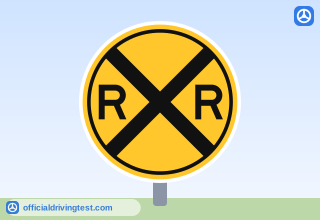
- Speed up and cross the tracks before a train arrives
- Slow down or stop, and look and listen for a train
- Watch only for pedestrians walking on the tracks
- Move to the left lane and keep a steady speed
Show answer
Correct answer: Slow down or stop, and look and listen for a train
The round warning sign with an X and black RR letters cautions the driver to slow down or stop, and to look and listen for a train or railroad vehicle before proceeding.
Source: New Hampshire Driver’s Manual (DSMV 360 (Rev. 11/25)), page 22 · Open this page in the manual (Manual page 22)
-
Where is a round warning sign with an X and black RR letters placed?
- Only at the center of the tracks, between the rails
- After the crossing, on the far side of the tracks
- At the start of every school zone and crosswalk
- Along the road before a highway-railroad crossing
Show answer
Correct answer: Along the road before a highway-railroad crossing
A round warning sign with an X symbol (crossbuck) and black RR letters is placed along the road prior to a highway-railroad grade crossing.
Source: New Hampshire Driver’s Manual (DSMV 360 (Rev. 11/25)), page 22 · Open this page in the manual (Manual page 22)
-
When a train or railroad vehicle is approaching a crossing, a driver must stop behind the stop line or how far from the nearest rail of the track?
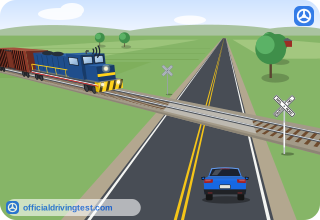
- Not less than 5 feet and not more than 10 feet
- Not less than 25 feet and not more than 100 feet
- Not less than 50 feet and not more than 150 feet
- Not less than 15 feet and not more than 50 feet
Show answer
Correct answer: Not less than 15 feet and not more than 50 feet
A driver must stop behind the stop line or not less than 15 feet, nor more than 50 feet from the nearest rail of the track.
Source: New Hampshire Driver’s Manual (DSMV 360 (Rev. 11/25)), page 22 · Open this page in the manual (Manual page 22)
-
Until when should drivers not proceed across the tracks at a railroad crossing?
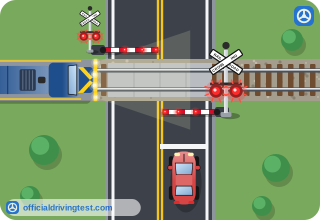
- Until the first car ahead has crossed the tracks
- Until the lights stop flashing or trains have passed
- Until the horn of the train stops sounding
- Until the lights have flashed twice in a row
Show answer
Correct answer: Until the lights stop flashing or trains have passed
Drivers should not proceed across the tracks until the lights stop flashing, or trains have passed.
Source: New Hampshire Driver’s Manual (DSMV 360 (Rev. 11/25)), page 22 · Open this page in the manual (Manual page 22)
-
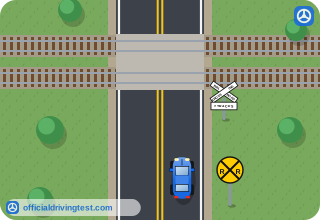
At a crossing with more than one track, when should a driver cross the tracks?
- As soon as the first train has passed
- After sounding the horn twice
- Only when there is a clear view of the tracks in both directions
- As soon as the lights stop flashing on the nearest track
Show answer
Correct answer: Only when there is a clear view of the tracks in both directions
If there is more than one track at the crossing, the driver should not cross the tracks until there is a clear view of the tracks in both directions.
Source: New Hampshire Driver’s Manual (DSMV 360 (Rev. 11/25)), page 22 · Open this page in the manual (Manual page 22)
-
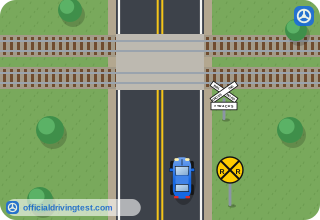
When a railroad crossing is clear, how should drivers cross the tracks?
- Look both ways and cross quickly, without stopping
- Stop on the tracks to look again before moving on
- Cross slowly in a low gear to avoid stalling
- Cross only after a second full stop at the tracks
Show answer
Correct answer: Look both ways and cross quickly, without stopping
When the crossing is clear, drivers should look both ways and cross the tracks quickly, without stopping.
Source: New Hampshire Driver’s Manual (DSMV 360 (Rev. 11/25)), page 22 · Open this page in the manual (Manual page 22)
-
Which vehicles does the law require to stop before any railroad crossing, even with no sign of a train?
- Passenger buses and trucks carrying flammable or hazardous material
- All passenger vehicles that carry more than one person inside
- Any truck carrying a load over 10,000 pounds in weight
- Only school buses and vehicles used by emergency crews
Show answer
Correct answer: Passenger buses and trucks carrying flammable or hazardous material
The law requires buses that carry passengers and trucks carrying flammable or hazardous material to stop before any railroad crossing, even if there is no sign of a train coming.
Source: New Hampshire Driver’s Manual (DSMV 360 (Rev. 11/25)), page 22 · Open this page in the manual (Manual page 22)
-
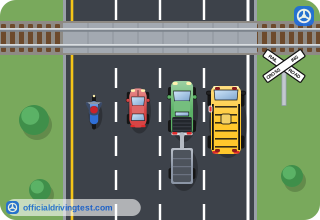
What should drivers be ready to do when driving behind a bus that carries passengers or a truck carrying hazardous material near a railroad crossing?
- Pass before the crossing
- Honk to hurry it along
- Be ready to stop
- Follow within one car length
Show answer
Correct answer: Be ready to stop
Drivers should be ready to stop when driving behind buses carrying passengers and trucks carrying flammable or hazardous material, which must stop at railroad crossings.
Source: New Hampshire Driver’s Manual (DSMV 360 (Rev. 11/25)), page 22 · Open this page in the manual (Manual page 22)