New Hampshire: Pavement markings Practice Test
White and yellow lane lines, double lines and passing, edge lines, stop lines, crosswalks and arrows painted on the road.
Independent educational site · not affiliated with any government agency or DMV
Ready? Test yourself
- Instant feedback with an explanation
- Every answer cites its source in the manual
- Your best score is saved on this device
- Keyboard: press 1 to 4 to answer and Enter for the next question
Questions are original and based on the official manual "New Hampshire Driver’s Manual" (DSMV 360 (Rev. 11/25)), New Hampshire Division of Motor Vehicles (DMV).
All 13 questions in this practice test
Take the test above first, then use this list to study. Tap “Show answer” to see the correct answer and explanation.
Show the questions and answersHide the questions
-
What are pavement markings?
- Signs on poles beside the road that show the rules
- Lines, arrows, words, or symbols painted on the roadway
- Lights that show when to stop or turn
- Hand signals given by workers and officers
Show answer
Correct answer: Lines, arrows, words, or symbols painted on the roadway
Pavement markings are lines, arrows, words, or symbols painted on the roadway to give a driver directions or warnings.
Source: New Hampshire Driver’s Manual (DSMV 360 (Rev. 11/25)), page 23 · Open this page in the manual (Manual page 23)
-
What do white single or broken (dotted) lane lines mean?
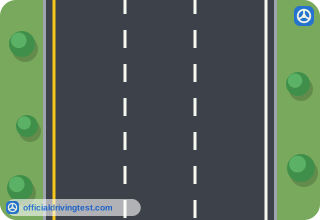
- The lanes of traffic are moving in opposite directions
- Passing is never allowed
- The lanes of traffic are moving in the same direction
- The lane is reserved for turning vehicles
Show answer
Correct answer: The lanes of traffic are moving in the same direction
White lines mean the lanes of traffic are moving in the same direction.
Source: New Hampshire Driver’s Manual (DSMV 360 (Rev. 11/25)), page 23 · Open this page in the manual (Manual page 23)
-
What do yellow single or broken (dotted) lane lines mean?
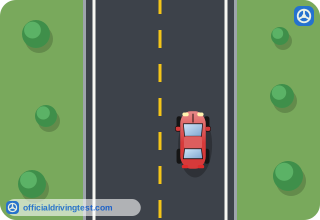
- The lanes of traffic are moving in the opposite direction
- The lanes of traffic are moving in the same direction
- The lane ends ahead
- The road is closed to passing in both directions
Show answer
Correct answer: The lanes of traffic are moving in the opposite direction
Yellow lines mean the lanes of traffic are moving in the opposite direction.
Source: New Hampshire Driver’s Manual (DSMV 360 (Rev. 11/25)), page 23 · Open this page in the manual (Manual page 23)
-
When may a driver pass other vehicles over a broken (dotted) line?
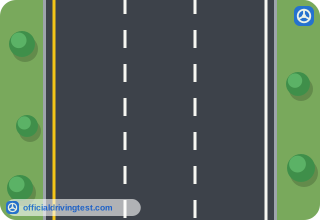
- When it is safe to do so
- Never, in any situation
- Only on a one-way road
- Only when another vehicle is stopped
Show answer
Correct answer: When it is safe to do so
Drivers may pass other vehicles over broken (dotted) lines when it is safe to do so.
Source: New Hampshire Driver’s Manual (DSMV 360 (Rev. 11/25)), page 23 · Open this page in the manual (Manual page 23)
-
What are drivers prohibited from doing at a solid white line?
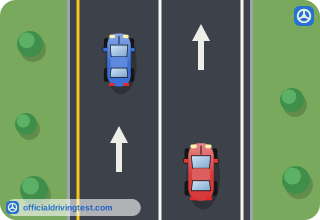
- Turning left into a driveway
- Driving faster than the speed limit
- Changing lanes or passing another vehicle
- Stopping to let a pedestrian cross
Show answer
Correct answer: Changing lanes or passing another vehicle
Solid white lines mean drivers are prohibited from changing lanes or passing another vehicle.
Source: New Hampshire Driver’s Manual (DSMV 360 (Rev. 11/25)), page 23 · Open this page in the manual (Manual page 23)
-
At double white or yellow lines, when may a driver pass?
- If both lines are solid and the road ahead is clear
- Whenever the road ahead looks clear
- Only if the other driver agrees
- If the driver’s side line is broken (dotted) and it is safe
Show answer
Correct answer: If the driver’s side line is broken (dotted) and it is safe
If the line on the driver’s side is broken (dotted), the driver may pass when safe to do so.
Source: New Hampshire Driver’s Manual (DSMV 360 (Rev. 11/25)), page 23 · Open this page in the manual (Manual page 23)
-
What color is the edge line on two-way roads and on the right edges of one-way roads?
- Yellow
- Red
- Orange
- White
Show answer
Correct answer: White
The edge line is white on two-way roads and on the right edges of one-way roads.
Source: New Hampshire Driver’s Manual (DSMV 360 (Rev. 11/25)), page 23 · Open this page in the manual (Manual page 23)
-
What color is the edge line on the left edges of one-way roads?
- White
- Yellow
- Red
- Orange
Show answer
Correct answer: Yellow
The edge line is yellow on the left edges of one-way roads.
Source: New Hampshire Driver’s Manual (DSMV 360 (Rev. 11/25)), page 23 · Open this page in the manual (Manual page 23)
-
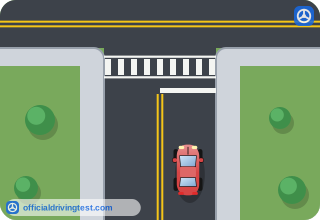
What do white stop lines on the pavement show?
- Where drivers may park
- Where lanes end
- Where drivers should stop
- Where drivers may pass
Show answer
Correct answer: Where drivers should stop
White stop lines are located on the pavement to show drivers where to stop.
Source: New Hampshire Driver’s Manual (DSMV 360 (Rev. 11/25)), page 23 · Open this page in the manual (Manual page 23)
-
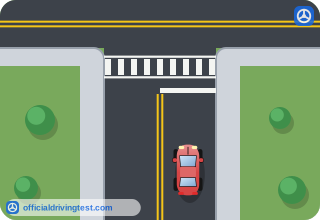
After initially stopping at the required point at a stop line, what should a driver do?
- Look both ways and proceed only when it is safe
- Proceed at once if no sign says otherwise
- Stop a second time at the crosswalk
- Sound the horn before entering
Show answer
Correct answer: Look both ways and proceed only when it is safe
After initially stopping, a driver should look both ways and proceed forward making sure it is safe to continue into the intersection.
Source: New Hampshire Driver’s Manual (DSMV 360 (Rev. 11/25)), page 23 · Open this page in the manual (Manual page 23)
-
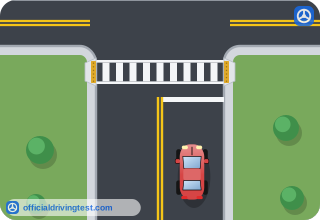
If there is no white stop line but only a crosswalk is present, where must drivers stop?
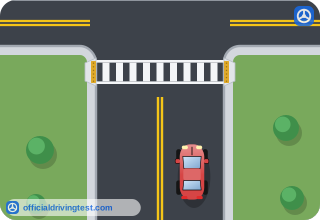
- Before the crosswalk
- At the center of the crosswalk
- Past the far edge of the crosswalk
- Beside the crosswalk, in the next lane
Show answer
Correct answer: Before the crosswalk
If there is no white stop line but only a crosswalk present, drivers must stop before the crosswalk.
Source: New Hampshire Driver’s Manual (DSMV 360 (Rev. 11/25)), page 23 · Open this page in the manual (Manual page 23)
-
What do crosswalk lines painted across a road show?
- Where vehicles may turn around
- The edge of the roadway
- Pedestrian crossing areas
- Lanes for left turns only
Show answer
Correct answer: Pedestrian crossing areas
Crosswalk lines are painted across a road to show pedestrian crossing areas.
Source: New Hampshire Driver’s Manual (DSMV 360 (Rev. 11/25)), page 23 · Open this page in the manual (Manual page 23)
-
What are white arrows painted on some roadways used for?
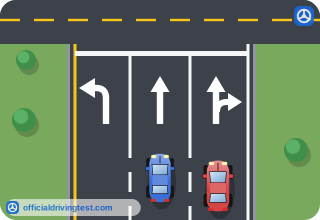
- To mark lanes that are reserved for buses and for bicycles only
- To show the speed limit that applies to each lane
- To warn drivers that a railroad crossing is ahead
- To guide drivers into the proper lanes for turning and through traffic
Show answer
Correct answer: To guide drivers into the proper lanes for turning and through traffic
White arrows are painted on some roadways to help guide drivers into the proper lanes for turning at intersections and through traffic.
Source: New Hampshire Driver’s Manual (DSMV 360 (Rev. 11/25)), page 24 · Open this page in the manual (Manual page 24)