New Hampshire: Highway and toll-road driving Practice Test
Entering and leaving a highway, minimum speeds, missed exits, E-ZPass and toll plazas.
Independent educational site · not affiliated with any government agency or DMV
Ready? Test yourself
- Instant feedback with an explanation
- Every answer cites its source in the manual
- Your best score is saved on this device
- Keyboard: press 1 to 4 to answer and Enter for the next question
Questions are original and based on the official manual "New Hampshire Driver’s Manual" (DSMV 360 (Rev. 11/25)), New Hampshire Division of Motor Vehicles (DMV).
All 15 questions in this practice test
Take the test above first, then use this list to study. Tap “Show answer” to see the correct answer and explanation.
Show the questions and answersHide the questions
-
On an entrance or acceleration ramp, who should drivers yield the right-of-way to?
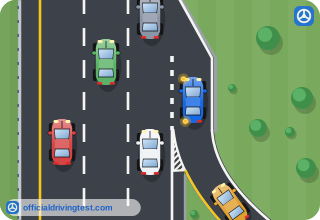
- Drivers waiting behind them on the ramp
- Whichever driver is going faster
- Drivers already on the interstate highway
- Drivers in the largest vehicles
Show answer
Correct answer: Drivers already on the interstate highway
Drivers should yield the right-of-way to drivers already on a limited access or interstate highway, on the entrance or acceleration ramp.
Source: New Hampshire Driver’s Manual (DSMV 360 (Rev. 11/25)), page 14 · Open this page in the manual (Manual page 14)
-
What is the minimum speed a driver may drive on an interstate highway, unless road and weather conditions make it unsafe?
- 25 mph
- 35 mph
- 45 mph
- 55 mph
Show answer
Correct answer: 45 mph
The minimum speed on an interstate highway is 45 mph, unless road and weather conditions are so bad that this speed is unsafe.
Source: New Hampshire Driver’s Manual (DSMV 360 (Rev. 11/25)), page 15 · Open this page in the manual (Manual page 15)
-
On the highway, how far before changing lanes or exiting the roadway should drivers signal?
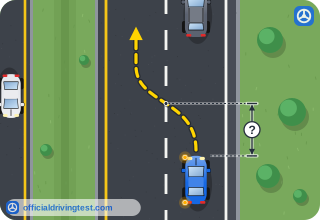
- At least 150 feet
- At least 500 feet
- At least 250 feet
- At least 300 feet
Show answer
Correct answer: At least 500 feet
On the highway, drivers should signal at least 500 feet before changing lanes or exiting the roadway.
Source: New Hampshire Driver’s Manual (DSMV 360 (Rev. 11/25)), page 15 · Open this page in the manual (Manual page 15)
-
What should a driver use to reach the speed of other vehicles before pulling onto a multi-lane highway?
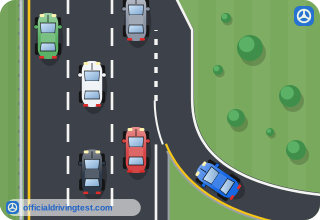
- The deceleration lane
- The acceleration lane
- The shoulder
- The left-most lane
Show answer
Correct answer: The acceleration lane
When entering a multi-lane highway, drivers should use the acceleration lane to reach the speed of other vehicles before pulling onto the roadway.
Source: New Hampshire Driver’s Manual (DSMV 360 (Rev. 11/25)), page 16 · Open this page in the manual (Manual page 16)
-
When exiting a roadway, when should a driver plan to move to the lane closest to the exiting point?
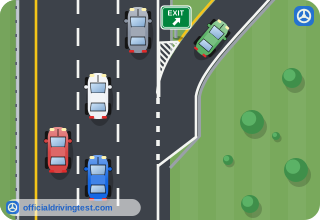
- At the last moment before the exit
- Only after entering the deceleration lane
- Right after slowing to the exiting speed
- Early, to avoid a quick lane change
Show answer
Correct answer: Early, to avoid a quick lane change
When exiting a roadway, drivers should plan to move to the lane closest to the exiting point early to avoid a quick lane change.
Source: New Hampshire Driver’s Manual (DSMV 360 (Rev. 11/25)), page 16 · Open this page in the manual (Manual page 16)
-
When exiting a roadway, where should a driver slow to the exiting speed?
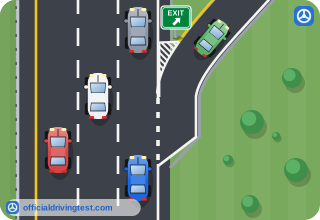
- In the deceleration lane
- On the main roadway
- In the acceleration lane
- On the shoulder
Show answer
Correct answer: In the deceleration lane
A driver exiting a roadway should signal, move to the deceleration lane and slow to exiting speed, while maintaining vehicle speed on the main roadway.
Source: New Hampshire Driver’s Manual (DSMV 360 (Rev. 11/25)), page 16 · Open this page in the manual (Manual page 16)
-
What is E-ZPass?
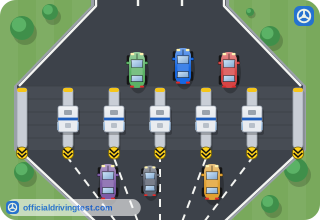
- An electronic toll collection system with lanes that need no stop to pay a cash toll
- A prepaid card that lets drivers pay for parking along state roads and highways
- A special lane on highways reserved for vehicles carrying several passengers
- A staffed toll booth where drivers pay an attendant with cash or a card
Show answer
Correct answer: An electronic toll collection system with lanes that need no stop to pay a cash toll
E-ZPass is an electronic toll collection system that lets drivers go through designated lanes without stopping to pay a cash toll, which reduces traffic congestion.
Source: New Hampshire Driver’s Manual (DSMV 360 (Rev. 11/25)), page 25 · Open this page in the manual (Manual page 25)
-
In an E-ZPass toll lane, what should drivers do about the speed limit?
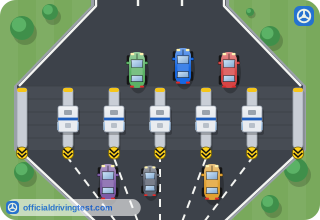
- Come to a complete stop and then continue slowly
- Slow to a crawl and stop only if the lane is crowded
- Obey the posted speed limit but not come to a stop
- Ignore the posted limit while inside the lane
Show answer
Correct answer: Obey the posted speed limit but not come to a stop
In E-ZPass toll lanes drivers should obey posted speed limits but must not come to a stop.
Source: New Hampshire Driver’s Manual (DSMV 360 (Rev. 11/25)), page 25 · Open this page in the manual (Manual page 25)
-
What should drivers do at a staffed lane in a cash-only toll lane?
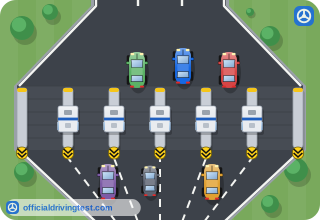
- Slow down but keep rolling
- Come to a complete stop
- Stop only when traffic is heavy
- Stop only if the attendant signals them
Show answer
Correct answer: Come to a complete stop
In cash-only toll lanes drivers should come to a complete stop at staffed lanes.
Source: New Hampshire Driver’s Manual (DSMV 360 (Rev. 11/25)), page 25 · Open this page in the manual (Manual page 25)
-
Which of these should drivers never do at a toll plaza?
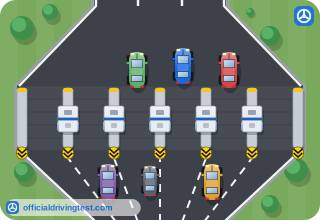
- Obey the posted speed limit
- Come to a complete stop at a staffed lane
- Stay inside the vehicle
- Back up or reverse direction
Show answer
Correct answer: Back up or reverse direction
Drivers should never back up or reverse direction at a toll plaza.
Source: New Hampshire Driver’s Manual (DSMV 360 (Rev. 11/25)), page 25 · Open this page in the manual (Manual page 25)
-
While waiting in a toll lane, what should a driver do about leaving the vehicle?
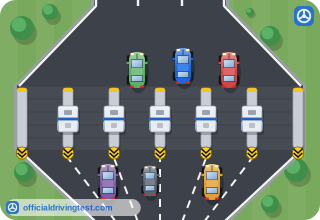
- Get out only to pay at a staffed lane
- Get out to check the lane ahead
- Not get out of the vehicle
- Get out only in an E-ZPass lane
Show answer
Correct answer: Not get out of the vehicle
Drivers should not get out of their vehicle in toll lanes.
Source: New Hampshire Driver’s Manual (DSMV 360 (Rev. 11/25)), page 25 · Open this page in the manual (Manual page 25)
-
Within a toll plaza, what applies to speed?
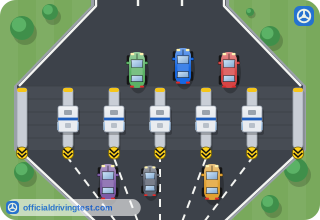
- Posted speed limits must be obeyed
- Speed limits apply only after the toll is paid
- Drivers may go as fast as traffic allows
- No speed limit applies inside the plaza
Show answer
Correct answer: Posted speed limits must be obeyed
Drivers should obey posted speed limits within toll plazas.
Source: New Hampshire Driver’s Manual (DSMV 360 (Rev. 11/25)), page 25 · Open this page in the manual (Manual page 25)
-
Which of these is another name for a highway?
- Boulevard
- Cul-de-sac
- Frontage road
- Turnpike
Show answer
Correct answer: Turnpike
The manual says highways can also be known as expressways, turnpikes, throughways and freeways.
Source: New Hampshire Driver’s Manual (DSMV 360 (Rev. 11/25)), page 25 · Open this page in the manual (Manual page 25)
-
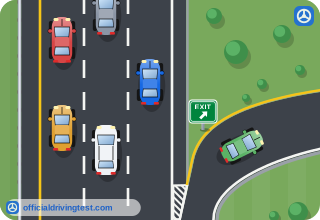
A driver misses an exit on a divided highway. What should the driver do to reverse direction?
- Stop on the shoulder and back up to the exit
- Drive to the next exit
- Make a U-turn across the median
- Slow down and turn around when traffic clears
Show answer
Correct answer: Drive to the next exit
A driver who misses an exit on a divided highway should drive to the next exit to reverse direction, never stopping, backing up or trying to turn around.
Source: New Hampshire Driver’s Manual (DSMV 360 (Rev. 11/25)), page 25 · Open this page in the manual (Manual page 25)
-
How should drivers allow space for vehicles entering a multiple-lane or limited access roadway?
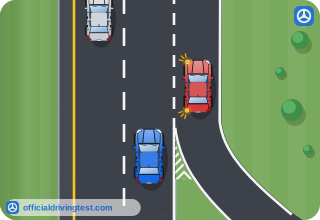
- Speed up to keep the entering vehicle behind them
- Stay in the same lane and sound the horn
- Brake hard in the lane to let the entering vehicle in ahead
- Move over a lane or adjust the speed of their vehicle
Show answer
Correct answer: Move over a lane or adjust the speed of their vehicle
Drivers should allow space for entering vehicles by moving over a lane or adjusting the speed of the vehicle.
Source: New Hampshire Driver’s Manual (DSMV 360 (Rev. 11/25)), page 31 · Open this page in the manual (Manual page 31)