New Hampshire: Emergency vehicles and work zones — Part 2 Practice Test
Questions in this part include: “Under the highway emergency law, a wide berth is given to vehicles displaying which colors of emergency warning lights?” · “If a police officer is in plain clothes during a traffic stop, what should the driver ask for?”
Independent educational site · not affiliated with any government agency or DMV
Ready? Test yourself
- Instant feedback with an explanation
- Every answer cites its source in the manual
- Your best score is saved on this device
- Keyboard: press 1 to 4 to answer and Enter for the next question
Questions are original and based on the official manual "New Hampshire Driver’s Manual" (DSMV 360 (Rev. 11/25)), New Hampshire Division of Motor Vehicles (DMV).
All 19 questions in this practice test
Take the test above first, then use this list to study. Tap “Show answer” to see the correct answer and explanation.
Show the questions and answersHide the questions
-
Under the highway emergency law, a wide berth is given to vehicles displaying which colors of emergency warning lights?
- Blue, red, or amber
- Green, white, or purple
- Red, green, or white
- Blue, white, or green
Show answer
Correct answer: Blue, red, or amber
The law requires drivers to give a wide berth to public safety personnel, persons in the roadway, and vehicles displaying blue, red, or amber emergency warning lights.
Source: New Hampshire Driver’s Manual (DSMV 360 (Rev. 11/25)), page 40 · Open this page in the manual (Manual page 40)
-
Under the highway emergency law, whose directions must drivers obey?
- Only a uniformed police officer
- Only the driver of the nearest emergency vehicle
- Any authorized person directing traffic
- Only a tow truck operator
Show answer
Correct answer: Any authorized person directing traffic
The law requires drivers to obey the directions of any authorized person directing traffic and all applicable emergency signals and traffic control devices.
Source: New Hampshire Driver’s Manual (DSMV 360 (Rev. 11/25)), page 40 · Open this page in the manual (Manual page 40)
-
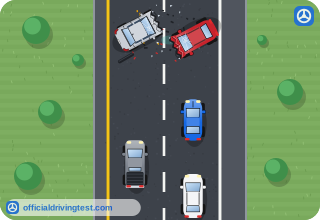
Under the highway emergency law, what must drivers do about a lane that is wholly or partially blocked?
- Stop in it and wait for instructions
- Vacate it as soon as possible
- Drive through it at reduced speed
- Continue in it until the next exit
Show answer
Correct answer: Vacate it as soon as possible
The law requires drivers to vacate any lane wholly or partially blocked as soon as possible.
Source: New Hampshire Driver’s Manual (DSMV 360 (Rev. 11/25)), page 40 · Open this page in the manual (Manual page 40)
-
Under the highway emergency law, what is the penalty for a subsequent offense in a 12-month period?
- The same fine as for a first offense
- A warning only, with no fine at all
- A fine with no penalty assessment added
- An increased fine plus penalty assessment
Show answer
Correct answer: An increased fine plus penalty assessment
A person violating this law is fined plus penalty assessment for a first offense and an increased fine plus penalty assessment for a subsequent offense in a 12-month period.
Source: New Hampshire Driver’s Manual (DSMV 360 (Rev. 11/25)), page 40 · Open this page in the manual (Manual page 40)
-
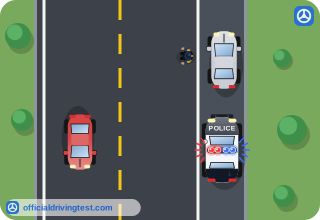
When a police vehicle with lights or sirens pulls in behind a vehicle that is pulling off to the side of the road, what must the driver do first?
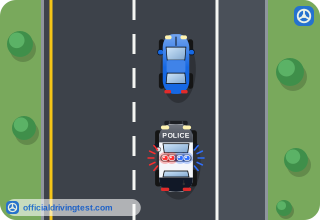
- Come to a complete stop and place the vehicle in park
- Slow down and keep driving until reaching a well lit area
- Get out and walk back to the police vehicle
- Stop and keep the vehicle in gear with the engine on
Show answer
Correct answer: Come to a complete stop and place the vehicle in park
The manual says the driver must come to a complete stop and place the vehicle in park.
Source: New Hampshire Driver’s Manual (DSMV 360 (Rev. 11/25)), page 40 · Open this page in the manual (Manual page 40)
-
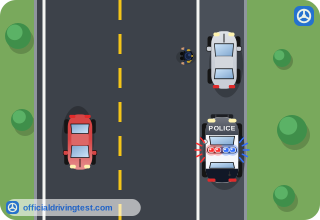
During a police traffic stop, when may the driver get out of the vehicle?
- As soon as the vehicle has stopped
- When the officer walks back to the police car
- Only when requested to
- When the driver needs to find documents
Show answer
Correct answer: Only when requested to
A driver stopped by police must remain in the vehicle unless requested to get out.
Source: New Hampshire Driver’s Manual (DSMV 360 (Rev. 11/25)), page 40 · Open this page in the manual (Manual page 40)
-
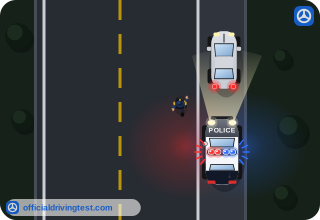
What should a driver do with the engine and lights during a police traffic stop?
- Leave the engine running and turn off all lights
- Turn off the engine, use hazard flashers, and at night turn on interior lights
- Turn off the engine, use hazard flashers, and turn off interior lights at night
- Keep the engine running and turn on the high beams
Show answer
Correct answer: Turn off the engine, use hazard flashers, and at night turn on interior lights
The driver should turn off the engine, turn on the hazard flashers and, at night, the interior lights to help the officer see that everything is in order inside the vehicle.
Source: New Hampshire Driver’s Manual (DSMV 360 (Rev. 11/25)), page 40 · Open this page in the manual (Manual page 40)
-
During a police traffic stop, what should the driver do with the safety belt and hands?
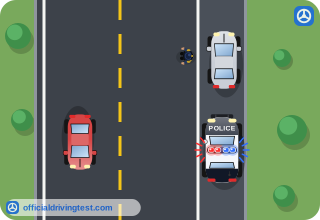
- Unfasten the safety belt and place hands on the dashboard
- Unfasten the safety belt and keep hands in the lap
- Keep the safety belt fastened and reach for the glove box
- Keep the safety belt fastened and place hands on the steering wheel
Show answer
Correct answer: Keep the safety belt fastened and place hands on the steering wheel
The driver should remain calm, keep the safety belt fastened, ask passengers to do so as well, place hands on the steering wheel and limit movements.
Source: New Hampshire Driver’s Manual (DSMV 360 (Rev. 11/25)), page 40 · Open this page in the manual (Manual page 40)
-
When an officer asks for the driver's license and vehicle registration, what should the driver do?
- Say where they are and reach slowly with one hand on the wheel
- Reach for them quickly with both hands off the wheel
- Get out of the vehicle to look for them in the trunk
- Reach for them without saying anything to the officer
Show answer
Correct answer: Say where they are and reach slowly with one hand on the wheel
If the officer asks for these documents, the driver should tell the officer where they are located and reach for them slowly with one hand on the wheel.
Source: New Hampshire Driver’s Manual (DSMV 360 (Rev. 11/25)), page 41 · Open this page in the manual (Manual page 41)
-
If a police vehicle is unmarked, what should a driver be sure of during a traffic stop?
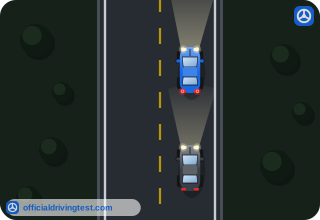
- That it has a siren sounding
- That it displays red and amber lights
- That it has its blue lights activated
- That a second police vehicle is present
Show answer
Correct answer: That it has its blue lights activated
If the vehicle is unmarked, the driver should be sure it has its blue lights activated.
Source: New Hampshire Driver’s Manual (DSMV 360 (Rev. 11/25)), page 41 · Open this page in the manual (Manual page 41)
-
If a police officer is in plain clothes during a traffic stop, what should the driver ask for?
- A copy of the officer's driver's license
- A badge or department identification card
- A written statement from the police department
- The officer's vehicle registration
Show answer
Correct answer: A badge or department identification card
If the police officer is in plain clothes (no uniform), the driver should ask for identification such as a badge or department identification card.
Source: New Hampshire Driver’s Manual (DSMV 360 (Rev. 11/25)), page 41 · Open this page in the manual (Manual page 41)
-
What is a work zone?
- Any area where a road is covered with sand or gravel
- A stretch of road with a reduced speed limit at all times
- An area where vehicles may park for maintenance
- An area where roadwork takes place and may involve lane closures
Show answer
Correct answer: An area where roadwork takes place and may involve lane closures
A work zone is an area where roadwork takes place and may involve lane closures, detours and moving equipment.
Source: New Hampshire Driver’s Manual (DSMV 360 (Rev. 11/25)), page 41 · Open this page in the manual (Manual page 41)
-
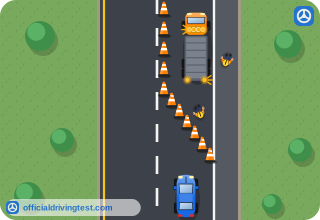
What should a driver do in a work zone even if no signs indicate a change in the speed limit?
- Keep the normal speed
- Speed up to leave the work zone
- Reduce speed
- Follow the vehicle ahead more closely
Show answer
Correct answer: Reduce speed
The manual says to always reduce speed in a work zone, because the narrower lanes and rough pavement can create hazardous conditions.
Source: New Hampshire Driver’s Manual (DSMV 360 (Rev. 11/25)), page 41 · Open this page in the manual (Manual page 41)
-
In a work zone, what should a driver do with speed and following distance?
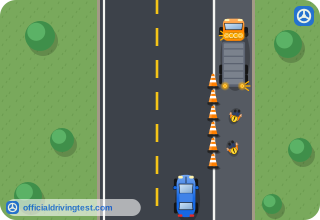
- Reduce speed and decrease the following distance
- Reduce speed and increase the following distance
- Keep speed and increase the following distance
- Increase speed and keep the following distance
Show answer
Correct answer: Reduce speed and increase the following distance
While driving in a work zone, drivers should reduce speed, increase the following distance, watch the traffic around the vehicle and be prepared to stop.
Source: New Hampshire Driver’s Manual (DSMV 360 (Rev. 11/25)), page 41 · Open this page in the manual (Manual page 41)
-
When should a driver use extreme caution when driving through a work zone at night?
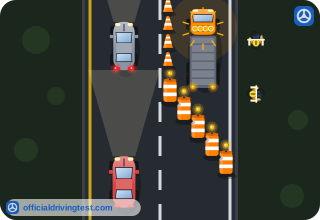
- Only when workers are present
- Only when lane closures are in place
- Only when the speed limit is posted
- Whether workers are present or not
Show answer
Correct answer: Whether workers are present or not
Drivers should use extreme caution when driving through a work zone at night whether workers are present or not.
Source: New Hampshire Driver’s Manual (DSMV 360 (Rev. 11/25)), page 41 · Open this page in the manual (Manual page 41)
-
What should a driver adjust in a work zone to allow space for workers and construction vehicles?
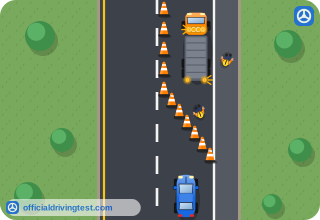
- Lane position
- Headlight angle
- Seat position
- Mirror angle
Show answer
Correct answer: Lane position
Drivers should adjust lane position to allow space for workers and construction vehicles.
Source: New Hampshire Driver’s Manual (DSMV 360 (Rev. 11/25)), page 41 · Open this page in the manual (Manual page 41)
-
When may a driver resume normal speed after driving through a work zone?
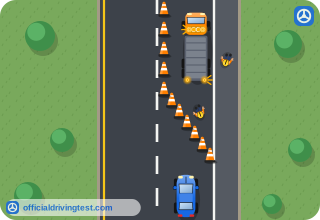
- As soon as the workers are out of sight
- After passing the last traffic cone
- Not until the "End Road Work" sign is visible
- When the road ahead has two lanes again
Show answer
Correct answer: Not until the "End Road Work" sign is visible
Drivers should observe the posted work zone signs and not resume normal speed until the "End Road Work" sign is visible.
Source: New Hampshire Driver’s Manual (DSMV 360 (Rev. 11/25)), page 41 · Open this page in the manual (Manual page 41)
-
What should a driver do about expected delays from a work zone?
- Drive faster through the work zone to make up time
- Plan for them and leave early to reach a destination on time
- Follow other vehicles closely
- Ignore them and use the shoulder
Show answer
Correct answer: Plan for them and leave early to reach a destination on time
Drivers should expect delays, plan for them, and leave early to reach a destination on time.
Source: New Hampshire Driver’s Manual (DSMV 360 (Rev. 11/25)), page 41 · Open this page in the manual (Manual page 41)
-
What should a driver do, when available, to avoid work zones?
- Drive in the right lane
- Increase speed
- Drive on the shoulder
- Use alternate routes
Show answer
Correct answer: Use alternate routes
When available, drivers should use alternate routes to avoid work zones.
Source: New Hampshire Driver’s Manual (DSMV 360 (Rev. 11/25)), page 41 · Open this page in the manual (Manual page 41)